
Imploding hot water cylinder
Discussion


Come back from holiday to be greeted by an imploded hot water cylinder in my garage. I'm currently having some building work done and while I was away the plumber was to change some pipework which required draining down the hot water system. In the process looks like he's introduced a vacuum into the cylinder and the engine couldn't take it, Jim. He's installed a new cylinder but his report is that the old cylinder was "plumbed incorrectly" and this is what caused the vacuum.
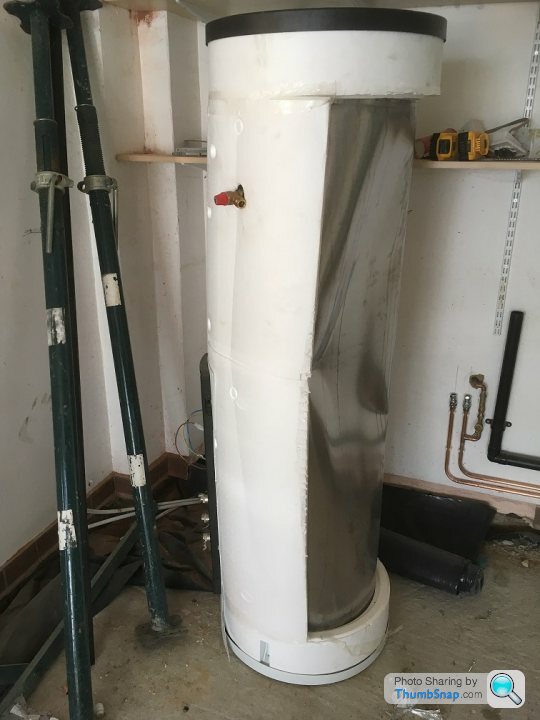
Now, the cylinder that has failed has got a heating coil flow & return, a cold water inlet at the bottom and an outlet at the top. It was installed as cylinder 2 in the schematic below.
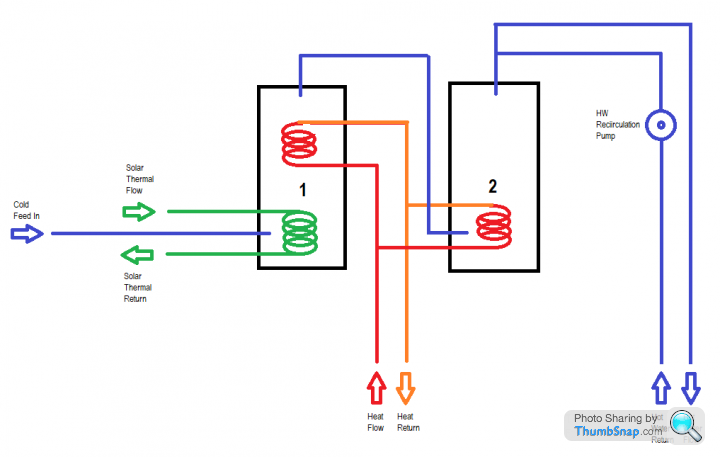
There was a secondary loop on the hot water system with a recirculating pump, but personally I just can't see how the plumbing of the cylinder could be wrong so as to cause the vacuum. From his comment I'm anticipating that the plumber is expecting me to wear the cost of the new cylinder and installation, but I think he must have done something wrong in the draining of the system.
Is there any way the original installation was wrong, or did the plumber forget to do something and let the system drain under gravity causing a vacuum? I am anticipating a battle over this so I'd like to challenge any BS.
Now, the cylinder that has failed has got a heating coil flow & return, a cold water inlet at the bottom and an outlet at the top. It was installed as cylinder 2 in the schematic below.
There was a secondary loop on the hot water system with a recirculating pump, but personally I just can't see how the plumbing of the cylinder could be wrong so as to cause the vacuum. From his comment I'm anticipating that the plumber is expecting me to wear the cost of the new cylinder and installation, but I think he must have done something wrong in the draining of the system.
Is there any way the original installation was wrong, or did the plumber forget to do something and let the system drain under gravity causing a vacuum? I am anticipating a battle over this so I'd like to challenge any BS.
a) if cylinder 1 has been left empty, you've still got a "connection" between cylinder 2 and 1. If 2 had water in it, you've got a lute seal.
If cylinder 1 cooled down (even as a gas space when empty if the solar was running in the day, and cooling at night) you could suck back through the lute seal from 2 to 1 and quite easily, depending on the level in the ullage of cylinder 2 start to draw a vacuum. I can't guess what vacuum the cylinder would collapse at but they're not too far below atmospheric. e.g. you can collapse an oil drum easily by throwing a lighted rag in and then sealing the top - my old party piece. The burning rag consumes 20% of the air (the oxygen) and replaces it with water vapour and CO2 - so a vacuum of only 1/20th atmospheric can collapse a tank in on itself.
Was there a none return valve on the water line from tank 2 to tank 1 (should only let water flow from tank 1 to 2)?
[From experience, this didn't quite happen to me, unfortunately for me, tank 2 had a cold feed level switch so after tank 1 leaked its contents, the increasing vacuum created a syphon over from tank 2 and then carried on feeding itself from tank 2 make-up water]. A "minor" amount of damage doesn't cover it, but when you can't easily open your front door due to water coming from behind it, you know you've a problem!].
b) the / builders haven't reverse into the tank in the garage and then cut the insulation off to remove damage and present "collapsed tank"?
If cylinder 1 cooled down (even as a gas space when empty if the solar was running in the day, and cooling at night) you could suck back through the lute seal from 2 to 1 and quite easily, depending on the level in the ullage of cylinder 2 start to draw a vacuum. I can't guess what vacuum the cylinder would collapse at but they're not too far below atmospheric. e.g. you can collapse an oil drum easily by throwing a lighted rag in and then sealing the top - my old party piece. The burning rag consumes 20% of the air (the oxygen) and replaces it with water vapour and CO2 - so a vacuum of only 1/20th atmospheric can collapse a tank in on itself.
Was there a none return valve on the water line from tank 2 to tank 1 (should only let water flow from tank 1 to 2)?
[From experience, this didn't quite happen to me, unfortunately for me, tank 2 had a cold feed level switch so after tank 1 leaked its contents, the increasing vacuum created a syphon over from tank 2 and then carried on feeding itself from tank 2 make-up water]. A "minor" amount of damage doesn't cover it, but when you can't easily open your front door due to water coming from behind it, you know you've a problem!].
b) the / builders haven't reverse into the tank in the garage and then cut the insulation off to remove damage and present "collapsed tank"?
Many thanks for the detailed reply.
The cylinders are installed in the loft, so I hope that eliminates your option (b)! They had already replaced the cylinder with new and put the old in the garage when I got back from holiday.
There isn't a non-return valve between the cylinders, so there could have been a syphon effect. However, in anticipation of work being done (and in the interest of saving money) I actually switched off the boiler before I went away so both tanks should have been unheated. However Tank 1 does get solar thermal and last week it was 30 degrees, so Tank 1 would have got pretty warm.
So, key question: who or what is to blame here? Is there anything the plumber should have done to prevent this? I have a meeting with him tomorrow as he seems adamant it's not his fault.
The cylinders are installed in the loft, so I hope that eliminates your option (b)! They had already replaced the cylinder with new and put the old in the garage when I got back from holiday.
There isn't a non-return valve between the cylinders, so there could have been a syphon effect. However, in anticipation of work being done (and in the interest of saving money) I actually switched off the boiler before I went away so both tanks should have been unheated. However Tank 1 does get solar thermal and last week it was 30 degrees, so Tank 1 would have got pretty warm.
So, key question: who or what is to blame here? Is there anything the plumber should have done to prevent this? I have a meeting with him tomorrow as he seems adamant it's not his fault.
I think you need to get the plumber to explain exactly how he thinks that happened and what he would have put in the system to prevent it and why he didn't notice it on doing the work.
- Ask him why the damage looks from the half of the cylinder visible, more like impact than vacuum collapse?
- Ask him when he went to drain the system down did he take all reasonable diligence and competence as required by his professional trade body?
- Ask him was he aware of the second cylinder. Why didn't he drain / isolate it? All well and good after the event to say there was a fault? Did he only realise after he'd caused the tank to implode?
- Ask him how he can prove that his way of modifying the system was a safe system of work for himself and your property?
None of this will necessarily get you a 100% refund and everything back to normal, you're probably lucky you have had a flaw found out (had our system failed eight weeks later, we'd have had a newborn and be at the start of the 13 week freeze of 2009/2010 when you couldn't get a boiler repaired or event routine serviced). But it might get to a point where you can "handshake" and move on.
Looking at it, I say it still looks strange for a vessel collapse under vacuum (I know we can only see where the insulation is gone). Still looks more like impact damage. My cylinder crushed from all sides (which at a pressure differential ambient to vacuum should apply equally to all surfaces). I wouldn't have though the insulation would be strong enough to hold through penetration nozzles.
...see https://www.google.com/search?biw=1024&bih=657...
or https://www.google.com/search?biw=1024&bih=657...
Mind you, now you mention the loft, let us say you have a house where each floor is 2.5 - 3 metres apart.Your header tanks could be 6 - 8 metres up. Let the liquid drain under gravity with no air feed into the tank and you're pulling 60 - 80% vacuum. Enough to collapse a tank and make quite a racket (people don't realise, a tank imploding under vacuum is often a more violent collapse than a tank exploding under pressure).
I have a sneaking interest in this as a Client wants us not to modify a vessel we think will almost certainly see a vacuum. And at £400 unmodified compared to £900 modified we can see why they are trying to sneak the design condition past as unnecessary. For the each one of 4,000 - 9,000 vessels they want us to make. I think in their case CE = Crap Engineering rather than Conformite Europe.
- Ask him why the damage looks from the half of the cylinder visible, more like impact than vacuum collapse?
- Ask him when he went to drain the system down did he take all reasonable diligence and competence as required by his professional trade body?
- Ask him was he aware of the second cylinder. Why didn't he drain / isolate it? All well and good after the event to say there was a fault? Did he only realise after he'd caused the tank to implode?
- Ask him how he can prove that his way of modifying the system was a safe system of work for himself and your property?
None of this will necessarily get you a 100% refund and everything back to normal, you're probably lucky you have had a flaw found out (had our system failed eight weeks later, we'd have had a newborn and be at the start of the 13 week freeze of 2009/2010 when you couldn't get a boiler repaired or event routine serviced). But it might get to a point where you can "handshake" and move on.
Looking at it, I say it still looks strange for a vessel collapse under vacuum (I know we can only see where the insulation is gone). Still looks more like impact damage. My cylinder crushed from all sides (which at a pressure differential ambient to vacuum should apply equally to all surfaces). I wouldn't have though the insulation would be strong enough to hold through penetration nozzles.
...see https://www.google.com/search?biw=1024&bih=657...
or https://www.google.com/search?biw=1024&bih=657...
Mind you, now you mention the loft, let us say you have a house where each floor is 2.5 - 3 metres apart.Your header tanks could be 6 - 8 metres up. Let the liquid drain under gravity with no air feed into the tank and you're pulling 60 - 80% vacuum. Enough to collapse a tank and make quite a racket (people don't realise, a tank imploding under vacuum is often a more violent collapse than a tank exploding under pressure).
I have a sneaking interest in this as a Client wants us not to modify a vessel we think will almost certainly see a vacuum. And at £400 unmodified compared to £900 modified we can see why they are trying to sneak the design condition past as unnecessary. For the each one of 4,000 - 9,000 vessels they want us to make. I think in their case CE = Crap Engineering rather than Conformite Europe.
StanleyT said:
... you mention the loft, let us say you have a house where each floor is 2.5 - 3 metres apart.Your header tanks could be 6 - 8 metres up. Let the liquid drain under gravity with no air feed into the tank and you're pulling 60 - 80% vacuum. Enough to collapse a tank ...
Yeah I dont really know how this would work.With a normal single tank you cant drain the tank by opening the hot tap as far as I know, because the take off is at the top, certainly our new tank has a drain cock at the bottom of the tank for this. But they probably weren't trying to empty the tank, but let some water out of the hot pipework.
But as said, if there was no air let in and you had a 6-8 meter run down with no air feed into the tank, I can see the weight of the water in that pipe pulling enough vac to do that. I dont know how you would normally go about avoiding that, other than perhaps closing an valve on the hot outlet, but I also cant really see how having two tanks as you have them makes that worse.
Two tanks is not very common, and from a past thread I understand often they are in parallel (for additional capacity) rather than series (to add more 'height' for solar pre-heat) as you have them, but that's not plumbed wrongly its just uncommon and or high-spec. If both tanks are side by side in the attic it would have been ruddy obvious there was two, and a solar setup, at which point proceed with caution! If there is one tank in the airing cupboard and they didn't know about the other hot tank in the attic maybe different...? How much/what work where they doing, how aware of the system design were they before they started?
Anyway
As said I think my take would very much be of the "well you are the expert, why didn't you know that and avoid it" type tack if they try and pin the cost on you. Hindsight is obviously 20:20 and if they didn't fit the original system(s) it could be that the previous installer made a boo-boo, but while I am not a plumber, I can't thing of an obvious thing they have done that would cause what you have from what I see quickly.
So yeah, ask them what 'plumbed incorrectly' which caused it, and why they didn't spot if before they started. See what comes of that.
A new tank that size is going to £900-1200 odd depending on spec maybe? That's what our 250l OSO was, so worth standing your ground.
Daniel
The 'incorrectly plumbed' bit may refer to the secondary pump which would circulate increasing cool water around the loop until an outlet was opened drawing hot water back in. Defeats it's object I believe. I can't decide if plumbing the secondary this way would give a greater risk of vacuum effect though.
I'm not a plumber or in any way qualified (heck, I'm not even that intelligent :-)) but I can't imagine how draining down can cause this. How can draining, even if the tank is in the roof and the drain point in the cellar, cause enough of a vacuum to cause this? Those tanks will be designed to hold maybe 300 litres of water and that is a lot of force. Opening a tap and allowing gravity to work just doesn't seem likely to do this?
As I a say I am not a plumber and I am not a physicist but surely something has had to create a huge negative pressure in that tank and I dont think a gravity drain would do that? Maybe it could be "encouraged" to collapse by being in negative pressure and then hit but even that doesn't seem likely.
Personally I would be asking the manufacturer to help work out what has happened.
As I a say I am not a plumber and I am not a physicist but surely something has had to create a huge negative pressure in that tank and I dont think a gravity drain would do that? Maybe it could be "encouraged" to collapse by being in negative pressure and then hit but even that doesn't seem likely.
Personally I would be asking the manufacturer to help work out what has happened.
I would be interested to know what brand it was.
A mate fitted an Ariston and plumbed it in exactly as per instructions. Within a few months, it had experienced “vacuum” and the cylinder collapsed – worse than yours though. After some “discussion” with Ariston and an engineer visit, he agreed that it was a fault with the cylinder, and told my mate he had done a first-class job of plumbing it in.
They replaced the cylinder free of charge.
I’ll ask him tonight what the fault actually was.
A mate fitted an Ariston and plumbed it in exactly as per instructions. Within a few months, it had experienced “vacuum” and the cylinder collapsed – worse than yours though. After some “discussion” with Ariston and an engineer visit, he agreed that it was a fault with the cylinder, and told my mate he had done a first-class job of plumbing it in.
They replaced the cylinder free of charge.
I’ll ask him tonight what the fault actually was.
Thanks all. Have had meeting with plumber today.
Bit more background info: this is quite a high spec system servicing quite a large house. All installed from scratch in 2011 (I bought the house last year) and looks pretty well installed in general, with labelled flow & return, good quality lagging, tidy pipe runs, no sloppy solder. The whole system (boiler, tanks, solar thermal) is Vaillant. The 2 tanks were installed in the loft side by side with fantastic access and the plumber had previously drained the solar thermal system so I could re-roof the property, so absolutely nothing about the system was unknown or hidden.
I've had a better look at the imploded tank and it is kinked on all sides, so definitely not impact damage and there wouldn't have been any reason for them to have been up in the loft doing anything that could have hit it with that force.
The second tank (the one that imploded) had a strange steel T piece for the secondary loop with the recirculation. I noticed that the recirculation loop didn't go back into the tank and therefore looked like it constantly circulated the same water which would gradually cool. I did wonder about this so I contacted Vaillant back in February who confirmed that the design was a fully recognised one for higher end installations and so nothing inherently wrong. However the plumber has today told me that this T piece fed inside the tank into a sort of double pipe which fed the recirculating return loop deeper into the tank with the flow coming from a pipe surrounding it. He noted that this would have done nothing for the flow rate - I have asked the plumber in the past to investigate low flow in the system. I haven't seen this double pipe but from the plumber's description I'd imagine it looks something like this:

Here it is in it's original installation, nicely corroded as you can see:

So, onto the meeting. He said that he just cut the secondary loop where the pipework alterations needed to be made (2 floors ~6m down from the loft) and drained the system, then his apprentice who happened to be in the loft (not sure what he "happened" to be doing up there) heard colossal noises from the cylinder as it gave way and phoned down to tell the other guy to stop what he was doing.
The plumber's position is that he did nothing wrong, he's never had a tank vacuum before, therefore it's something about my system that caused it and as expected he wants me to stand for the £1000 for the replacement tank he installed and £400 for the fitting (not sure if there's VAT on this or not). Obviously my position is that there was a working system before, the design of which has been validated by Vaillant just 6 months ago, and so there's no reason I should be £1400 down. He then went on to say that the whole system is wrong, twin tanks should be in parallel not in series etc even though I told him that the principle of the design is that the first tank simply adds capacity to the system and potentially feeds hot water into the second cylinder cold inlet if the solar thermal is delivering, thereby reducing demand on the coil.
I will accept that the previous design of the hot water recirculating loop was distinctly suboptimal, and that I now have a better system (the recirculating loop now joins the "cold" inlet of tank 2. I expect that I'll settle for paying for the cylinder at trade cost, and the plumber stands for his own time, but I've sent him away to consider the situation.
Bit more background info: this is quite a high spec system servicing quite a large house. All installed from scratch in 2011 (I bought the house last year) and looks pretty well installed in general, with labelled flow & return, good quality lagging, tidy pipe runs, no sloppy solder. The whole system (boiler, tanks, solar thermal) is Vaillant. The 2 tanks were installed in the loft side by side with fantastic access and the plumber had previously drained the solar thermal system so I could re-roof the property, so absolutely nothing about the system was unknown or hidden.
I've had a better look at the imploded tank and it is kinked on all sides, so definitely not impact damage and there wouldn't have been any reason for them to have been up in the loft doing anything that could have hit it with that force.
The second tank (the one that imploded) had a strange steel T piece for the secondary loop with the recirculation. I noticed that the recirculation loop didn't go back into the tank and therefore looked like it constantly circulated the same water which would gradually cool. I did wonder about this so I contacted Vaillant back in February who confirmed that the design was a fully recognised one for higher end installations and so nothing inherently wrong. However the plumber has today told me that this T piece fed inside the tank into a sort of double pipe which fed the recirculating return loop deeper into the tank with the flow coming from a pipe surrounding it. He noted that this would have done nothing for the flow rate - I have asked the plumber in the past to investigate low flow in the system. I haven't seen this double pipe but from the plumber's description I'd imagine it looks something like this:
Here it is in it's original installation, nicely corroded as you can see:
So, onto the meeting. He said that he just cut the secondary loop where the pipework alterations needed to be made (2 floors ~6m down from the loft) and drained the system, then his apprentice who happened to be in the loft (not sure what he "happened" to be doing up there) heard colossal noises from the cylinder as it gave way and phoned down to tell the other guy to stop what he was doing.
The plumber's position is that he did nothing wrong, he's never had a tank vacuum before, therefore it's something about my system that caused it and as expected he wants me to stand for the £1000 for the replacement tank he installed and £400 for the fitting (not sure if there's VAT on this or not). Obviously my position is that there was a working system before, the design of which has been validated by Vaillant just 6 months ago, and so there's no reason I should be £1400 down. He then went on to say that the whole system is wrong, twin tanks should be in parallel not in series etc even though I told him that the principle of the design is that the first tank simply adds capacity to the system and potentially feeds hot water into the second cylinder cold inlet if the solar thermal is delivering, thereby reducing demand on the coil.
I will accept that the previous design of the hot water recirculating loop was distinctly suboptimal, and that I now have a better system (the recirculating loop now joins the "cold" inlet of tank 2. I expect that I'll settle for paying for the cylinder at trade cost, and the plumber stands for his own time, but I've sent him away to consider the situation.
If the pipe arrangement is as described in your sketches and the modified inlet drawing, if the plumber cut the secondary loop on the return leg 1st then it would start to syphon water back over the top of the thicker lagged pipes you show, and keep going.
As soon as the water level in the tank was below the feed (wider pipe) then a vacuum would have been started to be pulled, at least for a while depending on how good the seals on the rest of the circuit were (e.g. does the pump when not running provide a full hydraulic seal)?
Should have broke the vacuum on the seal side first I'd say. This is my poor (I'm on a train so using paint on a kiddies pad) representation of what happened to our system (we think - to be fair to our guy when he did the work, the cylinder drain valves had been hidden in the back).


I'd ask the apprentice why he was up there. Was it to say when he heard the pipes start to run empty of water? I bet his sphincter didn't implode, rather the other way.
Ask the plumber if he checked for cylinder drain valves and why he didn't use them if he did check.
Ask the plumber why he was trying to drain the cylinder by pipes that luted over the top of the tank (defy physics).
If he is a member of a registered scheme, I'd be suggesting to him that you'll report this to them. Whilst the original system may have been installed incorrectly (I doubt it, I think he CBA to put a flexi hose into the attic and drain the cylinder down via there - have you a manual for the cylinder or can you get one online showing the drain procedure - if you can as a layman - and the professional hasn't followed it, you've a good case to prove)
He has a duty of care to ensure any works he does are safe and don't cause harm to people etc or property. We do work all the time on old systems and have to satisfy ourselves of the risk and make the client aware.
Your suggestion of "cost" for materials and free restoration I think would be seen as a good middle ground, as you are getting a new system. But if he doesn't play ball you've a couple of nice points for a small claims case further down the line.
As soon as the water level in the tank was below the feed (wider pipe) then a vacuum would have been started to be pulled, at least for a while depending on how good the seals on the rest of the circuit were (e.g. does the pump when not running provide a full hydraulic seal)?
Should have broke the vacuum on the seal side first I'd say. This is my poor (I'm on a train so using paint on a kiddies pad) representation of what happened to our system (we think - to be fair to our guy when he did the work, the cylinder drain valves had been hidden in the back).
I'd ask the apprentice why he was up there. Was it to say when he heard the pipes start to run empty of water? I bet his sphincter didn't implode, rather the other way.
Ask the plumber if he checked for cylinder drain valves and why he didn't use them if he did check.
Ask the plumber why he was trying to drain the cylinder by pipes that luted over the top of the tank (defy physics).
If he is a member of a registered scheme, I'd be suggesting to him that you'll report this to them. Whilst the original system may have been installed incorrectly (I doubt it, I think he CBA to put a flexi hose into the attic and drain the cylinder down via there - have you a manual for the cylinder or can you get one online showing the drain procedure - if you can as a layman - and the professional hasn't followed it, you've a good case to prove)
He has a duty of care to ensure any works he does are safe and don't cause harm to people etc or property. We do work all the time on old systems and have to satisfy ourselves of the risk and make the client aware.
Your suggestion of "cost" for materials and free restoration I think would be seen as a good middle ground, as you are getting a new system. But if he doesn't play ball you've a couple of nice points for a small claims case further down the line.
Having two cylinders in series is the only way to get the best out of solar thermal (exactly as I have).
However, heating the top of cylinder 1 is to some extent self defeating and wastes energy.
All circulating systems waste energy regardless of how well insulated they are.
If the heat source is gas then having the circulating return at the top or bottom of the cylinder makes little difference. But there is the opportunity of fitting a UV light to the circulating system, then the whole thing can be run at lower temperatures so saving money.
Can't comment on the collapsed cylinder, never seen it.
Plumber fitting new cylinder at cost price would seem to be a pragmatic solution.
I would be surprised if the valiant hot return system was designed in a away which limited flow badly, I'm not familiar with they system but they make well regarded kit.
Is the new cylinder of a similar and suitable spec? It is all but irrelevant, but I presume he holds a g3 unvented ticket to do that work?
I think what's caught him out here is the greater than normal height better the cylinder and where he was draining it too. If he is a nice guy that you want to use again you can come to whatever agreement you want but I think I would be standing my ground longer and would aim compromise at maybe covering half materials no labour. Ie £500 of the £1400.
Mind you I've just had the plumber who did out boiler move and new hot cylinder back for the for forth time now.
-shower plumbed wrong following cylinder fit
-boiler moved up a foot to location I asked for
-boiler flu pipe dislodged and leaking rain
-this morning, gas leak in the feed pipe
So if someone was any good at all I would move heaven and earth to keep them!
Daniel
Is the new cylinder of a similar and suitable spec? It is all but irrelevant, but I presume he holds a g3 unvented ticket to do that work?
I think what's caught him out here is the greater than normal height better the cylinder and where he was draining it too. If he is a nice guy that you want to use again you can come to whatever agreement you want but I think I would be standing my ground longer and would aim compromise at maybe covering half materials no labour. Ie £500 of the £1400.
Mind you I've just had the plumber who did out boiler move and new hot cylinder back for the for forth time now.
-shower plumbed wrong following cylinder fit
-boiler moved up a foot to location I asked for
-boiler flu pipe dislodged and leaking rain
-this morning, gas leak in the feed pipe
So if someone was any good at all I would move heaven and earth to keep them!
Daniel
StanleyT - thanks very much for the drawings, I agree that is probably how the vacuum got introduced.
Caziques - I agree about the design of the heating of cylinder 1 in addition to the solar thermal; it must be the case that the gas coil kicks in when the water is cold which reduces the ability of the solar thermal to deliver benefits throughout the day.
dhutch - I'm a bit stuck as I'm in the late stages of a £300k extension project and the plumber's company is a subbie to the main building contractor and I need him to finish his works elsewhere. If I stand my ground he may flounce and the builder is likely to value his long-standing relationship with a key subbie rather than £1400 of my money. I think the plumber is generally good but I also think that he has spent his (considerable) working life working on much more simple systems. My system has a few less frequently seen features in general and I just don't think he has seen them before. Unfortunately he is branding them as "wrong" just because they are unfamiliar to him.
The replacement cylinder is another Vaillant unit, same 250l capacity. The recirculation return loop is now plumbed into the inlet for cylinder 2 as below, but now I think about it I am wondering if this means that the outlet of cylinder 1 could be trying to push water around the recirculation loop on the return side. If the HW recirculation pump is running then this will create an opposing pressure which should redirect flow into cylinder 2, but if the pump is not running (it's on a timer) then it would need to form a hydraulic lock otherwise I can't see a loop.

I've had excellent response from Vaillant customer services in the past so I've put a few questions out to them about the correct drain down process and will follow up with a query on this new design to make sure it's OK.
Ultimately I think the plumber failed to educate himself on the correct drain down process for my system and this directly caused the problem. However if I make him stand for the cost I suspect he'll refuse to finish the rest of the works and that is going to cause me a different set of problems. He's been packed off to get feedback from his trade body or someone, and I will follow up with Vaillant. I'll still compromise on shared costs if needs be - I'll stand for the direct trade cost of the cylinder and he will have to stand for his time & materials to fit - as long as Vaillant confirm the new setup is OK.
Unfortunately the plumber's position is "I've been doing this the same way for 40 years and never had this before so therefore it must be your system that is wrong" which is a naive view if my system is different from what he's been working on for all that time...
Caziques - I agree about the design of the heating of cylinder 1 in addition to the solar thermal; it must be the case that the gas coil kicks in when the water is cold which reduces the ability of the solar thermal to deliver benefits throughout the day.
dhutch - I'm a bit stuck as I'm in the late stages of a £300k extension project and the plumber's company is a subbie to the main building contractor and I need him to finish his works elsewhere. If I stand my ground he may flounce and the builder is likely to value his long-standing relationship with a key subbie rather than £1400 of my money. I think the plumber is generally good but I also think that he has spent his (considerable) working life working on much more simple systems. My system has a few less frequently seen features in general and I just don't think he has seen them before. Unfortunately he is branding them as "wrong" just because they are unfamiliar to him.
The replacement cylinder is another Vaillant unit, same 250l capacity. The recirculation return loop is now plumbed into the inlet for cylinder 2 as below, but now I think about it I am wondering if this means that the outlet of cylinder 1 could be trying to push water around the recirculation loop on the return side. If the HW recirculation pump is running then this will create an opposing pressure which should redirect flow into cylinder 2, but if the pump is not running (it's on a timer) then it would need to form a hydraulic lock otherwise I can't see a loop.
I've had excellent response from Vaillant customer services in the past so I've put a few questions out to them about the correct drain down process and will follow up with a query on this new design to make sure it's OK.
Ultimately I think the plumber failed to educate himself on the correct drain down process for my system and this directly caused the problem. However if I make him stand for the cost I suspect he'll refuse to finish the rest of the works and that is going to cause me a different set of problems. He's been packed off to get feedback from his trade body or someone, and I will follow up with Vaillant. I'll still compromise on shared costs if needs be - I'll stand for the direct trade cost of the cylinder and he will have to stand for his time & materials to fit - as long as Vaillant confirm the new setup is OK.
Unfortunately the plumber's position is "I've been doing this the same way for 40 years and never had this before so therefore it must be your system that is wrong" which is a naive view if my system is different from what he's been working on for all that time...
PhilboSE said:
Unfortunately the plumber's position is "I've been doing this the same way for 40 years and never had this before so therefore it must be your system that is wrong" which is a naive view if my system is different from what he's been working on for all that time...
he has some self-educating to do if that is his approach. Solar panel/collector integration with CHG is going to cause issues for anyone like him. I think your man has cooked up.
Unvented cylinders are tested to withstand positive pressure and have safety devices such as pressure reducing valve on the incoming feed, pressure relief valves and so on. They are not built or tested to withstand negative pressure, nor are vacuum relief valves fitted as standard.
Your man created negative pressure by closing the inlet and cutting in two floors down.
He did not even need to have to drained the cylinder to have avoided this; opening a hot tap on the intermediate floor or loosening the joint on the cylinder outlet to allow air in would have sufficed.
In his defence: it's an unusual set-up. I've never seen an unvented cylinder implode.
I hope you reach an accommodation with the guy.
Unvented cylinders are tested to withstand positive pressure and have safety devices such as pressure reducing valve on the incoming feed, pressure relief valves and so on. They are not built or tested to withstand negative pressure, nor are vacuum relief valves fitted as standard.
Your man created negative pressure by closing the inlet and cutting in two floors down.
He did not even need to have to drained the cylinder to have avoided this; opening a hot tap on the intermediate floor or loosening the joint on the cylinder outlet to allow air in would have sufficed.
In his defence: it's an unusual set-up. I've never seen an unvented cylinder implode.
I hope you reach an accommodation with the guy.
PhilboSE said:
dhutch - I'm a bit stuck as I'm in the late stages of a £300k extension project and the plumber's company is a subbie to the main building contractor and I need him to finish his works elsewhere. If I stand my ground he may flounce and the builder is likely to value his long-standing relationship with a key subbie rather than £1400 of my money. I think the plumber is generally good but I also think that he has spent his (considerable) working life working on much more simple systems. My system has a few less frequently seen features in general and I just don't think he has seen them before. Unfortunately he is branding them as "wrong" just because they are unfamiliar to him.
Cant fault that.PhilboSE said:
The replacement cylinder is another Vaillant unit, same 250l capacity. The recirculation return loop is now plumbed into the inlet for cylinder 2 as below, but now I think about it I am wondering if this means that the outlet of cylinder 1 could be trying to push water around the recirculation loop on the return side. If the HW recirculation pump is running then this will create an opposing pressure which should redirect flow into cylinder 2, but if the pump is not running (it's on a timer) then it would need to form a hydraulic lock otherwise I can't see a loop.
Sounds good. I cant see any problems with the circ pump effectly pumping out of the top of the tank and into the bottom again, that basically the normal system. Awflysorrychaps said:
He did not even need to have to drained the cylinder to have avoided this; opening a hot tap on the intermediate floor or loosening the joint on the cylinder outlet to allow air in would have sufficed.
Or isolating the outlet, rather than the inlet, of the cylinder. If there is an valve on the outlet.Daniel
Gassing Station | Homes, Gardens and DIY | Top of Page | What's New | My Stuff