
Hollow steel bar deflection calculation
Discussion


I'm trying to find out what the weight limit would be for a hollow steel bar beam. Clearly there are several different factors for this, eg where in the span the load is situated, what type of steel, etc, but as a starting point, I would like to know:
For a 5m wide beam, supported at each end, and consisting of a mild steel hollow square tube 100mm x 100mm x 5mm wall thickness, what is the maximum load at the centre point for a deflection of, say, 5mm?
Ideally I'd like to find an online calculator where I can play with this, for example adjusting the section, the wall thickness, the support points, etc but the ones I have turned up so far require inputs of data which I don't know or understand, frankly! This doesn't need to be a precision calculation, just a guide as to how much said beam would flex.
One calculator suggested that this would deflect 37mm naturally without any weight on it at all - can't be right surely? 100 x 100 x 5mm beam/bar, I'd expect to be able to hang off that myself without it giving much?
For a 5m wide beam, supported at each end, and consisting of a mild steel hollow square tube 100mm x 100mm x 5mm wall thickness, what is the maximum load at the centre point for a deflection of, say, 5mm?
Ideally I'd like to find an online calculator where I can play with this, for example adjusting the section, the wall thickness, the support points, etc but the ones I have turned up so far require inputs of data which I don't know or understand, frankly! This doesn't need to be a precision calculation, just a guide as to how much said beam would flex.
One calculator suggested that this would deflect 37mm naturally without any weight on it at all - can't be right surely? 100 x 100 x 5mm beam/bar, I'd expect to be able to hang off that myself without it giving much?
Deflection of a simply supported beam from a distributed load is calculated as (5xWxL^3) / (384xExI)
Where:
W = Load (in this case the weight of the steel tube)
L = Length of the tube
E = Youngs modulus (approximately) 210x10^9 N/m2 for mild steel
I = Second moment of area for the shape
The second moment of area of a tube is expressed as (b^4 – (b – 2t)^4) / 12
Where:
T = wall thickness of tube
b = outside dimension
Watch your units carefully!
Therefore based on the dimensions you’ve given I work it out that the tube would weigh roughly 75kg and deflect by 9mm simply due to its own weight.
Applying the same principles for a point load the equation is (WxL^3) / (48xExI) so the load is in the centre of the beam where the deflection would be greatest and again using the figures provided, you would need a load of roughly 120kg to cause the beam to deflect by a further 5mm.
All this also ignores whether the load exceeds the moment and shear capacity of the tube which would lead to failure. And also if I’ve not made a mistake anywhere above.
Where:
W = Load (in this case the weight of the steel tube)
L = Length of the tube
E = Youngs modulus (approximately) 210x10^9 N/m2 for mild steel
I = Second moment of area for the shape
The second moment of area of a tube is expressed as (b^4 – (b – 2t)^4) / 12
Where:
T = wall thickness of tube
b = outside dimension
Watch your units carefully!
Therefore based on the dimensions you’ve given I work it out that the tube would weigh roughly 75kg and deflect by 9mm simply due to its own weight.
Applying the same principles for a point load the equation is (WxL^3) / (48xExI) so the load is in the centre of the beam where the deflection would be greatest and again using the figures provided, you would need a load of roughly 120kg to cause the beam to deflect by a further 5mm.
All this also ignores whether the load exceeds the moment and shear capacity of the tube which would lead to failure. And also if I’ve not made a mistake anywhere above.
Edited by smokey mow on Thursday 28th January 09:07

Give Structx a try if you want a quick calculator.
https://structx.com/beams.html
Pretty easy to edit the loadings and see the effect on deflection.
https://structx.com/beams.html
Pretty easy to edit the loadings and see the effect on deflection.
smokey mow said:
Deflection of a simply supported beam from a distributed load is calculated as (5xWxL^3) / (384xExI)
Where:
W = Load (in this case the weight of the steel tube)
L = Length of the tube
E = Youngs modulus (approximately) 210x10^9 N/m2 for mild steel
I = Second moment of area for the shape
The second moment of area of a tube is expressed as (b^4 – (b – 2t)^4) / 12
Where:
T = wall thickness of tube
b = outside dimension
Watch your units carefully!
Therefore based on the dimensions you’ve given I work it out that the tube would weigh roughly 75kg and deflect by 9mm simply due to its own weight.
Applying the same principles for a point load the equation is (WxL^3) / (48xExI) so the load is in the centre of the beam where the deflection would be greatest and again using the figures provided, you would need a load of roughly 120kg to cause the beam to deflect by a further 5mm.
All this also ignores whether the load exceeds the moment and shear capacity of the tube which would lead to failure. And also if I’ve not made a mistake anywhere above.
I think you've taken 5x too much loading in your distributed calc. The first part of your formula should be to the power of 4 also (5 x wL^4)Where:
W = Load (in this case the weight of the steel tube)
L = Length of the tube
E = Youngs modulus (approximately) 210x10^9 N/m2 for mild steel
I = Second moment of area for the shape
The second moment of area of a tube is expressed as (b^4 – (b – 2t)^4) / 12
Where:
T = wall thickness of tube
b = outside dimension
Watch your units carefully!
Therefore based on the dimensions you’ve given I work it out that the tube would weigh roughly 75kg and deflect by 9mm simply due to its own weight.
Applying the same principles for a point load the equation is (WxL^3) / (48xExI) so the load is in the centre of the beam where the deflection would be greatest and again using the figures provided, you would need a load of roughly 120kg to cause the beam to deflect by a further 5mm.
All this also ignores whether the load exceeds the moment and shear capacity of the tube which would lead to failure. And also if I’ve not made a mistake anywhere above.
Edited by smokey mow on Thursday 28th January 09:07
The w is load per metre of beam, not total load. As you take the W and multiply it by the length of the beam, so total weight is taken into account within the calc.
So the approx. weight of a 100x100x5 SHS is 15kg/m, or 0.15kN/m to simplify.
So you end up with:
Deflection max,centre= (5 x WL^4)/384EI = (5 x 0.15kN/m x 5000mm^4)/384 x 210000MPa x 2865833mm^4 = 2.02mm
Switching out the 0.15 for 0.75 you get ~10mm which is what you look to have.
It's early still though and I'm not quite awake yet.
Edited by Sycamore on Thursday 28th January 09:51
Edited by Sycamore on Thursday 28th January 09:52
Edited by Sycamore on Thursday 28th January 09:57
Sycamore said:
smokey mow said:
Deflection of a simply supported beam from a distributed load is calculated as (5xWxL^3) / (384xExI)
Where:
W = Load (in this case the weight of the steel tube)
L = Length of the tube
E = Youngs modulus (approximately) 210x10^9 N/m2 for mild steel
I = Second moment of area for the shape
The second moment of area of a tube is expressed as (b^4 – (b – 2t)^4) / 12
Where:
T = wall thickness of tube
b = outside dimension
Watch your units carefully!
Therefore based on the dimensions you’ve given I work it out that the tube would weigh roughly 75kg and deflect by 9mm simply due to its own weight.
Applying the same principles for a point load the equation is (WxL^3) / (48xExI) so the load is in the centre of the beam where the deflection would be greatest and again using the figures provided, you would need a load of roughly 120kg to cause the beam to deflect by a further 5mm.
All this also ignores whether the load exceeds the moment and shear capacity of the tube which would lead to failure. And also if I’ve not made a mistake anywhere above.
I think you've taken 5x too much loading in your distributed calc. The first part of your formula should be to the power of 4 also (5 x wL^4)Where:
W = Load (in this case the weight of the steel tube)
L = Length of the tube
E = Youngs modulus (approximately) 210x10^9 N/m2 for mild steel
I = Second moment of area for the shape
The second moment of area of a tube is expressed as (b^4 – (b – 2t)^4) / 12
Where:
T = wall thickness of tube
b = outside dimension
Watch your units carefully!
Therefore based on the dimensions you’ve given I work it out that the tube would weigh roughly 75kg and deflect by 9mm simply due to its own weight.
Applying the same principles for a point load the equation is (WxL^3) / (48xExI) so the load is in the centre of the beam where the deflection would be greatest and again using the figures provided, you would need a load of roughly 120kg to cause the beam to deflect by a further 5mm.
All this also ignores whether the load exceeds the moment and shear capacity of the tube which would lead to failure. And also if I’ve not made a mistake anywhere above.
Edited by smokey mow on Thursday 28th January 09:07
The w is load per metre of beam, not total load. As you take the W and multiply it by the length of the beam, so total weight is taken into account within the calc.
So the approx. weight of a 100x100x5 SHS is 15kg/m, or 0.15kN/m to simplify.
So you end up with:
Deflection max,centre= (5 x WL^4)/384EI = (5 x 0.15kN/m x 5000mm^4)/384 x 210000MPa x 2865833mm^4 = 2.02mm
Switching out the 0.15 for 0.75 you get ~10mm which is what you look to have.
It's early still though and I'm not quite awake yet.
Edited by Sycamore on Thursday 28th January 09:51
Edited by Sycamore on Thursday 28th January 09:52
Edited by Sycamore on Thursday 28th January 09:57

Your main issue is that 5m is a long span for such a shallow beam.
A 200x100x5 RHS would give a notable difference
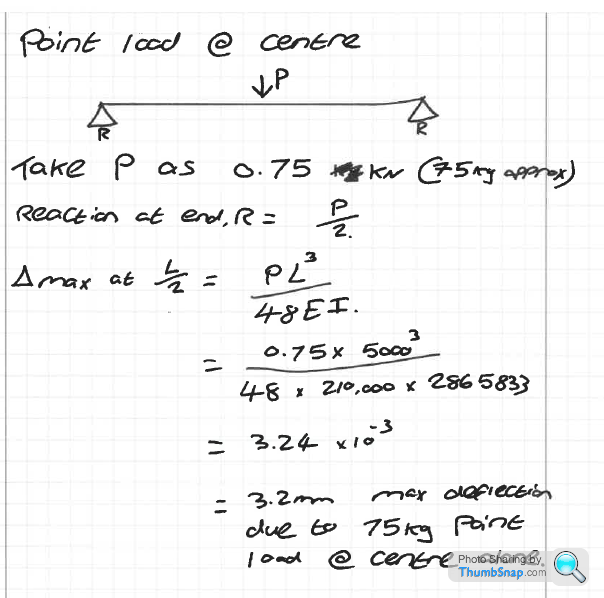
On the offchance that its of any interest or use, quick calcs below for deflection through a uniform load (beam selfweight alone) and also a point load in the centre alone.
Naturally the values would need to be combined for total deflection, and wouldn’t take into account any safety factors and so on.
Excuse the crap hand writing..

A 200x100x5 RHS would give a notable difference
On the offchance that its of any interest or use, quick calcs below for deflection through a uniform load (beam selfweight alone) and also a point load in the centre alone.
Naturally the values would need to be combined for total deflection, and wouldn’t take into account any safety factors and so on.
Excuse the crap hand writing..


eps said:
5m span and 5mm of deflection? Think about it... It's going to deflect more than that just on its own. 5m is quite a large span.
Is it really a point load or UDL? Is there another beam attached to it?
and why hollow square section?
I'm helping someone convert a pair of 40ft hi-cube containers into a workshop. Basically a full side will be cut out of each one and then they'll be joined together, permanently. It's in a yard, not a resi property. It will be this type of thing:Is it really a point load or UDL? Is there another beam attached to it?
and why hollow square section?
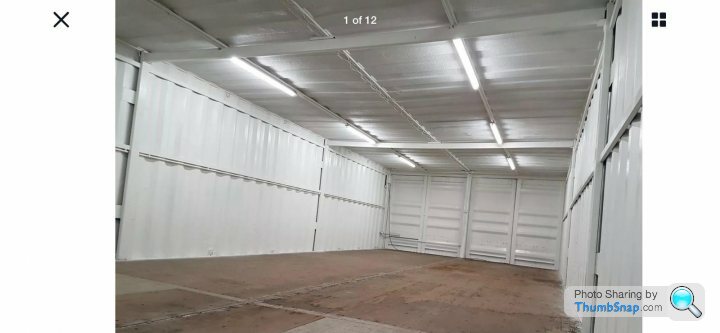
That's a stock picture from a company who modify and sell these. The side rails at the top of the container are made from 50mm square section (not sure on thickness) and obviously, like an Ikea wardrobe, a lot of the strength comes from the full welded sides (which incidentally are really quite thin).
You can see the cross-beams which have been installed in this picture and given the 50x50 side rails I'm estimating that those cross beams are 100x100, hence my original question. I was curious about how much those beams would deflect.
In terms of load it's entirely possible that "stuff" will be stored on top so the aim is to put a bit more strength in the roof. An unmodified container happily takes, say, a 1.25t car trailer sat on top, that would be point loads on the road wheels and jockey wheel. We could use I-beams/RSJs, that's an option. but equally don't want to over-engineer it. Definitely don't want any posts in the middle, there will be some big cars going in there and posts will massively compromise the useable space.

anonymous said:
[redacted]
That was the first thing I thought. However, I have had a look inside a few other containers recently, some have furniture stored in them and one in particular has a very large quantity of high-quality tools and equipment in there (SnapOn, etc), no insulation at all and everything inside is completely bone dry. We're pondering whether to insulate or not (a) for condensation and (b) for comfort. The main idea is to get a decent workspace whilst not spending the cost of a purpose-built building, so, somewhere in between the base price of the containers and the sky's the limit!Insulation options we have considered so far are rock wool batts (cheapest), polystyrene sheets (middle), or something like Celotex (most expensive). Then we'd need to batten and board over that so it runs a long way into 4 figures very quickly. Still pondering that one.
We should have the shell finished and joined & sealed in the next day, then the support beams and we'll see from there.
CAPP0 said:
anonymous said:
[redacted]
That was the first thing I thought. However, I have had a look inside a few other containers recently, some have furniture stored in them and one in particular has a very large quantity of high-quality tools and equipment in there (SnapOn, etc), no insulation at all and everything inside is completely bone dry. We're pondering whether to insulate or not (a) for condensation and (b) for comfort. The main idea is to get a decent workspace whilst not spending the cost of a purpose-built building, so, somewhere in between the base price of the containers and the sky's the limit!Insulation options we have considered so far are rock wool batts (cheapest), polystyrene sheets (middle), or something like Celotex (most expensive). Then we'd need to batten and board over that so it runs a long way into 4 figures very quickly. Still pondering that one.
We should have the shell finished and joined & sealed in the next day, then the support beams and we'll see from there.
You might be able to get away with it if the contents are bone-dry and it's left sealed shut over winter, but any in-use container needs insulation, I believe. Especially if you're driving a wet car into it! Spray foam is quite a common approach to consider for the ceilings.
Gassing Station | Homes, Gardens and DIY | Top of Page | What's New | My Stuff