
Bifolds Below DPC?
Discussion


I've had a bit of a nightmare with my extension build with builders giving up halfway etc, but I'm now almost at the stage of a dry shell. It's time to fit the bifolds, which have arrived, but I'm slightly unsure with how the dpm/dpc works with the level threshold we're after. As it stands the dpc runs in line with the top of the blocks that the bifolds will sit on, which I understand is fine because we plan on having acos in front of the doors (otherwise I believe the dpc would have to be 150mm above ground level?). It turns out that to get the level threshold we're after the doors need to be lowered 20mm so that the screed runs up to the frame, however that would put the bottom of the doors lower than the dpc in the external skin blockwork...is this OK because the doors will be sat on a dpc which runs up the sides to meet the external dpc, or is it a nono?
Pic attached incase it helps (ignore the state of it!)
Cheers, Dom

Pic attached incase it helps (ignore the state of it!)
Cheers, Dom
Can’t see as you have any other option with a level threshold. Not that I’m any expert on this but might be worth thinking of an Aco drain running along the same level of the DPC both in front of the door itself but along each side of the wall. 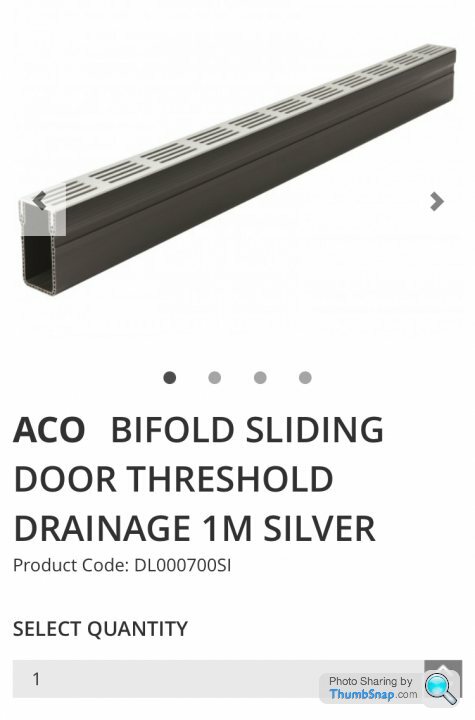
Edited by JezHill on Thursday 25th November 16:59
Aluminati said:
The screed should be below the frame, so your finished floor runs level to the frame. What is the finished floor ?
Aco’s are ugly, look at linear drains.
We used Aco Threshold Slot Channel Drain which are much more concealed. Aco’s are ugly, look at linear drains.
https://www.roofingsuperstore.co.uk/product/thresh...
Even with an Aco or similar drain, you shouldn't just have a single DPC less than 150mm. above ground level.
There are specific details for a secondary DPC to accommodate this arrangement, for example:

Where you use this sort of detail with a door cutting through it, the vertical DPC at the door jamb should be linked to the cavity tray.
There are specific details for a secondary DPC to accommodate this arrangement, for example:
Where you use this sort of detail with a door cutting through it, the vertical DPC at the door jamb should be linked to the cavity tray.
Thank you everyone, that's all really helpful. It's the aco slot drains we've got and equus as your diagram shows we have the flexible dpc which steps up a course onto the inside skin and have weep holes on the outside at ground level.
So it sounds like I'm OK to have the bottom of the doors an inch lower than the dpc level, if I run a dpc along the blockwork under the doors and lap it up the sides to connect (does this literally mean overlap?) with the dpc in the walls?
Cheers, Dom
So it sounds like I'm OK to have the bottom of the doors an inch lower than the dpc level, if I run a dpc along the blockwork under the doors and lap it up the sides to connect (does this literally mean overlap?) with the dpc in the walls?
Cheers, Dom
Zeemax_Mini said:
So it sounds like I'm OK to have the bottom of the doors an inch lower than the dpc level, if I run a dpc along the blockwork under the doors and lap it up the sides to connect (does this literally mean overlap?) with the dpc in the walls?
Yes. And yes, 'connect' means (in practice} that it will need to overlap.ETA: the DPC will also need to connect to the DPM under the floor, of course. Basic principle is that there should be no way for ground moisture, or any moisture within 150mm. above the ground (to allow for rain splashback or ponding) to get past the DPM/DPC and into the building.
Aco/slot drains should be regarded as a belt-and-braces approach, not primary protection (because they can block and/or surcharge).
Edited by Equus on Friday 26th November 10:50
Thanks very much, that's mega helpful and I really appreciate it. Yep I've got the dpm coming up the wall, should this also lay over the blocks under the doors (with the dpc run along the top of it) or does this just tuck up the wall and get cut off where it touches under the doors?
Dom
Dom
Zeemax_Mini said:
...I've got the dpm coming up the wall, should this also lay over the blocks under the doors (with the dpc run along the top of it) or does this just tuck up the wall and get cut off where it touches under the doors?
Yes, ideally the DPM should lap into the DPC.To repeat and simplify what I've said above: the DPC should be continuous, and the DPM should connect to it continuously.
Any discontinuity or break in the DPC/DPM is a path for ground moisture to find its way into the building, and hence a potential defect.
Admittedly, in practice builders tend to be pretty sloppy about this sort of thing, and most of the time they will get away with it. But only most of the time...
Gassing Station | Homes, Gardens and DIY | Top of Page | What's New | My Stuff