
Stud walls upstairs in a 90s house
Discussion


In a small-ish 90s 3 bed house with a fully-trussed roof, AFAIK, the walls dividing the bedrooms parallel with the roof trusses are (almost always) not load bearing.
Is it likely that the studded wall perpendicular to the trusses, eg. Making the box room by taking space from a larger bedroom be used as structural support? It seems unlikely, as it is only short and would be asymmetrical as it is relatively close to the front wall.
Asking for a friend. My house is a more traditional, solid, house.
Is it likely that the studded wall perpendicular to the trusses, eg. Making the box room by taking space from a larger bedroom be used as structural support? It seems unlikely, as it is only short and would be asymmetrical as it is relatively close to the front wall.
Asking for a friend. My house is a more traditional, solid, house.
No it's not terribly likely: modern trussed rafter roofs usually span from eaves to eaves, with no need of intermediate support, but if you get your 'friend' to take a photograph of what the loft looks like, we'll be able to confrim that much more positively (trussed rafter roofs are very easy to identify).
The only common exception to to this rule is usually on timber frame houses, where sometimes the internal stud walls are acting as buttressing 'wind walls' or 'shear walls', but usually the giveaway there (apart from timber frame construction) is that they are commonly skinned with OSB or plywood on at least one side, rather than just plasterboard.
The only common exception to to this rule is usually on timber frame houses, where sometimes the internal stud walls are acting as buttressing 'wind walls' or 'shear walls', but usually the giveaway there (apart from timber frame construction) is that they are commonly skinned with OSB or plywood on at least one side, rather than just plasterboard.
Edited by Equus on Monday 6th February 18:27
I was watching one of the many home improvement/wrecking programmes on TV & was surprised to see a terraced house with exactly the same layout as the one I was living in - it must have been nearby & built by the same builder. i was even more surprised to see a later visit to the house where every wall on the first floor had been cleared leaving one open space clear from front to back. These weren't stud walls either, they were block walls.
Presuambly it didn't fall down, although they didn't revisit it as I remember.
Presuambly it didn't fall down, although they didn't revisit it as I remember.
Equus said:
No it's not terribly likely: modern trussed rafter roofs usually span from eaves to eaves, with no need of intermediate support, but if you get your 'friend' to take a photograph of what the loft looks like, we'll be able to confrim that much more positively (trussed rafter roofs are very easy to identify).
The only common exception to to this rule is usually on timber frame houses, where sometimes the internal stud walls are acting as buttressing 'wind walls' or 'shear walls', but usually the giveaway there (apart from timber frame construction) is that they are commonly skinned with OSB or plywood on at least one side, rather than just plasterboard.
The only common exception to to this rule is usually on timber frame houses, where sometimes the internal stud walls are acting as buttressing 'wind walls' or 'shear walls', but usually the giveaway there (apart from timber frame construction) is that they are commonly skinned with OSB or plywood on at least one side, rather than just plasterboard.
Cheers.
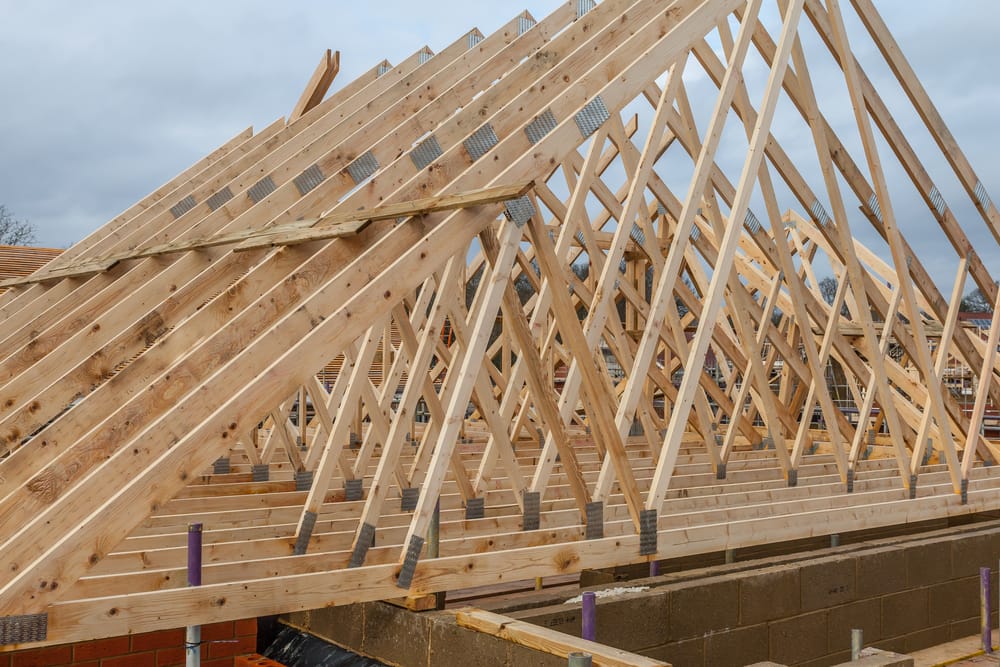
From memory, the loft looks like this. There isn't an open "loft space".
I did do some structural stuff in first year at university (bending moments, truss analysis etc.) . It's not a big house and my impression was that the roof trusses are symmetrical and self supporting, but the house is fairly flimsy compared with the older houses I'm more familiar with.
-I wasn't sure if there were sometimes struts/columns added post-truss fitting, at corners or the like.
Our 70's built house has brick outer /concrete block inner skin outer walls. Thermalite (or similar) internal ground floor walls and a fully trussed roof as in the picture above.
The first floor is T&G boards on timber joists on the ground floor walls. The first floor walls are studwork on top of the T&G. I'm pretty certain that I could gut the upstairs to completely open plan! Where the stairwell is formed, the wall construction changes from block to stud at 1st floor level.
The first floor is T&G boards on timber joists on the ground floor walls. The first floor walls are studwork on top of the T&G. I'm pretty certain that I could gut the upstairs to completely open plan! Where the stairwell is formed, the wall construction changes from block to stud at 1st floor level.
Gassing Station | Homes, Gardens and DIY | Top of Page | What's New | My Stuff