
Earth bonding is this redundant?
Discussion


I'm in the process of renovating my kitchen and the existing pipework is joined by earth wires.
This is the supply:
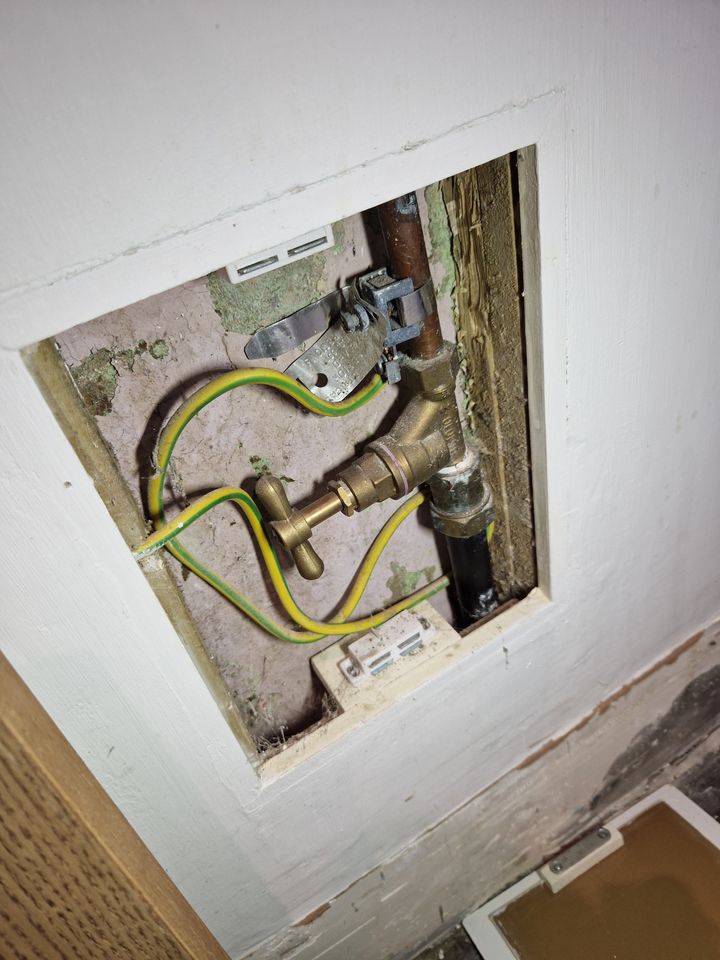
That incoming pipe appears to be some of plastic, I'm assuming MDPE or HDPE.
Am I right in saying that any earth bonding is now completely redundant and should be removed?
The old stainless sink was earthed for example and I want to be sure that the new one doesn't need it too.
This is the supply:
That incoming pipe appears to be some of plastic, I'm assuming MDPE or HDPE.
Am I right in saying that any earth bonding is now completely redundant and should be removed?
The old stainless sink was earthed for example and I want to be sure that the new one doesn't need it too.
bangerhoarder said:
AFAIK, you have a copper pipe and fittings there so the bonding isn't redundant. If something touches that pipe making it go live, you have protection. It can be isolated from ground, plastic both ends, but it's still a conductor.
As far as I can tell there is no actual connection to earth though. My neighbour in the terrace has an earth driven into the ground by her front door, but we don't. (not an electrician)
My understanding is that it used to be required, but now it's not.
See https://electrical.theiet.org/wiring-matters/years...
My understanding is that it used to be required, but now it's not.
See https://electrical.theiet.org/wiring-matters/years...
When we recently had smart meters fitted, they left a card pointing out there was no earth bonding at the gas meter even though the gas supply pipe is obviously plastic.
Apparently they leave these cards regardless of the pipe if they can't see bonding.
Internally, the gas pipework is bonded. I've seen discussions that it doesn't need to be, or in fact it might even be bad to do it, but it's almost certainly going to be earthed anyway via various appliance connections.
Apparently they leave these cards regardless of the pipe if they can't see bonding.
Internally, the gas pipework is bonded. I've seen discussions that it doesn't need to be, or in fact it might even be bad to do it, but it's almost certainly going to be earthed anyway via various appliance connections.
Here's something from somewhere that had a water supply incoming on MDPE pipe.
Testing the electrical earth showed it was floating above physical ground even with the incoming supply isolated.
Turned out the volts were coming from the water main due to an external fault and pulling up the PME via the bonding. Removing the bond to the pipework would have fixed the earth but wouldn't have much helped the tingle from using a tap.
I tend to err to the side of having bonding on pipework even if not strictly needed.
Testing the electrical earth showed it was floating above physical ground even with the incoming supply isolated.
Turned out the volts were coming from the water main due to an external fault and pulling up the PME via the bonding. Removing the bond to the pipework would have fixed the earth but wouldn't have much helped the tingle from using a tap.
I tend to err to the side of having bonding on pipework even if not strictly needed.
It’s more that the internal pipe work, both gas and water, is bonded to the earth.
This is usually achieved just house side of the gas meter and water stop cock.
Bond is run back to the wherever the electricity earth point is.
The intent is that if any internal pipework comes into contact with an electrical supply it will blow a fuse / trip a breaker, rather than become ‘live’ awaiting someone to touch the pipework…
This is usually achieved just house side of the gas meter and water stop cock.
Bond is run back to the wherever the electricity earth point is.
The intent is that if any internal pipework comes into contact with an electrical supply it will blow a fuse / trip a breaker, rather than become ‘live’ awaiting someone to touch the pipework…
Gassing Station | Homes, Gardens and DIY | Top of Page | What's New | My Stuff