
Shower waste fall
Discussion


I'm installing a shower and sink etc in our ensuite. The wall has been moved so the shower is now further away. I don't think I can get a decent fall from the waste into the soil stack. At the moment I'm just thinking ideas through, is there any type of waste pump I could use to boost the draining of the shower? A plumber we know said ideally I'd want to drill outside and take the waste outside and back in again ( the soil is inside the house). Also we couldn't notch out the joists to the degree we needed without compromising the structure.
Any help please
Any help please
As above, could you drill trough the joists rather than notch?
I had to do that on mine.
I sistered the joists - belt and braces
(Sistering joists = reinforcing an existing floor/ceiling joist by fastening another joist right alongside it. It s a super common fix for sagging, cracked, or undersized joists)
Glued and screwed chunky marine ply to the joists, both sides, as much length as possible before drilling.
May have to use shorter waste pipe lengths to get them in, glued joint fittings.
Stronger now than before!
I had to do that on mine.
I sistered the joists - belt and braces
(Sistering joists = reinforcing an existing floor/ceiling joist by fastening another joist right alongside it. It s a super common fix for sagging, cracked, or undersized joists)
Glued and screwed chunky marine ply to the joists, both sides, as much length as possible before drilling.
May have to use shorter waste pipe lengths to get them in, glued joint fittings.
Stronger now than before!
How long is the run going to be? There are limitations in that regard as well.
And what fall are you able to achieve? There’s nothing particularly lumpy that needs sweeping away from a shower waste (or you’d hope not) so you might even get away with 1/50 or less with some kind of low-profile trap. (I’m not recommending you do, by the way.)
And what fall are you able to achieve? There’s nothing particularly lumpy that needs sweeping away from a shower waste (or you’d hope not) so you might even get away with 1/50 or less with some kind of low-profile trap. (I’m not recommending you do, by the way.)
Measure your run length and fall - make a mock up, and see the result.
"Roman aqueducts were engineered with incredibly precise and shallow slopes to manage water pressure, typically with an overall fall (gradient) ranging between 0.013% and 0.5%. This means the channels dropped just 10 to 50 cm per kilometer, or roughly 5 to 10 feet per mile. "
Edited by RGG on Tuesday 3rd February 11:33
This is the room excuse the mess! Shower to go on the left. Top right sink, toilet bottom right where the waste is.
Unsure if it's best to get a shower tray with the waste at the top and then the sink can connect into it. That way I'm hoping I can have a decent fall going out the shower but there could be an issue of a bottle neck once it leaves the sink and can't fall as much.
Or I get a tray and use the waste at the other end but would mean sink and tray are using different pipes so more cutting.
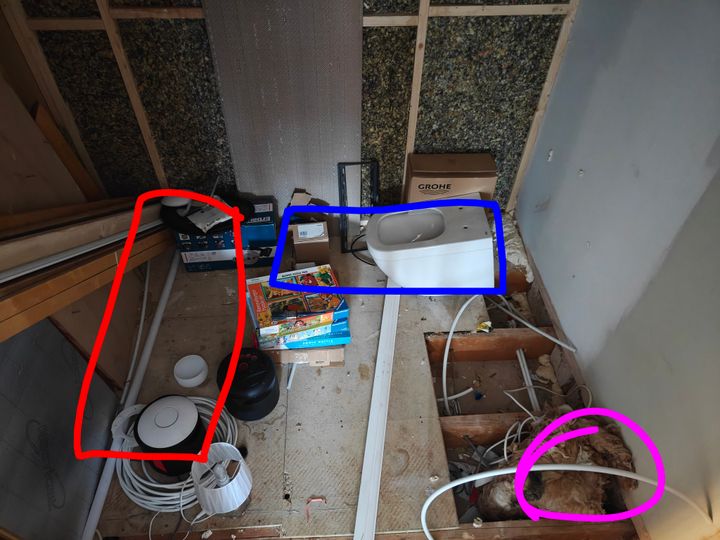
Unsure if it's best to get a shower tray with the waste at the top and then the sink can connect into it. That way I'm hoping I can have a decent fall going out the shower but there could be an issue of a bottle neck once it leaves the sink and can't fall as much.
Or I get a tray and use the waste at the other end but would mean sink and tray are using different pipes so more cutting.
dave7108 said:
I'm installing a shower and sink etc in our ensuite. The wall has been moved so the shower is now further away. I don't think I can get a decent fall from the waste into the soil stack. At the moment I'm just thinking ideas through, is there any type of waste pump I could use to boost the draining of the shower? A plumber we know said ideally I'd want to drill outside and take the waste outside and back in again ( the soil is inside the house). Also we couldn't notch out the joists to the degree we needed without compromising the structure.
Any help please
I have this problem as the builders bodged the top floor shower so there is hardly any slope on the drain from the shower, best option i can find is a macertator which as long as you have power will work automatically and will pump up and away. Ones I found are between 200-500 and varying sizes. Any help please
https://www.victorianplumbing.co.uk/bathroom-acces...
Just an example and I can't recommend vicotrianplumbing as they take an age to refund if anything is wrong (I think screwfix sell them as well)
This looks similar (and cheaper) as it doesn't include an inlet for the toilet waste https://www.plumbworld.co.uk/flo-force-elite-lifti...
Edited by anonymous-user on Thursday 5th February 15:11
Gassing Station | Homes, Gardens and DIY | Top of Page | What's New | My Stuff