
Fix my wooden worktop
Discussion


Is that solid timber? It’s funny for it to lift like that, looks like a veneer that’s lifting tbh. You could flood the crack with this, Chair Doctor glue, then sand it down flush.
TheDrownedApe said:
Its solid hard wood, slightly cracked/lifted on the surface.
I don't want to use anything that will swell the wood; rather fill it with a matching or clear glue, that i can sand down.
I think it's sticking up because water has got in and swelled the wood already. In fact the whole top looks rough, which I wouldn't expect with the right sort of Osmo.I don't want to use anything that will swell the wood; rather fill it with a matching or clear glue, that i can sand down.
I would sand the whole lot flat, and if there's a slight groove there that bothers you, use some brown filler and sand perfectly smooth before finishing with Osmo.
Simpo Two said:
I think it's sticking up because water has got in and swelled the wood already. In fact the whole top looks rough, which I wouldn't expect with the right sort of Osmo.
I would sand the whole lot flat, and if there's a slight groove there that bothers you, use some brown filler and sand perfectly smooth before finishing with Osmo.
Thanks, yeah its weird as its a new 3m return we had fitted last Nov. We sanded it and coated it exactly the same as we have done for the past 8 years with the rest of the worktop. There are two dark staves together, both of which are a PITA to get really smooth and noticed this within a couple of weeks of it being fitted. Haven't got a round to fixing it yet but moving soon and want to give it all a sanding for the photos etc. I would sand the whole lot flat, and if there's a slight groove there that bothers you, use some brown filler and sand perfectly smooth before finishing with Osmo.
Here is a image from further away.
May i ask; which filler?
The close-up looks like oak but the wider view looks more like some kind of mahogany or maybe iroko. Must have been pricey if its solid.
As for fillers, if the colour's OK maybe this: https://www.amazon.co.uk/Ronseal-RSLMPWFM100G-Medi...
Or you could get more creative with something like https://www.amazon.co.uk/dp/B0D95ZZ2L3/ though I haven't tried it.
The wood seems to have a very open grain, so perhaps try to build up the Osmo and sand between coats to get a flatter surface. Another option might be grain filling but I haven't tried that successfully.
As for fillers, if the colour's OK maybe this: https://www.amazon.co.uk/Ronseal-RSLMPWFM100G-Medi...
Or you could get more creative with something like https://www.amazon.co.uk/dp/B0D95ZZ2L3/ though I haven't tried it.
The wood seems to have a very open grain, so perhaps try to build up the Osmo and sand between coats to get a flatter surface. Another option might be grain filling but I haven't tried that successfully.
As Mr Wolfracesonic says, this sort of fissure more often occurs in a veneered surface... but can develop in solid wood.
Timber can be a funny bbugger and who knows what causes these anomalies. The stress induced by felling an enormous tree can take its toll, creating unseen fractures... and then there are lightning shakes, caused by a lightning strike whilst the tree was still growing. And which most probably killed it.
Whatever... you have a bit of a split.
I'd be tempted to try thin superglue, a plastic bag, a bit of wood, a plate and something heavy.
Thin superglue so it'll wick into the crack. A bit of plastic bag... or clingfilm to put over the glued crack and stop the piece of wood (just a bit bigger than the crack, 1" x 3") sticking and something heavy. (A lead ingot, a pan full of water, or a weighty engine component.)
In short order, squirt a bit of runny superglue into the crack, cover with the bit of plastic, centre the small piece of wood on the plastic above the crack, place the plate on the small piece of wood and place your heavy object on the plate.
Wait an hour. remove the weight, the plate, the piece of wood, peel off the plastic and see what you've got.
Hopefully the crack will be flat and stuck fast. Any imperfection, then apply a little of Simpo Two's filler.
Alternatively sand a bit of an unseen area of the worktop with a machine to produce a little sand dust. Mix this dust with a bit of Osmo to create a paste and use as a filler.
Sand off and refinish.
Of course, the existing Osmo finish might interfere with the superglue ... but then, He who dares Rodney...
Timber can be a funny bbugger and who knows what causes these anomalies. The stress induced by felling an enormous tree can take its toll, creating unseen fractures... and then there are lightning shakes, caused by a lightning strike whilst the tree was still growing. And which most probably killed it.
Whatever... you have a bit of a split.
I'd be tempted to try thin superglue, a plastic bag, a bit of wood, a plate and something heavy.
Thin superglue so it'll wick into the crack. A bit of plastic bag... or clingfilm to put over the glued crack and stop the piece of wood (just a bit bigger than the crack, 1" x 3") sticking and something heavy. (A lead ingot, a pan full of water, or a weighty engine component.)
In short order, squirt a bit of runny superglue into the crack, cover with the bit of plastic, centre the small piece of wood on the plastic above the crack, place the plate on the small piece of wood and place your heavy object on the plate.
Wait an hour. remove the weight, the plate, the piece of wood, peel off the plastic and see what you've got.
Hopefully the crack will be flat and stuck fast. Any imperfection, then apply a little of Simpo Two's filler.
Alternatively sand a bit of an unseen area of the worktop with a machine to produce a little sand dust. Mix this dust with a bit of Osmo to create a paste and use as a filler.
Sand off and refinish.
Of course, the existing Osmo finish might interfere with the superglue ... but then, He who dares Rodney...
loughran said:
Of course, the existing Osmo finish might interfere with the superglue ... but then, He who dares Rodney...
When it's regularly treated with oil, the wood likely filled with oil so close to the surface. While traditional glues don't like oil, you might want to try an oil-based clear paint that hardens when it dries. https://www.owatrol.com/en/rustol.html is one such I've used to stick oily wood together
Andeh1 said:
How odd, we have a solid wood table from furniture village (or equivalent), with an identical fault... Was a £2000 for a ruddy table.
Emailed them a few months after we bought it and never heard back. Forgot to follow it up, but keen to see possible solutions myself!
Pic attached!
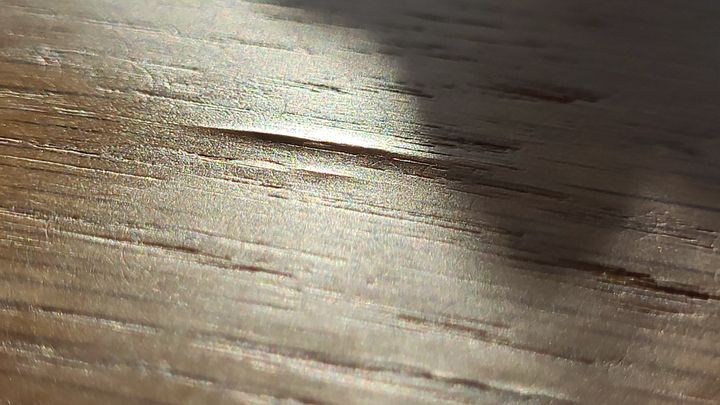
That looks like a raised ridge. I would shave that off with a new Stanley blade held flush to the surface, rub the removed shard between two pieces of sandpaper to produce sawdust and mix that with clear-setting glue and work it into the crack.Emailed them a few months after we bought it and never heard back. Forgot to follow it up, but keen to see possible solutions myself!
Pic attached!
There are proper dedicated products to make sawdust filler, regular glues tend not to be ideal.
The harder part is getting a suitable supply of dust to mix in if you haven't got an offcut or anything else to play with as a source. Then you have to actually turn it into something fine enough.
Before doing much else worth confirming if that bit moves/can be pushed down or if you'll just be stabilising it where it is. One risk is you shave it down and end up going into the underlying split.
Also try to make sure if you're messing with glue that none gets on the top surface as it could be fun removing it.
The harder part is getting a suitable supply of dust to mix in if you haven't got an offcut or anything else to play with as a source. Then you have to actually turn it into something fine enough.
Before doing much else worth confirming if that bit moves/can be pushed down or if you'll just be stabilising it where it is. One risk is you shave it down and end up going into the underlying split.
Also try to make sure if you're messing with glue that none gets on the top surface as it could be fun removing it.
Panamax said:
IMO you definitely need to get some liquid adhesive under there and let it set with weight on top before you even dream about sanding anything. In these situations the risk of making it worse is never to be under-estimated.
That’s what the Chair Doctor glue is for, that I linked to, extremely low viscosity for just this type of situation.Gassing Station | Homes, Gardens and DIY | Top of Page | What's New | My Stuff