
Static van heating
Discussion


Been pondering on how to heat a static van, and been playing around with AI with my ideas.
Below is a basic concept just for amusement but what would the reality implications be if I wanted to live in it all year round.
Basic considerations of damp and heat loss have been roughly taken into account but would be interesting to know other variables.
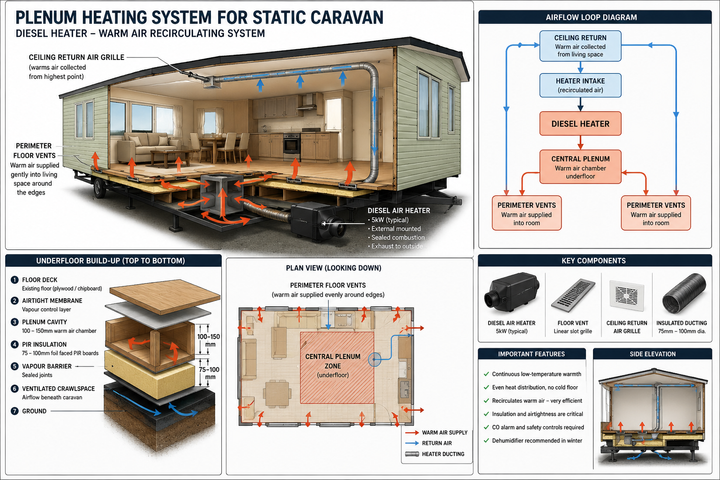
And yes I know it doesn’t show bedrooms or bathroom yet, it’s still experimental
Below is a basic concept just for amusement but what would the reality implications be if I wanted to live in it all year round.
Basic considerations of damp and heat loss have been roughly taken into account but would be interesting to know other variables.
And yes I know it doesn’t show bedrooms or bathroom yet, it’s still experimental
Edited by saknog on Tuesday 12th May 08:55
All those pipes look like a dream for mould & damp? Would they be materially better than a sensibly-located diesel heater, and a ceiling (or table) fan to spread the heat around? (Ceiling fans go backwards in winter to spread the heat, rather than giving a cooling effect).
Mini-split A/C would be even better, but depends how static the static is.
Mini-split A/C would be even better, but depends how static the static is.
Let’s say the scenario is I have a piece of land to put the static van on and live in full time. Planning rules and regulations are not important in this scenario.
Electric heating via mains or solar panels to possibly power a heat pump or electric heaters but that has its own issues so experimenting with diesel heating, cost to be determined depending on usage and temperature output.
Electric heating via mains or solar panels to possibly power a heat pump or electric heaters but that has its own issues so experimenting with diesel heating, cost to be determined depending on usage and temperature output.
biggiles said:
saknog said:
Bit more complex and expensive but has advantages
That looks incredibly complex. Do statics all come with "plenums" or is that AI making up a mad USA-style heating system to fit a UK portacabin (TM)?They're both pretty simple systems, with the 'heater' being almost identical.
Diesel burns, it heats either fluid or air. If air, use blowers and ducting to route it. If fluid, then run PEX and mini radiators (or fit new flooring with underfloor pipe runs). Both have options for multizone stuff, plus hot water heating too.

donaircooleone said:
Fit an Alde boiler, you'd be glad you did.
Alde are good, but there are alternatives!Personally, in this scenario instead of Alde I'd external mount the heater unit (probably an autoterm) and diesel tank then run pipe through. Three zones (underfloor and two rad based) and a calorifier loop in as big a vessel as I could find for cheap hot water too.
That way, it'll be cheaper/quieter/easier to maintain and greater capacity for both heat and hot water.
Look for used residential specification caravans.
Most have wet central heating using standard domestic boilers that are overkill for such a small space and can therefore run up to toasty temperature.
A well insulated van can be as good as a passiv haus type building, but possibly adding a couple of electric radiators and keeping it week vented will be the key.
Lived in a single glazed poverty spec van during November snowing while moving, damp was the issue but a well built “all year” van would be a different proposition.
If it’s older and there is access to fuel, as the poster above mentioned, log burner would be a huge bonus…
Most have wet central heating using standard domestic boilers that are overkill for such a small space and can therefore run up to toasty temperature.
A well insulated van can be as good as a passiv haus type building, but possibly adding a couple of electric radiators and keeping it week vented will be the key.
Lived in a single glazed poverty spec van during November snowing while moving, damp was the issue but a well built “all year” van would be a different proposition.
If it’s older and there is access to fuel, as the poster above mentioned, log burner would be a huge bonus…
It's a bit like a yacht in some ways.
Light structure, low heat capacity.
Loads of people have gone through the mill with this, covering all the variables of size, budget, climate, whatever.
Diesel-air heaters work, but are noisy.
Diesel-water heater can be better, and heat capacity of the water helps smooth things out.
Wood burner is cheap, but there's a bonus in heating that 'just works' when you push the button or the timer kicks in.
Ventilation and humidity control is important. If the place is dry and well aired you can be surprisingly comfortable with little heat.
Top tip is to sod off to warmer climes for the winter.
Light structure, low heat capacity.
Loads of people have gone through the mill with this, covering all the variables of size, budget, climate, whatever.
Diesel-air heaters work, but are noisy.
Diesel-water heater can be better, and heat capacity of the water helps smooth things out.
Wood burner is cheap, but there's a bonus in heating that 'just works' when you push the button or the timer kicks in.
Ventilation and humidity control is important. If the place is dry and well aired you can be surprisingly comfortable with little heat.
Top tip is to sod off to warmer climes for the winter.
Gassing Station | Homes, Gardens and DIY | Top of Page | What's New | My Stuff