
Advice needed re sealing a stone wall.
Discussion


Hi,
I'm after some advice, probably from any builders on here.
We have a stone cottage which is probably 180 years old and solid walls. The gable end gets hammered by the weather and since moving in approx 30 years ago, we have had major damp problems on that end in various places.
We've had scaffolding up 4 times now and replaced the chimney 3 times. A long story that I will not bore you with, but different people have different views on the way things should be done. It's surprising how many people in the trade don't know what a chimney tray is!
Anyway, the scaffolding is up again and the chimney is coming down again. A really good chap who does lead work all day long is on board and the single tray will be replaced with two (correctly so), and if need be, the whole chimney will be covered in lead!
Some of the stones have blown and will be replaced. The stones are a bit of everything, including blue lias, sandstone, and limestone. It's previously been repointed twice by us and the mortar is a lime mix.
We are hearing from different angles that once the wall and chimney is sorted, that we should paint on a product called Storm Dry which is a type of seal which breathes.
Question; The wall has to breathe so surely painting a form of sealant on it isn't the way to go?
The company's paperwork says that it doesn't work on blue lias and limestone, but my thoughts are, the wall has to breathe, and the product breathes, so how would it work and is there any point using it?
To date, numerous people in the trade are saying to use it, and an old school builder who's done work for us previously (not on that gable end) who's retired, is saying that you can't in order for the wall to breathe.
Thanks.
I'm after some advice, probably from any builders on here.
We have a stone cottage which is probably 180 years old and solid walls. The gable end gets hammered by the weather and since moving in approx 30 years ago, we have had major damp problems on that end in various places.
We've had scaffolding up 4 times now and replaced the chimney 3 times. A long story that I will not bore you with, but different people have different views on the way things should be done. It's surprising how many people in the trade don't know what a chimney tray is!
Anyway, the scaffolding is up again and the chimney is coming down again. A really good chap who does lead work all day long is on board and the single tray will be replaced with two (correctly so), and if need be, the whole chimney will be covered in lead!
Some of the stones have blown and will be replaced. The stones are a bit of everything, including blue lias, sandstone, and limestone. It's previously been repointed twice by us and the mortar is a lime mix.
We are hearing from different angles that once the wall and chimney is sorted, that we should paint on a product called Storm Dry which is a type of seal which breathes.
Question; The wall has to breathe so surely painting a form of sealant on it isn't the way to go?
The company's paperwork says that it doesn't work on blue lias and limestone, but my thoughts are, the wall has to breathe, and the product breathes, so how would it work and is there any point using it?
To date, numerous people in the trade are saying to use it, and an old school builder who's done work for us previously (not on that gable end) who's retired, is saying that you can't in order for the wall to breathe.
Thanks.
I’m not a builder but I live in a stone house in Saddleworth so we get lots of weather.
What pointing is on the stone wall now?
We had cement strap pointing removed from our entire house and replaced it with lime mortar. The theory being that the lime helps dry the stone out. We don’t have any damp.
I also use a big dehumidifier for 5 hours every night during the cheap rate of our EV tariff which I think helps a lot.
What pointing is on the stone wall now?
We had cement strap pointing removed from our entire house and replaced it with lime mortar. The theory being that the lime helps dry the stone out. We don’t have any damp.
I also use a big dehumidifier for 5 hours every night during the cheap rate of our EV tariff which I think helps a lot.
The main problem with the chimney is probably that you don't have a fire in the grate 9 months of the year.
The way old houses are supposed to 'breathe' needs that heat to make the water vapour go away.
Breathable waterproof coatings can work wonders, but water vapour will only ever want to move towards lower partial pressure.
I don't know anything about the particular coating mentioned and how its chemistry might not suit the stone in question.
The problem is, these magick jollops are not removable.
One traditional solution is slate hanging on the weather wall.
The way old houses are supposed to 'breathe' needs that heat to make the water vapour go away.
Breathable waterproof coatings can work wonders, but water vapour will only ever want to move towards lower partial pressure.
I don't know anything about the particular coating mentioned and how its chemistry might not suit the stone in question.
The problem is, these magick jollops are not removable.
One traditional solution is slate hanging on the weather wall.
Thanks for the replies.
When we first took off the cracked render (due to major leaks) which was in place when we moved in, underneath was a coating of black tar. This had to be sand blasted to be removed. It had obviously been leaking for many years.
A family member was adamant that he knew what needed to be done and he repointed it. However he hadn't used any lime and it dried very hard. When winter arrived, the water was entering via the chimney bricks and elsewhere and was literally flowing down the inner walls as it couldn't go elsewhere. One very wet carpet which had only been laid 3 days earlier!
This pointing was removed and redone with a lime mix.
Chimney rebuilt with single chimney tray (mistake). Leaks continuing.
The same family member had put in a round window incorrectly and used a short length of 2"x2" untreated pine as a lintel !!! It's now rotten and the 18" of stonework above it is moving downwards and has opened up cracks.
Knowing what we do now, if at the beginning again, we would build another vertical wall making it a cavity one and tie the roof into that. It can't be done now due to a sun room being in the way.
We've explored putting cladding on the end, but the owner of such a company (a friend and neighbour) has confidently said that there isn't anything on the market that would look ok with the cottage.
We'd also considered using slates and depending upon the general condition of the wall and the number of blown stones, this may still be an option.
Your mention of the fire not drying the wall out isn't the case here I'm afraid. Too much is and always has come in, even when the fire is in use every day.
When we first took off the cracked render (due to major leaks) which was in place when we moved in, underneath was a coating of black tar. This had to be sand blasted to be removed. It had obviously been leaking for many years.
A family member was adamant that he knew what needed to be done and he repointed it. However he hadn't used any lime and it dried very hard. When winter arrived, the water was entering via the chimney bricks and elsewhere and was literally flowing down the inner walls as it couldn't go elsewhere. One very wet carpet which had only been laid 3 days earlier!
This pointing was removed and redone with a lime mix.
Chimney rebuilt with single chimney tray (mistake). Leaks continuing.
The same family member had put in a round window incorrectly and used a short length of 2"x2" untreated pine as a lintel !!! It's now rotten and the 18" of stonework above it is moving downwards and has opened up cracks.
Knowing what we do now, if at the beginning again, we would build another vertical wall making it a cavity one and tie the roof into that. It can't be done now due to a sun room being in the way.
We've explored putting cladding on the end, but the owner of such a company (a friend and neighbour) has confidently said that there isn't anything on the market that would look ok with the cottage.
We'd also considered using slates and depending upon the general condition of the wall and the number of blown stones, this may still be an option.
Your mention of the fire not drying the wall out isn't the case here I'm afraid. Too much is and always has come in, even when the fire is in use every day.
mkjess123 said:
Thanks for the replies.
When we first took off the cracked render (due to major leaks) which was in place when we moved in, underneath was a coating of black tar. This had to be sand blasted to be removed. It had obviously been leaking for many years.
A family member was adamant that he knew what needed to be done and he repointed it. However he hadn't used any lime and it dried very hard. When winter arrived, the water was entering via the chimney bricks and elsewhere and was literally flowing down the inner walls as it couldn't go elsewhere. One very wet carpet which had only been laid 3 days earlier!
This pointing was removed and redone with a lime mix.
Chimney rebuilt with single chimney tray (mistake). Leaks continuing.
The same family member had put in a round window incorrectly and used a short length of 2"x2" untreated pine as a lintel !!! It's now rotten and the 18" of stonework above it is moving downwards and has opened up cracks.
Knowing what we do now, if at the beginning again, we would build another vertical wall making it a cavity one and tie the roof into that. It can't be done now due to a sun room being in the way.
We've explored putting cladding on the end, but the owner of such a company (a friend and neighbour) has confidently said that there isn't anything on the market that would look ok with the cottage.
We'd also considered using slates and depending upon the general condition of the wall and the number of blown stones, this may still be an option.
Your mention of the fire not drying the wall out isn't the case here I'm afraid. Too much is and always has come in, even when the fire is in use every day.
Can you put bubble Insulation internally and fit a suitable drain?When we first took off the cracked render (due to major leaks) which was in place when we moved in, underneath was a coating of black tar. This had to be sand blasted to be removed. It had obviously been leaking for many years.
A family member was adamant that he knew what needed to be done and he repointed it. However he hadn't used any lime and it dried very hard. When winter arrived, the water was entering via the chimney bricks and elsewhere and was literally flowing down the inner walls as it couldn't go elsewhere. One very wet carpet which had only been laid 3 days earlier!
This pointing was removed and redone with a lime mix.
Chimney rebuilt with single chimney tray (mistake). Leaks continuing.
The same family member had put in a round window incorrectly and used a short length of 2"x2" untreated pine as a lintel !!! It's now rotten and the 18" of stonework above it is moving downwards and has opened up cracks.
Knowing what we do now, if at the beginning again, we would build another vertical wall making it a cavity one and tie the roof into that. It can't be done now due to a sun room being in the way.
We've explored putting cladding on the end, but the owner of such a company (a friend and neighbour) has confidently said that there isn't anything on the market that would look ok with the cottage.
We'd also considered using slates and depending upon the general condition of the wall and the number of blown stones, this may still be an option.
Your mention of the fire not drying the wall out isn't the case here I'm afraid. Too much is and always has come in, even when the fire is in use every day.
Yes, you will almost certainly need to knock some plaster off, having had ongoing damp.
The only other thing that's clear is that this has been a problem for a very long time, with efforts including blackjack, chimney rebuilds, rendering and repointing all failing to stop the water come in.
IMO you're likely to need professional advice once the plaster is removed.
The only other thing that's clear is that this has been a problem for a very long time, with efforts including blackjack, chimney rebuilds, rendering and repointing all failing to stop the water come in.
IMO you're likely to need professional advice once the plaster is removed.
I have a rubble stone built cottage in the West of Ireland that gets a bit of “weather” and which was originally cement rendered, but we took the render off and lime pointed it.
The bare stone was coated with 2 coats of Diasen BKK ECO clear hydro repellent coating and all is good so far. Matt finish and can’t be seen.
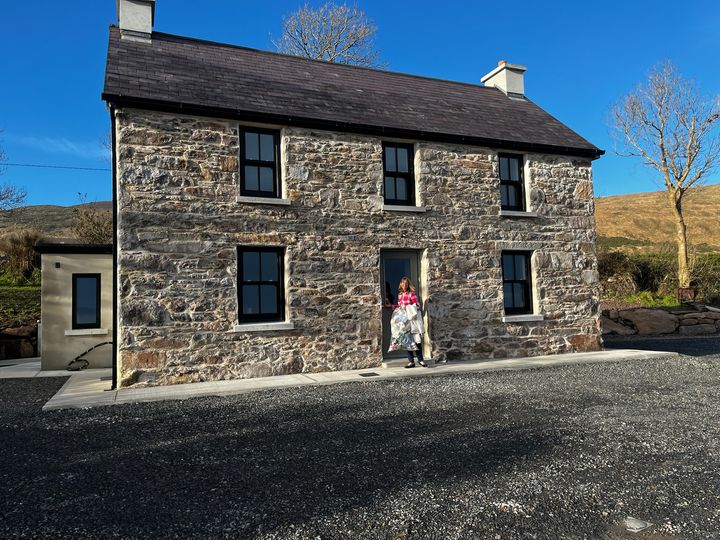
The bare stone was coated with 2 coats of Diasen BKK ECO clear hydro repellent coating and all is good so far. Matt finish and can’t be seen.
mkjess123 said:
Thanks for the replies.
When we first took off the cracked render (due to major leaks) which was in place when we moved in, underneath was a coating of black tar. This had to be sand blasted to be removed. It had obviously been leaking for many years.
A family member was adamant that he knew what needed to be done and he repointed it. However he hadn't used any lime and it dried very hard. When winter arrived, the water was entering via the chimney bricks and elsewhere and was literally flowing down the inner walls as it couldn't go elsewhere. One very wet carpet which had only been laid 3 days earlier!
This pointing was removed and redone with a lime mix.
Chimney rebuilt with single chimney tray (mistake). Leaks continuing.
The same family member had put in a round window incorrectly and used a short length of 2"x2" untreated pine as a lintel !!! It's now rotten and the 18" of stonework above it is moving downwards and has opened up cracks.
Knowing what we do now, if at the beginning again, we would build another vertical wall making it a cavity one and tie the roof into that. It can't be done now due to a sun room being in the way.
We've explored putting cladding on the end, but the owner of such a company (a friend and neighbour) has confidently said that there isn't anything on the market that would look ok with the cottage.
We'd also considered using slates and depending upon the general condition of the wall and the number of blown stones, this may still be an option.
Your mention of the fire not drying the wall out isn't the case here I'm afraid. Too much is and always has come in, even when the fire is in use every day.
You have to have some significant leaks to let that much water in?When we first took off the cracked render (due to major leaks) which was in place when we moved in, underneath was a coating of black tar. This had to be sand blasted to be removed. It had obviously been leaking for many years.
A family member was adamant that he knew what needed to be done and he repointed it. However he hadn't used any lime and it dried very hard. When winter arrived, the water was entering via the chimney bricks and elsewhere and was literally flowing down the inner walls as it couldn't go elsewhere. One very wet carpet which had only been laid 3 days earlier!
This pointing was removed and redone with a lime mix.
Chimney rebuilt with single chimney tray (mistake). Leaks continuing.
The same family member had put in a round window incorrectly and used a short length of 2"x2" untreated pine as a lintel !!! It's now rotten and the 18" of stonework above it is moving downwards and has opened up cracks.
Knowing what we do now, if at the beginning again, we would build another vertical wall making it a cavity one and tie the roof into that. It can't be done now due to a sun room being in the way.
We've explored putting cladding on the end, but the owner of such a company (a friend and neighbour) has confidently said that there isn't anything on the market that would look ok with the cottage.
We'd also considered using slates and depending upon the general condition of the wall and the number of blown stones, this may still be an option.
Your mention of the fire not drying the wall out isn't the case here I'm afraid. Too much is and always has come in, even when the fire is in use every day.
It's not just detail of porosity or breathability, it sounds like water running down some masonry or other is entering via actual holes?
You need someone who understands the detail of the building.
Sometimes it's a mistake to assume things were ever right at some point in the past. but dodgy repairs often trap water which inevitably penetrates, some water will always get in, sometimes what matters is how it gets out again. Things like sealant in the wrong place around a flashing can do much more harm than good.
Thanks again for all of the replies and FBP1, that cottage looks good!
The damp is definitely from water coming through. It's a bit disconcerting to be fast asleep in bed and be woken up by Drip. Drip Drip (and that's not an age thing!) when there's a storm blowing.
We can't put slates on the gable end as it's not flat and any battens would need to be packed out so much that it's not practicable.
We took the chimney apart today and found that the lead tray was partially melted and allowing water in. A flue liner will now be fitted. In addition, the wooden lintel above the window was totally rotten allowing quite a bit of water in.
Our main hurdle throughout has been trying to find somebody that genuinely knows what they are talking about. On a positive note, the current builders are pretty good, as is the chap doing the leadwork.
We have taken the decision to use the Storm Dry product whilst the scaffolding is up.
Thanks again for your replies.
The damp is definitely from water coming through. It's a bit disconcerting to be fast asleep in bed and be woken up by Drip. Drip Drip (and that's not an age thing!) when there's a storm blowing.
We can't put slates on the gable end as it's not flat and any battens would need to be packed out so much that it's not practicable.
We took the chimney apart today and found that the lead tray was partially melted and allowing water in. A flue liner will now be fitted. In addition, the wooden lintel above the window was totally rotten allowing quite a bit of water in.
Our main hurdle throughout has been trying to find somebody that genuinely knows what they are talking about. On a positive note, the current builders are pretty good, as is the chap doing the leadwork.
We have taken the decision to use the Storm Dry product whilst the scaffolding is up.
Thanks again for your replies.
mkjess123 said:
Thanks for the replies.
When we first took off the cracked render (due to major leaks) which was in place when we moved in, underneath was a coating of black tar. This had to be sand blasted to be removed. It had obviously been leaking for many years.
A family member was adamant that he knew what needed to be done and he repointed it. However he hadn't used any lime and it dried very hard. When winter arrived, the water was entering via the chimney bricks and elsewhere and was literally flowing down the inner walls as it couldn't go elsewhere. One very wet carpet which had only been laid 3 days earlier!
This pointing was removed and redone with a lime mix.
Chimney rebuilt with single chimney tray (mistake). Leaks continuing.
The same family member had put in a round window incorrectly and used a short length of 2"x2" untreated pine as a lintel !!! It's now rotten and the 18" of stonework above it is moving downwards and has opened up cracks.
Knowing what we do now, if at the beginning again, we would build another vertical wall making it a cavity one and tie the roof into that. It can't be done now due to a sun room being in the way.
We've explored putting cladding on the end, but the owner of such a company (a friend and neighbour) has confidently said that there isn't anything on the market that would look ok with the cottage.
We'd also considered using slates and depending upon the general condition of the wall and the number of blown stones, this may still be an option.
Your mention of the fire not drying the wall out isn't the case here I'm afraid. Too much is and always has come in, even when the fire is in use every day.
The history reads as if it could potentially be one of those scenarios where the damp began when central heating was fitted and the fire place stopped being used. The previous owners then tried to remedy with bitumen and render?When we first took off the cracked render (due to major leaks) which was in place when we moved in, underneath was a coating of black tar. This had to be sand blasted to be removed. It had obviously been leaking for many years.
A family member was adamant that he knew what needed to be done and he repointed it. However he hadn't used any lime and it dried very hard. When winter arrived, the water was entering via the chimney bricks and elsewhere and was literally flowing down the inner walls as it couldn't go elsewhere. One very wet carpet which had only been laid 3 days earlier!
This pointing was removed and redone with a lime mix.
Chimney rebuilt with single chimney tray (mistake). Leaks continuing.
The same family member had put in a round window incorrectly and used a short length of 2"x2" untreated pine as a lintel !!! It's now rotten and the 18" of stonework above it is moving downwards and has opened up cracks.
Knowing what we do now, if at the beginning again, we would build another vertical wall making it a cavity one and tie the roof into that. It can't be done now due to a sun room being in the way.
We've explored putting cladding on the end, but the owner of such a company (a friend and neighbour) has confidently said that there isn't anything on the market that would look ok with the cottage.
We'd also considered using slates and depending upon the general condition of the wall and the number of blown stones, this may still be an option.
Your mention of the fire not drying the wall out isn't the case here I'm afraid. Too much is and always has come in, even when the fire is in use every day.
Then to exacerbate you've had repeated issues with the chimney.
So you may have two issues. A leaking chimney which can hopefully be fixed but a gable end that faces the weather and has always soaked up more water than is ideal but was historically held at bay by daily use of the fireplace through the wettest months and possibly an original lime render?
When it comes to sealants I completely feel your pain. Sellers will tend to tell you that it's awesome, will do the job, don't worry about the small print, just hand over the money, while locals tend to fall into two distinct camps of wise and well read or the usual f
 king idiot who thinks he knows everything and instead is just a bucket of conspiracy bks, old wives tales and a need to just make st up to sound clever. The problem is that the two types tend to look and sound the same.
 As you have a mix of stone in the wall is it all cheap cobbles that were intended to be lime rendered originally and is part of the problem that the original render failed decades ago and was replaced by bitumen and cement render?
Is it worth trying to establish if it would have been rendered originally and is it also worth considering a log burner so as to put the chimney back in use?
Gassing Station | Homes, Gardens and DIY | Top of Page | What's New | My Stuff