
Creaky floors - replace chipboard with OSB or ply?
Discussion


I have creaking floors in every room, the floors are 50 years old and I think 1970s chipboard, so I think rather than glue and screw everything and hope that works out ok, it's probably best to lay new hard underfloor, so my question is, can I use OSB T&G boards or do I have to use ply sheets?
Link to sample OSB T&G boards: https://www.selcobw.com/sterling-zero-osb3-t-g-boa...
Link to sample OSB T&G boards: https://www.selcobw.com/sterling-zero-osb3-t-g-boa...
OutInTheShed said:
Creaking is often because the boards are not evenly supported by the joists.
Gluing may help, but if there is a gap between the board and the joist, it may still creak when you stand on it.
In my case, that is a distinct possibility. I will get more laminate up over the weekend and take a closer look, But whatever the reason, should I need to lay a new subfloor, I still have to figure out what material to use.Gluing may help, but if there is a gap between the board and the joist, it may still creak when you stand on it.
Usually it's the flooring grade chipboard not ply or OSB, though the cement board is useful for some spots.
Also consider if you might use 22mm instead of 18mm flooring.
You'd want to glue it all but the glue does go off very very quickly.
Screws alone won't stop it creaking, you either glue it to the joists or the other option is acoustic joist tape (foam, not the decking sort) which allows for irregularity and movement.
Fair bet the joints currently aren't particularly flat or equal so might need sorting.
Might be fixable as-is if the boards are sound just with some extra fixings & some glue? Don't screw down through it without knowing exactly where any pipes or wires are first.
Also consider if you might use 22mm instead of 18mm flooring.
You'd want to glue it all but the glue does go off very very quickly.
Screws alone won't stop it creaking, you either glue it to the joists or the other option is acoustic joist tape (foam, not the decking sort) which allows for irregularity and movement.
Fair bet the joints currently aren't particularly flat or equal so might need sorting.
Might be fixable as-is if the boards are sound just with some extra fixings & some glue? Don't screw down through it without knowing exactly where any pipes or wires are first.
I'm not sure this would work well enough in your case...
For my 20 yr old house with 22mm flooring tongue and groove chipboard floors I laid a bead of expanding foamy Gorilla Glue along every joint and it COMPLETELY eliminated all squeaky floorboards. I was amazed. I scraped the excess off.
I also recommend using Armed 127mm Solid Board Cutter caps to access services under the floorboards.
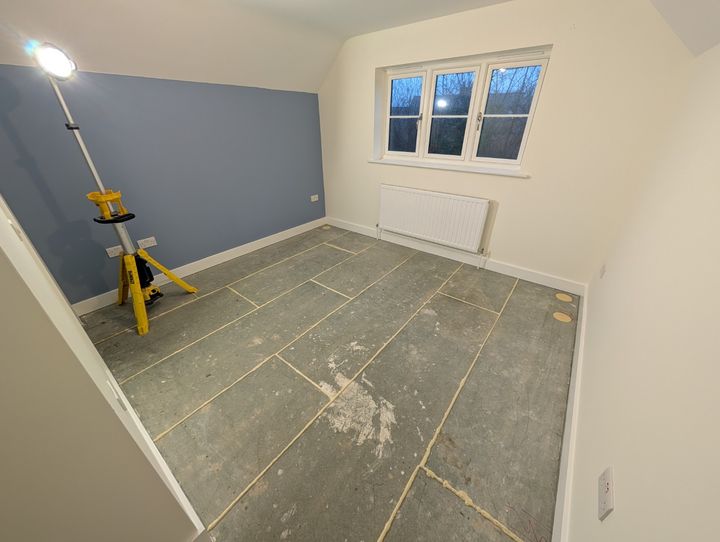
For my 20 yr old house with 22mm flooring tongue and groove chipboard floors I laid a bead of expanding foamy Gorilla Glue along every joint and it COMPLETELY eliminated all squeaky floorboards. I was amazed. I scraped the excess off.
I also recommend using Armed 127mm Solid Board Cutter caps to access services under the floorboards.
Actual said:
I laid a bead of expanding foamy Gorilla Glue along every joint and it COMPLETELY eliminated all squeaky floorboards.
Stuff like the Egger D4 flooring glue is basically the same, just thinner, and sets more quickly.Much easier to run into any gaps.
Cheaper too as far as I remember.
OutInTheShed said:
Creaking is often because the boards are not evenly supported by the joists.
Gluing may help, but if there is a gap between the board and the joist, it may still creak when you stand on it.
Not entirely true.Gluing may help, but if there is a gap between the board and the joist, it may still creak when you stand on it.
Creaking is usually board movement and the fixing ie lost head nail staying put in the joist but moving slightly in the floor board.
That is one reason why 20 years ago on site we moved to what is called silent flooring.
We were using chipboard flooring previous to this but Pva on the joints and 3 nails in every joist run per board so 12-15 nails a board.
Then D4 glue came out and they said only nail the first row on the perimeter nogging run, then just one nail per board to hold it in situ and stop it sliding as you decked the plot.
With D4 glue you glue the tongue and groove plus every joist top the board sits on, the site agents look for the foam pissing out underneath when it’s done as well as all the joints.
Screws creak too not just lost head nails.
We have also revisited at customer care stage and cut out the floor as the twist nails in the joist hangers also creak when walked on, so we poured copious d4 glue over all nails to hold them in situ.
It’s not bad workmanship, a lot is down to the joists, flooring open to the elements for a month or two before roof is covered over, then you have a period of drying out and natural movement.
Old properties the joist, flooring won’t be anywhere near the original thickness due to drying out and movement hence creaking as well.
TJI joists with 8x2 chipboard flooring and d4 glue will create about as silent a gloor as is possible at present.
Promised Land said:
OutInTheShed said:
Creaking is often because the boards are not evenly supported by the joists.
Gluing may help, but if there is a gap between the board and the joist, it may still creak when you stand on it.
Not entirely true.Gluing may help, but if there is a gap between the board and the joist, it may still creak when you stand on it.
Creaking is usually board movement and the fixing ie lost head nail staying put in the joist but moving slightly in the floor board.
That is one reason why 20 years ago on site we moved to what is called silent flooring.
We were using chipboard flooring previous to this but Pva on the joints and 3 nails in every joist run per board so 12-15 nails a board.
Then D4 glue came out and they said only nail the first row on the perimeter nogging run, then just one nail per board to hold it in situ and stop it sliding as you decked the plot.
With D4 glue you glue the tongue and groove plus every joist top the board sits on, the site agents look for the foam pissing out underneath when it s done as well as all the joints.
Screws creak too not just lost head nails.
We have also revisited at customer care stage and cut out the floor as the twist nails in the joist hangers also creak when walked on, so we poured copious d4 glue over all nails to hold them in situ.
It s not bad workmanship, a lot is down to the joists, flooring open to the elements for a month or two before roof is covered over, then you have a period of drying out and natural movement.
Old properties the joist, flooring won t be anywhere near the original thickness due to drying out and movement hence creaking as well.
TJI joists with 8x2 chipboard flooring and d4 glue will create about as silent a gloor as is possible at present.
My house has chipboard floors upstairs. The previous owner had cut a lot of the boards for access to services above the ceiling. I replaced all the screws holding the areas that were removed by these screws which hold the boards as well as screwing them into the joists:
https://www.screwfix.com/p/spax-tx-countersunk-sel...
Ten years use since then and minimal problems with creaking

https://www.screwfix.com/p/spax-tx-countersunk-sel...
Ten years use since then and minimal problems with creaking
I had to lift and relay all of my flooring in a 70's detached house for a rewire.
It's all tongue and groove 18mm chipboard.
I had never done this before so i did all sorts of stupid cuts that required noggins later on.
The big win was using Lost tite screws in every board, this has multiple threads that pull the boards in where needed and don't come loose.
I'd recommend trying that first as its the least messy and you can follow the nail locations to place them without hitting services.
It's all tongue and groove 18mm chipboard.
I had never done this before so i did all sorts of stupid cuts that required noggins later on.
The big win was using Lost tite screws in every board, this has multiple threads that pull the boards in where needed and don't come loose.
I'd recommend trying that first as its the least messy and you can follow the nail locations to place them without hitting services.
southerndriver said:
My house has chipboard floors upstairs. The previous owner had cut a lot of the boards for access to services above the ceiling. I replaced all the screws holding the areas that were removed by these screws which hold the boards as well as screwing them into the joists:
https://www.screwfix.com/p/spax-tx-countersunk-sel...
Ten years use since then and minimal problems with creaking
Yes, the same as external decking screws and hood at their job.https://www.screwfix.com/p/spax-tx-countersunk-sel...
Ten years use since then and minimal problems with creaking
But as I said above on new build they sooner go for a silent floor with minimal fixings to reduce squeaks.
On a lived in floor these would work well.
I would stay on the side of less fixings and use d4 glue on the boards yours replacing and joist tops as well though.
The downside to d4 glue is if you ever want access again it’s a messy, destructive job lifting the boards.
Gassing Station | Homes, Gardens and DIY | Top of Page | What's New | My Stuff