
Please critique my home battery project.
Discussion


Hopefully the diagram will help.
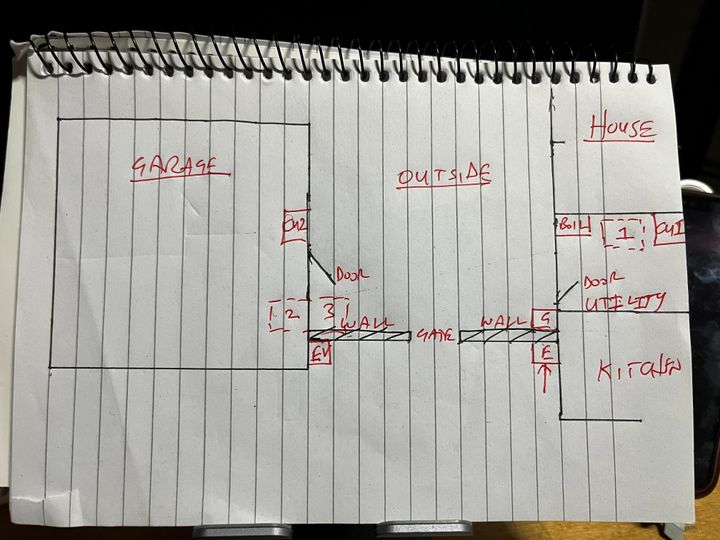
Starting on a project to get a home battery install - no solar at this stage but potential in the future behind the garage.
Before the battery project I'm going to upgrade all my RCD's to RCBO's
From the picture (bottom of the page is the front "driveway" and top is back garden "lawn")
G = Gas meter
E = Electric Meter
Boil = Gas Boiler
EV = zappi car charger
CU1 = main CU 2 x 16 RCD's
CU2 = secondary 2 RCD's (fed from RCD on CU1)
utility room is about 2m x 1.6m (it has a powered extractor above the back door but that will be uprated if required).
1 ,2 ,3 = potential place for inverter & battery
my preferred location for battery & inverter is 2 since safety and security is key.
But I would then have to cable from the meter box and back again so that the inverter would be the first in line and act as a UPS.
In terms of Brand
inverter = Victron Multiplus II GX
batteries = Fogstar 16.1Kwh 48V x2 (on wheels)
Sounds like you'd have some chunky wiring anyway if you wanted the whole CU buffered on the battery even if it was in the utility?
I guess there's nothing fundamental to stop you running from meter to garage, then having the garage feed to the house, and it makes some sense as there's some hefty loads there. And it's not a wild divergence from the existing layout. Does assume you're able to route some fat cables though.
Not a DIY job though!
Very similar setup to what we have. Detached garage with solar, battery, inverter. Mains feed to meter box on the outside of the house, connected to garage with separate consumer unit etc. Made most sense with Solar panels on the garage roof.
I was more comfortable with having the battery physically separated from the house.
We did have to dig up and duct between the house and garage and put some chunky cables in.
I was more comfortable with having the battery physically separated from the house.
We did have to dig up and duct between the house and garage and put some chunky cables in.
Are there not limits on the length of cabling allowed between meter and main CU?
You may be limited in the total run meter > gateway > main CU?
What is the rating of the inverter?
If your batteries are say 16 kWh, you should probably be aiming for 8kW max continuous discharge?
Compared with your home supply being 80A or 18kW?
I don't know the regs for domestic installs.
But I think you have to consider that the big picture is mains feeding loads which might include a car charger, heat pump and an electric hob all at once, limited to 80 or 100A. Do you really intend to UPS all of that, or just a subset? I suspect the fact that you currently have gas doesn't change that?
Also I would think about stuff failing or getting damaged. Buried cables do have faults sometimes, any complex stuff can fail, so I think I'd want it to be as simple as possible to revert to plain old mains feeding the consumer unit.
Likewise keeping the path from the meter to the car charger as short and simple as possible makes sense? If you ever need to charge the car from your battery, use a granny lead?
Do you REALLY need to have the whole house on the battery like a UPS? It complicates the wiring hugely, and means that in a power-cut you may well burn through your whole battery without even noticing. Forgive me if this is obvious, but for running the house on battery power (e.g. with an EV tariff) in normal use, the battery can be nearly anywhere, it doesn't need to be upstream of the CU.
I have mine in an outbuilding, with a couple of "UPS" sockets, which run servers and freezers. In a power-cut I can run an extension lead to the house for a kettle.
I'd put the batteries outside the garage. The newer Fogstar units have frost protection. They are unlikely to be stolen. They take up a lot of space: my 32kwh+inverter is similar to a small wardrobe, and the battery weighs over 200kg.
"This isn't a DIY project" etc., but also watch out for having two batteries - the wiring needs to be v. careful to ensure they are "balanced". A single bigger battery may be easier.
Thanks for all your replies. Please keep them coming.
By having the inverter upstream of everything I assumed that the wiring install would be much simpler.
As I get older what I want to avoid is carrying out actions say during a power cut. I'm pretty good at managing my energy and so will make sure that only essentials will be used.
I plan to invest in proper screening (from direct sunlight) if I choose to install the batteries outside. Nice to know about frost protection.
Finally - yes this ISN'T a DIY project. I have an excellent electrician who will do everything. Just brainstorming possible solutions before I call him in.
For option 1, I think you'd have to have the utility room fire-proofed and prove that exit isn't needed as a fire escape route. That might prove rather expensive, depending on what the walls and ceiling are made of.
Of the other two options, I'd go for inside the garage as long as you don't need the space for anything else. It will reduce parasitic losses due to battery heating slightly and mean the battery isn't exposed to the elements. As above you'll need some longish runs of very heavy duty cable though, which will push the price up a bit.
Another option would be to split the battery and inverter, putting the inverter and gateway next to the meter box and the battery in the garage since that would avoid long AC runs. If you're going to do that, it would probably be better to go for a higher voltage battery though, to reduce the current through the long run between inverter and battery.
If you're going for a whole-home backup, make sure the gatway supports your current requirements because it will be the limiting factor on how much power you can draw, even when you are on the grid. It should really be rated to the same continuous throughput as your main fuse (probably 100amps). If Google AI is to be believed, the integral gateway in that unit seems to be limited to a maximum of 50amps pass-through current which would limit you to about 12kW for your entire house at all times.
Edited by kambites on Thursday 5th November 08:59
kambites said:
Of the other two options, I'd go for inside the garage as long as you don't need the space for anything else. It will reduce parasitic losses due to battery heating slightly and mean the battery isn't exposed to the elements. As above you'll need some longish runs of very heavy duty cable though, which will push the price up a bit.
Another option would be to split the battery and inverter, putting the inverter and gateway next to the meter box and the battery in the garage since that would avoid long AC runs. If you're going to do that, it would probably be better to go for a higher voltage battery though, to reduce the current through the long run between inverter and battery.
I'm not sure that's right, kambites - in my experience usually it's the cable from inverter to battery which is the £/heaviest, by far, and it's practical to keep them close together. Perhaps I'm used to 48v systems, and your advice is for HV inverter/battery systems.Another option would be to split the battery and inverter, putting the inverter and gateway next to the meter box and the battery in the garage since that would avoid long AC runs. If you're going to do that, it would probably be better to go for a higher voltage battery though, to reduce the current through the long run between inverter and battery.
Like Griffith4ever I run RS485 through cat5 for the CT meters - you can also run 100mbps ethernet through the same cable at the same time if that's helpful. But easier to have 2 cables if you can.
I'm intrigued by these set ups so pls forgive my ignorance but what is the business case for these set ups? Unless you live remotely and/or need guaranteed UPS type power for some reason I struggle to see why, is using nighttime rates and fully depleting the battery in the day that beneficial at home??
Payback 8 yrs ish exc. solar, if you inc. opportunity cost of capital and sparky fees you're well over 10 years pay back (by which time the market/equipment/prices will have changed)
Just intrigued??? The cheap DIY plug ins may well be viable....
Payback 8 yrs ish exc. solar, if you inc. opportunity cost of capital and sparky fees you're well over 10 years pay back (by which time the market/equipment/prices will have changed)
Just intrigued??? The cheap DIY plug ins may well be viable....
biggiles said:
I'm not sure that's right, kambites - in my experience usually it's the cable from inverter to battery which is the £/heaviest, by far, and it's practical to keep them close together. Perhaps I'm used to 48v systems, and your advice is for HV inverter/battery systems.
Yes it obviously depends on relative voltages. At 48V, an 8kW inverter can draw 170amps which requires a decidedly chunky cable; at 400V (which I think is what our battery runs at) it's only drawing 20amps for the same power. Our main incoming feed which goes meter -> gateway -> consumer unit can in theory take 100 amps (at 240 volts) which obviously falls somewhere between the two, although in practice I doubt we ever pull anywhere near that!
Edited by kambites on Thursday 5th November 10:41
v8notbrave said:
Payback 8 yrs ish exc. solar, if you inc. opportunity cost of capital and sparky fees you're well over 10 years pay back (by which time the market/equipment/prices will have changed)
8 years sounds over the top to me, although I'm not sure of the cost of battery-only installs so I might be wrong. A fully utilised (as in fully charged over night and fully discharged during the day, every day) 16kWh battery will save you about £1100 a year in electricity costs at current rates, more like £1200 if you're already on a TOU tariff for other reasons. I would imagine a simple 16kWh battery install is going to cost, what, £6k? So in simplistic terms that would be about a four and a half year pay-back, probably closer to 6 or 7 including opportunity losses. Obviously we don't know what electricity prices are going to do, and how the difference in peak vs off-peak rates will vary, but I don't think they're likely to change that radically in the next 6 or 7 years.
ETA: Obviously if you want a reliable backup, you can't fully discharge the battery every day, but then you're gaining another benefit beyond pure electricity cost savings.
Edited by kambites on Thursday 5th November 10:49
Greenmantle said:
1 ,2 ,3 = potential place for inverter & battery
my preferred location for battery & inverter is 2 since safety and security is key.
But I would then have to cable from the meter box and back again so that the inverter would be the first in line and act as a UPS.
Get the sparky to put a new outdoor CU beside the electricity meter, connected via henley blocks, then just run a mains cable out to the garage where your batteries and inverter are.my preferred location for battery & inverter is 2 since safety and security is key.
But I would then have to cable from the meter box and back again so that the inverter would be the first in line and act as a UPS.
Unless you have frequent blackouts, or absolutely need it for medical equipment, I wouldn't bother about UPS. The inverter may not even support what you need. E.g. my GivEnergy inverter has an Emergency Power Supply (EPS) but it cannot be connected to house ring-main and it needs significant earthing equipment.
Edited by gmaz on Thursday 5th November 11:02
For resilience in a power cut it might be worth considering low voltage circuits rather than the complexity of running 240v all-over. Look at what you actually need to be able to get through a week with the power off and how much of it is actually 240v.
Eg if the power goes off my gas boiler stops working, but it steps 240v down to 12v, so I can fire up the central heating directly off the car if I really needed to.
I think I would lose the TV, my computers and the router, but I can run the router off a 12v circuit, use my tablet and the only thing I could do with sorting now is a UPS that keeps my server up long enough that it can send whatever I was watching on Plex to my tablet and then shutdown gracefully. If I get bored I'll just go for a walk or drive somewhere with electricity.
Hoofy said:
For those of you with a battery in a detached garage, do you have issues with extreme cold and extreme heat? If not, what have you done to mitigate extreme temperatures so the battery can operate?
Drafty shed in South Devon 30m from house (it's never got cold enough to stop charging)You can insulate or add a heater (germination mats are good)
paulrockliffe said:
For resilience in a power cut it might be worth considering low voltage circuits rather than the complexity of running 240v all-over. Look at what you actually need to be able to get through a week with the power off and how much of it is actually 240v.
Eg if the power goes off my gas boiler stops working, but it steps 240v down to 12v, so I can fire up the central heating directly off the car if I really needed to.
I think I would lose the TV, my computers and the router, but I can run the router off a 12v circuit, use my tablet and the only thing I could do with sorting now is a UPS that keeps my server up long enough that it can send whatever I was watching on Plex to my tablet and then shutdown gracefully. If I get bored I'll just go for a walk or drive somewhere with electricity.
For an extended power cut, the freezer might be important.Eg if the power goes off my gas boiler stops working, but it steps 240v down to 12v, so I can fire up the central heating directly off the car if I really needed to.
I think I would lose the TV, my computers and the router, but I can run the router off a 12v circuit, use my tablet and the only thing I could do with sorting now is a UPS that keeps my server up long enough that it can send whatever I was watching on Plex to my tablet and then shutdown gracefully. If I get bored I'll just go for a walk or drive somewhere with electricity.
'Pure Sine' inverters of 500W or so are not that expensive.
Gassing Station | Homes, Gardens and DIY | Top of Page | What's New | My Stuff