
Tell me good things about solar panels
Discussion


Right, having just completed phase 1 of "Turn a draughty rambling old pile into a comfy warm house" with the installation of some wood burning stoves, and phase 2, being the installation of a large quantity of insulation booked to go in during May, phase 3 becomes do something about the hot water issue.
So, if you have solar panels for your hot water, please tell me about them. We have a large easily accessible south facing roof, so positioning and installation won't be an issue. I don't want to hear that they are only of any use on July 19th, or it will take eleventy three years to pay back the installation costs either. Every little helps, and everything costs, whether it is oil, as at the moment, solar or burning shavings off unicorn horns. I'd rather be paying something like this off anyway than contributing to the oil company coffers, or giving Broon and Darling more of my hard earned to waste on the feckless.
Right, now you.
Go!
So, if you have solar panels for your hot water, please tell me about them. We have a large easily accessible south facing roof, so positioning and installation won't be an issue. I don't want to hear that they are only of any use on July 19th, or it will take eleventy three years to pay back the installation costs either. Every little helps, and everything costs, whether it is oil, as at the moment, solar or burning shavings off unicorn horns. I'd rather be paying something like this off anyway than contributing to the oil company coffers, or giving Broon and Darling more of my hard earned to waste on the feckless.
Right, now you.
Go!
So how is your hot water heated at the moment?
There is a version of solar hot water that works in the dark, cold and rain - it's called a hot water heat pump.
Solar hot water is barely viable here in NZ, with 2000 hours of sunshine a year, the hot water heat pump on the other hand uses about a third of the usual amount of electricity to heat water - and is cheaper and easier to install than solar.
I've got both, and over the last 18 months my hot water (3/4 people) has averaged under 25p a day, the heat pump provides most of the savings.
In the sunny UK, if you use electric hot water heating, that you install a hot water heat pump, I can usually do them for under fifteen hundred installed.
There is a version of solar hot water that works in the dark, cold and rain - it's called a hot water heat pump.
Solar hot water is barely viable here in NZ, with 2000 hours of sunshine a year, the hot water heat pump on the other hand uses about a third of the usual amount of electricity to heat water - and is cheaper and easier to install than solar.
I've got both, and over the last 18 months my hot water (3/4 people) has averaged under 25p a day, the heat pump provides most of the savings.
In the sunny UK, if you use electric hot water heating, that you install a hot water heat pump, I can usually do them for under fifteen hundred installed.
Disagree with Sleep Envy!!
We have an 1840 farmhouse, which consumed vast qauntities of heating oil for CH and Hot Water, despite lots of insulation, etc. When the oil price was very high a couple of years ago, we installed a large Woodburner with back boiler and put an evacuated tube solar hot water heating system on the roof. I have a good south facing roof.
For two years now between Easter and End of September my oil cost has been virually nil (and I've not lit a fire) and we've had plenty of hot water. I have gone from using approx 4 tanks of oil per year to less than 2, although during the winter our logs/wood cost has increased slightly, this is still far more cost effective than oil.
Even during recent days, I have had full tanks of hot water (and I have an extra large 250l tank - 3 days worth of hot water) at around 56 degrees just from the solar, to top that up to 60 degrees does not take much energy from another source. Even today where it is currently wet and windy, the solar array is at 26 degrees, and every degree that is above the incoming cold water feed, is one less degree that the water temperature needs to be raised by another means.
With the high oil price of two years ago, my payback for the Woodburner and Solar Panels was around 5 years!, with the oil pricing dropping this increased to around 8 years, but oil is on the rise again. And before anyone says you must live in the south or the Channel Islands, I live in Mid Wales.
There are two basic types of solar hot water heating, evacuated tubes or the SolarTwin method (effectively a radiator on the roof). The former is more expensive but is much more efficient in our climate. I also had a large array installed on the roof (40 tubes) and had the hot water tank increased to 6ft high and 250litres so that it can hold a decent amount of water.
HTH
davidy
We have an 1840 farmhouse, which consumed vast qauntities of heating oil for CH and Hot Water, despite lots of insulation, etc. When the oil price was very high a couple of years ago, we installed a large Woodburner with back boiler and put an evacuated tube solar hot water heating system on the roof. I have a good south facing roof.
For two years now between Easter and End of September my oil cost has been virually nil (and I've not lit a fire) and we've had plenty of hot water. I have gone from using approx 4 tanks of oil per year to less than 2, although during the winter our logs/wood cost has increased slightly, this is still far more cost effective than oil.
Even during recent days, I have had full tanks of hot water (and I have an extra large 250l tank - 3 days worth of hot water) at around 56 degrees just from the solar, to top that up to 60 degrees does not take much energy from another source. Even today where it is currently wet and windy, the solar array is at 26 degrees, and every degree that is above the incoming cold water feed, is one less degree that the water temperature needs to be raised by another means.
With the high oil price of two years ago, my payback for the Woodburner and Solar Panels was around 5 years!, with the oil pricing dropping this increased to around 8 years, but oil is on the rise again. And before anyone says you must live in the south or the Channel Islands, I live in Mid Wales.
There are two basic types of solar hot water heating, evacuated tubes or the SolarTwin method (effectively a radiator on the roof). The former is more expensive but is much more efficient in our climate. I also had a large array installed on the roof (40 tubes) and had the hot water tank increased to 6ft high and 250litres so that it can hold a decent amount of water.
HTH
davidy
Edited by DavidY on Wednesday 31st March 10:04
Ken Sington said:
Sleep Envy - Not Viable? How so, finacially or effectively, or both?
both essentiallythe uk is too far north to get sufficient energy from the sun to utilise the SPs - the angle of the sun is too shallow
as mentioned, ground source heat pumps would be a better solution - just make sure that none of your neighbours are utilising this technology already as it will reduce the effectiveness of your installation
DavidY said:
With the high oil price of two years ago, my payback for the Woodburner and Solar Panels was around 5 years!, with the oil pricing dropping this increased to around 8 years, but oil is on the rise again.
what is the life span of the SPs?surprised to find the payback is 8 years from investment, the last lot I looked at were 23 years (this was 18 months ago)
Sleep Envy
The payback is less than 8 years when taken into account with the woodburner and back boiler. Tube life is in excess of 20 years, Guaranteed for 10.
My solar installation was around £3700 including all labour, this included the following:-
2 x 20 tube arranys on the roof, each one approx 4.5m2
1 x new hot water tank (250l 6ft) with solar heating coil and normal coil
1 x solar heating controller plus pumps, valves, etc
1 x dump radiator in the loft
All pipework installation costs
Installation and Setting Up
Even if this saves me half a tank of oil in the summer months, I would see the return in 10 years. The reality is that I get more from it, though I would say that going for the extra array on the roof was a good idea, and only increased the system cost by approx £450.
davidy
The payback is less than 8 years when taken into account with the woodburner and back boiler. Tube life is in excess of 20 years, Guaranteed for 10.
My solar installation was around £3700 including all labour, this included the following:-
2 x 20 tube arranys on the roof, each one approx 4.5m2
1 x new hot water tank (250l 6ft) with solar heating coil and normal coil
1 x solar heating controller plus pumps, valves, etc
1 x dump radiator in the loft
All pipework installation costs
Installation and Setting Up
Even if this saves me half a tank of oil in the summer months, I would see the return in 10 years. The reality is that I get more from it, though I would say that going for the extra array on the roof was a good idea, and only increased the system cost by approx £450.
davidy
Are people using/looked at heat stores/accumulators to use with solar/back boilers? We are looking and I think for a fairly big tank and controls and overflow bits etc. for a 4 bedroom house. Worked out around £1500. No idea if that is good or not or how it compares to your run-of-the-mill tank.
Is the chap from NZ talking about using the solar water heater as the loop for picking up heat. Not heard of that before but sounds like a good idea. Although wouldn't it be too hot?
Is the chap from NZ talking about using the solar water heater as the loop for picking up heat. Not heard of that before but sounds like a good idea. Although wouldn't it be too hot?
Google Navitron, then check ebay out too.
If you can DIY it, using evacuated tubes, working on one tube per 5 litres of tank space (I think!) then yes, it'll work, and will pay-back in a reasonable time, especially compared to oil fired heating.
Read the Navitron forums (they sell kits too, but similar gear without the backup and support is cheaper on ebay). There's a lot of info on there, if you can do basic plumbing and aren't scared of heights you could DIY for minimal cost.
Pay Worcester Bosch or whoever 5 grand for some undersized flat panels, and the payback will be looong.
If you can DIY it, using evacuated tubes, working on one tube per 5 litres of tank space (I think!) then yes, it'll work, and will pay-back in a reasonable time, especially compared to oil fired heating.
Read the Navitron forums (they sell kits too, but similar gear without the backup and support is cheaper on ebay). There's a lot of info on there, if you can do basic plumbing and aren't scared of heights you could DIY for minimal cost.
Pay Worcester Bosch or whoever 5 grand for some undersized flat panels, and the payback will be looong.
Forgot to add - google FITs first - whether solar thermal comes under the FITs scheme I don't know, but solar PV (electricity generation) fitted by gubbermint approved installers is a money earner - 41 pence per kwh paid to you I think. Whether solar PV panels will still work after 25 years is debatable but anyway..

I think that one of the issues here is that if you use a government approved installer so that you can claim a grant towards the system, then you certainly pay for it.
In my case, a government approved installer less the grant reclaim was still higher than the cost that I paid to have it independently installed. Unfortunatley this leads a lot of people to assume that solar is expensive.
In my case, a government approved installer less the grant reclaim was still higher than the cost that I paid to have it independently installed. Unfortunatley this leads a lot of people to assume that solar is expensive.
Oh dear, what a lot of armchair experts. 
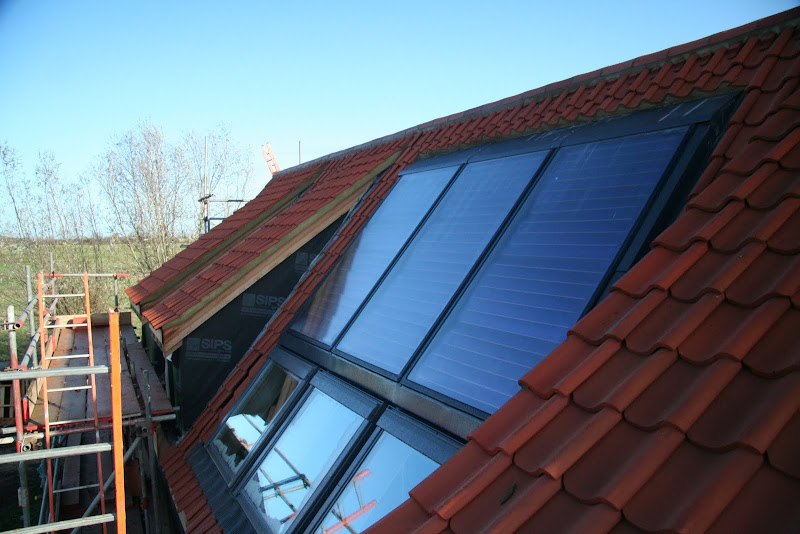
You can go for either flat panel or tubes. Flat panels look better (like a 'dark velux') and last longer (25 years plus). Tubes are more efficient and for reasons I can't quite understand can be cheaper. Navitron and Eco-nomical are regularly mentioned. Our (flat) panels came from Navitron and are German made - seem to be indestructable and look very smart.
You can get useful amounts of heat in the UK, for a panel facing south, positioned at 40 degrees from flat, you can get:
Winter: 112 kWh/m2
Spring: 293 kWh/m2
Summer: 401 kWh/m2
Autumn: 293 kWh/m2
For a total of 1099 kWh/m2 in a year - earning you the equivalent of approx £150 quids worth of electrical heating at 13p/kWh
So a standard 2.5 sqm panel at £460 from Navitron can 'earn' you £375 worth of hot water in a year. If you're on mains gas, the saving is less (as it costs a lot less to heat water on gas) - about £150 a year.
Obviously, you need more than just the panel - there are pumps and so on to consider, so it's hard to estimate the cost of the full kit without knowing whether you're retro-fitting, plumbing into a new system, or going for a full on multi-fuel thermal store. It wouldn't be out of order to assume £500 for the additional kit though and labour isn't going to make a huge difference if you're already working on the roof and plumbing.
So... that gives a ballpark figure of £960 for a 2.5m2 solar panel, saving you at least £150 quid a year (more if you don't have mains gas). Payback works out at 6 and a half years - or down to 2 and a half years if you heat with electricity at present. Most panels will last at least 10 years, and when it comes to replacement you should find that you don't need to replace the entire kit. The figures get better the more panels you have, but obviously if you can't use the hot water being produced, you're not saving any money so there's no point in over sizing the system.
There are a lot of caveats to this:
1. If you get a 'professional installer', they'll charge you two or three times as much - so payback is much poorer.
2. The savings are at today's fuel prices. Doom-mongers suggest that they're going to rocket up, which would dramatically improve the payback time. I don't think anyone would expect prices to go down though.
3. If you already have an efficient mains gas hot water system that doesn't need replacing, your saving is going to be much less.
4. Yes, you don't get much heat in the winter. Big deal. A lot of people are now installing systems that combine solar with a wood burner for year round 'cheap' heat.
And one final thought - the government are planning to introduce a renewable heat scheme which will pay you to have solar panels on your roof. The proposed payments are quite generous, and would at least halve the above payback times. As the payments last for the lifetime of the installed system, installing solar could be quite profitable.
You can go for either flat panel or tubes. Flat panels look better (like a 'dark velux') and last longer (25 years plus). Tubes are more efficient and for reasons I can't quite understand can be cheaper. Navitron and Eco-nomical are regularly mentioned. Our (flat) panels came from Navitron and are German made - seem to be indestructable and look very smart.
You can get useful amounts of heat in the UK, for a panel facing south, positioned at 40 degrees from flat, you can get:
Winter: 112 kWh/m2
Spring: 293 kWh/m2
Summer: 401 kWh/m2
Autumn: 293 kWh/m2
For a total of 1099 kWh/m2 in a year - earning you the equivalent of approx £150 quids worth of electrical heating at 13p/kWh
So a standard 2.5 sqm panel at £460 from Navitron can 'earn' you £375 worth of hot water in a year. If you're on mains gas, the saving is less (as it costs a lot less to heat water on gas) - about £150 a year.
Obviously, you need more than just the panel - there are pumps and so on to consider, so it's hard to estimate the cost of the full kit without knowing whether you're retro-fitting, plumbing into a new system, or going for a full on multi-fuel thermal store. It wouldn't be out of order to assume £500 for the additional kit though and labour isn't going to make a huge difference if you're already working on the roof and plumbing.
So... that gives a ballpark figure of £960 for a 2.5m2 solar panel, saving you at least £150 quid a year (more if you don't have mains gas). Payback works out at 6 and a half years - or down to 2 and a half years if you heat with electricity at present. Most panels will last at least 10 years, and when it comes to replacement you should find that you don't need to replace the entire kit. The figures get better the more panels you have, but obviously if you can't use the hot water being produced, you're not saving any money so there's no point in over sizing the system.
There are a lot of caveats to this:
1. If you get a 'professional installer', they'll charge you two or three times as much - so payback is much poorer.
2. The savings are at today's fuel prices. Doom-mongers suggest that they're going to rocket up, which would dramatically improve the payback time. I don't think anyone would expect prices to go down though.
3. If you already have an efficient mains gas hot water system that doesn't need replacing, your saving is going to be much less.
4. Yes, you don't get much heat in the winter. Big deal. A lot of people are now installing systems that combine solar with a wood burner for year round 'cheap' heat.
And one final thought - the government are planning to introduce a renewable heat scheme which will pay you to have solar panels on your roof. The proposed payments are quite generous, and would at least halve the above payback times. As the payments last for the lifetime of the installed system, installing solar could be quite profitable.
Edited by Tuna on Wednesday 31st March 12:38
DavidY said:
I think that one of the issues here is that if you use a government approved installer so that you can claim a grant towards the system, then you certainly pay for it.
In my case, a government approved installer less the grant reclaim was still higher than the cost that I paid to have it independently installed. Unfortunatley this leads a lot of people to assume that solar is expensive.
The grant scheme is being scrapped in favour of the Renewable heat incentive, which pays you an annual fee for using solar etc. Unfortunately, it's still likely to require 'accredited' installers who push the price up of their kit by a quite ridiculous amount.In my case, a government approved installer less the grant reclaim was still higher than the cost that I paid to have it independently installed. Unfortunatley this leads a lot of people to assume that solar is expensive.
Gassing Station | Homes, Gardens and DIY | Top of Page | What's New | My Stuff