
CH/hot water help please
Discussion


Hi guys,
This is our CH/hot water set up:

We've had a problem that occurs some, but not all, of the time since it's been too warm for the CH to be on. It doesn't happen at all if the CH has already been running before the HW comes on (ie, all winter) and it didn't happen last year at all.
Basically, when the HW valve opens we get one hell of a noise from the pipes. It bangs loud enough to hear all over the house. But not for very long, so I don't get to hear it close up because it's usually finished before I get my head into the airing cupboard. I did catch it the other morning however, and it started with hissing from the black air valve thing at the top just after the HW valve opened, then followed by what sounded like fairly chunky volumes of air and water sloshing around the pipes - rather like a big version of my aquarium filter when I'm priming it.
Despite the valve on the top of the system, I'm guessing there's not supposed to be that much air in it on a 1/2/3 daily basis, but it doesn't seem to be losing water anywhere...
And if the CH comes on first, neither system does it.
Any simple ideas, or is it plumber time?
Thanks in advance....
This is our CH/hot water set up:
We've had a problem that occurs some, but not all, of the time since it's been too warm for the CH to be on. It doesn't happen at all if the CH has already been running before the HW comes on (ie, all winter) and it didn't happen last year at all.
Basically, when the HW valve opens we get one hell of a noise from the pipes. It bangs loud enough to hear all over the house. But not for very long, so I don't get to hear it close up because it's usually finished before I get my head into the airing cupboard. I did catch it the other morning however, and it started with hissing from the black air valve thing at the top just after the HW valve opened, then followed by what sounded like fairly chunky volumes of air and water sloshing around the pipes - rather like a big version of my aquarium filter when I'm priming it.
Despite the valve on the top of the system, I'm guessing there's not supposed to be that much air in it on a 1/2/3 daily basis, but it doesn't seem to be losing water anywhere...
And if the CH comes on first, neither system does it.
Any simple ideas, or is it plumber time?
Thanks in advance....
dirkgently said:
At a guess the flow through the cylinder is restricted somewhere causing the boiler to overheat,(the bangs and hissing).
Ok, so how do we sort that? (And wouldn't this affect the CH as well?)dirkgently said:
O/T who did the soldering? were they wearing boxing gloves?
Also to Shadowninja:It's a 300 year old house - we've had it for 2 1/2 of them - so God only knows!
dirkgently said:
At a guess the flow through the cylinder is restricted somewhere causing the boiler to overheat,(the bangs and hissing).
From the description, it seems to be doing it on start-up, so it wouldn't be the boiler overheating.Unless maybe the boiler overheated the last time it was run and the trapped air is released on start-up? But then it would do that for both CH & HW.
From the picture, it doesn't look as though there's a bypass?
Edited by Deva Link on Tuesday 13th July 14:19
ShadownINja said:
Slightly off-topic but why do you have two valves? I have one tri-valve.
In that installation it doesn't make much sense although 3 port valves are less reliable than 2 port. Usually they're used as there's flexibility as to where they're located - they don't need to be together.defblade said:
Deva Link said:
From the picture, it doesn't look as though there's a bypass?
Um, what's that, how would I know/find, is it important?!BTW, it's a straight forward oil fired boiler, located downstairs from and about 10 foot horizontally away from the hot water tank.
The fact that you have an Auto Air Vent installed suggests that the system has always had a problem with air.
Leave the system off for a while and with no demand for heat manually open the DHW zone valve using the lever on the top and see if any air escapes past the valve.
I've learnt from a few powerflushes that Drayton zone valves make a very loud banging noise if you try and close them as water is flowing through them the wrong way. Could be the air travelling the wrong way through the valve causing it bang.
You need to investigate how the air is getting into the system.
A picture of below the pump if possible would be a help!
Leave the system off for a while and with no demand for heat manually open the DHW zone valve using the lever on the top and see if any air escapes past the valve.
I've learnt from a few powerflushes that Drayton zone valves make a very loud banging noise if you try and close them as water is flowing through them the wrong way. Could be the air travelling the wrong way through the valve causing it bang.
You need to investigate how the air is getting into the system.
A picture of below the pump if possible would be a help!
Ferg said:
defblade said:
Deva Link said:
From the picture, it doesn't look as though there's a bypass?
Um, what's that, how would I know/find, is it important?!BTW, it's a straight forward oil fired boiler, located downstairs from and about 10 foot horizontally away from the hot water tank.
Do auto vents ever allow air to be sucked in? But doesn't make sense (to me) why the effect is only seen with HW and not with CH.
Deva Link said:
Wonder if the pump runs on after the valves have closed (ours does, but it's a lightweight gas boiler).
No. Oil boilers don't run a pump overrun.Deva Link said:
Do auto vents ever allow air to be sucked in?
They can indeed, but I don't think that one would unless the return is super-sludged.Ok, here's a picture of below the pump:
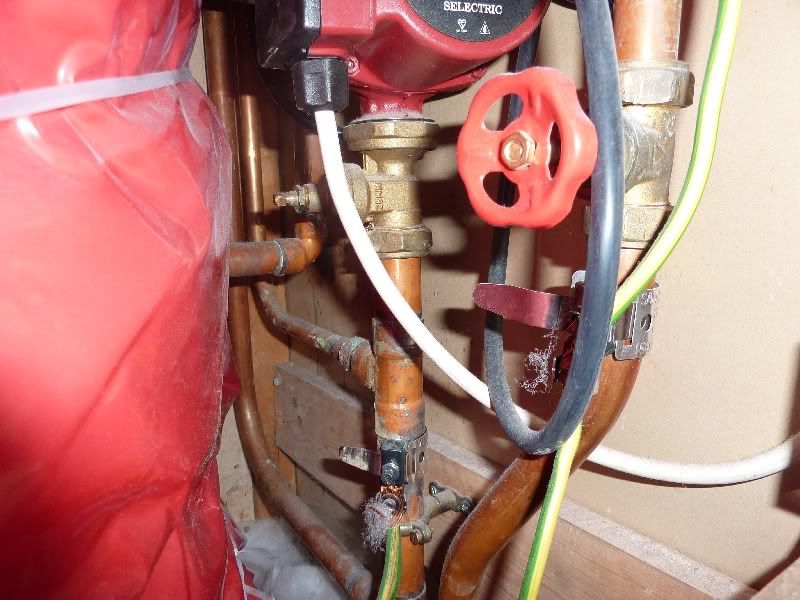
The 2 pipes T-ed off below the pump both head up to the attic.
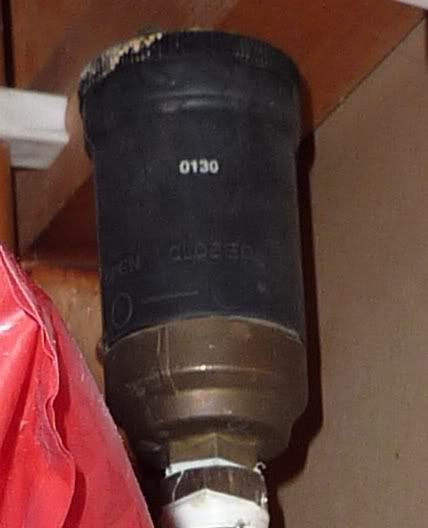
Also, here's more detail of the air valve. It's got open-closed written on it, and it looks like the index mark is the line in the brass section. It's half way between open and closed and the black body doesn't move with gentle-to-nervous-moderate pressure. There's a bit of sediment around the top where water has come out and the water here is pretty soft so it takes a while to build up any scale/sediments/precipitate. The airing cupboard floor/insulation/everywhere is bone dry (although it would be of course. It's the airing cupboard!).
The whole system does run pretty hot - could it be that air is getting sucked back in through this valve as it cools overnight? (CH not on, remember, otherwise it wouldn't be cooling so much (I have one of those "wife" thingies so the CH is on for at least 6 months of the year ))
))
The 2 pipes T-ed off below the pump both head up to the attic.
Also, here's more detail of the air valve. It's got open-closed written on it, and it looks like the index mark is the line in the brass section. It's half way between open and closed and the black body doesn't move with gentle-to-nervous-moderate pressure. There's a bit of sediment around the top where water has come out and the water here is pretty soft so it takes a while to build up any scale/sediments/precipitate. The airing cupboard floor/insulation/everywhere is bone dry (although it would be of course. It's the airing cupboard!).
The whole system does run pretty hot - could it be that air is getting sucked back in through this valve as it cools overnight? (CH not on, remember, otherwise it wouldn't be cooling so much (I have one of those "wife" thingies so the CH is on for at least 6 months of the year
))Ferg said:
That's really badly vented. Air coming up the flow is going straight into the pump. Unlikely to turn sharp left and go up EITHER the cold feed or vent.
The arrangement in my airing cupboard is vaguely similar to the OP's, but the feed and expansion are connected to an air separator. I'd never heard of them before but the supplier (20 odd years ago) said it's always a good idea to use one. It'd be a bit of bugger to retrofit one in the OP's system though. I haven't got the auto vent.Edited by Deva Link on Wednesday 14th July 19:33
The vent arrangement is poor unfortunately.
This pic shows the traditional fully pumped layout:

The flow is coming up on the left, air bubbles are vented at the tee straight up, then the water is drawn by the circulator across to the other tee where cold water from the tank is added if required and down through the circulator to the system valves.
This isn't actually the best bit of plumbing ever, but it gives the general idea.
This pic shows the traditional fully pumped layout:
The flow is coming up on the left, air bubbles are vented at the tee straight up, then the water is drawn by the circulator across to the other tee where cold water from the tank is added if required and down through the circulator to the system valves.
This isn't actually the best bit of plumbing ever, but it gives the general idea.
Gassing Station | Homes, Gardens and DIY | Top of Page | What's New | My Stuff