
Discussion


There has been a nest of wild bees in a fallen willow near our house for 3 or 4 years. Very active at the moment with the high temps.
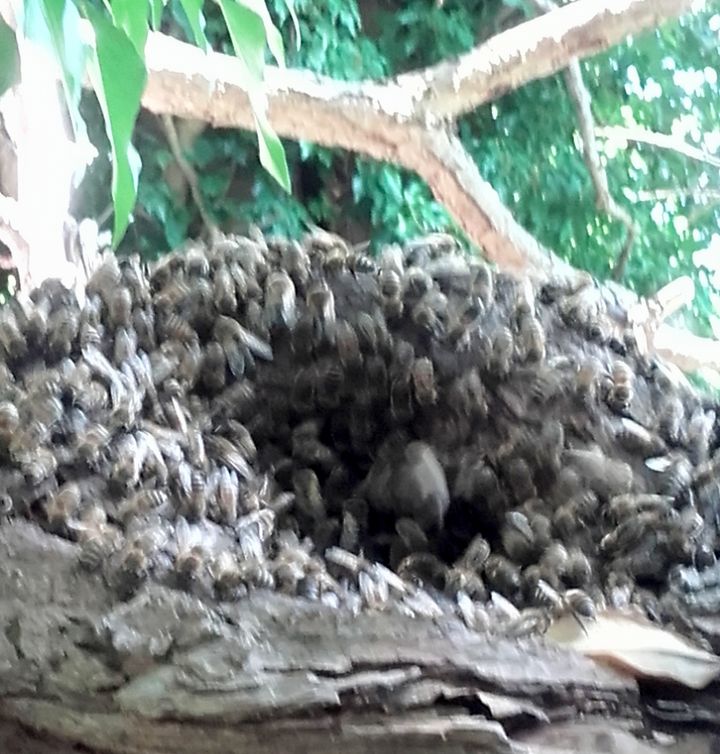
In the photo I've tried to show that there is a cluster of them encircling the entrance hole. Dozens are entering & leaving in the course of a minute, but the ones around the hole don't really move much at all - it's as though they are nibbling at the bark or something. I didn't see any doing what might be a 'waggle dance'. Some big lime trees in flower smelling lovely & they seem to be heading for them. If you know your bees would love an idea of what might be going on.
In the photo I've tried to show that there is a cluster of them encircling the entrance hole. Dozens are entering & leaving in the course of a minute, but the ones around the hole don't really move much at all - it's as though they are nibbling at the bark or something. I didn't see any doing what might be a 'waggle dance'. Some big lime trees in flower smelling lovely & they seem to be heading for them. If you know your bees would love an idea of what might be going on.
48k said:
They are guard bees. Typically 2-3 weeks old - so middle aged in bee terms. As the moniker suggests - their role is to patrol the entrance, fight off predators, and ID check any incoming forager bees to make sure they are allowed in.
"YOU AINT GETTIN IN IF YOU AINT ON THE LIST!" That's really interesting - thanks a lot for the replies. Pity I can't put up a video as they are whizzing in & out!
Couple of qns -
As it's been there for a few years would a new queen take over each spring?
Would a swarm or 2 would have left this base for new pastures?
Thanks again, Julian
Couple of qns -
As it's been there for a few years would a new queen take over each spring?
Would a swarm or 2 would have left this base for new pastures?
Thanks again, Julian
julianm said:
That's really interesting - thanks a lot for the replies. Pity I can't put up a video as they are whizzing in & out!
Couple of qns -
As it's been there for a few years would a new queen take over each spring?
Would a swarm or 2 would have left this base for new pastures?
Thanks again, Julian
The queen can live for several years so as long as she stays healthy it will be the same queen. Once she is too old to be useful, or becomes unhealthy, the worker bees kill her (basically they have a big pile on and huddle around her to raise her body temperature until she overheats and dies). When the queen dies she is removed and the worker bees will create a new queen. Couple of qns -
As it's been there for a few years would a new queen take over each spring?
Would a swarm or 2 would have left this base for new pastures?
Thanks again, Julian
If the queen decides the place is a bit too overcrowded she can leave and take a swarm of workers with her and establish a new nest. If that happens then again the workers will create a new queen.
I'm not an expert but I did a bee keeping course last year and am looking to get my own hive set up at home they are fascinating creatures. I know there are a few PHers with their own hives.
WrekinCrew said:
48k said:
WrekinCrew said:
Are wild honeybees evolving to cope with varroa?
Given that bees have been on planet Earth for over 100 million years, if I were to guess I'd say yes.Gassing Station | All Creatures Great & Small | Top of Page | What's New | My Stuff