
Hnd/degree calculator recommendations..
Discussion


When i attempted my beng i used a pretty basic Shape calculator from smiths. It as long as it has the common scientifc functions you will be ok.
The reason i used a sharp over the obvious casio was becasue the sharp allowed for direct input rather that working backwards for some functions.
ie. if you wanted the square root of something you pressed square root then the number, but on casios i found that you had to press the number and then the root button. It seems trival but when you compiling complex equations with lots of variables ease of use was very important
ps. it was the square root button btw, that was just an example
have i made sense?
edit - found it
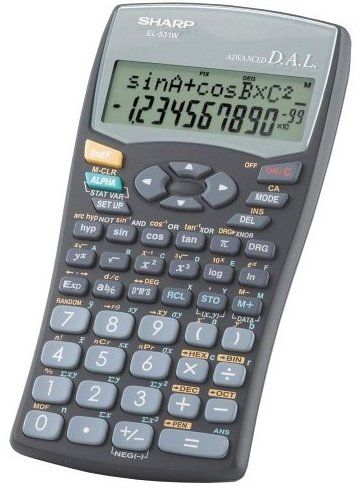
advanced D.a.l. made a lot to sense to me.
The reason i used a sharp over the obvious casio was becasue the sharp allowed for direct input rather that working backwards for some functions.
ie. if you wanted the square root of something you pressed square root then the number, but on casios i found that you had to press the number and then the root button. It seems trival but when you compiling complex equations with lots of variables ease of use was very important
ps. it was the square root button btw, that was just an example
have i made sense?
edit - found it
advanced D.a.l. made a lot to sense to me.
Edited by Lord Pikey on Thursday 19th November 14:12
 I've got one sat on my desk right now. Been using it for a few years now.
snotrag said:
Speaking as a recent Engineering/Design Graduate...
by far the most important thing is - to buy the same calculator that your tutor uses.
Seriously, do this.
Nah, where is the fun in that. Its great getting the 60 odd year old to jab the buttons on your shiney new cadget trying to replicate his circa 1984 casio by far the most important thing is - to buy the same calculator that your tutor uses.
Seriously, do this.

I got through my degree (Physics with Astrophysics) with just the basic Casio jobby I did my GCSEs with I actually preferred using a pen and paper to store interim results so I had more insight as to what I was actually doing. Personally I'd recommend starting with something cheap and seeing how you get on, and then if you want another one at least you've seen the other students' calculators in action to make a better decision. Obviously as a minimum you'll need Sin, Cos, Tan plus their inverses, X^n plus that's inverse, but I'd have thought most cheap scientific calculators do that these days? That's actually what I did, and just stuck with the cheap one in the end! Another consideration is ease of operation - some exams can be quite rushed and you don't need to be thinking about how to work your calculator or struggling in any way.
I actually preferred using a pen and paper to store interim results so I had more insight as to what I was actually doing. Personally I'd recommend starting with something cheap and seeing how you get on, and then if you want another one at least you've seen the other students' calculators in action to make a better decision. Obviously as a minimum you'll need Sin, Cos, Tan plus their inverses, X^n plus that's inverse, but I'd have thought most cheap scientific calculators do that these days? That's actually what I did, and just stuck with the cheap one in the end! Another consideration is ease of operation - some exams can be quite rushed and you don't need to be thinking about how to work your calculator or struggling in any way.I wasnt joking.
Imagine the scene - your in an maths/mechanics class.
Your tutor is at the front of 40 people, trying to teach them factorising or something.
For the clever kids who bought the same model/make calculator - you get a complete step by step walkthrough, and its easy to learn.
Everyone else sits there with their hand in the air, falling behind, has to wait after class while the tutor tries to work out how to get their calculator to work, gets stuck, gets stressed...
It wasnt an off the hook comment - I genuinely reccomend it, and Im very sure that when the persons tutors would too.
Imagine the scene - your in an maths/mechanics class.
Your tutor is at the front of 40 people, trying to teach them factorising or something.
For the clever kids who bought the same model/make calculator - you get a complete step by step walkthrough, and its easy to learn.
Everyone else sits there with their hand in the air, falling behind, has to wait after class while the tutor tries to work out how to get their calculator to work, gets stuck, gets stressed...
It wasnt an off the hook comment - I genuinely reccomend it, and Im very sure that when the persons tutors would too.
Given the above I should state that my comments were firmly from a Physics degree mindset. In Physics and Astrophysics calculators were not even mentioned, it's all algebra and then when you need an answer you bung the numbers in (on your own with no guidance). Obviously the OP's (and HellDiver's) degrees were taught in a different way (Engineering maybe?).
I totally agree, was just having a laugh.
I was a bit spoilt because there were only 10 or so in my degree class so we could stop the whole lesson to get clarity or jsut catch up
I admit it would of been a lot easier to have the same calculator but in my case id had a DAL sharp since GCSE so casios frstrated me
dxg said:
Check the regulations of the institution. It's a bit pointless to buy a fancy calculator, learn how to use it, and only then discover that you won't be allowed to take into an examination.
Yup you'll find that most exam boards and unis have a list of calculators they allow and the fanciest mosting signing dancing ones aren't on it.RobM77 said:
Given the above I should state that my comments were firmly from a Physics degree mindset. In Physics and Astrophysics calculators were not even mentioned, it's all algebra and then when you need an answer you bung the numbers in (on your own with no guidance). Obviously the OP's (and HellDiver's) degrees were taught in a different way (Engineering maybe?).
And most of the time the answers are multiples of pi anyway fleetelise said:
RobM77 said:
Given the above I should state that my comments were firmly from a Physics degree mindset. In Physics and Astrophysics calculators were not even mentioned, it's all algebra and then when you need an answer you bung the numbers in (on your own with no guidance). Obviously the OP's (and HellDiver's) degrees were taught in a different way (Engineering maybe?).
And most of the time the answers are multiples of pi anyway  Which is of course approximated to 3
 Gassing Station | The Lounge | Top of Page | What's New | My Stuff