
Cycle or walk the same route?
Discussion


If you are just an 'average Joe' and are not at any decent level of fitness:
Cycling would probably help to strengthen your cardiovascular and muscle fitness, if done at a reasonable pace.
Walking would not give the same CV gains, but would be more helpful in burning off some body fat.
It basically comes down to the rate at which your heart is working over the route.
Put simply, walking would probably see your heart rate at not much more than 50 or 60 percent of your maximum rate (which is roughly the figure of 220 minus your age). At this rate, your body will be burning mainly lipid stores for energy, along with a portion of your stored glycogen.
Cycling at a decent pace would firstly use glycogen for energy, which means you wouldn't burn much body fat at first, but you will be exercising your muscles and CV system, and hence get a little 'fitter' each time. Then you would probably find, assuming you're not a fitness freak, that after expending your stored glycogen energy, your body (at this heart rate) would then feel like you had 'hit a wall' and you would grind to a bit of a halt.
Have a Google round for how your body reacts to exercise under different conditions - there is plenty of advice available!
Cycling would probably help to strengthen your cardiovascular and muscle fitness, if done at a reasonable pace.
Walking would not give the same CV gains, but would be more helpful in burning off some body fat.
It basically comes down to the rate at which your heart is working over the route.
Put simply, walking would probably see your heart rate at not much more than 50 or 60 percent of your maximum rate (which is roughly the figure of 220 minus your age). At this rate, your body will be burning mainly lipid stores for energy, along with a portion of your stored glycogen.
Cycling at a decent pace would firstly use glycogen for energy, which means you wouldn't burn much body fat at first, but you will be exercising your muscles and CV system, and hence get a little 'fitter' each time. Then you would probably find, assuming you're not a fitness freak, that after expending your stored glycogen energy, your body (at this heart rate) would then feel like you had 'hit a wall' and you would grind to a bit of a halt.
Have a Google round for how your body reacts to exercise under different conditions - there is plenty of advice available!
Thanks for this.
I guess that the answer for me is probably to alternate.
I'm 59, Diabetic but generally pretty fit.
Recently bought a multi-gym too.
I would love to lose some more weight and generally improve my fitness levels and so can see the benefits of both cycling and walking - thanks.
I have to say that I feel better and fitter than I have done for a few years now but have always walked four or five times a week.
I guess that the answer for me is probably to alternate.
I'm 59, Diabetic but generally pretty fit.
Recently bought a multi-gym too.
I would love to lose some more weight and generally improve my fitness levels and so can see the benefits of both cycling and walking - thanks.
I have to say that I feel better and fitter than I have done for a few years now but have always walked four or five times a week.
Ray Luxury-Yacht said:
if done at a reasonable pace.
If the cycling was done at a reasonable pace you'd move at c.15 mph and complete the distance in 40 mins - it's only about here where the body's glycogen becomes depleted so consequently little fat burning would occur over this distance using a pushbike (approx 500 cals).Walking 10 miles at a reasonable pace would take a fair bit over two hours and as you're actually moving your bodyweight more overall effort would be required, and total calories used at the of the walk would be a fair bit more than cycling (approx 800 cals).
Running is the best bang for buck calorie wise: approx 1200 cals, done at about 8 minute mile pace. Roughly

Cycling.
Cycling will get your heart rate to around 130bpm, walking at about 100bpm. + 20-30bpm for both for hill climbs. At an average rate, walking will burn about 2.5 times more calories than cycling for the same journey, but cycling will get you there in about 1/4 of the time.
Depends how fast you walk or cycle though. Both will get you fit.
Cycling will get your heart rate to around 130bpm, walking at about 100bpm. + 20-30bpm for both for hill climbs. At an average rate, walking will burn about 2.5 times more calories than cycling for the same journey, but cycling will get you there in about 1/4 of the time.
Depends how fast you walk or cycle though. Both will get you fit.
goldblum said:
If the cycling was done at a reasonable pace you'd move at c.15 mph and complete the distance in 40 mins - it's only about here where the body's glycogen becomes depleted so consequently little fat burning would occur over this distance using a pushbike (approx 500 cals).
Walking 10 miles at a reasonable pace would take a fair bit over two hours and as you're actually moving your bodyweight more overall effort would be required, and total calories used at the of the walk would be a fair bit more than cycling (approx 800 cals).
Running is the best bang for buck calorie wise: approx 1200 cals, done at about 8 minute mile pace. Roughly
If he's doing 10 miles at 8min pm pace I dont think he's the sort to be asking about if he should walk somewhere Walking 10 miles at a reasonable pace would take a fair bit over two hours and as you're actually moving your bodyweight more overall effort would be required, and total calories used at the of the walk would be a fair bit more than cycling (approx 800 cals).
Running is the best bang for buck calorie wise: approx 1200 cals, done at about 8 minute mile pace. Roughly

goldblum said:
If the cycling was done at a reasonable pace you'd move at c.15 mph and complete the distance in 40 mins - it's only about here where the body's glycogen becomes depleted so consequently little fat burning would occur over this distance using a pushbike (approx 500 cals).
Are you seriously saying that 40mins (500kcals) of cycling won't assist with losing fat?Or are you being pedantic and saying that fat won't be 'burned' over that distance, but ignoring the energy expenditure required to replace the 'glycogen levels'?
swerni said:
I think he's a little confused.
Yep but I'm always amazed at the old wive's tales, the pseudo-science and the actual science (which 99% of the time has no relevance to the situation at hand) spouted by Gym Goer BSc (Bronze Swimming Certificate).Given enough time and if you followed all advice given, this thread would eventually have the OP on a 7 day split, drinking protein shakes twice a day, before doing some HIIT, swallowing stacked supplements and working on his Positive Mental Attitude.
Now any of those things may have some application in some situations but the reality here is that the OP is an older man with diabetes who wants to get a bit fitter and lose some weight.
Davel - the simple answer, which you already know, is eat less and move more. That will take care of the weight. If you want to get fitter for walking, cycling or anything else, do it repeatedly. If you want to get healthier, eat healthier. The most important thing is to do something. If you like it, you are more likely to stick at it.
IIRC cycling burns roughly 1/3rd of the calories per mile compared to walking/jogging at an equivalent level of effort. It burns more per hour because you travel faster but that's not relevant if you're only going to do 10 miles regardless of pace.
Personally I'd mix and match. Cycle some days, walk on others, perhaps take the long way round on the bike from time to time. No reason it has to be the same thing every day. That gets boring!
Personally I'd mix and match. Cycle some days, walk on others, perhaps take the long way round on the bike from time to time. No reason it has to be the same thing every day. That gets boring!
swerni said:
stevenjhepburn said:
goldblum said:
If the cycling was done at a reasonable pace you'd move at c.15 mph and complete the distance in 40 mins - it's only about here where the body's glycogen becomes depleted so consequently little fat burning would occur over this distance using a pushbike (approx 500 cals).
Are you seriously saying that 40mins (500kcals) of cycling won't assist with losing fat?Or are you being pedantic and saying that fat won't be 'burned' over that distance, but ignoring the energy expenditure required to replace the 'glycogen levels'?
Glycogen is the storage form of glucose and is stored in the liver and muscles. When there is little glycogen available or it becomes seriously depleted, which will occur in an average person after about 30/40 minutes of moderate intensity cardio, then the body will reach for its second energy source which is stored fat and muscle protein. This is fundamental energy system stuff, don't dig yourselves any deeper by disputing it, please.
BTW what gibberish is this?:
stevenjhepburn said:
...ignoring the energy expenditure required to replace the 'glycogen levels'?
Let me help you some more...
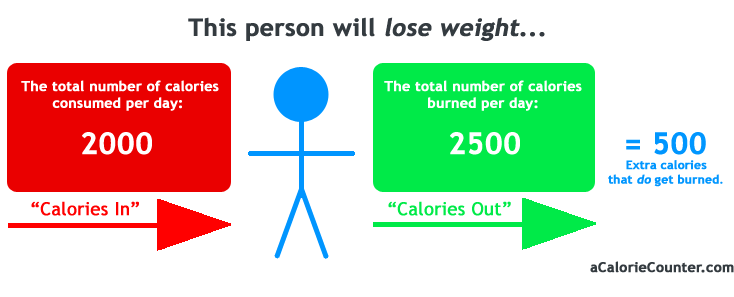
If the energy that goes in to the body is less than the energy that goes out of the body, fat will be lost - no matter which energy pathway is initially used for exercise. Hell, fat will be lost even if NO exercise is done. As long as there is a calorie deficit.
If the energy that goes in to the body is less than the energy that goes out of the body, fat will be lost - no matter which energy pathway is initially used for exercise. Hell, fat will be lost even if NO exercise is done. As long as there is a calorie deficit.
In conclusion you simply do not have to deplete glycogen before the body starts 'working on the fat'. Also the body does not use one pathway exclusively then "switch". Also "seriously depleted" glycogen is known as "hitting the wall". Average people do not 'hit the wall' after 40 minutes of moderate exercise.
Tiggsy said:
ewenm said:
Run it
This...and your walk can easily progress to this.Gassing Station | Health Matters | Top of Page | What's New | My Stuff