
Epco Trolley Jack - advice required
Discussion


Hello,
I have inherited a very substantial trolley jack from my wife's uncle; an Epco model 65. I'm guessing this is 50 odd years old, but very well made, suitable for commercial use. When I first tried it, it was working in all respects and would hold up a heavy load - except that it would only go to 60/70% of its full height. I assumed the seals must all be good and it just needed a top up of jack oil. As I was reluctant to add new oil to the old, I took out the three 'plugs' and turned it upside down to drain out the oil. I then refilled it with new oil and replaced the plugs. Unfortunately, it now doesn't work at all
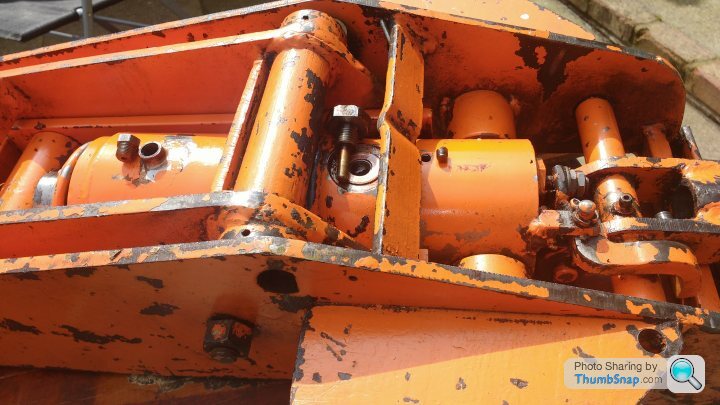
I would have sworn that nothing other than oil came out of it when I was draining it, but I guess it's possible that a small ball bearing or similar could have come out. I have attached a photo of the main cylinder of the jack showing the three holes and the their respective threaded plugs. I have been told that the left most one should be the filler (the plug is also drilled through to vent), and the large middle one is for access to the 'valve' - but I can't verify any of that. I have not been able to find any schematics of this jack on the interweb.
I really would like to get it working again - any advice will be appreciated.
I have inherited a very substantial trolley jack from my wife's uncle; an Epco model 65. I'm guessing this is 50 odd years old, but very well made, suitable for commercial use. When I first tried it, it was working in all respects and would hold up a heavy load - except that it would only go to 60/70% of its full height. I assumed the seals must all be good and it just needed a top up of jack oil. As I was reluctant to add new oil to the old, I took out the three 'plugs' and turned it upside down to drain out the oil. I then refilled it with new oil and replaced the plugs. Unfortunately, it now doesn't work at all
I would have sworn that nothing other than oil came out of it when I was draining it, but I guess it's possible that a small ball bearing or similar could have come out. I have attached a photo of the main cylinder of the jack showing the three holes and the their respective threaded plugs. I have been told that the left most one should be the filler (the plug is also drilled through to vent), and the large middle one is for access to the 'valve' - but I can't verify any of that. I have not been able to find any schematics of this jack on the interweb.
I really would like to get it working again - any advice will be appreciated.
ArthurH said:
If it were a bleeding issue, I think it would move, even with much less force than normal.
I don't think that's right. You've got two hydraulic cylinders and a pair of one-way valves in there. If you have air in the master cylinder or valves, it's not going to generate any pressure at all.Thanks again, It would be great if you are correct, as it would imply I have not lost any parts. I have experimented with all sorts of bleeding methods, pump handle valve open/ closed. Handle vertical/horizontal. Combinations of the plugs refitted or left out. Nothing I have tried has made any difference so far.
It's for a different model, but suggests that bleeding is straight forward:
http://www.classic-british-car-jacks.uk/Epco%20Jac...
I expect if it was that simple, the problem would have been resolved by now.
http://www.classic-british-car-jacks.uk/Epco%20Jac...
I expect if it was that simple, the problem would have been resolved by now.
Thanks again. I had been corresponding with the owner of that website, but these instructions hadn't come to light - perhaps I was being to specific about the model I have. The model in this user instruction leaflet does seem quite a bit simpler - specifically in having just the one removable filler/bleed plug which does reduce the combinations to try when bleeding. The bleeding instructions are similar to all the others I had found on the web and YouTube, but one thing I have just picked up on though is "...and the handle approximately horizontal...." I don't think I have tried that yet.
It would be great to find the actual Epco document for my model 65....
It would be great to find the actual Epco document for my model 65....
I`ve got an old Epco - best £20 of motoring money I ever spent!
There might be some tips here for you -
http://www.mig-welding.co.uk/forum/threads/hydraul...
http://www.mig-welding.co.uk/forum/threads/epco-tr...
Hopefully that might be some help for you - maybe contact the authors for some advice. Good luck!
There might be some tips here for you -
http://www.mig-welding.co.uk/forum/threads/hydraul...
http://www.mig-welding.co.uk/forum/threads/epco-tr...
Hopefully that might be some help for you - maybe contact the authors for some advice. Good luck!


The Jack is now working again! I just wanted to bring the thread to a conclusion for the benefit of anyone else and to thank all those that helped.
Although Simon Petch at https://www.commercialsupplies.co.uk wasn't able to help with the fault diagnosis, he did point me towards Alan at "The Doreth Engineering co ltd". I sent Alan the same photo as the top of this thread - he was able to talk me through the purpose of the three plugs - and concluded that I had indeed accidently flushed out the two ball bearings that form part of the valving while draining the old oil. Fortunately, I did so into an oil drain tray and having carefully filtered through the sludge, was able to find, clean, and refit them. The bleeding process was typical for a trolley jack (pumping the handle through the lowest part of its arc while the release valve was open), but the jack was already working from the first pump.
Alan has a wealth of knowledge on these old jacks - an extremely helpful person.
Although Simon Petch at https://www.commercialsupplies.co.uk wasn't able to help with the fault diagnosis, he did point me towards Alan at "The Doreth Engineering co ltd". I sent Alan the same photo as the top of this thread - he was able to talk me through the purpose of the three plugs - and concluded that I had indeed accidently flushed out the two ball bearings that form part of the valving while draining the old oil. Fortunately, I did so into an oil drain tray and having carefully filtered through the sludge, was able to find, clean, and refit them. The bleeding process was typical for a trolley jack (pumping the handle through the lowest part of its arc while the release valve was open), but the jack was already working from the first pump.
Alan has a wealth of knowledge on these old jacks - an extremely helpful person.
Hi ArtherH,
Thank you for posting this thread about your EPCO no 65 jack.
I have an EPCO no 65 which was given to me some years ago in a very sorry state.
I also tipped the jack upside down and the balls rolled out but I was able to catch them before they disappeared.
However in my case the balls were of different sizes, I think that the small one goes in first, followed by the larger one, please can you confirm that this is correct ?
The previous owner of this jack left it outside in all weathers for years and used it occasionally so eventually the wheels seized up and wore away the bottom side. Now, the small wheels which castor have worn so much that I don't know how big they are supposed to be, is there any chance that you could measure the diameter of these wheels for me please ?
I intend to turn up some new wheels from steel stock to fix this problem.
Thank you for any help that you can give me.
Best Regards,
Ian.
Thank you for posting this thread about your EPCO no 65 jack.
I have an EPCO no 65 which was given to me some years ago in a very sorry state.
I also tipped the jack upside down and the balls rolled out but I was able to catch them before they disappeared.
However in my case the balls were of different sizes, I think that the small one goes in first, followed by the larger one, please can you confirm that this is correct ?
The previous owner of this jack left it outside in all weathers for years and used it occasionally so eventually the wheels seized up and wore away the bottom side. Now, the small wheels which castor have worn so much that I don't know how big they are supposed to be, is there any chance that you could measure the diameter of these wheels for me please ?
I intend to turn up some new wheels from steel stock to fix this problem.
Thank you for any help that you can give me.
Best Regards,
Ian.
Hi, yes, and I'm pleased to be able to help here having had such good advice from this forum.
The first/lower ball bearing is 3/16" diameter, the second/upper ball is 3/8"
I will measure the diameter of the castor wheels when I get home this evening, I could take more photos if that were to help
The first/lower ball bearing is 3/16" diameter, the second/upper ball is 3/8"
I will measure the diameter of the castor wheels when I get home this evening, I could take more photos if that were to help
Gassing Station | Home Mechanics | Top of Page | What's New | My Stuff