
1999 VW Golf Mk4 1.6 Oil Fill moisture/build up
Discussion


Hi.
I bought a Mk 4 Golf and have found milky sludge on the oil cap and in the reservoir. It doesn't seem to lose any coolant and the dipstick looks fine. I have read many things about short trips causing condensation etc.
I cleaned off the filler cap and inside the reservoir before giving it an oil and filter change. I also used an engine flush. I took it for a drive, and checked the cap a few days later, and the sludge reappeared. I cleaned it again and checked, and it's still coming back. It has been very cold recently. The engine doesn't seem to want to get about 80 degrees at the moment. Could this be a factor? I cleaned it again this morning, checked the cap, and found water droplets on the cap. The water that had collected looked very clean. It didn't have a tinge or a smell to it. Could a faulty thermostat or coolant sensor stop it from getting hot enough to evaporate it?
The articles I've read have not gone into as much detail about just after an oil change, or how quickly it can appear.
I hope someone can shed some light to help put my mind at rest! Or maybe some tests I can perform to find out (or eliminate) a blown head gasket!
Thanks very much.
 (same principal as driving in 4th)
thedtjs said:
Hi.
Thanks for the reply. It's an auto so I'm unable to keep it in a lower gear. I'll take it for a good run tonight and see what happens.
Cheers.
You should be able to move the shifter from "D" to "3" and that will keep it in 3rd gear - it won't change automatically then.Thanks for the reply. It's an auto so I'm unable to keep it in a lower gear. I'll take it for a good run tonight and see what happens.
Cheers.
Just in the same way you can drive it like a manual, put it in "1" and pull away and then push the shifter to "2" and so on.
The above assumes your gearshift looks like this:

If you aren't losing any coolant you don't have hgf - or at least not one involving coolant.
Mayo in the filler cap is not the surefire indicator that you have hgf & I wonder how many have paid for unnecessary work having been told it is.
Burning a gallon of petrol/diesel produces amongst other things a large quantity of water.
Some of this will condense inside a cold engine, more will condense inside the exhaust - the liquid you see dripping from the tailpipe - & the rest will be visible as steam out of the exhaust.
More common in cold weather & on cars used for short journeys as they don't get hot enough to boil it off.
Also the reason why cars used for short trips go through exhausts quicker than those used for distance - they rot out from inside.
If the car takes a long time to warm up & stays cool then it is possible that either your thermostat has failed in the open position OR has been removed to hide an overheating issue.
Identify the location of your stat - often at or near the location of the top hose from the engine to the radiator. Start the car from cold & as it warms up the hose should stay cold/cool & suddenly get hot as the stat opens. If it warms up gradually in line withe the rest of the engine it's either defective or missing.
Edited by paintman on Sunday 3rd February 22:57
Tony1963 said:
OP,
Once the temp gauge indicates 80, does it stay there, or does it tend to rise and fall depending on engine load? For example, an 85mph blat (on that private runway) might cause the temp to rise to an indicated 90.
The temperature guage moves a fair bit. At idle it shows 90 and will move to around 70-80 once driving. I took it out for an hour last night and it didn't hit 90 the whole time I was out, only when I had stopped and let it idle for a couple of minutes.Once the temp gauge indicates 80, does it stay there, or does it tend to rise and fall depending on engine load? For example, an 85mph blat (on that private runway) might cause the temp to rise to an indicated 90.
I'll replace the thermostat and see what happens.
paintman said:
If you aren't losing any coolant you don't have hgf - or at least not one involving coolant.
Mayo in the filler cap is not the surefire indicator that you have hgf & I wonder how many have paid for unnecessary work having been told it is.
Burning a gallon of petrol/diesel produces amongst other things a large quantity of water.
Some of this will condense inside a cold engine, more will condense inside the exhaust - the liquid you see dripping from the tailpipe - & the rest will be visible as steam out of the exhaust.
More common in cold weather & on cars used for short journeys as they don't get hot enough to boil it off.
Also the reason why cars used for short trips go through exhausts quicker than those used for distance - they rot out from inside.
If the car takes a long time to warm up & stays cool then it is possible that either your thermostat has failed in the open position OR has been removed to hide an overheating issue.
Identify the location of your stat - often at or near the location of the top hose from the engine to the radiator. Start the car from cold & as it warms up the hose should stay cold/cool & suddenly get hot as the stat opens. If it warms up gradually in line withe the rest of the engine it's either defective or missing.
Thanks for this. I will check the stat after work.Mayo in the filler cap is not the surefire indicator that you have hgf & I wonder how many have paid for unnecessary work having been told it is.
Burning a gallon of petrol/diesel produces amongst other things a large quantity of water.
Some of this will condense inside a cold engine, more will condense inside the exhaust - the liquid you see dripping from the tailpipe - & the rest will be visible as steam out of the exhaust.
More common in cold weather & on cars used for short journeys as they don't get hot enough to boil it off.
Also the reason why cars used for short trips go through exhausts quicker than those used for distance - they rot out from inside.
If the car takes a long time to warm up & stays cool then it is possible that either your thermostat has failed in the open position OR has been removed to hide an overheating issue.
Identify the location of your stat - often at or near the location of the top hose from the engine to the radiator. Start the car from cold & as it warms up the hose should stay cold/cool & suddenly get hot as the stat opens. If it warms up gradually in line withe the rest of the engine it's either defective or missing.
Edited by paintman on Sunday 3rd February 22:57
TonyRPH said:
thedtjs said:
Hi.
Thanks for the reply. It's an auto so I'm unable to keep it in a lower gear. I'll take it for a good run tonight and see what happens.
Cheers.
You should be able to move the shifter from "D" to "3" and that will keep it in 3rd gear - it won't change automatically then.Thanks for the reply. It's an auto so I'm unable to keep it in a lower gear. I'll take it for a good run tonight and see what happens.
Cheers.
Just in the same way you can drive it like a manual, put it in "1" and pull away and then push the shifter to "2" and so on.
The above assumes your gearshift looks like this:

I seem to recall the 1.6's, think it was the 8v, having quite a long filler neck, in which case condensation in the relatively cool filler neck would be quite normal.
Can you post a pic up of the rocker cover / filler neck?
But as others have said, this time of year and short trips where the engine doesn't get hot will exacerbate the issue.
Can you post a pic up of the rocker cover / filler neck?
But as others have said, this time of year and short trips where the engine doesn't get hot will exacerbate the issue.
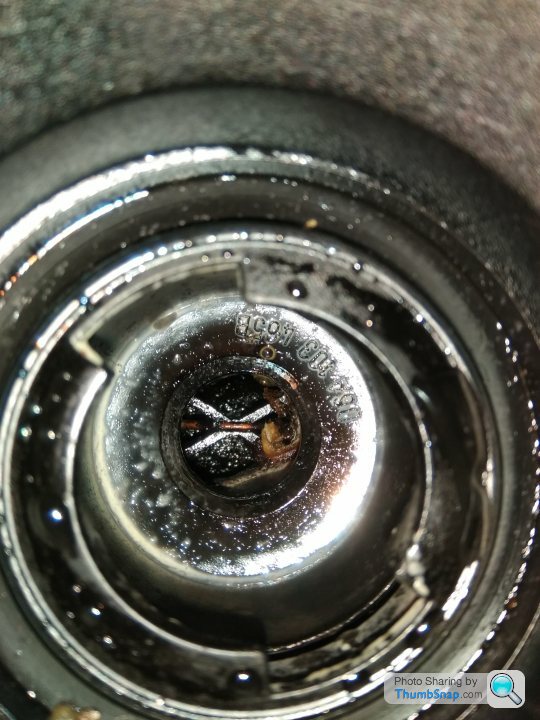
The second picture is inside the filler neck itself. I've just been out. Car actually got to 90 this time. I parked up, checked the cap, and steam was coming out from the oil fill. Checked the cap about 10 minutes later, and most of the white stuff has gone. Just a few water droplets. It's been warmer today so looks like it's solved!
I've posted a picture of the cap. Went to take a picture of inside the neck and the flash broke on my phone. Typical!

I've posted a picture of the cap. Went to take a picture of inside the neck and the flash broke on my phone. Typical!
As others have said, you can pretty well ignore signs of moisture in the oil because it's perfectly normal. If you suspect that you might have HGF into a coolant passage, look in the coolant filler cap after the engine has cooled down. Oil or combustion gasses in the coolant will be immediately obvious as scum or muck in the coolant and are positive proof that there is a problem. (The problem might not be HGF but that is an obvious candidate.)
FYI.
Bear with me while I explain.
When fitting an oil cooler it is always recommended that a thermostat be fitted inline, this is for the following reasons:
Water condenses inside an engine as a product of combustion as previously explained.
This water will start to evaporate off at around 80 degrees C, can you see where I am headed now?
The thermostat in your engine cooling system will be set to fully open somewhere above 80 degrees C for this reason also.
Until your car has been above this temperature for a sustained period of time you will have this issue.
It sounds like your thermostat is goosed/removed and you need to get that sorted & use the car more effectively.
As an aside, I bought an e36 328 some years ago that had been stood for a year & the owner had religiously started it for 10 min every week & the cap was FULL of mayonnaise. I bought the car taking a risk but was vindicated in the end as by the time I had driven the car the 200 miles home it was fully clear.
Gassing Station | Home Mechanics | Top of Page | What's New | My Stuff