
Timing belt tensioner gauge
Discussion


Does anyone recognise this timing belt tensioning gauge? I believe it was for for Ford CVH models but maybe others.
I'm after information in setting up and using as well as what the guage increments mean?
Thanks for your help.
Regards
Steve

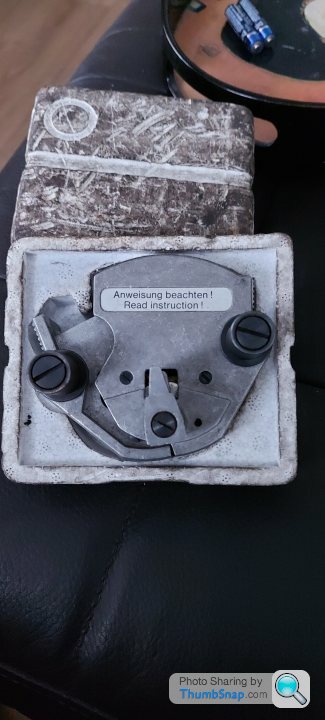
I'm after information in setting up and using as well as what the guage increments mean?
Thanks for your help.
Regards
Steve
Edited by binsie2003 on Sunday 1st November 15:52
Edited by binsie2003 on Sunday 1st November 15:55
Edited by binsie2003 on Sunday 1st November 15:56
I have been a mechanic for 45 years and never used a timing belt tension gauge. The majority of modern timing belt set ups are either automatic tensioners or a pointer system on the tensioner for correct tension. In the era of CVH engines if you could get 90 degrees twist on the belt after tightening the tension was fine.
Zulu 10 said:
With all due respect to the last two posters, having come from the aviation industry I’m sceptical of anyone who claims to be able to do any job without the tools specified by the design authority...
I suspect a bit more experience working on cars would change your mind. Sometimes you absolutely need a manufacturers special tool to do a job, but very often there are other ways to achieve the goal.Zulu 10 said:
I’ve got a Burroughs tensioning tool for the Lotus 907 series engines, but I find it far more accurate and repeatable to set tension using a spectrum analyser application on a mobile phone – you simply ‘twang’ the belt to measure its natural frequency.
With all due respect to the last two posters, having come from the aviation industry I’m sceptical of anyone who claims to be able to do any job without the tools specified by the design authority...
Interesting.With all due respect to the last two posters, having come from the aviation industry I’m sceptical of anyone who claims to be able to do any job without the tools specified by the design authority...
You are sceptical of anybody not using the tools specified, but are happy to use an app on a mobile phone?
Zulu 10 said:
I absolutely agree that there are often other ways to achieve the goal, hence my use of spectrum analysis to achieve the correct tension.
But a claim to be able to correctly tension belts by feel, is just like those who claim to be able to set torque by feel, and is simply laziness, which in a professional organisation would be a disciplinary matter.
There's a reason why there are torque measuring gauges in the walkway between the tool stores and most hangars.
you don't do most by feel you don't even have to set the tension on a lol these daysBut a claim to be able to correctly tension belts by feel, is just like those who claim to be able to set torque by feel, and is simply laziness, which in a professional organisation would be a disciplinary matter.
There's a reason why there are torque measuring gauges in the walkway between the tool stores and most hangars.
Zulu 10 said:
LimSlip said:
.....Patronising stuff..... Sometimes you absolutely need a manufacturers special tool to do a job, but very often there are other ways to achieve the goal.
I absolutely agree that there are often other ways to achieve the goal, hence my use of spectrum analysis to achieve the correct tension. But a claim to be able to correctly tension belts by feel, is just like those who claim to be able to set torque by feel, and is simply laziness, which in a professional organisation would be a disciplinary matter.
There's a reason why there are torque measuring gauges in the walkway between the tool stores and most hangars.
There're plenty of them in the aviation industry too. They just refuse to be accept that there could be something they don't know. The number of times I've made someone take something apart (because they were too experienced to ask/wait for a stage check) and found it to be wrong is ludicrous.
Zulu 10 said:
I absolutely agree that there are often other ways to achieve the goal, hence my use of spectrum analysis to achieve the correct tension.
But a claim to be able to correctly tension belts by feel, is just like those who claim to be able to set torque by feel, and is simply laziness, which in a professional organisation would be a disciplinary matter.
There's a reason why there are torque measuring gauges in the walkway between the tool stores and most hangars.
Apologies if that came across as patronising, it wasn't my intention. Aircraft are not cars, and it doesn't seem like you have professional experience on the latter. With aircraft you go by the book or likely get kicked out, and for good reason. But a claim to be able to correctly tension belts by feel, is just like those who claim to be able to set torque by feel, and is simply laziness, which in a professional organisation would be a disciplinary matter.
There's a reason why there are torque measuring gauges in the walkway between the tool stores and most hangars.
With sufficient experience you can absolutely torque non-critical fasteners by hand, the fact that millions of cars are not falling to pieces on a regular basis shows this, since I have yet to see a garage break out a torque wrench to reattach e.g. a horn bracket or a piece of trim. The same experience also means you know when a torque wrench is actually required, e.g. on critical fasteners within the engine.
In the real world when you are working on some rusty old banger with corroded fasteners a torque wrench doesn't do you a lot of good even if you felt compelled to use it. Unlike aircraft maintenance where fasteners are regularly replaced due to life or corrosion damage, the majority of fasteners on a car get reused unless new ones are supplied with a replacement part.
Zulu 10 said:
Have you looked at this page:
http://workshop-manuals.com/ford/fiesta_1996_08.19... ?
It describes how to use the gauge on a CVH engine, and on the same website there are manuals for many other Ford vehicles, so you should be able to see other applications for the tool.
There’s a diagram here https://ustroistvo-avtomobilya.ru/dvigatel/izmeren... (albeit the words are in Russian so put it through a translator), showing a comparison between other tools, but you’ll find that the calibration is generally in the manufacturer’s abstract units, rather than SI units.
I’ve got a Burroughs tensioning tool for the Lotus 907 series engines, but I find it far more accurate and repeatable to set tension using a spectrum analyser application on a mobile phone – you simply ‘twang’ the belt to measure its natural frequency.
With all due respect to the last two posters, having come from the aviation industry I’m sceptical of anyone who claims to be able to do any job without the tools specified by the design authority...
I have a 907 in a 7 and I used the twist longest run 90deg between thumb and fingers method.http://workshop-manuals.com/ford/fiesta_1996_08.19... ?
It describes how to use the gauge on a CVH engine, and on the same website there are manuals for many other Ford vehicles, so you should be able to see other applications for the tool.
There’s a diagram here https://ustroistvo-avtomobilya.ru/dvigatel/izmeren... (albeit the words are in Russian so put it through a translator), showing a comparison between other tools, but you’ll find that the calibration is generally in the manufacturer’s abstract units, rather than SI units.
I’ve got a Burroughs tensioning tool for the Lotus 907 series engines, but I find it far more accurate and repeatable to set tension using a spectrum analyser application on a mobile phone – you simply ‘twang’ the belt to measure its natural frequency.
With all due respect to the last two posters, having come from the aviation industry I’m sceptical of anyone who claims to be able to do any job without the tools specified by the design authority...
It's worked for me.
Evoluzione said:
The twist method is idiotic. It relies on every human having the same strength and for every single one to be able to apply exactly the same amount of twisting force to a belt.
This is never going to happen.
I also use the same common sense/experience approach to virtually every nut & bolt I tighten.This is never going to happen.
You can't reach for a torque wrench every time nut meets bolt.
Modern twin cam engines run with the belts so tensioned that you can barely move them far less twist them. Belt technology has improved so much that they hardly ever break nowadays, failure is ussually down to a collapsed pulley bearing due to the tension forces.
In the era of CVH engines where this thread started belts werent nearly so highly tensioned and a 90 degree twist was the standard the majority of mechanics used.
In the era of CVH engines where this thread started belts werent nearly so highly tensioned and a 90 degree twist was the standard the majority of mechanics used.
imagineifyeswill said:
Modern twin cam engines run with the belts so tensioned that you can barely move them far less twist them. Belt technology has improved so much that they hardly ever break nowadays, failure is ussually down to a collapsed pulley bearing due to the tension forces.
In the era of CVH engines where this thread started belts werent nearly so highly tensioned and a 90 degree twist was the standard the majority of mechanics used.
Exactly this. back in the days of the (80's) cvh (vauxhall used the water pump as the tensioner), then a twist of the belt to check was adequate.In the era of CVH engines where this thread started belts werent nearly so highly tensioned and a 90 degree twist was the standard the majority of mechanics used.
Can't think of a modern car where you can even use a gauge to test.
And they are so tightly fitted its is often a struggle to get the belt onto all the pulleys, let alone check its tension, which most of the time are automatic adjust anyway.
But it is the pulleys and tensioners that usually cause any issues, very rare it is the belt that fails.
rustednut said:
imagineifyeswill said:
Modern twin cam engines run with the belts so tensioned that you can barely move them far less twist them. Belt technology has improved so much that they hardly ever break nowadays, failure is ussually down to a collapsed pulley bearing due to the tension forces.
In the era of CVH engines where this thread started belts werent nearly so highly tensioned and a 90 degree twist was the standard the majority of mechanics used.
Exactly this. back in the days of the (80's) cvh (vauxhall used the water pump as the tensioner), then a twist of the belt to check was adequate.In the era of CVH engines where this thread started belts werent nearly so highly tensioned and a 90 degree twist was the standard the majority of mechanics used.
Can't think of a modern car where you can even use a gauge to test.
And they are so tightly fitted its is often a struggle to get the belt onto all the pulleys, let alone check its tension, which most of the time are automatic adjust anyway.
But it is the pulleys and tensioners that usually cause any issues, very rare it is the belt that fails.
Gassing Station | Home Mechanics | Top of Page | What's New | My Stuff