
Multimeter, what am I doing wrong?
Discussion


My 2000MY Jeep is discharging it’s battery. Sometimes over night, sometimes after a week. The battery is a brand new Yuasa to slightly above OEM specs.
I suspect that a relay is stuck open somewhere. To diagnose this I planned on checking the amp / milli amp readings across the fuses one by one until I find one still forming an open circuit, then using a wiring diagram, check to see which relay is linking to that fuse and what the relay does / powers.
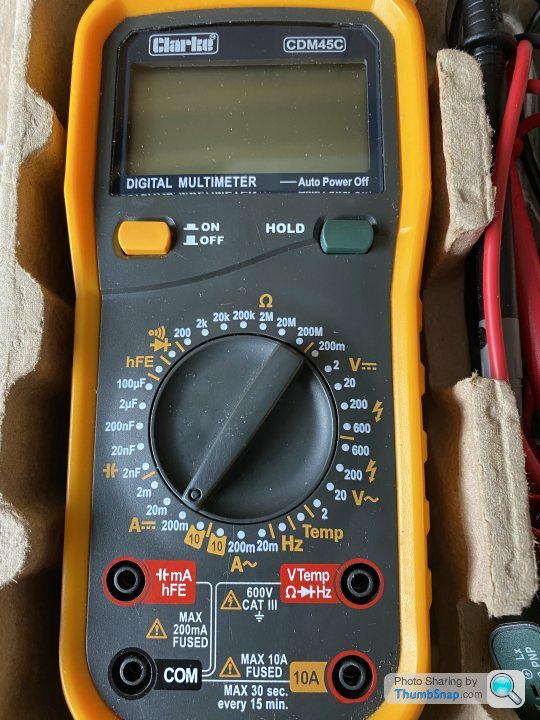
I’ve tried multiple settings on my multimeter and the only reading I get is -1, regardless of whether the multimeter is attached to anything or not.
Admittedly I’m really crap with electrics. Could someone with a bit more brain power than I possibly advise on whether my diagnosis plan is the correct one, and what setting I should have the multimeter at please.
I’ll include a picture of my multimeter for your convenience.
Edited to add; the vehicle doesn’t appear to have any aftermarket electrical systems fitted, not even an aftermarket stereo.
Many thanks in advance
I suspect that a relay is stuck open somewhere. To diagnose this I planned on checking the amp / milli amp readings across the fuses one by one until I find one still forming an open circuit, then using a wiring diagram, check to see which relay is linking to that fuse and what the relay does / powers.
I’ve tried multiple settings on my multimeter and the only reading I get is -1, regardless of whether the multimeter is attached to anything or not.
Admittedly I’m really crap with electrics. Could someone with a bit more brain power than I possibly advise on whether my diagnosis plan is the correct one, and what setting I should have the multimeter at please.
I’ll include a picture of my multimeter for your convenience.
Edited to add; the vehicle doesn’t appear to have any aftermarket electrical systems fitted, not even an aftermarket stereo.
Many thanks in advance
Edited by 105.4 on Wednesday 27th January 12:58
I'm not sure about this so maybe wait until somebody who knows what they're on about comes along, but...
I think the only thing you can measure *across* the fuse is its resistance. To measure current you'd have to put one probe on a fuse terminal, and the other probe to earth - bodywork, engine block etc.
I think. Happy to be corrected and educated.
I think the only thing you can measure *across* the fuse is its resistance. To measure current you'd have to put one probe on a fuse terminal, and the other probe to earth - bodywork, engine block etc.
I think. Happy to be corrected and educated.
If you have a battery drain the easiest thing to do would be to measure drain across the battery and simply pull fuses until the drain stops.
https://testmeterpro.com/parasitic-draw-test-with-...
https://testmeterpro.com/parasitic-draw-test-with-...
underwhelmist said:
I'm not sure about this so maybe wait until somebody who knows what they're on about comes along, but...
I think the only thing you can measure *across* the fuse is its resistance. To measure current you'd have to put one probe on a fuse terminal, and the other probe to earth - bodywork, engine block etc.
I think. Happy to be corrected and educated.
Please don’t do that. You’ll blow the fuse in the multimeter or the meter itself! I think the only thing you can measure *across* the fuse is its resistance. To measure current you'd have to put one probe on a fuse terminal, and the other probe to earth - bodywork, engine block etc.
I think. Happy to be corrected and educated.
The meter should go across the fuse terminals with the fuse removed and set to measure current . Not between the fuse and earth.
Because some consumers take a while to fully shut down this test is pretty meaningless unless you know what the fuse feeds, and what the current should be when shut down and how long that will take.
320d is all you need said:
If you have a battery drain the easiest thing to do would be to measure drain across the battery and simply pull fuses until the drain stops.
https://testmeterpro.com/parasitic-draw-test-with-...
Good idea, but one small, (probably stupid) question. https://testmeterpro.com/parasitic-draw-test-with-...
If I need to find something that is drawing milliamperes of current from the battery, would a cheap multimeter be sensitive enough to measure that current draw from the battery itself as opposed to directly from the electrical circuit?
Your idea is a good one, and certainly worth giving a go. Many thanks for the link

LordLoveLength said:
Please don’t do that. You’ll blow the fuse in the multimeter or the meter itself!
The meter should go across the fuse terminals with the fuse removed and set to measure current . Not between the fuse and earth.
Because some consumers take a while to fully shut down this test is pretty meaningless unless you know what the fuse feeds, and what the current should be when shut down and how long that will take.
All good points. The meter should go across the fuse terminals with the fuse removed and set to measure current . Not between the fuse and earth.
Because some consumers take a while to fully shut down this test is pretty meaningless unless you know what the fuse feeds, and what the current should be when shut down and how long that will take.
The interior light circuit will definitely still be ‘live’ as there is an under bonnet light. As for the amount of time other ECMs take to power-down, I don’t know. But with the vehicle being 21 years old, I’d guess that the electrical systems on it are reasonably basic?
What would you guess a power-down time is, 20 to 30 minutes?
Edited to add:
Should the current read ZERO once various ECMs have shut down? I’d be looking for any with a positive reading to point in the direction of a stuck relay?
Thinking about this some more, I have a Laser relay tester that I bought about 15 years ago and never used. It might just be easier to pull the easy to reach relays one-by-one and run them through the relay tester?
Edited by 105.4 on Wednesday 27th January 12:57
The meter needs to be in series (ie part of the circuit) to measure current.

Picture taken from this site which seems very useful to describe all things multimeters and testing.
https://dengarden.com/home-improvement/Using-a-Mul...
Picture taken from this site which seems very useful to describe all things multimeters and testing.
https://dengarden.com/home-improvement/Using-a-Mul...
105.4 said:
320d is all you need said:
If you have a battery drain the easiest thing to do would be to measure drain across the battery and simply pull fuses until the drain stops.
https://testmeterpro.com/parasitic-draw-test-with-...
Good idea, but one small, (probably stupid) question. https://testmeterpro.com/parasitic-draw-test-with-...
If I need to find something that is drawing milliamperes of current from the battery, would a cheap multimeter be sensitive enough to measure that current draw from the battery itself as opposed to directly from the electrical circuit?
Your idea is a good one, and certainly worth giving a go. Many thanks for the link
If you are getting mA level of draw you don't need to worry!
If you have a draw which is draining your battery in a few days it will be a 0.X Amp or even a 1+amp draw.
320d is all you need said:
No problem.
If you are getting mA level of draw you don't need to worry!
If you have a draw which is draining your battery in a few days it will be a 0.X Amp or even a 1+amp draw.
Well, this is where things get further complicated.If you are getting mA level of draw you don't need to worry!
If you have a draw which is draining your battery in a few days it will be a 0.X Amp or even a 1+amp draw.
The battery is brand new, a couple of weeks old.
Sometimes the battery can drain from fully charged to flat over night. Other times it can take five days and the weather / nightly temperatures have been pretty constant over the past few weeks.
It’s frying my noggin as to how an electrical fault like this could be so variable in terms of the current it’s sucking from the battery.
105.4 said:
LordLoveLength said:
Please don’t do that. You’ll blow the fuse in the multimeter or the meter itself!
The meter should go across the fuse terminals with the fuse removed and set to measure current . Not between the fuse and earth.
Because some consumers take a while to fully shut down this test is pretty meaningless unless you know what the fuse feeds, and what the current should be when shut down and how long that will take.
All good points. The meter should go across the fuse terminals with the fuse removed and set to measure current . Not between the fuse and earth.
Because some consumers take a while to fully shut down this test is pretty meaningless unless you know what the fuse feeds, and what the current should be when shut down and how long that will take.
The interior light circuit will definitely still be ‘live’ as there is an under bonnet light. As for the amount of time other ECMs take to power-down, I don’t know. But with the vehicle being 21 years old, I’d guess that the electrical systems on it are reasonably basic?
What would you guess a power-down time is, 20 to 30 minutes?
Edited to add:
Should the current read ZERO once various ECMs have shut down? I’d be looking for any with a positive reading to point in the direction of a stuck relay?
Thinking about this some more, I have a Laser relay tester that I bought about 15 years ago and never used. It might just be easier to pull the easy to reach relays one-by-one and run them through the relay tester?
Edited by 105.4 on Wednesday 27th January 12:57
Have you checked for loom damage? Boot light? Wiring damage as loom enters tailgate and doors?
Easy to check and eliminate.
Could be a faulty alternator. It’s possible to have a unit that will drain the battery when stopped whilst still capable of charging. Is there an easy to remove plug to eliminate this?
Any water ingress? Cabin, boot etc? Could be a waterlogged module.
Finding a random drain in a module can take ages - try to eliminate as many bits as you can by eye.
Measuring current with a multimeter isn't as easy as measuring resistance or voltage. If you put the multimeter in series with your circuit then the amount of current passing will be impacted by the internal resistance of the multimeter itself.
https://www.electronics-notes.com/articles/test-methods/meters/how-to-measure-current.php said:
For measurements of around an amp, the resistance of a meter should be much less than an ohm. For example if a meter had a resistance of one ohm, and a current of one amp was flowing, then it would develop a voltage of one volt across it. For most measurements this would be unacceptably high. Therefore resistances of meters used to measure current are normally very low.
Your multimeter might have some specs detailing its internal resistance. Worth noting.Buzz84 said:
This.Also note that you will need the leads plugged into the correct sockets on the multimeter and the dial in the correct place:
- One in 'COM'
- One in '10A' (at least to start with)
- Turn the dial to the 10A DC position.
LordLoveLength said:
I have no idea how long it takes to shutdown- varies by model but can be 30mins or more. Some cars will drop consumers after a couple of days of non use. You won’t have zero current though - alarm and central locking receiver at least.
Have you checked for loom damage? Boot light? Wiring damage as loom enters tailgate and doors?
Easy to check and eliminate.
Could be a faulty alternator. It’s possible to have a unit that will drain the battery when stopped whilst still capable of charging. Is there an easy to remove plug to eliminate this?
Any water ingress? Cabin, boot etc? Could be a waterlogged module.
Finding a random drain in a module can take ages - try to eliminate as many bits as you can by eye.
LordLoveLength, (as awesome a username as any I’ve ever come across), all fantastic points.Have you checked for loom damage? Boot light? Wiring damage as loom enters tailgate and doors?
Easy to check and eliminate.
Could be a faulty alternator. It’s possible to have a unit that will drain the battery when stopped whilst still capable of charging. Is there an easy to remove plug to eliminate this?
Any water ingress? Cabin, boot etc? Could be a waterlogged module.
Finding a random drain in a module can take ages - try to eliminate as many bits as you can by eye.
As a short answer, I was trying to find a short-cut to solving this problem.
Since you posted your detailed advice I’ve had an auto-electrical mate pop round for a quick look. I’m drawing 1.762 amps at my battery negative lead, and 0.25 amps on the alternator lead with the engine switched off. My alarm is constantly going off once the battery is connected, and even continues to go off at a reduced decibel level with the battery and the bonnet switch disconnected.
We’ve drawn up a plan of replacing the central locking actuators, (two of which have failed anyway), disabling the alarm system, fixing the in-op tailgate and taking things from there. I’ll also work through the list you kindly drew up in your post.
As an aside, my 2 year old Clarke’s multimeter is scrap. We’ve changed the battery but it’s still either giving no readings at all, or throwing up random and inaccurate readings. Any recommendations for decent and accurate multimeters at under £150?
the cueball said:
start with fuse number 7 just pull it out and see if that stops the drain. 
Common cause of a parasitic drain on Jeeps.
You might just get lucky and save yourself a load of time.
Is that the fuse box under the bonnet or the fuse box by the passenger footwell? Both have fuse no:7’s.Common cause of a parasitic drain on Jeeps.
You might just get lucky and save yourself a load of time.
Edited by the cueball on Wednesday 27th January 14:28
https://fuse-box.info/jeep/jeep-grand-cherokee-wj-...
105.4 said:
LordLoveLength said:
I have no idea how long it takes to shutdown- varies by model but can be 30mins or more. Some cars will drop consumers after a couple of days of non use. You won’t have zero current though - alarm and central locking receiver at least.
Have you checked for loom damage? Boot light? Wiring damage as loom enters tailgate and doors?
Easy to check and eliminate.
Could be a faulty alternator. It’s possible to have a unit that will drain the battery when stopped whilst still capable of charging. Is there an easy to remove plug to eliminate this?
Any water ingress? Cabin, boot etc? Could be a waterlogged module.
Finding a random drain in a module can take ages - try to eliminate as many bits as you can by eye.
LordLoveLength, (as awesome a username as any I’ve ever come across), all fantastic points.Have you checked for loom damage? Boot light? Wiring damage as loom enters tailgate and doors?
Easy to check and eliminate.
Could be a faulty alternator. It’s possible to have a unit that will drain the battery when stopped whilst still capable of charging. Is there an easy to remove plug to eliminate this?
Any water ingress? Cabin, boot etc? Could be a waterlogged module.
Finding a random drain in a module can take ages - try to eliminate as many bits as you can by eye.
As a short answer, I was trying to find a short-cut to solving this problem.
Since you posted your detailed advice I’ve had an auto-electrical mate pop round for a quick look. I’m drawing 1.762 amps at my battery negative lead, and 0.25 amps on the alternator lead with the engine switched off. My alarm is constantly going off once the battery is connected, and even continues to go off at a reduced decibel level with the battery and the bonnet switch disconnected.
We’ve drawn up a plan of replacing the central locking actuators, (two of which have failed anyway), disabling the alarm system, fixing the in-op tailgate and taking things from there. I’ll also work through the list you kindly drew up in your post.
As an aside, my 2 year old Clarke’s multimeter is scrap. We’ve changed the battery but it’s still either giving no readings at all, or throwing up random and inaccurate readings. Any recommendations for decent and accurate multimeters at under £150?
Regarding multimeters I’m fortunate enough to have a few different types and tend to grab whatever is to hand.
It’s very rare that you need something super accurate or expensive for most automotive stuff.
I tend to just buy cheapies and treat them as disposable - try to find something with 10A at least and decent leads. Ideally with a ruggedised rubber protective sleeve.
Personally I’d rather have a couple to hand and be aware of their limitations- generally one in the car one in the house.
LordLoveLength said:
underwhelmist said:
I'm not sure about this so maybe wait until somebody who knows what they're on about comes along, but...
I think the only thing you can measure *across* the fuse is its resistance. To measure current you'd have to put one probe on a fuse terminal, and the other probe to earth - bodywork, engine block etc.
I think. Happy to be corrected and educated.
Please don’t do that. You’ll blow the fuse in the multimeter or the meter itself! I think the only thing you can measure *across* the fuse is its resistance. To measure current you'd have to put one probe on a fuse terminal, and the other probe to earth - bodywork, engine block etc.
I think. Happy to be corrected and educated.
The meter should go across the fuse terminals with the fuse removed and set to measure current . Not between the fuse and earth.
Because some consumers take a while to fully shut down this test is pretty meaningless unless you know what the fuse feeds, and what the current should be when shut down and how long that will take.

Gassing Station | Home Mechanics | Top of Page | What's New | My Stuff