
Can decent impact sockets make a difference?
Discussion


Whilst my spritual side is being seen to over in my other thread I thought I'd start a fresh one to cover a more mechanical problem...
I need to undo the crank bolt on a 1L Ecoboost. It is a stretch bolt tightened to 300Nm + 90° so pretty tight, and of course there's 10 years of usage/exposure to add into the mix.
A friend's Dad predicted his 1/2" Snap-On battery impact gun would 'shift it no problem' but that soon turned into 'ooh that's tight that is' when he gave it a go. He only brought the gun with him though and, perhaps crucially and hence the thread title, we were using my impact sockets which I can't remember buying but as it's an unbranded set (of 8/10 sockets?) it would not surprise me if there were not very expensive at all. Must've been less than £20 for the set otherwise I would've remembered the 'investment'. Probably much less I suspect.
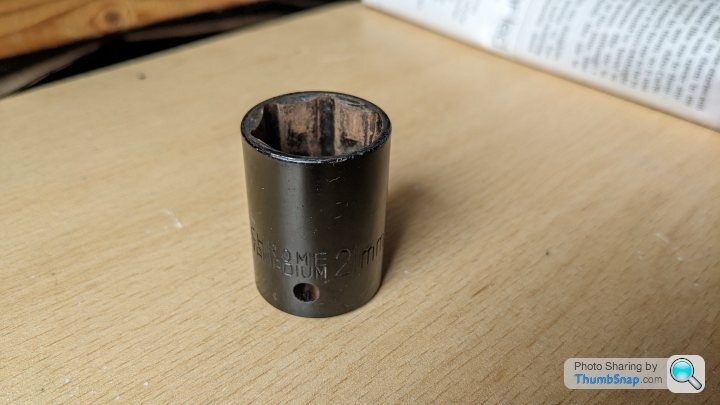
Now I do remember him saying that the socket was getting warm in use and I didn't put any significance into this at the time but I've since been wondering: why is this? If the heat was from the gun I doubt he would've mentioned it if it happens all the time, and so I am wondering if the heat is from the socket itself? Perhaps it is deforming, stretching, slightly loose fitting, whatever - even at an otherwise unnoticeable level - and this heat is a sign of inefficient torque transfer and might be the reason behind why it isn't quite shifting? Certainly looking at my socket now it is relatively thin-walled - in fact it doesn't look much different to my chrome sockets in all honesty so for all I know it might just be a chrome socket painted black!
Should I buy a better socket? If so, any suggestions? It's a 21mm I need. Next time I speak to him I will ask him to bring his sockets too in case they are beefier than mine.
I need to undo the crank bolt on a 1L Ecoboost. It is a stretch bolt tightened to 300Nm + 90° so pretty tight, and of course there's 10 years of usage/exposure to add into the mix.
A friend's Dad predicted his 1/2" Snap-On battery impact gun would 'shift it no problem' but that soon turned into 'ooh that's tight that is' when he gave it a go. He only brought the gun with him though and, perhaps crucially and hence the thread title, we were using my impact sockets which I can't remember buying but as it's an unbranded set (of 8/10 sockets?) it would not surprise me if there were not very expensive at all. Must've been less than £20 for the set otherwise I would've remembered the 'investment'. Probably much less I suspect.
Now I do remember him saying that the socket was getting warm in use and I didn't put any significance into this at the time but I've since been wondering: why is this? If the heat was from the gun I doubt he would've mentioned it if it happens all the time, and so I am wondering if the heat is from the socket itself? Perhaps it is deforming, stretching, slightly loose fitting, whatever - even at an otherwise unnoticeable level - and this heat is a sign of inefficient torque transfer and might be the reason behind why it isn't quite shifting? Certainly looking at my socket now it is relatively thin-walled - in fact it doesn't look much different to my chrome sockets in all honesty so for all I know it might just be a chrome socket painted black!
Should I buy a better socket? If so, any suggestions? It's a 21mm I need. Next time I speak to him I will ask him to bring his sockets too in case they are beefier than mine.
Edited by tux850 on Monday 9th October 10:42
The good thing about good brands of socket is you can buy just the one of that's all you need. I can vouch for Wera impact sockets being good, however the amount of energy being lost as heat on your one is going to be a tiny fraction of the energy being ugga-duggered onto the shoulders of the screwhead. The benefit is more than you won't round off the head.
Do you have a pic of the job? On pulleys I've had success with using a crowbar and breaker bar at the same time but no idea if that would work with what you are doing.
Do you have a pic of the job? On pulleys I've had success with using a crowbar and breaker bar at the same time but no idea if that would work with what you are doing.
Just googled to see if I could find a pic of the crank pulley, and this popped up:
https://youtu.be/_I1a6dVWhWU?si=WUZm9dJqDKhc2mzM
OP, seems you aren't the first to find this a problem with this engine!
https://youtu.be/_I1a6dVWhWU?si=WUZm9dJqDKhc2mzM
OP, seems you aren't the first to find this a problem with this engine!
donkmeister said:
Just googled to see if I could find a pic of the crank pulley, and this popped up:
https://youtu.be/_I1a6dVWhWU?si=WUZm9dJqDKhc2mzM
OP, seems you aren't the first to find this a problem with this engine!
Oh wow. I was going to say I've watched various videos of it being done now, some have (or borrow) a torque multiplier, some have an air impact gun and others cut to an after-commentary saying how hard it was (and you can almost see their bent breakers in the background!) but I must say I've *never* seen that method above involving ramming an extension up inside the bottom of the engine! I am am impressed and horrified in equal measures... https://youtu.be/_I1a6dVWhWU?si=WUZm9dJqDKhc2mzM
OP, seems you aren't the first to find this a problem with this engine!

donkmeister said:
The good thing about good brands of socket is you can buy just the one of that's all you need. I can vouch for Wera impact sockets being good, however the amount of energy being lost as heat on your one is going to be a tiny fraction of the energy being ugga-duggered onto the shoulders of the screwhead. The benefit is more than you won't round off the head.
It wasn't so much the energy lost as heat itself which I thought might be significant and worth recovering/avoiding but more what is actually happening to even create that heat - it was more the 'what is actually happening' bit that I thought might be relevant, if you see what I mean.donkmeister said:
Do you have a pic of the job? On pulleys I've had success with using a crowbar and breaker bar at the same time but no idea if that would work with what you are doing.
There are loads of pictures of the pulley online but I am guessing that context and what the surroundings look like is more helpful so will sort out a picture when I'm home.If it says Chrome Vanadium on it, then it's definitely not an impact socket even if it's painted black. Chrome vanadium is quite brittle and there's a risk of the socket shattering when used with an impact wrench. Impact sockets are made from chrome molybdenum steel which is less brittle and has elastic and ultimately ductile properties that protect it from breakage and also help transfer more energy into the fastener.
Having said that, I wouldn't imagine that many 1/2" impact wrenches could undo a crank pulley bolt. That's what breaker bars are for!
Having said that, I wouldn't imagine that many 1/2" impact wrenches could undo a crank pulley bolt. That's what breaker bars are for!
LunarOne said:
That's what breaker bars are for!
The 1/2" breaker - which was a Snap-on so presumably decent - was bending too much and we suspect the extension bars (plural - I think we had three) that we were using were likely also allowing to much spring and absorbing torque too.The old man that's helping is going to come round with a 3/4" bar tonight and, interestingly, he also said he'd 'sort something out for the extension' which is making me wonder if he's going to weld a socket and nut on either end of a scaffold pipe or something! Or I might be overthinking it and he's just going to bring an appropriate length extension.
tux850 said:
The 1/2" breaker - which was a Snap-on so presumably decent - was bending too much and we suspect the extension bars (plural - I think we had three) that we were using were likely also allowing to much spring and absorbing torque too.
The old man that's helping is going to come round with a 3/4" bar tonight and, interestingly, he also said he'd 'sort something out for the extension' which is making me wonder if he's going to weld a socket and nut on either end of a scaffold pipe or something! Or I might be overthinking it and he's just going to bring an appropriate length extension.
How did he get on?The old man that's helping is going to come round with a 3/4" bar tonight and, interestingly, he also said he'd 'sort something out for the extension' which is making me wonder if he's going to weld a socket and nut on either end of a scaffold pipe or something! Or I might be overthinking it and he's just going to bring an appropriate length extension.
tux850 said:
The 1/2" breaker - which was a Snap-on so presumably decent - was bending too much and we suspect the extension bars (plural - I think we had three) that we were using were likely also allowing to much spring and absorbing torque too.
The old man that's helping is going to come round with a 3/4" bar tonight
Yes & Yes, too much effort lost in bending ½inch drive, first discovered working on Audi 5 cylinders. You'd think it was holding the whole car together.The old man that's helping is going to come round with a 3/4" bar tonight

eltax91 said:
How did he get on?
Ah, well, since you asked...He came round and first thing I said to him was that I was a bit worried about going for the 3/4" breaker bar as I am not entirely confident in the chinese flywheel locking tool and didn't want a) it snapping and falling inside the bellhousing, or b) him hurting itself in the process! As it happens he was thinking along the same lines and so he'd instead brought a compressor and 3/4" air gun round:


Now, one thing I haven't previously mentioned is that I've got a spare (but broken) engine on a stand in the garage and so we put the gun on that and managed to get the bolt off:

Okay great! Took a fair bit of effort mind, and with the bolt in my hand it felt like it should be holding a pylon up not a pulley on a car. Anyway, boosted with much needed confidence, we moved on to the car...
But no joy! So why not? Well, whilst the engines are at first glance the same the spare has a 24mm bolt head but it is 21mm on the car.... The smallest 3/4" socket he had was a 24mm though which meant we had to use my new 21mm 1/2" socket (a Draper one that was bulkier than the one I'd pictured earlier in the thread) in conjunction with a 3/4"-to-1/2" adapter which we think was robbing just enough torque to make us unsuccessful. He did say he could tell by the vibrations from the double coupling that it wasn't working as well as it could. Furthermore, the compressor was struggling to keep up and you could hear after the first few whacks it was running out of steam so we had to keep waiting for it to recharge so couldn't go hell-for-leather with long attacks which might also have helped.
So, Plan B is that I've ordered a 3/4" 21mm socket off Amazon which should be arriving later in the week (the thing you really want is never available next-day delivery is it?!) so once that arrives he's going to return and we can give it another go without the adapter. Having watched a video on YouTube it looks like you can be losing as much as 20% with a 3/4"-to-1/2" adapter so that might be making all the difference.
If that fails then he's got a bigger compressor that he can bring round in his trailer (which makes me wonder exactly how big is this thing given he came round in a van tonight?!) on Sunday. That's got to be the end of it, surely.
Edited by tux850 on Monday 16th October 19:57
Gassing Station | Home Mechanics | Top of Page | What's New | My Stuff