
Electric City
UK to get 250 electric car recharging stations
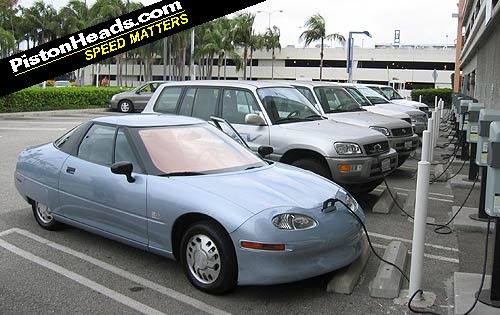
Recharge the Californian way
The viability of electric cars is set to take a giant leap forward after energy giant EDF announced it is to install 250 recharging stations across the UK by April 2008.
The company is to join forces with recharging station manufacturer Elektromotive to provide the recharging stations, which it claims will make electric cars such as the G-Wiz and MEGA City more attractive propositions for urban commuters.
Calvey Taylor-Haw, managing director of Elektromotive, said the provision of a network of recharging stations would allow commuters without off-street parking to consider purchasing electric vehicles and also extend the cars' range.
He said: "Electric cars already do about 40 miles per charge, so they are more than adequate for most urban journeys but this will introduce a real comfort factor for people as they know they will be able to recharge away from home."
He added that around 200 of the charging stations, which provide a standard 240V charge, are expected to be deployed in London with a further 50 planned for other cities including Brighton and Sheffield.
Payment plans for the recharging stations are likely to vary from council to council with some planning to offer the service for free and others expected to charge. However, with most electric cars costing 1.3p to 1.5p per mile to run, costs would be minimal.


Complete tosh. How inflexable is a car that requires a time consuming recharge every 40 miles ?. My granny and the paper boy may get away with it but technology needs to advance some way before I go electric !!!! Assuming I have a choice of course !

I can see a future for hybrids. Electric motors certainly have the potential (no pun) for large bhp, and can be positioned to drive all 4 wheels independently, thus removing the necessity for a diff and gearbox. You can have computer control over your 4 wheels, far greater control than you can have by manipulating diffs (although I believe the Ferrari e-diff is a work of engineering-art).


the zytek smart did achieve 70 miles with a 70mph top speed - not sure what happened to it though - some complications with the politics with daimler got in the way.
don't understand why you can't make it so that leccy cars go to a petrol station and swap out dead batteries for charged one - hey presto no hanging around waiting for your car to charge.
i personally would love to have something like this for my daily commute - and it looks pretty good on a track too..!
http://www.youtube.com/watch?v=GINWQ0QakV0
There have a been a good few examples of 'leccy cars with 200 mile ranges in the last 10 years or so. Electric motors are incredibly powerful, correctly designed there aint much that can match them for power to weight, how does 100% torque from about 0rpm to 10000rpm sound?
The problem is in providing the fuel source to them, petrol is an incredibly dense form of chemical fuel but that needs converting to electricity. Batteries are rubbish and heavy, hydrogen fuel cells are dangerous, rubbish and heavy. Mini nuclear power plants would be excellent fun if the shielding could be sorted, but I dont like the idea of some doddery old dear crashing her mini chernobyl into me when I stop at the lights...
So in other words, the internal combustion engine will be around for a good while yet

No direct driveline between diesel engine and wheels, just electrics. A little bit like a very tiny train.
Since you spend most of your time in city traffic either idling or coasting down to a stop, the generator would get chance to top up the batteries for the next spurt of acceleration.
Sustained top speed would be a bit crap, but would it be more suited to cities than a purely electrical solution?


No direct driveline between diesel engine and wheels, just electrics. A little bit like a very tiny train.
Since you spend most of your time in city traffic either idling or coasting down to a stop, the generator would get chance to top up the batteries for the next spurt of acceleration.
Sustained top speed would be a bit crap, but would it be more suited to cities than a purely electrical solution?
You actually lose less energy in conversion from mechanical energy to electrical energy, storage and then conversion back to mechanical energy than you do in a conventional gearbox. Thus, even ignoring the advantages of regenerative braking and a completely flat torque curve, they are still a good idea.

Gassing Station | General Gassing [Archive] | Top of Page | What's New | My Stuff