
2 or 4 valves?
Discussion


I recently purchased a 90 brake 1.6 8v 4pot eubox and I must say it pulls pretty allright.
In my experience four valvers do run smoother but lack the nice 'fat' bottom. So in everyday traffic and legalspeed highways why would I need a 4v for?
I'll put up mpg figures when I emptied a few tanks of petrol. Onboard computer now says 7 / 100 km, which is approx 43 mpg.
Please give me your opinions.
In my experience four valvers do run smoother but lack the nice 'fat' bottom. So in everyday traffic and legalspeed highways why would I need a 4v for?
I'll put up mpg figures when I emptied a few tanks of petrol. Onboard computer now says 7 / 100 km, which is approx 43 mpg.
Please give me your opinions.
There shouldn't be any loss of low end torque in a modern 4 valve-per-cylinder engine. Before the days of electronic management (and certainly before variable valve timing) an engine had to be more or less optimised for certain conditions. This meant that the sportier 16v engines were configured to make maximum use of the higher gas flows they allowed and the primitive management systems lost out lower down. This hsouldn't really be an issue any more.
Boosted LS1 said:
In theory 2 valve heads make more torque lower down due to the smaller valve area (higher velocities)but small VE restricts flow higher up the rev range. A 4 valver is the opposite, ie big VE, low velocity at low rpm's, high flow etc at higher rpm's.
Thanks for the informative response.Mr Will said:
It doesn't reduce the torque at low RPM, a 16v car will always pull better at any point in the rev range...
See Boosted's response. 4-valves can quite easily result in reduced torque at low RPM, particularly if you're using fierce cams with lots of overlap and no VVT to compensate.4-valves only really come into their own at the upper end of the normal road car rev range and most still feel pretty gutless low down, compared to a good 8-valver. I own an 8-valve 1600 Twin Cam (in my Lotus), which produces about 145bhp and I've owned several 1800cc 16 valve K-series powered cars that produce similar power (still got one, in my Westfield). The old Lotus engine feels far more 'gutsy' below about 5,000 revs, but it starts to get a bit breathless toward the top end (redline 6,750rpm), whereas the K-series will rev in a very linear fashion to over 7,000 but is pretty underwhelming when picking up from 'cruising' revs.
I remember the technical discussions amongst F1 engine builders a few years back about whether there was any advantage in going to 5-valves per cylinder. The concensus at the time was that, even revving to 13,500-14,000rpm, the negligible advantages offered by the extra valve were probably outweighed by the increased complexity and weight.
It's not necessarily the case that the 8v head has more low rev torque, though; consider the Citroen 1.6 in the Xsara (picking the first 8v/16v comparison from http://www.rri.se/index.php?DN=29 )
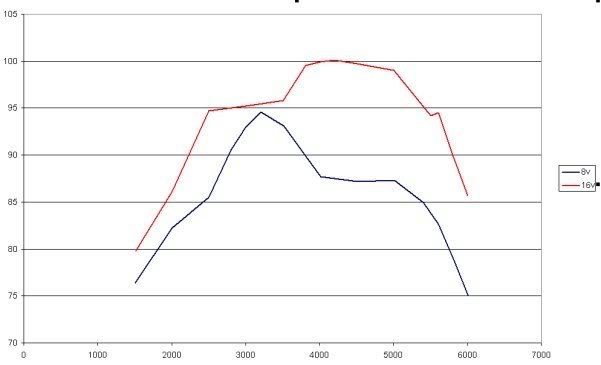
It's often the case that, as here, peak torque is at lower revs in the the 8v lump. The peak torque@rpm figure is so bloody misleading that I almost wish it wasn't quoted. People compare rpm with a "lower is better" mindset and torque with a "higher is better" mindset and completely overlook (a) that the statistic is virtually worthless compared to a graph of torque against rpm and (b) that completely different gearing may render the difference academic (consider that the version of the RX-8 with the lower peak torque figure at higher rpm actually pulls harder in any gear, any road speed, than the lower power / higher torque version).
It's often the case that, as here, peak torque is at lower revs in the the 8v lump. The peak torque@rpm figure is so bloody misleading that I almost wish it wasn't quoted. People compare rpm with a "lower is better" mindset and torque with a "higher is better" mindset and completely overlook (a) that the statistic is virtually worthless compared to a graph of torque against rpm and (b) that completely different gearing may render the difference academic (consider that the version of the RX-8 with the lower peak torque figure at higher rpm actually pulls harder in any gear, any road speed, than the lower power / higher torque version).
How about the bhp diagram? and the mpg diagram?
I'm beginning to wonder what the everyday advantages of 4v are . . . just for commuting and all . . .
My 16v 1.3: 15 kms on a litre (17,5 on long hals)
My 8v 1.6 13,5 kms on a litre . . . and I'm not used to the car.
ETA: http://uk.youtube.com/watch?v=E4FlD24iBu0
Watch the last bit where PW explaines the 2V bit . . . classic.
I'm beginning to wonder what the everyday advantages of 4v are . . . just for commuting and all . . .
My 16v 1.3: 15 kms on a litre (17,5 on long hals)
My 8v 1.6 13,5 kms on a litre . . . and I'm not used to the car.
ETA: http://uk.youtube.com/watch?v=E4FlD24iBu0
Watch the last bit where PW explaines the 2V bit . . . classic.
Edited by dinkel on Saturday 5th April 14:43


fatboy b said:
More isn't always better. The old Mondeo V6 used to only have one intake valve operational upto about 2400 rpm I think, then switched to both. So low revs = less valve, high revs = more valves.
The Mondeo engine didn't even have VVT except on version used by Jaguar and Mazda. I suspect what it did probably have would be a variable length inlet manifold which is one way of improving low down torque.Surely it depends on the engine. Early Golf Gti 8v's had as much if not more torque low down compared to the 16v engine. In the real world, this meant that the 8v was almost as quick to 60, but lost outer when going quicker.
Surely modern 16v engines fitted with VVC have the best of both worlds.
16v engines aren't just found in hot hatches any more, but are used to keep within the ever stricter emissions regs being imposed?
Surely modern 16v engines fitted with VVC have the best of both worlds.
16v engines aren't just found in hot hatches any more, but are used to keep within the ever stricter emissions regs being imposed?
Talksteer said:
fatboy b said:
More isn't always better. The old Mondeo V6 used to only have one intake valve operational upto about 2400 rpm I think, then switched to both. So low revs = less valve, high revs = more valves.
The Mondeo engine didn't even have VVT except on version used by Jaguar and Mazda. I suspect what it did probably have would be a variable length inlet manifold which is one way of improving low down torque.For each cylinder, one inlet valve is fed via a long inlet, and the other inlet valve is fed via a short inlet. Under normal operation, the short inlet is closed off via a butterfly valve. At 3750rpm or under wide open throttle, the secondary inlets open. This gives improved torque and driveability at low speed without compromising power at high speed.
Gassing Station | General Gassing [Archive] | Top of Page | What's New | My Stuff