
Twin-cylinder Fiat 500 Launched
Green-tech can be cute at least, and Fiat's latest 500 shows how
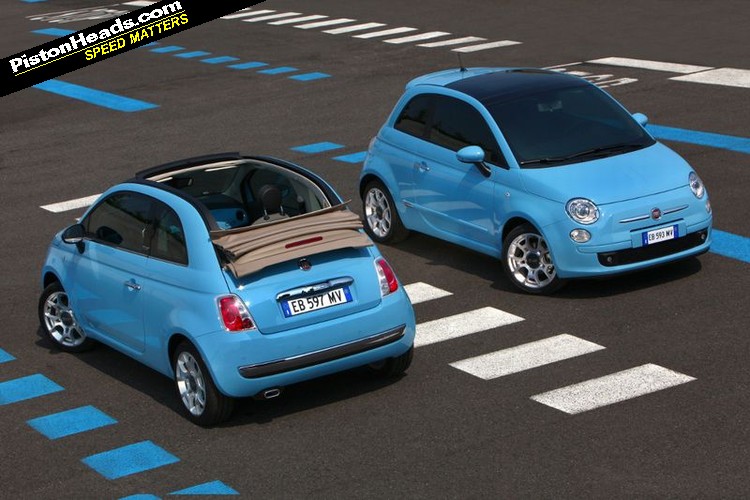
You can have a cabrio or hatch version
The engine is the first of a new family of two-cylinder engines made Fiat Powertrain Technologies, all using Fiat's MultiAir system and with outputs from 65hp to 105hp. To help show it off, Fiat has released a video animation of the engine in action, which we feel is sure to appeal to PH's techy-types.
We've not driven the two cylinder car yet but downsizing like this is pretty cool, we think, especially if it means we can still justify keeping that V12 Ferrari 599 in the garage for weekends. (Ed. That would be our 'virtual garage', obviously.)
Still, this is PH, and we know we're not really supposed to get over-excited by this sort of stuff. So if you want to know any more about it, you'll have to scroll down beyond the videos for the official blurb.
Now, where did we put that press release about the world's most powerful Camaro SS...
TwinAir 85 HP, world preview - press release
The new two-cylinder engine family made by FPT - Fiat Powertrain Technologies, called TwinAir, is debuting in the Fiat 500 today. This is a brand-new concept on the worldwide auto scene and confirms the leadership of the Fiat Group in this field.
Using next-generation technology, the new engine implements the revolutionary MultiAir system combined with special fluid dynamics optimised for maximum fuel efficiency. Furthermore, by taking the concept of downsizing to the extreme and masterfully tuning the basic mechanics, the new family - delivering from 65 to 105 HP - emits 30% less CO2 than an engine of equal performance.
On sale from next September, the 500 will be the first Fiat model to adopt this, which will be the progenitor of a new family of engines: a 85 HP (900 cc) turbo two-cylinder with the lowest CO2 emission for a petrol engine (92 g/km with a Dualogic robotised gearbox and 95 g/km with manual gearbox) without skimping on performance or driving pleasure. This is thanks to the small-sized turbine which, combined with dedicated valve management strategies, minimises transient response times and, at the same time, keeps maximum power levels high. In this way, despite its small size, the engine ensures excellent performance and an appreciable reduction in fuel consumption: compared with a 1.2 8v, the new 85 HP turbo has 23% more power and a 30% better performance index. In fact, the performance of the two-cylinder is not only equivalent to a 1.4 16v, but consumption is a remarkable 30% lower.
Equipped in this way, the Fiat 500 reaches a top speed of 173 km/h and accelerates from 0 to 100 km/h in only 11 seconds. This remarkable performance corresponds to a significant reduction of fuel consumption and emissions: 4.1 l/100 km and 95 g/km respectively on the urban cycle (with manual gearbox), that becomes 4,0 l/100 km and 92 g/km with a Dualogic robotised gearbox. Furthermore, the Fiat 500 with TwinAir 85 HP is provided with an ECO button - positioned on the dashboard - for further cutting fuel consumption in cities and guaranteeing very eco-friendly running. Two driving modes can be selected: Normal and ECO.
In the first mode, the ECO function is off and the engine delivers the maximum available torque (145 Nm), guaranteeing prompt, brilliant response and a "sportier" driving feel. Steering assistance is also specifically calibrated for Normal mode. No indication appears on the dashboard in this mode (City is not selected). Consequently, this configuration is recommended for maximum response and full enjoyment of all available torque.
In ECO mode, instead, the emphasis is on "eco-friendly" engine running: torque delivery is cut off to 100 Nm at 1750 rpm to minimise consumption and promote a driving style more suitable for city traffic. The steering wheel is lighter (CITY mode is automatically selected). The driver only needs to press the specific button on the dashboard to activate the ECO function. The lettering ECO will appear on the panel (the letter "E" will appear on the panel if the car has a Dualogic robotised gearbox). Furthermore, the Dualogic shifting strategy also switches to ECO mode to further optimise fuel consumption.
Furthermore, compared with a medium-sized four-cylinder of equal performance, the new engine is significantly shorter (-23%) and lighter (-10%), opening the way to further developments, such as methane fuel supply or hybrid technology combinations, again on the theme of greater eco-friendliness. In particular, a methane version of the TwinAir will be available soon providing a further CO2 emission reduction, by adopting a pair of special injectors in addition to the petrol injectors on the intake manifold ducts. Improving on these fuel saving results using internal combustion engines will be difficult and alternative technologies will need to be developed. The combination of traditional engines and electric motors appears particularly promising. Due to its reduced size, the TwinAir is quite suitable for being paired with an electric engine and in general with a device located between the engine and gearbox for recovering and storing the energy that is normally wasted during braking.
Interestingly, the TwinAir 85 HP comes with "Start&Stop" as standard. This device temporarily stops the engine and restarts it, ensuring reductions in fuel consumption and noise in the passenger compartment. The Gear Shift Indicator (GSI) associated to the Start&Stop system is a genuine "co-pilot" that discreetly suggests when to shift gear, leading to more efficient use of the engine in terms of fuel consumption. For example, the GSI may suggest shifting up, by means of an indication on the control panel, to allow the engine to burn a leaner mixture, i.e. one containing less fuel, or shifting down to make best use of the available torque.
Nothing short of an engineering gem, the two-cylinder implements the revolutionary MultiAir technology developed and patented by FPT - Fiat Powertrain Technologies, which was introduced on FIRE engines last year for the first time. The heart of MultiAir is a new electro-hydraulic valve management system that reduces fuel consumption by controlling air directly via the inlet valves (without using the throttle). MultiAir reduces polluting emissions (thanks to combustion control) and also considerably improves performance by boosting driveability with respect to a traditional petrol engine of equal displacement. In brief, the advantages of MultiAir technology applied to petrol engines are:
- maximum power boosted by 10% compared with a traditional engine of equal size;
- 15% more torque at low rpm and during transitions by applying early intake valve closing strategies to maximise the air introduced into the cylinders;
- less fuel consumption and consequently lower CO2 emissions, equal to 10% by eliminating pumping losses and precise parameter calibration for optimising combustion;
- lower polluting emissions from the engine by optimising valve control strategies during the intake stroke;
- prompter response to accelerator commands due to the constant air pressure upstream of the cylinders combined with extremely fast control of the intake valves.
Also, the new TwinAir engine takes the concept of downsizing to an extreme: by combining a small-sized engine with a next-generation turbocharger performance comparable to - or even better than - that of a larger engine is obtained but with less fuel consumption and lower emissions. Not only that, the turbo significantly increases the maximum torque, making it available at a very low rpm, with the result of offering greater flexibility and an unrivalled responsiveness compared to conventional aspirated engines. All this comes with a simple build to the benefit of strength and reliability.
Last but not least, the new engine was painstakingly optimised and tuned. For instance, the basic two-cylinder architecture - combined with the low friction of internal parts - ranks this engine best in the world as far as friction is concerned. Furthermore, calculated simulations have been used to identify the best possible unit displacement in terms of thermo-dynamic efficiency, and the best fluid dynamic configuration to optimise and get the best out of the MultiAir system. Finally, special attention has been placed on the NVH (Noise, vibration, and harshness) aspect to ensure vibration performance at least equivalent to that of a four-cylinder, with equal performance but with a characteristic sound. For this purpose, a balancing countershaft was used to maintain optimal vibration levels in all operating conditions of the engine, from idling speed to top power.


I have been watching this with interest since I first heard about it, i think it is paving the way, along with the more recent capacity downsizing into breaking the taboo about engine size and number of cylinders.
I know the less cylinders you have, the rougher an engine generally is but with the advances made in construction, NVH progress and the fact that a lot of modern cars are too refined anyway I think this will work, I suspect that it will be very enjoyable to drive, probably more so than a plain 4 cylinder of the same capacity with no turbo or clever valve management, a bit of a thrum wouldnt go amiss either, I think we have got too used to refined engines, and then generally go and spoil things with rock hard suspension and massive wheels !
 If I had the money, would definitely consider it alongside something a bit more fun
Is it because you can think of a good reason to put it there, or is it pure nostalgia? VW changed their mind about putting their engine under the boot in the VW Up recently because it couldn't be used as part of the crumple zone.

Gassing Station | General Gassing [Archive] | Top of Page | What's New | My Stuff