
Question about cars and cornering.
Discussion


Whilst driving, you might suppose (if you were me) that the rear wheels follow the same path as the front wheels. You might also (maybe subconsciously, if you were me) suppose that this continues to be the case when cornering.
In which case you would be wrong, as I was proven to be by a concrete column that was happily bypassed by the front of my car, but crunched along the rear quarter as I attempted to steer around it.
Further investigation revealed that the tracks left by the rear wheels diverged from and undercut those left by the front wheels. The rear wheels were cutting corners!
Now this explains why it is hard to corner with a locked centre differential, but the following question occured: If the rear wheels of a cornering car are always trying to cut inside the corner, what happens to cars circling a looped track - i.e. like the Mclaren speed record thing or even (shudder) Nascar? Are the real wheels constantly slipping towards the inside of the curve and if not, what keeps them straight?
In which case you would be wrong, as I was proven to be by a concrete column that was happily bypassed by the front of my car, but crunched along the rear quarter as I attempted to steer around it.
Further investigation revealed that the tracks left by the rear wheels diverged from and undercut those left by the front wheels. The rear wheels were cutting corners!
Now this explains why it is hard to corner with a locked centre differential, but the following question occured: If the rear wheels of a cornering car are always trying to cut inside the corner, what happens to cars circling a looped track - i.e. like the Mclaren speed record thing or even (shudder) Nascar? Are the real wheels constantly slipping towards the inside of the curve and if not, what keeps them straight?
kelk said:
Risking everything here.
Isn't this just a description of understeer i.e. the front wheels are "pushed" wider than the line taken by the rears?
Dont think so. Think of a push bike being turned round in a circle. The rear wheel can even be stationary, and the front still turns.Isn't this just a description of understeer i.e. the front wheels are "pushed" wider than the line taken by the rears?
On the oval racing side of things, the corners are usually banked to reduce this effect.
Thats the way it works, I spend a lot of my time at work modelling the way vehicles will get into places for this very reason, otherwise you could just draw a line.
To get around this I believe in the late 90's a few manufacturers made their longer, sportier cars with rear wheel steering such as the Honda Prelude and Nissan Skyline.
To get around this I believe in the late 90's a few manufacturers made their longer, sportier cars with rear wheel steering such as the Honda Prelude and Nissan Skyline.
Oh dear. The front and rear wheels do not pointin the same direction when cornering. The rear wheels want to keep going straight on, but are pulled around the corner by the direction in which the fronts are pointed.
Drive through some water then onto a nice flat concrete car park surface, make a 90 degree turn and look at the tyre tracks.
Drive through some water then onto a nice flat concrete car park surface, make a 90 degree turn and look at the tyre tracks.
Conian said:
The front wheels start to turn 3 meters ahead of the rear ones and immediately change the course of the car, the rear wheels dont get chance to cover that 3 meters, they alter course straight away so will follow a different course while the car is steering.
Correct, which is why it takes less movement to reverse into a parallel parking space than to drive in forwardsEdited by itsnotarace on Wednesday 4th August 15:26
Ayahuasca said:
Whilst driving, you might suppose (if you were me) that the rear wheels follow the same path as the front wheels. You might also (maybe subconsciously, if you were me) suppose that this continues to be the case when cornering.
Please let me know if you ever drive an articulated lorry so I can stay at home that day. 
andrew. said:
the centre of the turning circle with the path of least lateral tyre resistance will always be nearer the rear of the car
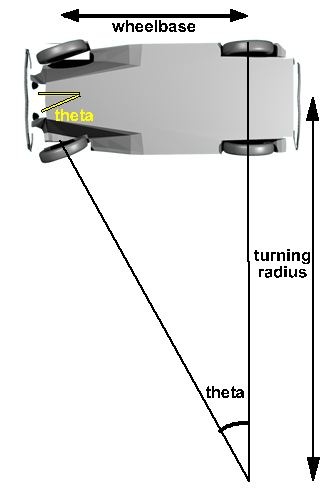
In that diagram the line from the outside front wheel would be parallel to the one from the inside wheel, would intersect the 'radius' line higher up and so would have a different radius. So are the front wheels parallel or angled ?
OnTheOverrun said:
Ayahuasca said:
Whilst driving, you might suppose (if you were me) that the rear wheels follow the same path as the front wheels. You might also (maybe subconsciously, if you were me) suppose that this continues to be the case when cornering.
Please let me know if you ever drive an articulated lorry so I can stay at home that day. 
You're a long term poster so don't want to rip it too much, but isn't this sort of obvious?
All wheels straight, no "undercut" as you put it.
Front wheels turning, the back will always be on the inside of whatever way you are turning, purely based on the fact they are about 2 metres from each other.
How do you park?
All wheels straight, no "undercut" as you put it.
Front wheels turning, the back will always be on the inside of whatever way you are turning, purely based on the fact they are about 2 metres from each other.
How do you park?
Front wheels are angled.
Inside turned in further.
If that is what you mean?
The rears - generally - do not have an option but to slip somewhat.
Again, if you think of a bus it should help. If you see a bus on lock the front inside wheel is turned much further towards the inside of the radius that the outside wheel.
At slow speeds you can see a bus inside rear turn backwards on full lock.
The same effect is present at speed, however the results are less pronounced unless something has gone really wrong.
Try and picture a bus on an alpine hairpin. think how wide they go out.
Inside turned in further.
If that is what you mean?
The rears - generally - do not have an option but to slip somewhat.
Again, if you think of a bus it should help. If you see a bus on lock the front inside wheel is turned much further towards the inside of the radius that the outside wheel.
At slow speeds you can see a bus inside rear turn backwards on full lock.
The same effect is present at speed, however the results are less pronounced unless something has gone really wrong.
Try and picture a bus on an alpine hairpin. think how wide they go out.
Ayahuasca said:
andrew. said:
the centre of the turning circle with the path of least lateral tyre resistance will always be nearer the rear of the car
In that diagram the line from the outside front wheel would be parallel to the one from the inside wheel, would intersect the 'radius' line higher up and so would have a different radius. So are the front wheels parallel or angled ?

andrew. said:
Ayahuasca said:
andrew. said:
the centre of the turning circle with the path of least lateral tyre resistance will always be nearer the rear of the car
In that diagram the line from the outside front wheel would be parallel to the one from the inside wheel, would intersect the 'radius' line higher up and so would have a different radius. So are the front wheels parallel or angled ?
look up Ackermann Geometry for more info.
Ayahuasca said:
Now this explains why it is hard to corner with a locked centre differential, but the following question occured: If the rear wheels of a cornering car are always trying to cut inside the corner, what happens to cars circling a looped track - i.e. like the Mclaren speed record thing or even (shudder) Nascar? Are the real wheels constantly slipping towards the inside of the curve and if not, what keeps them straight?
I would imagine these have a differential, and that the rear wheel higher up the banking will be rotating slightly faster than the one lower down. I could well be wrong on this however.Edited by RenesisEvo on Wednesday 4th August 16:03
Gassing Station | General Gassing [Archive] | Top of Page | What's New | My Stuff