
Puma clutch position sensor - what, why, how?
Discussion


Got the Puma back from the bodyshop yesterday (Total Car Solutions in Derby - highly recommended), and it had developed a strange (and quite fierce) engine judder on trailing throttle at approx 1650rpm.
Shortly after discovering this, I felt something brush against my foot... on stopping I found it to be some sort of sprung slide switch, with quite a long travel, hanging from its wire.
Hmmmm... it looks like it fits in that clip above the clutch pedal arm. It does!
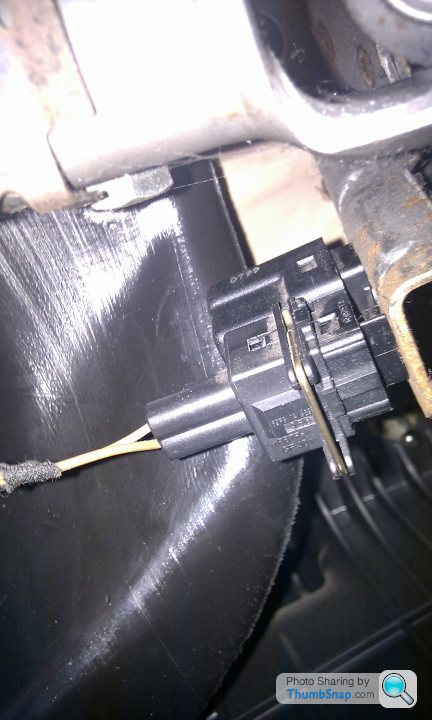
Short drive, no more juddering!

Anyone care to enlighten me on how this little system works? Something to do with the fuel cut off when on a trailing throttle evidently, but how exactly? How does it smooth out the transition between fuel cut off and on?
Shortly after discovering this, I felt something brush against my foot... on stopping I found it to be some sort of sprung slide switch, with quite a long travel, hanging from its wire.
Hmmmm... it looks like it fits in that clip above the clutch pedal arm. It does!
Short drive, no more juddering!
Anyone care to enlighten me on how this little system works? Something to do with the fuel cut off when on a trailing throttle evidently, but how exactly? How does it smooth out the transition between fuel cut off and on?
davepoth said:
rough guess - that sensor's there to tell the ECU when the clutch is disengaged at revs approaching idle so it can bung a bit of extra fuel in as the revs drop to avoid the transition between trailing throttle and idle being sudden and jerky.
That was my hunch. It was jerking like it was fueling on and off rapidly at a good 500rpm above idle though, and only in a 200rpm window (1650-1450) - so still above cut off at about 1150. (oh and this is all with clutch engaged... ie. in gear)
thinfourth2 said:
Odd
Try slowing down and knock it into neutral on a trailing throttle and then come off the gas without touching the throttle
Like I said in the op, its resolved now I've refitted the switch/sensor.Try slowing down and knock it into neutral on a trailing throttle and then come off the gas without touching the throttle
It was fine while trailing in neutral - which fits with the fuel cut-off idea... would still like to know exactly how this works... I've never noticed a clutch position sensor on any other cars I've tinkered with, but then again I wasn't looking.
The CPS is used to identify the "driving mode" to the engine control ecu. It effectively switched between speed and torque control modes suitable for idle and idle drive. The engines base torque control values are modified depending on is the engine is idling in neutral (only the engines own inertia/friction to deal with) or in idle drive (overrun) where the vehicles inertia and road friction need accounting for. To get smooth control of the rate of decay of engine rpm, and a decent torque re-enstatment after DFSO (deccel fuel shut off) the system is calibrated differently for those two cases.
If the clutch switch(s) is missing (often there are two, a clutch "top" and a clutch "bottom" switch) the engine will be operating in the wrong mode, with the accompanying poor speed and torque control effects.
If the clutch switch(s) is missing (often there are two, a clutch "top" and a clutch "bottom" switch) the engine will be operating in the wrong mode, with the accompanying poor speed and torque control effects.
Max_Torque said:
The CPS is used to identify the "driving mode" to the engine control ecu. It effectively switched between speed and torque control modes suitable for idle and idle drive. The engines base torque control values are modified depending on is the engine is idling in neutral (only the engines own inertia/friction to deal with) or in idle drive (overrun) where the vehicles inertia and road friction need accounting for. To get smooth control of the rate of decay of engine rpm, and a decent torque re-enstatment after DFSO (deccel fuel shut off) the system is calibrated differently for those two cases.
If the clutch switch(s) is missing (often there are two, a clutch "top" and a clutch "bottom" switch) the engine will be operating in the wrong mode, with the accompanying poor speed and torque control effects.
Haha, I was actually thinking of you as I wrote the op! Cheers buddy.If the clutch switch(s) is missing (often there are two, a clutch "top" and a clutch "bottom" switch) the engine will be operating in the wrong mode, with the accompanying poor speed and torque control effects.
I think I'll cut out the middle man next time and just pm you :-)
Gassing Station | General Gassing | Top of Page | What's New | My Stuff