
Moal Gatto - I've just fallen in love
Discussion


Ladies and Gentleman, I give you the Moal Gatto:
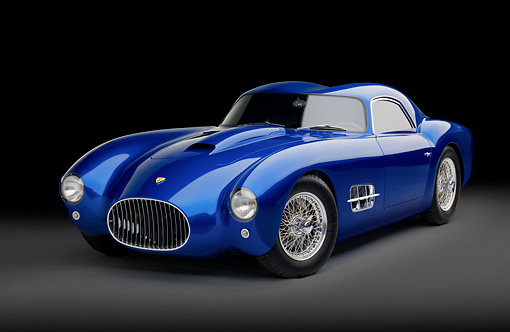
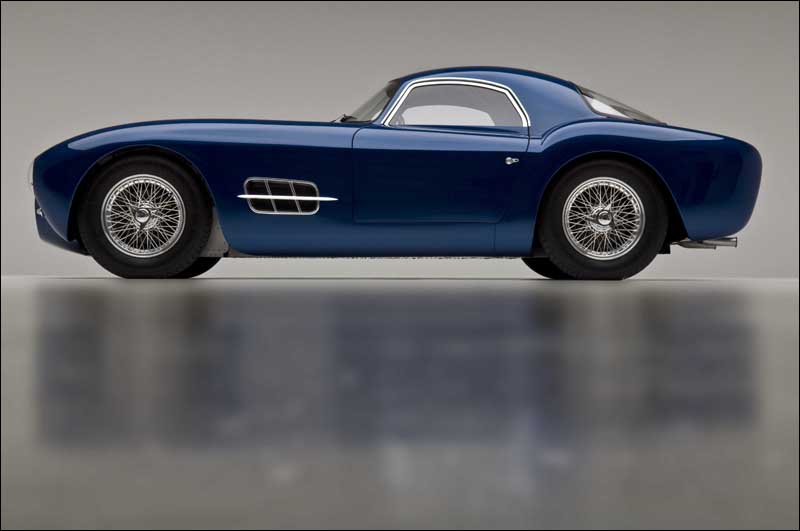


Chassis: Semi-monocoque with riveted and glued stressed panels
Engine: Ferrari 250 GTO Spec
Horspower: 300 @ 7800 RPM
Transmission: Tremec 5 speed
Weight: 2300 lbs
Wheels: Borrani wire
Tires: Michelin 6.00 x 16
Upholstery: Custom tubular seat frames covered in leather
Wheelbase: 96"
Front track: 58"
Rear track: 571/2"
Fuel Capacity: 15 Gallons
I think I need to go and lay down for a while.


The Moal website said:
Gatto from The House of Moal
Even within the rarified coachwork ethic, it takes more than hand, eye, template and tool to create a unique motoring conveyance like this superbly-executed and technologically-advanced high performance coupe. First, there is a translation from passion -- a passion for the automotive arts borne not only of familiarity with elevated driving experiences, but also of a personal fondness for the special forms and sculpted shapes that have imparted timeless notions of speed. Motifs that have for more than a half century signified heritage, tradition, enduring affect. Qualities attached to great automotive marques. Ferrari, Maserati. Porsche. Mercedes-Benz. Alfa Romeo. Duesenberg. Packard. Chrysler.
It is no coincidence, either, that the lineage of many of these automobiles is inseparable from the coachwork tradition, wherin a combine of like-minded craftsmen within early carrozzeria ("carriage works" in the Italian) orchestrated a process of assemblage--chassis, body, engine and driveline, wheels, upholstery, intrumentation and appointments-that would culminate in the final production: a unique motor car built to harness the dreams of owner and builder alike. Again, these houses bear legendary names of their masters: Brianza, Pinin Farina, Touring, Zagato, Viotti. That valued heritage continues today in the Oakland, California, shops of Moal Coachbuilders.
To create this remarkable vehicle, coachworks master Steve Moal and owner Bill Grimsley have engaged many of the same processes that guided the carrozzeria masters of the early 20th Century. Grimsley, a retired investment manager, knew he wanted a distinct vehicle that would amalgamate a number of ideas regarding form and function, convenience, performance and efficiency.
An experienced collector, amateur sports car racer and long-time motorsports aficionado, he knew he would like to own and drive a distinctive vehicle that was highly responsive (stiff and with the handling characteristics of a thoroughbred race car), light and lithe (like a Lotus), one that would incorporate front-mounted power and driveline from an iconic engine that bespeaks not only a special aesthetic--but stands at the ready to deliver vigourous horsepower (the Ferrari 250 GTO motor--one long-associated with the Ferrari Testa Rossa sports racer). The vehicle would have to have amenities that in his experience were missing in more traditional sports models: air conditioning, comfortable seating, a fail-safe cooling system, bold, easy-to-read instumentation, a sure and equitably-matched manual transmission--and the most effective braking system available today. This would be no lawn-locked show car, but a ready-to-rumble backcountry sprinter.
He would also seek the rare unification of design simplicity with functional accoutrements. Unique door handles, cabin and engine compartment vents, filler cap, grille, wheels, body accents. This would be a cumulative challenge that would broach no afterthoughts, add-ons or post-construction modifications.
Ever-present during the evolutionary phases of this coupe's three-year construction, Grimsley remains in awe of the Moal artisans and craftsmen who've created and assembled the vehicle. Everything from the smallest components like door hinges to the Borrani wheels to the substantial chassis itself. He pays tribute to this team for their creative and attentive workmanship, lavishing particular praise on Moal metalsmith Jimmy Kilroy, who so adroitly fashioned the aluminum bodywork as well as many of the exterior metal touches--the Mercedes-like fender vents, the exquisite circular grille, so reminiscent of early Maserati Grand Prix racers, the subtle fender creases that again impart a sense of motion and balance, the graceful, integrated topside cabin vents nestled ingeniously in the small rooftop bubble crevice.
His only lament is that when the car is finished much of the team's exquisitely-crafted handiwork will be hidden 'neath body, cabin and motor compartments.
SPECSEven within the rarified coachwork ethic, it takes more than hand, eye, template and tool to create a unique motoring conveyance like this superbly-executed and technologically-advanced high performance coupe. First, there is a translation from passion -- a passion for the automotive arts borne not only of familiarity with elevated driving experiences, but also of a personal fondness for the special forms and sculpted shapes that have imparted timeless notions of speed. Motifs that have for more than a half century signified heritage, tradition, enduring affect. Qualities attached to great automotive marques. Ferrari, Maserati. Porsche. Mercedes-Benz. Alfa Romeo. Duesenberg. Packard. Chrysler.
It is no coincidence, either, that the lineage of many of these automobiles is inseparable from the coachwork tradition, wherin a combine of like-minded craftsmen within early carrozzeria ("carriage works" in the Italian) orchestrated a process of assemblage--chassis, body, engine and driveline, wheels, upholstery, intrumentation and appointments-that would culminate in the final production: a unique motor car built to harness the dreams of owner and builder alike. Again, these houses bear legendary names of their masters: Brianza, Pinin Farina, Touring, Zagato, Viotti. That valued heritage continues today in the Oakland, California, shops of Moal Coachbuilders.
To create this remarkable vehicle, coachworks master Steve Moal and owner Bill Grimsley have engaged many of the same processes that guided the carrozzeria masters of the early 20th Century. Grimsley, a retired investment manager, knew he wanted a distinct vehicle that would amalgamate a number of ideas regarding form and function, convenience, performance and efficiency.
An experienced collector, amateur sports car racer and long-time motorsports aficionado, he knew he would like to own and drive a distinctive vehicle that was highly responsive (stiff and with the handling characteristics of a thoroughbred race car), light and lithe (like a Lotus), one that would incorporate front-mounted power and driveline from an iconic engine that bespeaks not only a special aesthetic--but stands at the ready to deliver vigourous horsepower (the Ferrari 250 GTO motor--one long-associated with the Ferrari Testa Rossa sports racer). The vehicle would have to have amenities that in his experience were missing in more traditional sports models: air conditioning, comfortable seating, a fail-safe cooling system, bold, easy-to-read instumentation, a sure and equitably-matched manual transmission--and the most effective braking system available today. This would be no lawn-locked show car, but a ready-to-rumble backcountry sprinter.
He would also seek the rare unification of design simplicity with functional accoutrements. Unique door handles, cabin and engine compartment vents, filler cap, grille, wheels, body accents. This would be a cumulative challenge that would broach no afterthoughts, add-ons or post-construction modifications.
Ever-present during the evolutionary phases of this coupe's three-year construction, Grimsley remains in awe of the Moal artisans and craftsmen who've created and assembled the vehicle. Everything from the smallest components like door hinges to the Borrani wheels to the substantial chassis itself. He pays tribute to this team for their creative and attentive workmanship, lavishing particular praise on Moal metalsmith Jimmy Kilroy, who so adroitly fashioned the aluminum bodywork as well as many of the exterior metal touches--the Mercedes-like fender vents, the exquisite circular grille, so reminiscent of early Maserati Grand Prix racers, the subtle fender creases that again impart a sense of motion and balance, the graceful, integrated topside cabin vents nestled ingeniously in the small rooftop bubble crevice.
His only lament is that when the car is finished much of the team's exquisitely-crafted handiwork will be hidden 'neath body, cabin and motor compartments.
Chassis: Semi-monocoque with riveted and glued stressed panels
Engine: Ferrari 250 GTO Spec
Horspower: 300 @ 7800 RPM
Transmission: Tremec 5 speed
Weight: 2300 lbs
Wheels: Borrani wire
Tires: Michelin 6.00 x 16
Upholstery: Custom tubular seat frames covered in leather
Wheelbase: 96"
Front track: 58"
Rear track: 571/2"
Fuel Capacity: 15 Gallons
I think I need to go and lay down for a while.

Watchman said:
Beautiful - I'll have mine that blue too.
Any idea of cost (have I missed it)?
It's a one-off built specifically for someone.Any idea of cost (have I missed it)?
No idea how much he paid for it, I'm guessing it wasn't cheap though
 .
.There's some more photos here:
http://www.moal.com/04_gallery/11gatto/index.php
 keth me what a load of pretentious twaddle
Mini1275 said:
Pure class. The build quality & attention to detail, see master cylinders, fuel tank & dash are just awesome.
It appears to be missing a trident in the centre of the grill. 
With the exception of a couple of minor styling cues, it looks exactly like a Maserati A6 GCS/53 Pinin Farina Berlinetta without the side-pipes. I wonder if Battista would be flattered or annoyed by the copy of one of his finest. Still a lovely looking thing.
With the exception of a couple of minor styling cues, it looks exactly like a Maserati A6 GCS/53 Pinin Farina Berlinetta without the side-pipes. I wonder if Battista would be flattered or annoyed by the copy of one of his finest. Still a lovely looking thing.
Gassing Station | General Gassing | Top of Page | What's New | My Stuff