
Steering feel RIP: PH Blog
Tap-tap-tap - there goes another nail into the coffin containing steering feel
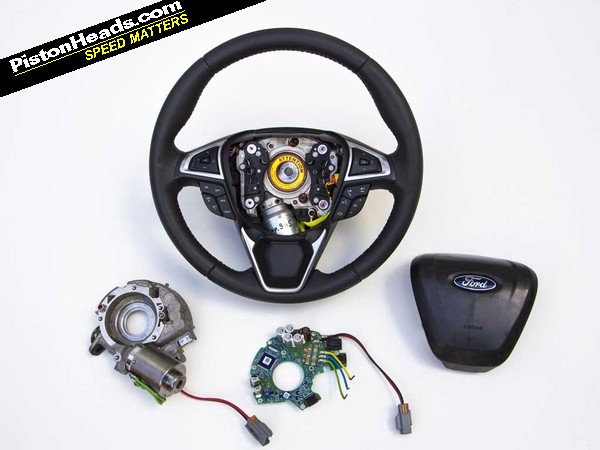
I had a brew and a biscuit. No, still there.

Vorsprung durch technik Lambo could do without
"This new steering technology can make any vehicle easier to manoeuvre and more fun to drive," says Raj Nair, Ford's VP for Global Product Development.
I should probably wait until I've driven a car fitted with it before passing judgement. But I won't. I think that's complete tosh. Furthermore, where exactly is the demand for this gimmickry coming from? Who drives a mainstream modern car and feels strongly enough that the steering effort and gearing is so intrusive they need to lobby the manufacturer for further electronic intervention? For crying out loud, if you really can't hack arm twirling at parking speeds you can already spec your Focus with a self-parking system to spare you the effort.

BMW M doesn't like variable racks either
With further time for reflection much of the understeer reported on in pretty much every Huracan roadtest - including mine - can I think be attributed to this variable rack. If you're a driver of even moderate track ability you should, after a couple of laps, be able to confidently say 'at a given speed if I hold half a turn of lock from turn-in point x, it should carry me to apex point y and then exit point z.' But what if you arrive at the corner a little bit faster than the previous lap? The steering 'relaxes' to give you your Autobahn sneeze factor, you get less steering angle at the front wheels for the same wheel input and it feels like the car is going to go straight on. Panicked you try and dial in a bit more lock but with the rack now literally half as direct as it was the previous lap you feel like there's nothing happening. Even if the front tyres were letting go and the car understeering you wouldn't feel it through the wheel - exactly the sensation in the Huracan.

AMG is resisting the move to variable steering
Maybe I'm being unduly pessimistic. Maybe Ford's excellent track record for democratised dynamics will deliver a system that covers all bases. But after driving the Audi system in both the RS5 and Huracan and noting that M binned the BMW equivalent for the M3/M4 and developed its own rack I don't think it's unreasonable to act a bit Luddite. There are rays of hope - respect to AMG for sticking to its purist guns, ditching the standard A-Class family variable rack and equipping the A-, CLA- and GLA45 with a linear one instead. But with Ford now joining the premium brands in offering this technology that kind of diehard mindset is going to become increasingly rare as these systems spread to more everyday cars.
Bah humbug. Pass the biscuits.
Dan


I'm no driving god, but I like to think I'm at least vaguely capable. I'm not dead yet so must be doing something "not wrong" ...
So long as the bloody thing goes in the direction that I point it I'm not that fussed. I notice super short racks (tuscan) compare to long ones more. And for the road a longer rack tends to work better.
Maybe I'm missing the point and I need to drive these super modern electric steering thingies.
Certainly since I started looking to change my MK3 Mondeo I couldn't help but notice that the steering in mine is better than many more modern cars, and the Focus MK1 is much more lively and responsive than the MK3.
Bring back manual chokes etc. etc.
Variable ratio steering is a physical mechanical system. The variable ratio the steering column end (pinion)has a fixed spline and rack side has spline/teeth closer together in the middle, spreading further apart towards outer edges of the rack this is what governs the variable ratio. Middle is slow and heavy getting lighter and faster towards the ends the more you turn the steering wheel.
Electric variable steering has same idea but mounted on the steering column using fewer splines in a smaller package so the electric motor has to work harder. Like the hydraulic variable ratio system it is a mechanical link and can't change ratio whenever it feels like it as PH doom presumes.
The amount of assistance dilutes feel with less spines the jump between ratios will be greater and matching electric assistance affects it but like the early hydraulic variable ratio system its fine tuning the assistance into a linear feel where ratios change.
BMW M3/M4 and Merc CLA A still have variable ratios on rack and pinion instead of on the column with a electric motor.
It's whiggism to assume all changes and trends are good.
When there's a real and significant reason to deem a change bad or good, it's neither. This is one of those times.
It might make sense in a shopping car, where fun was only ever a happy accident (although who's having trouble with those now?) but a sports car? Ew.
The reality is there *is* a demand for it. From older drivers. Who buys high-end hardware? Folks north of age 50. Here in the US, the median age for a 911 buyer is 53. For a Corvette buyer it's 59! Even Toyota had a crisis in the early 2000s here in the US market when their median buyer age was nearly 60.
Older drivers also buy more new cars, not used. They have more money to spend as well, so average transaction prices are higher with the older crowd. So there you go. Blame pensioners.
Interestingly, I watched a talented friend of mine drive a reverse steer car instinctively by feel and feedback alone. He could get it sideways and apply the correct 'opposite-opposite' lock just by feeling the resistance in the wheel and reacting accordingly, even though it was in the opposite direction to what he was used to.
http://en.wikipedia.org/wiki/Active_Steering
I'm no driving god, but I like to think I'm at least vaguely capable. I'm not dead yet so must be doing something "not wrong" ...
So long as the bloody thing goes in the direction that I point it I'm not that fussed. I notice super short racks (tuscan) compare to long ones more. And for the road a longer rack tends to work better.
Maybe I'm missing the point and I need to drive these super modern electric steering thingies.
Quite often, after changing their rack, these people found they did not need me to tune their suspension, as they could now handle that themselves. Far too many new cars steer just like those things, with their overly quick racks.
Note I am only talking about highway & higher speeds not motorkhana speeds.
We have a few cars. The ladies new Fiesta's steering is abominable. Too light too quick, no feel, a total catastrophe for anything but car parks.
My S2000 not much better. I tend to forgive it a bit because of it's fantastic turn in, but it is deadly in the same way as the Fiesta. It is no accident so many have ended their lives backwards in the scenery. It is very hard to put on little enough opposite lock correction when the back lets go, & the steering gives you no warning it is about to happen. Overcorrection results in the backend flicking back viscously, & the car exiting stage left resulting in another dead S2000.
My Ford/ Mercury Capri with it's 90s Mazda steering is pretty nothing, but also not bad.
However my Triumphs [7 & 8] still have their "armstrong steering". Yes it is a little heavy at parking lot speeds, but on a trip it is so much more relaxing, requiring less concentration than high powered electric steering.
Better still the wheel tells you if one end or the other is getting restless. You are already taking lock off before that tail goes walkabout. In the wet I can make better time, point to point, in the 7 than the S2000, despite the power difference, as I can drive so much closer to the limit in a car that gives me early warning.
And Goofnik "So there you go. Blame pensioners", I'm 74, & my male friends say the same thing, so you had better blame the ladies.
I did find it interesting, watching Monaco, that the latest F1 require more than 190 degrees of lock to get round the hairpin, just like of old, & slower steering than most modern shopping trolleys.
the cars i have driven are a 206(alright feedback), a mk4 fiesta(ok feedback) a focus (dreadful for feedback) a 6n2 polo (good feedback) a citron c1 (ok feedback) a new model seat ibiza (pretty good feedback), a mitsubishi galant latest mk (best feedback of all) Peugeot 207 (dreadful feedback).
the older cars had the best feedback, so if this is the way cars car going to be going, i will stick to cars before this s
 te came in, and just tune them up a bit if i want them to go faster.
Gassing Station | General Gassing | Top of Page | What's New | My Stuff