
Retrofit a timing chain?
Discussion


I have zero mechanical know how, as this question demonstrates.
Timing chains are from what I read probably a better thing to have than timing belts. I guess it's because they last longer which equates to less maintenance.
Assuming I am correct Inthinking this.
Why don't people retrofit timing chains to cars? Obviously there would need to be modifications to the pulleys and the like, but on cars where changing the belt is a ball ache surely a one-off job would be worth the effort?
Timing chains are from what I read probably a better thing to have than timing belts. I guess it's because they last longer which equates to less maintenance.
Assuming I am correct Inthinking this.
Why don't people retrofit timing chains to cars? Obviously there would need to be modifications to the pulleys and the like, but on cars where changing the belt is a ball ache surely a one-off job would be worth the effort?
No.
A number of reasons but you cannot replace a belt with a chain without significant re-design of the engine.
Belts are quieter, cheaper, easier to replace and if done right will last >100k.
Ok so they are a bit pricey to swap but on the whole there isn't enough of an advantage to swap to chain even if you could.
A number of reasons but you cannot replace a belt with a chain without significant re-design of the engine.
Belts are quieter, cheaper, easier to replace and if done right will last >100k.
Ok so they are a bit pricey to swap but on the whole there isn't enough of an advantage to swap to chain even if you could.
wildcat45 said:
I have zero mechanical know how, as this question demonstrates.
Timing chains are from what I read probably a better thing to have than timing belts. I guess it's because they last longer which equates to less maintenance.
Assuming I am correct Inthinking this.
Why don't people retrofit timing chains to cars? Obviously there would need to be modifications to the pulleys and the like, but on cars where changing the belt is a ball ache surely a one-off job would be worth the effort?
In short: Cost/benefit is not worth it.Timing chains are from what I read probably a better thing to have than timing belts. I guess it's because they last longer which equates to less maintenance.
Assuming I am correct Inthinking this.
Why don't people retrofit timing chains to cars? Obviously there would need to be modifications to the pulleys and the like, but on cars where changing the belt is a ball ache surely a one-off job would be worth the effort?
What is the perceived benefit for retro fitting a chain over a belt? Presumably because you think a chain is less likely to break and ruin your engine.
What is the cost of doing it? Massive redesign of the end of the engine, as others have said the tensioners and lubrication system for the chain would need to be addressed.
The cost benefit analysis fails on two counts: First is the outright cost of doing the job; it would be cheaper and less hassle to change the belt at 50% shorter intervals over the cars working life than it would be to build a chain mod.
Second there is also the risk that your "bespoke"/custom system would actually be less reliable than the stock tried and tested belt on that engine, so despite your best efforts you might be more likely to have a failure of some kind which would damage your engine.
A similar idea might be "can I convert my petrol engine to run on diesel so I get more MPG?". (I mean convert, not swap.) You probably could, with a fricken TON of work, but in no way would it ever be economic or sensible to do so due to the cost of the job compared with the money save on fuel. Plus your custom engine job will probably not end up being more fuel efficient anyway.
If you really want a car with a chain not a belt then sell your belt car and buy one with a chain. Or just keep the belt engined car and swap the belt more often if it's something that worries you.
HTH
It's very simple -
Timing belts generally sit out side of the crank case, you remove a plastic cover to get to it.
Timing chains sit inside of the crank case - as they are a metal chain, they are generally bathed or sprayed with oil whilst running. Significantly more work to remove a timing chain.
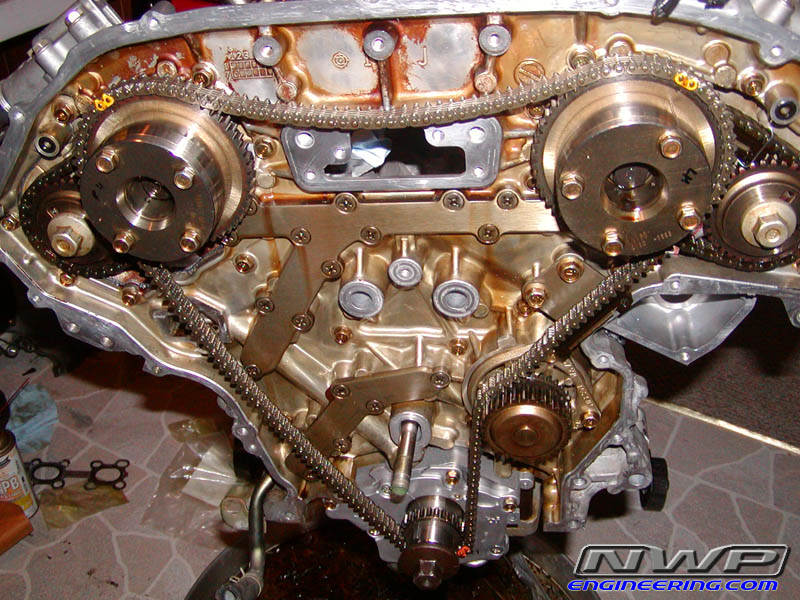
Timing belts generally sit out side of the crank case, you remove a plastic cover to get to it.
Timing chains sit inside of the crank case - as they are a metal chain, they are generally bathed or sprayed with oil whilst running. Significantly more work to remove a timing chain.
kambites said:
I think you'd be surprised at how much effort it would be to achieve. It's not something you can afford to do in a half-arsed way if you value your engine.
J4CKO said:
Probably simpler to change the engine for one with a chain !
Agreed! For starters you need to lubricate a chain..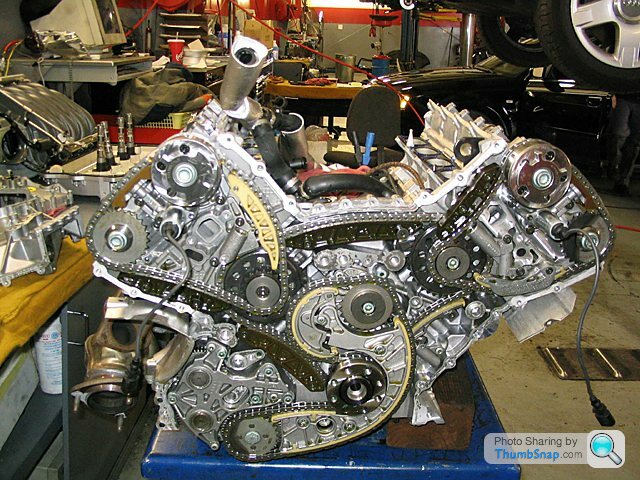
It has been done
the landrover 200/300tdi engine you can buy a kit to change from a belt to gears
https://www.google.co.uk/search?q=300tdi+zeus+gear...
The general opinion is AVOID
the landrover 200/300tdi engine you can buy a kit to change from a belt to gears
https://www.google.co.uk/search?q=300tdi+zeus+gear...
The general opinion is AVOID
Fastdruid said:
Belts are quieter, cheaper, easier to replace and if done right will last >100k.
agree with most of that bar the last bit..the homologation rules as they are (100K miles without major service) means that manufactures have to be able to demonstrate belt life exceeds 100K miles, hence why most engines now are back to chains.
Ah I see. I was thinking a timing chain was just a metal timing belt which worked in the same way as a rubber brot on the end of the engine. Lubrication never occurred to me.
Not that I was thinking of doing it myself. It was just an idle musing with no engineering back up to bring it to a conclusion.
Cheers. I've learnt something today!
Not that I was thinking of doing it myself. It was just an idle musing with no engineering back up to bring it to a conclusion.
Cheers. I've learnt something today!
Scuffers said:
Fastdruid said:
Belts are quieter, cheaper, easier to replace and if done right will last >100k.
agree with most of that bar the last bit..the homologation rules as they are (100K miles without major service) means that manufactures have to be able to demonstrate belt life exceeds 100K miles, hence why most engines now are back to chains.
There have been reports of cars doing >400k on the original belt.
In comparison you have things like the N47 from a certain well known "reliable" German brand with a timing chain...
Ideal is a belt and a non-interference engine. Run it until it snaps then replace.

Fastdruid said:
My 1998 Mondeo had a 100k belt change interval, my 2008 one has a 125k/10 years interval.
There have been reports of cars doing >400k on the original belt.
In comparison you have things like the N47 from a certain well known "reliable" German brand with a timing chain...
Ideal is a belt and a non-interference engine. Run it until it snaps then replace.
may I point out that 1998 cars only had to meet EU2?There have been reports of cars doing >400k on the original belt.
In comparison you have things like the N47 from a certain well known "reliable" German brand with a timing chain...
Ideal is a belt and a non-interference engine. Run it until it snaps then replace.
and yes, I am sure some belts have made more than 100K miles, the problem is guaranteeing it.
a car doing stellar annual mileage would be easy, one doing 5-6K a year won't.
Scuffers said:
.......a car doing stellar annual mileage would be easy, one doing 5-6K a year won't.
Thats why it has X miles/ Y years caveat on intervalsThe belt itself can last well over 100k, thats not always the issue, its the tensioners that fail.
Hence why Vauxhall changed the X25/30 V6 engines from 80k/ 8 years to 40k/ 4 years, then with 'modification' the Z32 V6 engine went back to 100k/ 8 years
mrmr96 said:
Fastdruid said:
Ideal is a belt and a non-interference engine. Run it until it snaps then replace.
Ideal would be a fully electronic linear drive system for the valves? Would allow fully variable timing and lift plus selective cylinder shutdown and no belts or chains.Although until then my favourite is still gear driven cams.
Gassing Station | General Gassing | Top of Page | What's New | My Stuff