
Asymmetrical Tyres - How so?
Discussion


Just had some Eagle F1s delivered and I'm sat here pondering and stroking my beard a bit.. 
Now, I understand the differences between directional, asymmetric, etc, BUT:
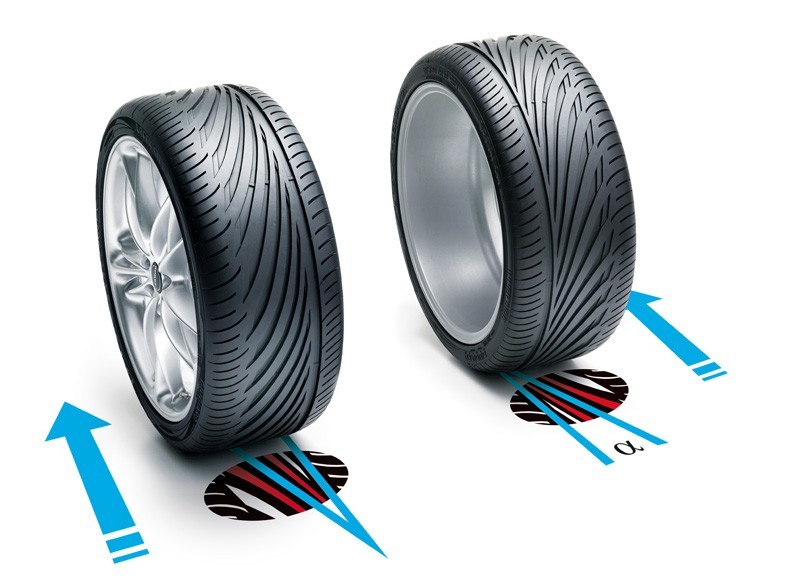
How can it be that a tread designed to work one way round is equally effective the other way round. My head hurts thinking about this as surely the 'sweep' of the lateral grooves was designed to perform best in one particular way... It just seems so counter-intuitive.
I'm probably not explaining myself very well but hopefully someone gets what I mean.

(p.s. £113 quid each delivered - pleased with that)
Now, I understand the differences between directional, asymmetric, etc, BUT:
How can it be that a tread designed to work one way round is equally effective the other way round. My head hurts thinking about this as surely the 'sweep' of the lateral grooves was designed to perform best in one particular way... It just seems so counter-intuitive.
I'm probably not explaining myself very well but hopefully someone gets what I mean.
(p.s. £113 quid each delivered - pleased with that)
Edited by DoubleSix on Friday 19th September 12:21
I know what you mean doublesix - the non-horizontal grooves are pointing the wrong way when rotated, but they obviously don't shift enough water to make a noticable difference when switched in rotation.
Those are relatively shallow rain-channelers to clear the solid tread bands, a completely different prospect to fitting something like a Toyo T1R the wrong way round!
Those are relatively shallow rain-channelers to clear the solid tread bands, a completely different prospect to fitting something like a Toyo T1R the wrong way round!

Krikkit said:
I know what you mean doublesix - the non-horizontal grooves are pointing the wrong way when rotated, but they obviously don't shift enough water to make a noticable difference when switched in rotation.
Those are relatively shallow rain-channelers to clear the solid tread bands, a completely different prospect to fitting something like a Toyo T1R the wrong way round!
The shoulder channels are actually very deep, but again they sweep in opposite directions.Those are relatively shallow rain-channelers to clear the solid tread bands, a completely different prospect to fitting something like a Toyo T1R the wrong way round!
callmedave said:
Are Eagle F1's not symetrical down the centre? can you post a pic so we can deliver our expert advice?
No. The clue is in the name "Goodyear Eagle F1 Asymmetric". The OP has included a pic, maybe you can't see it. If so, it's not too hard to google one.I think the reason is that people think that the direction of grooves in a tyre will help to funnel standing water one way of the other. My understanding is that in reality the water doesn't have time to move along the path of the groove from centre of the tyre to the edge. Instead the standing water that was underneath the tread block is simply moved sideways into the nearest channel and stays there. I.e. it simply moves from where there's rubber touching tarmac, to an area where there is no rubber touching tarmac. The rotation of the wheel has very little to do with forcing water to flow along the channels, really it just goes in the channel to get out of the way of the tread block.
This is why you can still aquaplane when you have tread, because the gaps between tread blocks fill up. If the water really was channelling away then the gaps would self empty and you wouldn't aquaplane.
The reason tyre manufactures add directional treads is purely because they look functional and punters buy them because of it. Look at the tread pattern used on full wet F1 tyres, they are not channelling water away:

Compare that to a Toyo T1R marketed as a perfomance tyre:

It's just marketing with respect to directionality of the tread IMO.
Hence there are better performance gains to be had by making the tyre asymmetric rather than rotational. Because the loads of a tyre side wall whilst cornering are certainly asymmetric, so designing to cope with that load will show more benefit.
I am not a tyre engineer, I'm just thinking critically about how tyres work.
mrmr96 said:
No. The clue is in the name "Goodyear Eagle F1 Asymmetric". The OP has included a pic, maybe you can't see it. If so, it's not too hard to google one.
I think the reason is that people think that the direction of grooves in a tyre will help to funnel standing water one way of the other. My understanding is that in reality the water doesn't have time to move along the path of the groove from centre of the tyre to the edge. Instead the standing water that was underneath the tread block is simply moved sideways into the nearest channel and stays there. I.e. it simply moves from where there's rubber touching tarmac, to an area where there is no rubber touching tarmac. The rotation of the wheel has very little to do with forcing water to flow along the channels, really it just goes in the channel to get out of the way of the tread block.
This is why you can still aquaplane when you have tread, because the gaps between tread blocks fill up. If the water really was channelling away then the gaps would self empty and you wouldn't aquaplane.
The reason tyre manufactures add directional treads is purely because they look functional and punters buy them because of it. Look at the tread pattern used on full wet F1 tyres, they are not channelling water away:
Compare that to a Toyo T1R marketed as a perfomance tyre:
It's just marketing with respect to directionality of the tread IMO.
Hence there are better performance gains to be had by making the tyre asymmetric rather than rotational. Because the loads of a tyre side wall whilst cornering are certainly asymmetric, so designing to cope with that load will show more benefit.
I am not a tyre engineer, I'm just thinking critically about how tyres work.
PH = Full of win. I think the reason is that people think that the direction of grooves in a tyre will help to funnel standing water one way of the other. My understanding is that in reality the water doesn't have time to move along the path of the groove from centre of the tyre to the edge. Instead the standing water that was underneath the tread block is simply moved sideways into the nearest channel and stays there. I.e. it simply moves from where there's rubber touching tarmac, to an area where there is no rubber touching tarmac. The rotation of the wheel has very little to do with forcing water to flow along the channels, really it just goes in the channel to get out of the way of the tread block.
This is why you can still aquaplane when you have tread, because the gaps between tread blocks fill up. If the water really was channelling away then the gaps would self empty and you wouldn't aquaplane.
The reason tyre manufactures add directional treads is purely because they look functional and punters buy them because of it. Look at the tread pattern used on full wet F1 tyres, they are not channelling water away:
Compare that to a Toyo T1R marketed as a perfomance tyre:
It's just marketing with respect to directionality of the tread IMO.
Hence there are better performance gains to be had by making the tyre asymmetric rather than rotational. Because the loads of a tyre side wall whilst cornering are certainly asymmetric, so designing to cope with that load will show more benefit.
I am not a tyre engineer, I'm just thinking critically about how tyres work.
This all makes really good sense mrmr96 - thanks for explanation!
Could it be the tyres re directional due to their construction rather than for water displacement qualities - ie stiffer construction on external sidewall or something.
Perhaps the angle of the little swipes in the tread are not important and are at such an angle for cosmetics instead of just being at 90 degrees to the tread?
Perhaps the angle of the little swipes in the tread are not important and are at such an angle for cosmetics instead of just being at 90 degrees to the tread?
graham22 said:
Could it be the tyres re directional due to their construction rather than for water displacement qualities - ie stiffer construction on external sidewall or something.
Perhaps the angle of the little swipes in the tread are not important and are at such an angle for cosmetics instead of just being at 90 degrees to the tread?
mrmr96 has nailed it. The water just needs somewhere to move to, it doesn't really get channelled as such.Perhaps the angle of the little swipes in the tread are not important and are at such an angle for cosmetics instead of just being at 90 degrees to the tread?
FYI Asymmetric tyres aren't directional (well very rarely) so think you may be confusing separate issues.
DoubleSix said:
mrmr96 has nailed it. The water just needs somewhere to move to, it doesn't really get channelled as such.
FYI Asymmetric tyres aren't directional (well very rarely) so think you may be confusing separate issues.
I was egging at the same, shouldn't have referred as directional but whatever the correct description would be for 'outside facing' - more for the tyre loading/construction mrmr96 answered better & quicker than me.FYI Asymmetric tyres aren't directional (well very rarely) so think you may be confusing separate issues.
Agree that the water is usually displaced fore&aft rather than into the tread patterns and that the patterns are somewhat for asthetics, noise and brand recognition - not to mention for matching should only one tyre get damaged.
Gassing Station | General Gassing | Top of Page | What's New | My Stuff