
How do you work out most efficient speed / rpm ?
Discussion


Pedantic Answer - read the technical section of your owner's handbook
Sensible Answer - For the most part, any speed where you can maintain a constant momentum with as little pressure on the accelerator pedal as possible.
It's not quite as straightforward as that, due to aerodynamic drag and so on, but 54mph in 5th/6th is normally the claimed most efficient.
Sensible Answer - For the most part, any speed where you can maintain a constant momentum with as little pressure on the accelerator pedal as possible.
It's not quite as straightforward as that, due to aerodynamic drag and so on, but 54mph in 5th/6th is normally the claimed most efficient.
Obviously Peak Power RPM will give you the most work per unit of fuel...however, that's now what you're asking. You want to know what uses the least fuel per unit work.
Parasitic losses are:
1) Aerodynamic Drag
2) Rolling resistance of the tyres
3) Mechanical losses in the powertrain/driveline
So probably around 25-30mph in top gear for most cars. The reason trucks go at 56mph in most cases is that it's 90km/h - what they do on the continent as a compromise between getting s t delivered and saving fuel. I see a lot of companies going down to 50mph these days to save extra fuel. Their decisions are not by doing CFD analysis of the truck, but by balancing the cost of paying the driver (per hour payment!) against loss of money through fuel or truck part servicing.
Parasitic losses are:
1) Aerodynamic Drag
2) Rolling resistance of the tyres
3) Mechanical losses in the powertrain/driveline
- 1 is purely dependant on speed, the slower you go the better. #2 is fairly speed independent as is #3.
So probably around 25-30mph in top gear for most cars. The reason trucks go at 56mph in most cases is that it's 90km/h - what they do on the continent as a compromise between getting s
t delivered and saving fuel. I see a lot of companies going down to 50mph these days to save extra fuel. Their decisions are not by doing CFD analysis of the truck, but by balancing the cost of paying the driver (per hour payment!) against loss of money through fuel or truck part servicing.Throttle opening is more influential than rpm. For example, accelerating in 4th at 1500rpm will use a lot more fuel than accelerating in 2nd at 3200rpm. You'll accelerate faster and get to cruising sooner.
In 4th @ 1500 you need a fair throttle position to accelerate a typical everyday car. In 2nd @ 3000 you only need to cover the throttle.
In 4th @ 1500 you need a fair throttle position to accelerate a typical everyday car. In 2nd @ 3000 you only need to cover the throttle.
GroundEffect said:
Parasitic losses are:
1) Aerodynamic Drag
2) Rolling resistance of the tyres
3) Mechanical losses in the powertrain/driveline
That's interesting... all the old textbooks suggest that rolling resistance goes up in an almost linear relationship to speed (actually a very gently rising curve) whereas, of course, aero drag goes up in proportion to the the square of the speed. Is this no longer the case - rolling resistance is considered pretty much fixed regardless of speed?1) Aerodynamic Drag
2) Rolling resistance of the tyres
3) Mechanical losses in the powertrain/driveline
- 1 is purely dependant on speed, the slower you go the better. #2 is fairly speed independent as is #3.
I assume peak engine efficiency (fuel consumption
 ower produced) will be at peak BMEP or thereabouts, but how that correlates with road speed will depend on the curves for parasitic losses, and gearing?
MintSprint said:
GroundEffect said:
Parasitic losses are:
1) Aerodynamic Drag
2) Rolling resistance of the tyres
3) Mechanical losses in the powertrain/driveline
That's interesting... all the old textbooks suggest that rolling resistance goes up in an almost linear relationship to speed (actually a very gently rising curve) whereas, of course, aero drag goes up in proportion to the the square of the speed. Is this no longer the case - rolling resistance is considered pretty much fixed regardless of speed?1) Aerodynamic Drag
2) Rolling resistance of the tyres
3) Mechanical losses in the powertrain/driveline
- 1 is purely dependant on speed, the slower you go the better. #2 is fairly speed independent as is #3.
I assume peak engine efficiency (fuel consumption
ower produced) will be at peak BMEP or thereabouts, but how that correlates with road speed will depend on the curves for parasitic losses, and gearing?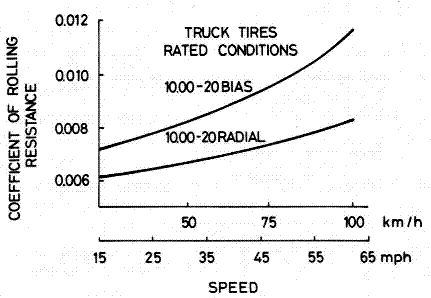
Above shows you the change in coefficient of RR with speed - the rise as speed increases is tiny. A lot of the calcs I've done usually ignore the change with speed because it's not significant, particularly compared to aero drag.
Peak BMEP = peak torque = minimum BFSC. That's the most efficient way to do the maximum work, but not necessarily the most efficient way (i.e. max mpg) to get from A to B. And as you said, there's loads of other variables that control that.
Maths are great but you cant do those and drive.
If you can set up a live reading of your injector duty cycle then you will quickly figure out the most efficient speed for current driving conditions - youll also learn a lot about what behaviours eat fuel and what don't.
Fwiw you can be doing 150 mph on overrun and using almost no fuel at all so you need to qualify the test conditions
Eta. Reread first post so am aware of the no computer rule.
If you can set up a live reading of your injector duty cycle then you will quickly figure out the most efficient speed for current driving conditions - youll also learn a lot about what behaviours eat fuel and what don't.
Fwiw you can be doing 150 mph on overrun and using almost no fuel at all so you need to qualify the test conditions
Eta. Reread first post so am aware of the no computer rule.
Gassing Station | General Gassing | Top of Page | What's New | My Stuff