
Same oil viscosity, does it matter what the brand is?
Discussion


If the spec says an oil for a particular application should be, say 10w/50, 75w140, Dexron III etc, does it matter what the brand is and are we paying more for 'performance' oil brands unnecessarily?
Why use Amsoil, Valvoline etc instead of petrol station brands that have the same viscosity grade for half the price? Does the viscosity grade rating not mean that it is the same oil?
Why use Amsoil, Valvoline etc instead of petrol station brands that have the same viscosity grade for half the price? Does the viscosity grade rating not mean that it is the same oil?
Not quite. You need the correct spec as well but as long as the spec and viscosity is correct then no it really doesn't. Not these days.
Sure I'd be a bit more careful with say an RX-8 (as the wrong oil can cause deposits and hence issues) or something very high performance but not for your boggo diesel/petrol 2l.
Sure I'd be a bit more careful with say an RX-8 (as the wrong oil can cause deposits and hence issues) or something very high performance but not for your boggo diesel/petrol 2l.
If it's an old beater it may not be too much of a problem what oil is used.
A few examples where it might cause an issue though:
- In a Diesel with particulate filter if the wrong ash content oil is used this can prematurely clog the filter. I think "low SAPs" is the general term for the right group of oil to use on those.
- If the manufacturer specifies a long service interval, such as on my E46, it's a nominal 15,000 miles (ECU decides based on the way it's driven). If people stick to these extremely long service intervals the detergency and anti corrosion package of the oil is critical, and on Diesels perhaps the soot dispersion too. Even run on the recommended Castrol edge at ~£80 per oil change, with these long intervals my engine was fairly gunked up when I bought the car, with over 100,000 miles. A fluhh and double oil change sorted it out.
- Some engines have a weak point if the wrong oil is used, such as the VW pump Duse Diesels needing the correct oil to avoid excessive camshaft wear, fine on the right stuff as I understand it, but a ticking time bomb if run on some other oils.
A few examples where it might cause an issue though:
- In a Diesel with particulate filter if the wrong ash content oil is used this can prematurely clog the filter. I think "low SAPs" is the general term for the right group of oil to use on those.
- If the manufacturer specifies a long service interval, such as on my E46, it's a nominal 15,000 miles (ECU decides based on the way it's driven). If people stick to these extremely long service intervals the detergency and anti corrosion package of the oil is critical, and on Diesels perhaps the soot dispersion too. Even run on the recommended Castrol edge at ~£80 per oil change, with these long intervals my engine was fairly gunked up when I bought the car, with over 100,000 miles. A fluhh and double oil change sorted it out.
- Some engines have a weak point if the wrong oil is used, such as the VW pump Duse Diesels needing the correct oil to avoid excessive camshaft wear, fine on the right stuff as I understand it, but a ticking time bomb if run on some other oils.
Why take the risk?
- Additional cost of using correct oil/filter - about £20
- Additional cost of an engine rebuild - about £2,000
Just to add, quite often there is a cheaper brand that still meets all the specs the engine needs:
Example, my car, 2005 330Ci:
Popular/BMW specified oil - Castrol Edge - 8 litres = £73 (Eurocarparts)
Cheaper alternative I use (meet the BMW longlife spec. recommended) - 8 litres = £50
8 litres will give me plenty left over for any topping up between oil services too.
For me it's the happy medium, saving a bit by buying an alternative brand that meets ALL the specs.
However, my engine could probably run on any oil meeting the viscosity required, without the extended change intervals, as although it's a a decent performing engine, with variable valve timing, lots of people run it on very cheap oil with no issues - it seems tolerant of a variety of oils. To make an informed decision I would scour the owners club forums of the car in question and see how sensitive the engine is to using "any old oil", but being aware of the SAPS/DPF issue on Diesels, and reduced drain intervals on some cars.
Example, my car, 2005 330Ci:
Popular/BMW specified oil - Castrol Edge - 8 litres = £73 (Eurocarparts)
Cheaper alternative I use (meet the BMW longlife spec. recommended) - 8 litres = £50
8 litres will give me plenty left over for any topping up between oil services too.
For me it's the happy medium, saving a bit by buying an alternative brand that meets ALL the specs.
However, my engine could probably run on any oil meeting the viscosity required, without the extended change intervals, as although it's a a decent performing engine, with variable valve timing, lots of people run it on very cheap oil with no issues - it seems tolerant of a variety of oils. To make an informed decision I would scour the owners club forums of the car in question and see how sensitive the engine is to using "any old oil", but being aware of the SAPS/DPF issue on Diesels, and reduced drain intervals on some cars.
Ozzie Osmond said:
Why take the risk?
Problem on an old car is you could find yourself topping it up so much that you spend more than the value of the car on oil in a year. - Additional cost of using correct oil/filter - about £20
- Additional cost of an engine rebuild - about £2,000
Plus you 2k engine rebuild quote is OTT. Using the correct viscosity oil but not a 'top' brand won't cause that to happen.
jazzdude said:
If the spec says an oil for a particular application should be, say 10w/50, 75w140, Dexron III etc, does it matter what the brand is and are we paying more for 'performance' oil brands unnecessarily?
Viscosity is only one part of an oils specification. If the oil complies to the required specification for your engine then it's fine to use.The label on oil containers usually lists the various car manufacturers specification numbers.
This is a complex subject, and a difficult thing to be certain about.
So, the vehicle manufacturers come up with specifications that give them the characteristics they want in their engines. Most often, this means the big oil companies spend a lot of time developing and testing formulations to meet the new specification. When they can prove they have passed the test, they are officially approved by the OEM. Castrol, Mobil, Fuchs etc. will be approved in this way.
Then there are a bunch of additive manufacturers, who make viscosity modifiers, soot dispersants, and all the chemicals that need to be added to base oils to make it perform properly. They are often owned by the big oil companies, but as well as supplying their parent company, they will market an additive package that 'meets the standards of' whichever OE test we're talking about. Often they won't be allowed to do so for a few years after the test is introduced, so the big boys retain their hold on the OE franchised network, but when they do, the likes of Comma and Tetrosyl can start making a competing lubricant. But note it 'meets the standards of', rather than being 'approved by'. Their lubricant has never been tested by the OE, won't have done the bench testing and longevity testing that the big boys do, and will not have been formulated specifically for a particular base oil - those guys spot buy whatever they can.
Does this matter? Well, yes, a bit. Firstly, it leaves room at the bottom of the market for unscrupulous traders to put more or less anything in a bottle, claim it 'meets the standards of', and who's going to know? I would treat lesser-known brands with extreme caution. Personally, I would not put Silverhook, ECP's Triple QX, or anything I've never heard of anywhere near my car. Secondly, it is a good test of who is changing your oil. Ask them what they put in - if you find a mechanic who knows there is a difference, and can explain it to you, he (or she) is worth your business. If they say 'it's all the same, we use the cheapest', get away, because you will also receive cardboard clutches, brake pads made from CHS (compressed horse s t) and Prittstick, and oil filters made of Andrex.
For anything a few years old, stick with the reputable aftermarket brands - Comma, Tetrosyl (Carlube) etc.
If you have a nice car and you like it, treat it to a decent brand. It isn't a massive extra investment. Especially if you have a manufacturer warranty - they have been known to knock back claims if the wrong oil was used....
So, the vehicle manufacturers come up with specifications that give them the characteristics they want in their engines. Most often, this means the big oil companies spend a lot of time developing and testing formulations to meet the new specification. When they can prove they have passed the test, they are officially approved by the OEM. Castrol, Mobil, Fuchs etc. will be approved in this way.
Then there are a bunch of additive manufacturers, who make viscosity modifiers, soot dispersants, and all the chemicals that need to be added to base oils to make it perform properly. They are often owned by the big oil companies, but as well as supplying their parent company, they will market an additive package that 'meets the standards of' whichever OE test we're talking about. Often they won't be allowed to do so for a few years after the test is introduced, so the big boys retain their hold on the OE franchised network, but when they do, the likes of Comma and Tetrosyl can start making a competing lubricant. But note it 'meets the standards of', rather than being 'approved by'. Their lubricant has never been tested by the OE, won't have done the bench testing and longevity testing that the big boys do, and will not have been formulated specifically for a particular base oil - those guys spot buy whatever they can.
Does this matter? Well, yes, a bit. Firstly, it leaves room at the bottom of the market for unscrupulous traders to put more or less anything in a bottle, claim it 'meets the standards of', and who's going to know? I would treat lesser-known brands with extreme caution. Personally, I would not put Silverhook, ECP's Triple QX, or anything I've never heard of anywhere near my car. Secondly, it is a good test of who is changing your oil. Ask them what they put in - if you find a mechanic who knows there is a difference, and can explain it to you, he (or she) is worth your business. If they say 'it's all the same, we use the cheapest', get away, because you will also receive cardboard clutches, brake pads made from CHS (compressed horse s
t) and Prittstick, and oil filters made of Andrex.For anything a few years old, stick with the reputable aftermarket brands - Comma, Tetrosyl (Carlube) etc.
If you have a nice car and you like it, treat it to a decent brand. It isn't a massive extra investment. Especially if you have a manufacturer warranty - they have been known to knock back claims if the wrong oil was used....
ajcj said:
They are often owned by the big oil companies,
Not true any more. There are four major lubricant additive suppliers and none of them are owned by oil companies and the largest has never been owned by one. www.lubrizol.comGrayedout said:
The simple test is cost as you most certainly get what you pay for.
If somebody tries to sell you 5 litres of oil for not much over £20 that supposedly meets all the current specifications then walk away because it's b*llsh*t !
Absolutely. These dodgy companies that no one has heard of making unsubstantiated claims.....If somebody tries to sell you 5 litres of oil for not much over £20 that supposedly meets all the current specifications then walk away because it's b*llsh*t !
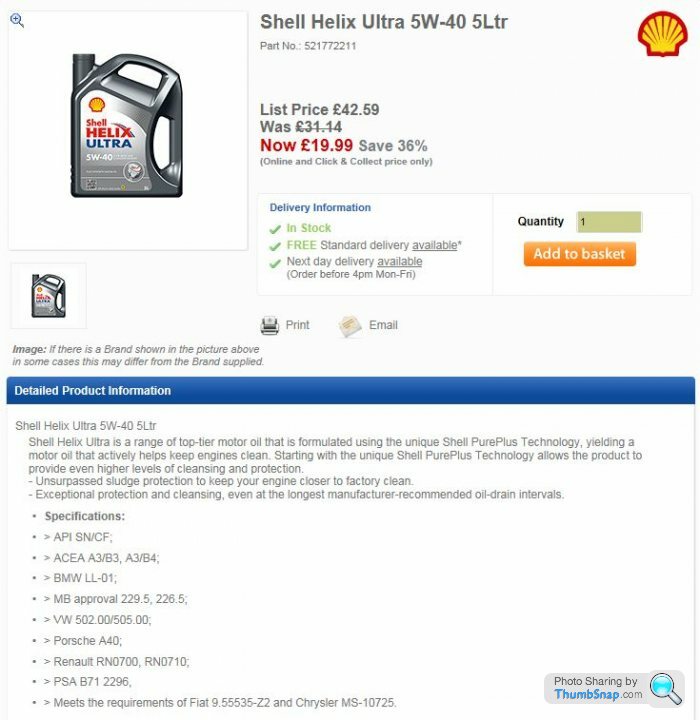
http://www.eurocarparts.com/ecp/p/car-accessories/...
Puddenchucker said:
Grayedout said:
The simple test is cost as you most certainly get what you pay for.
If somebody tries to sell you 5 litres of oil for not much over £20 that supposedly meets all the current specifications then walk away because it's b*llsh*t !
Absolutely. These dodgy companies that no one has heard of making unsubstantiated claims.....If somebody tries to sell you 5 litres of oil for not much over £20 that supposedly meets all the current specifications then walk away because it's b*llsh*t !
http://www.eurocarparts.com/ecp/p/car-accessories/...
And thats not all the specs!
ajcj's response is a good one.
...and I'm going to be the lone voice so far that says "yes, it does matter".
And the short answer is that the more expensive oils will put up with more use/abuse - typically speaking an expensive esther-based synthetic will have more durability, for the same grade/weight, than a 'cracked' synthetic, which will be better than a basic mineral oil.
So if you do low miles, or change oil frequently, or do a high % of low-impact miles (i.e. longer journeys at lower rpm), then it's less important.
But if you fit the opposite categories - short journeys, lots of 'fun' drives, lots of variability in the driving, long gaps between services (e.g. using the bloody awful 'service indicator' on the dash), then the engine life will definitely be improved by a higher-quality oil, as will the overall running/efficiency of it. Albeit probably not by that noticeable an amount - frequent oil changes and good cold-running discipline are more important overall...and it'll only really matter if owning an older car or running the car for a longer time outside of warranty...which is why most people don't care anymore...
...and I'm going to be the lone voice so far that says "yes, it does matter".
And the short answer is that the more expensive oils will put up with more use/abuse - typically speaking an expensive esther-based synthetic will have more durability, for the same grade/weight, than a 'cracked' synthetic, which will be better than a basic mineral oil.
So if you do low miles, or change oil frequently, or do a high % of low-impact miles (i.e. longer journeys at lower rpm), then it's less important.
But if you fit the opposite categories - short journeys, lots of 'fun' drives, lots of variability in the driving, long gaps between services (e.g. using the bloody awful 'service indicator' on the dash), then the engine life will definitely be improved by a higher-quality oil, as will the overall running/efficiency of it. Albeit probably not by that noticeable an amount - frequent oil changes and good cold-running discipline are more important overall...and it'll only really matter if owning an older car or running the car for a longer time outside of warranty...which is why most people don't care anymore...
Theres a guy on the Volvo owners club forum who is an oil sniffer, When he does an oil change he sends a sample off to a specialist oil place and has it analysed and gets a print out of all the % of copper, Iron etc thats in the used oil, He's tried loads of brands and reackons shell oils are the best bang for buck as they use good quality base oils, Ive used Helix for years and i found it has excellent detergents that do keep the engine internals clean and sludge free. The fact its dark brown/Black when you drain it shows that its done its job 
As I always say, in 40 years in the industry I have never seen a BMW, Halford, Tesco etc oil refinery. All oil brands comes from the same source, and is blended with slightly diffrent additives for cleaning etc, very often by the same people for different suppliers. The OP asked about brand, no the brand is not important the viscosity and the spec is.
Same with filters, my first job from school was with Fram filters and they made Fram, Ford, Unipart, and even Rolls Royce branded filters on the same line the only thing that changed was the outer paper sleeve and the boxs.
Petrol is the same what you get depends on the region, it was the case that all petrol in S Wales was Esso refined and all in N Wales was Shell (from Stanlow) just blended differently. I know there are exceptions today where people get one tanker of cheap stuff from Europe, but the big super markets don't do that.
Same with filters, my first job from school was with Fram filters and they made Fram, Ford, Unipart, and even Rolls Royce branded filters on the same line the only thing that changed was the outer paper sleeve and the boxs.
Petrol is the same what you get depends on the region, it was the case that all petrol in S Wales was Esso refined and all in N Wales was Shell (from Stanlow) just blended differently. I know there are exceptions today where people get one tanker of cheap stuff from Europe, but the big super markets don't do that.
ajcj said:
Personally, I would not put Silverhook, ECP's Triple QX, or anything I've never heard of anywhere near my car.
Triple QX:"Earlier this year, our 5w40 PD (521776081) was approved by VAG for use in VW505.01
Yesterday, we had confirmation from Mercedes that our Triple QX 5w30 C3 Engine Oil (521776061) has passed their manufacturer testing and been given full Mercedes Approval for use in MB229.51"
I have used it many times, just as I have used some of the most expensive oils you can buy. It all looks the same when it goes in and comes out and I have never found the engines to run any better or worse.
Gassing Station | General Gassing | Top of Page | What's New | My Stuff