
Mazda's new compression ignition engine
Discussion


Higher octane fuel should allow them to up the compression ratio a bit further if they want to. The prototypes are 16:1 on 87, you might get 18:1 on 95.
It sounds like very clever, interesting tech to me. If it works properly it'll be nice to have a free-revving N/A engine with decent economy.
It sounds like very clever, interesting tech to me. If it works properly it'll be nice to have a free-revving N/A engine with decent economy.
One problem I can see is in the "the engine compresses the fuel/air to just below its ignition point" bit. With fuels in different markets having significantly different knock ratings, wont they need different compression ratios depending on where the car is sold? Or can the same effect be achieved by altering how much fuel is injected depending on its knock rating?
Similarly, what happens if you shove 99 RON petrol in an engine tuned for 95 RON? The fuel's not going to be anywhere near its knock-point so it's not going to burn properly; or if you put 95RON in a car tuned for 99, it'll presumably diesel?
It's an interesting idea, but they need to do some work to demonstrate the practicalities of it.
Similarly, what happens if you shove 99 RON petrol in an engine tuned for 95 RON? The fuel's not going to be anywhere near its knock-point so it's not going to burn properly; or if you put 95RON in a car tuned for 99, it'll presumably diesel?
It's an interesting idea, but they need to do some work to demonstrate the practicalities of it.
Edited by kambites on Friday 26th January 11:43
While I'm not particularly keen on the NVH and ignoring the pollution aspect my biggest issue with FI diesels is the way they make their power (or rather their torque). A hefty amount of boost makes almost all except the very expensive twin turbo larger versions laggy below the boost threshold and with a narrow powerband.
Unfortunately all too many testers seem to either gloss over how laggy diesels can be (or have diesel Stockholm syndrome) so its impossible to judge from reviews which are the good ones and which are terrible.
That it's not turbocharged however bodes well (from what I've read NA diesels have a nice torque curve... there just isn't much of it) but I'll reserve judgement until I've driven one.
Unfortunately all too many testers seem to either gloss over how laggy diesels can be (or have diesel Stockholm syndrome) so its impossible to judge from reviews which are the good ones and which are terrible.
That it's not turbocharged however bodes well (from what I've read NA diesels have a nice torque curve... there just isn't much of it) but I'll reserve judgement until I've driven one.
Krikkit said:
Higher octane fuel should allow them to up the compression ratio a bit further if they want to. The prototypes are 16:1 on 87, you might get 18:1 on 95.
Don't forget they're talking about US fuel when they say "87". The US uses RON+MON/2, everywhere else uses RON - which gives higher numbers for the same thing, on the whole.US 87 is their standard grade fuel. It's roughly equivalent to 91RON, which was briefly available in some European countries in the 80s, and is the "standard" unleaded grade to 95RON's "premium".
Every pump in the US has several grades on it.

If and when it comes here, I'm sure they'll map it for our "vanilla" ("premium") 95RON.
Nanook said:
kambites said:
One problem I can see is in the "the engine compresses the fuel/air to just below its ignition point" bit. With fuels in different markets having significantly different knock ratings, wont they need different compression ratios depending on where the car is sold? Or can the same effect be achieved by altering how much fuel is injected depending on its knock rating?
Similarly, what happens if you shove 99 RON petrol in an engine tuned for 95 RON? The fuel's not going to be anywhere near its knock-point so it's not going to burn properly; or if you put 95RON in a car tuned for 99, it'll presumably diesel?
It's an interesting idea, but they need to do some work to demonstrate the practicalities of it.
I remember seeing pictures a few years back of a Lotus (maybe) proposal for a 4-stroke with variable compression ratio.Similarly, what happens if you shove 99 RON petrol in an engine tuned for 95 RON? The fuel's not going to be anywhere near its knock-point so it's not going to burn properly; or if you put 95RON in a car tuned for 99, it'll presumably diesel?
It's an interesting idea, but they need to do some work to demonstrate the practicalities of it.
Edited by kambites on Friday 26th January 11:43
Otherwise, yeah, surely even changes in ambient temperature, therefore air pressure/density are going to mess with your 'ignition' timing?
TooMany2cvs said:
Krikkit said:
Higher octane fuel should allow them to up the compression ratio a bit further if they want to. The prototypes are 16:1 on 87, you might get 18:1 on 95.
Don't forget they're talking about US fuel when they say "87". The US uses RON+MON/2, everywhere else uses RON - which gives higher numbers for the same thing, on the whole.
Nanook said:
I remember seeing pictures a few years back of a Lotus (maybe) proposal for a 4-stroke with variable compression ratio.
SAAB, back in the early 00s. Basically, the upper half of the block was one part with the head (like quite a few pre-war engines), and hinged.
Nissan did similar with an extra crankshaft to vary the conrod's throw.
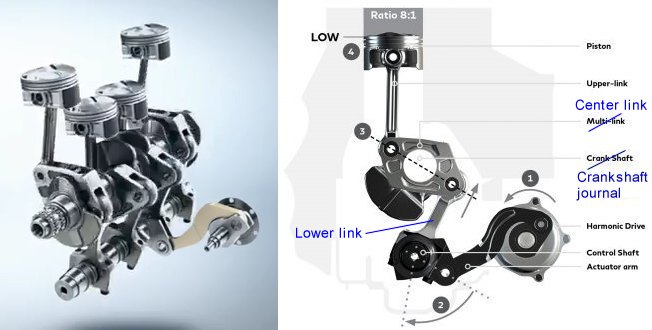
Nanook said:
TooMany2cvs said:
Nanook said:
I remember seeing pictures a few years back of a Lotus (maybe) proposal for a 4-stroke with variable compression ratio.
SAAB, back in the early 00s. Basically, the upper half of the block was one part with the head (like quite a few pre-war engines), and hinged.Nissan did similar with an extra crankshaft to vary the conrod's throw.
http://www.lotuscars.com/engineering/case-study-om...
kambites said:
One problem I can see is in the "the engine compresses the fuel/air to just below its ignition point" bit. With fuels in different markets having significantly different knock ratings, wont they need different compression ratios depending on where the car is sold? Or can the same effect be achieved by altering how much fuel is injected depending on its knock rating?
]
Variable valve timing would give you effectively dynamically variable compression .. maybe Fiat's solenoid driven version would be nice.]
Nanook said:
kambites said:
One problem I can see is in the "the engine compresses the fuel/air to just below its ignition point" bit. With fuels in different markets having significantly different knock ratings, wont they need different compression ratios depending on where the car is sold? Or can the same effect be achieved by altering how much fuel is injected depending on its knock rating?
Similarly, what happens if you shove 99 RON petrol in an engine tuned for 95 RON? The fuel's not going to be anywhere near its knock-point so it's not going to burn properly; or if you put 95RON in a car tuned for 99, it'll presumably diesel?
It's an interesting idea, but they need to do some work to demonstrate the practicalities of it.
I remember seeing pictures a few years back of a Lotus (maybe) proposal for a 4-stroke with variable compression ratio.Similarly, what happens if you shove 99 RON petrol in an engine tuned for 95 RON? The fuel's not going to be anywhere near its knock-point so it's not going to burn properly; or if you put 95RON in a car tuned for 99, it'll presumably diesel?
It's an interesting idea, but they need to do some work to demonstrate the practicalities of it.
Edited by kambites on Friday 26th January 11:43
Otherwise, yeah, surely even changes in ambient temperature, therefore air pressure/density are going to mess with your 'ignition' timing?
kambites said:
One problem I can see is in the "the engine compresses the fuel/air to just below its ignition point" bit. With fuels in different markets having significantly different knock ratings, wont they need different compression ratios depending on where the car is sold? Or can the same effect be achieved by altering how much fuel is injected depending on its knock rating?
Similarly, what happens if you shove 99 RON petrol in an engine tuned for 95 RON? The fuel's not going to be anywhere near its knock-point so it's not going to burn properly; or if you put 95RON in a car tuned for 99, it'll presumably diesel?
It's an interesting idea, but they need to do some work to demonstrate the practicalities of it.
The engine will adjust to different octane levels; the higher the octane the more peak torque shifts to higher engine speeds.Similarly, what happens if you shove 99 RON petrol in an engine tuned for 95 RON? The fuel's not going to be anywhere near its knock-point so it's not going to burn properly; or if you put 95RON in a car tuned for 99, it'll presumably diesel?
It's an interesting idea, but they need to do some work to demonstrate the practicalities of it.
Edited by kambites on Friday 26th January 11:43
J4CKO said:
This seems a bit like a really clever improvement to a CRT telly in about 2004 just as everyone started getting LCD's and Plasmas, and is it really going to make big improvements to Petrol engine economy ?
If you read the article you'll see I clearly explain exactly why this isn't the case. Between this, Infiniti's VC-Turbo (the mechanically variable compression ratio engine already posted in this thread) and Tula/Delphi's Dynamic Skip Fire (which does cylinder deactivation but in a very clever way) it's actually a really exciting time in internal combustion engine technology.
anonymous said:
[redacted]
Perhaps I'm just a bigger car nerd than anyone on PH staff?  But with our audience at Ars, if you leave out the minutest detail they start throwing toys out the pram, so you have to include everything. The flipside of that is I'm lucky that I can write a 2000 word piece on a new engine and no one tells me it's too long and I have to cut it down or simplify it.
Edited by Dr Gitlin on Friday 26th January 14:28
Harji said:
Mazda do some interesting stuff, but because they don't produce a straight line 3,000BHP vehicle , they get no news, while we hear of another Mclaren/Ferrari/Audi/AMG that can do 0-60 .0001 secs quicker than previous model.
Oh, you can read about Bloodhound at Ars too https://arstechnica.com/gadgets/2014/03/bloodhound...
J4CKO said:
This seems a bit like a really clever improvement to a CRT telly in about 2004 just as everyone started getting LCD's and Plasmas, and is it really going to make big improvements to Petrol engine economy ?
Yes and no. With the push towards electrification some of it will be pure battery vehicles (unaffected by this) but a considerable and possibly larger percentage will be hybrid petrol-electric or diesel-electric. Any technology that further improves the efficiency of the ICE component of the drivetrain correlates to making a better vehicle overall.
This probably isn't the night-and-day difference to engine power/fuel economy that turbocharging was - but credit to Mazda for exploring all these sorts of possibilities. (Rotaries never caught on - but hey, how about this then?)
Nanook said:
kambites said:
One problem I can see is in the "the engine compresses the fuel/air to just below its ignition point" bit. With fuels in different markets having significantly different knock ratings, wont they need different compression ratios depending on where the car is sold? Or can the same effect be achieved by altering how much fuel is injected depending on its knock rating?
Similarly, what happens if you shove 99 RON petrol in an engine tuned for 95 RON? The fuel's not going to be anywhere near its knock-point so it's not going to burn properly; or if you put 95RON in a car tuned for 99, it'll presumably diesel?
It's an interesting idea, but they need to do some work to demonstrate the practicalities of it.
I remember seeing pictures a few years back of a Lotus (maybe) proposal for a 4-stroke with variable compression ratio.Similarly, what happens if you shove 99 RON petrol in an engine tuned for 95 RON? The fuel's not going to be anywhere near its knock-point so it's not going to burn properly; or if you put 95RON in a car tuned for 99, it'll presumably diesel?
It's an interesting idea, but they need to do some work to demonstrate the practicalities of it.
Edited by kambites on Friday 26th January 11:43
Otherwise, yeah, surely even changes in ambient temperature, therefore air pressure/density are going to mess with your 'ignition' timing?
Probably a bit more rudimentary given how much the likes of AVL charge for combustion analysis systems, but if they can detect peak pressure level and its location in terms of crank angle degrees (and perhaps they'll also do some heat release rate calcs on that pressure data as its easy enough to do) then they should have all info necessary to punt the timing in the right direction.
I suspect as well that the engine will be able to run purely spark ignited. They can just reduce the effective compression ratio by leaving the intake valves open late. Leaving the spark plug in really is the key to getting the transition between the combustion modes to happen and to get the compression ignition to happen reliably. Though they must have some improvement on spark plugs because I thought they didn't work at high compressions: i.e. getting too hot and not being able to wick the heat away and perhaps the pressure suppressing the spark?
I currently have a Mazda 3 with the Skyactiv-G petrol engine. Its a great car; performance in excess of what the spec sheet suggests, lovely the drive and returns 40 MPG without trying (will do nearly 50 on a motorway schlep) which isn't bad for a 2.0 NA engine (it has already got a 14:1 compression tho).
Edited by Otispunkmeyer on Friday 26th January 15:17
Dr Gitlin said:
J4CKO said:
This seems a bit like a really clever improvement to a CRT telly in about 2004 just as everyone started getting LCD's and Plasmas, and is it really going to make big improvements to Petrol engine economy ?
If you read the article you'll see I clearly explain exactly why this isn't the case. Between this, Infiniti's VC-Turbo (the mechanically variable compression ratio engine already posted in this thread) and Tula/Delphi's Dynamic Skip Fire (which does cylinder deactivation but in a very clever way) it's actually a really exciting time in internal combustion engine technology.
Mazda are innovators but the rest of the market doesnt seem to follow suit, Rotaries, and they put a Miller Cycle engine in the Xedos 9 some years back, nobody followed suit.
Love to hear of developments but realistically cant see this being much more than a footnote.
J4CKO said:
Trouble is, its a Mazda, which are decent enough but sell in pretty tiny numbers, 1.73 percent of UK car sales in 2017, also it is a petrol model and it isnt available yet, nobody has any fuel consumption figures but generally these developments sound awesome and game changing and equate to very little improvement in economy in reality, I remember lean burn stuff being touted in the eighties.
Lean burn was great... but it was killed by the blanket requirement for everything to have a catalytic converter. Gassing Station | General Gassing | Top of Page | What's New | My Stuff