
Petrol Particulate Filters
Discussion


I've been trying to delve into the impact of the recent changes but information seems limited as the advent of the PPF is relatively recent, and there's a lot of contradictory views on the web as usual.
So perhaps a general thread on the topic...
I'm personally trying to understand what impact this has on changes to the OEM exhaust system. Legalities, impact on MOT etc... Seems BMW, Porsche and I suspect many others are no longer offering sports exhausts as an option. Is this due to PPF or regulation regarding decibels?
Some of the questions I've failed to find an answer to include:
- Are current aftermarket solutions (Capristo, Akrapovic, AWE etc) no longer compatible with PPF cars - do we have to wait for new versions of the existing products to be released?
- There's talk of switchable exhausts no longer being a thing. But I read an article yesterday that says the new M340i will have a switchable exhaust...
- I assume a simple axle back system would have no impact on cars with PPF, no threat to MOT etc? Or would this fall foul of decibel limits?
- What effect would axle back AND mid pipe changes have? does the PPF sit before that?
- How do changes to sound limits legislation link in with the PPF are these two separate requirements?
Essentially, I'm trying to work out what options are available for a new PPF fitted car now that OEM sports exhausts seem to have been taken off the table. Am I limited to a back box only or can one still look at full systems and stay within the law? All seems a bit of minefield...
If anyone is particularly well placed to shed some light on all this then I'd love to hear your views and understand the present situation more clearly.
So perhaps a general thread on the topic...
I'm personally trying to understand what impact this has on changes to the OEM exhaust system. Legalities, impact on MOT etc... Seems BMW, Porsche and I suspect many others are no longer offering sports exhausts as an option. Is this due to PPF or regulation regarding decibels?
Some of the questions I've failed to find an answer to include:
- Are current aftermarket solutions (Capristo, Akrapovic, AWE etc) no longer compatible with PPF cars - do we have to wait for new versions of the existing products to be released?
- There's talk of switchable exhausts no longer being a thing. But I read an article yesterday that says the new M340i will have a switchable exhaust...
- I assume a simple axle back system would have no impact on cars with PPF, no threat to MOT etc? Or would this fall foul of decibel limits?
- What effect would axle back AND mid pipe changes have? does the PPF sit before that?
- How do changes to sound limits legislation link in with the PPF are these two separate requirements?
Essentially, I'm trying to work out what options are available for a new PPF fitted car now that OEM sports exhausts seem to have been taken off the table. Am I limited to a back box only or can one still look at full systems and stay within the law? All seems a bit of minefield...
If anyone is particularly well placed to shed some light on all this then I'd love to hear your views and understand the present situation more clearly.
Edited by DoubleSix on Saturday 12th January 10:44
May I be so bold as to give a little feedback as to why there might be few responses? I think the title of the thread doesn't really communicate your specific interest in the implications of PPFs on aftermarket exhausts, just the filters in general. Also you asked for "if anyone is particularly well placed to shed some light on all this", which made me think that you only want informed people to chip in.
It appears that there may be two approaches; a PPF as a separate add-on to the exhaust, downstream of the cat, and another approach which integrates the PPF into the cat inside the downpipe, so close to the turbo outlet.
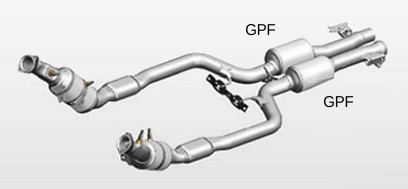
The integrated / downpipe approach feels like it's the way most manufacturers will go in the future. In this case I guess it's unlikely to have much effect on aftermarket exhausts unless they're including a replacement downpipe / cat.
Incidentally, if you're looking for info online I think 'GPF' (Gasoline Particulate Filter) is often the term used.
DoubleSix said:
Seems BMW, Porsche and I suspect many others are no longer offering sports exhausts as an option. Is this due to PPF or regulation regarding decibels?
My guess would be that the sports exhaust might affect the emissions and thus might require separate testing under WLTP. With test stations booked up, it could be that they simply haven't prioritised getting optional extras like the sports exhaust re-homologated for sale.Echoing the above, the reason cats are at the engine end of the exhaust is they need heat to work effectively. Like DPFs, GPFs also need a lot of heat in order to regenerate, so it makes sense to have them as close to the headers as possible so they can use the latent heat in the exhaust gases rather than having to install some sort of petrol-burning apparatus further down the exhaust.
samoht said:
May I be so bold as to give a little feedback as to why there might be few responses? I think the title of the thread doesn't really communicate your specific interest in the implications of PPFs on aftermarket exhausts, just the filters in general. Also you asked for "if anyone is particularly well placed to shed some light on all this", which made me think that you only want informed people to chip in.
Thanks, take your points on board and cheers for the useful info Re GPFs. I was trying to keep the thread general so as not to limit the discussion but understand that may have been counterproductive!The noise regs have no real link with GPFs, but did change within the last couple of years.
There's nothing to rule out switchable exhausts, but there is a far wider range of tests so the systems need to be a bit more clever than they used to be. Aftermarket exhausts (if ECE approved) need to comply with all the same tests within a certain margin of the OE exhaust.
GPF removal will be an MOT fail, same as DPF removal, but there should be less appetite to do it as (in theory) they won't have the same clogging up issues.
Pre GPF aftermarket exhausts probably won't fit GPF cars in a lot of cases, but there's no reason they can't be made as long as the GPF stays in place.
There's nothing to rule out switchable exhausts, but there is a far wider range of tests so the systems need to be a bit more clever than they used to be. Aftermarket exhausts (if ECE approved) need to comply with all the same tests within a certain margin of the OE exhaust.
GPF removal will be an MOT fail, same as DPF removal, but there should be less appetite to do it as (in theory) they won't have the same clogging up issues.
Pre GPF aftermarket exhausts probably won't fit GPF cars in a lot of cases, but there's no reason they can't be made as long as the GPF stays in place.
Edited by blank on Sunday 13th January 13:57
DoubleSix said:
A500leroy said:
Do these block upon constant short journeys like the diesel ones?
From what I've read the inherent higher temps of petrol exhaust make this less of an issue, as do the nature of the particles themselves being smaller than the soot from a diesel.https://phys.org/news/2017-07-diesel-gas.html
Pica-Pica said:
But from what I understand, the smaller nature of gasoline particles make them more pernicious than diesel particulates. They are especially so at low ambient temperatures.
https://phys.org/news/2017-07-diesel-gas.html
Worse to breathe in, but quicker to burn off in regen. Smaller particles provide a greater surface area-mass ratio. https://phys.org/news/2017-07-diesel-gas.html
DoubleSix said:
A500leroy said:
Do these block upon constant short journeys like the diesel ones?
From what I've read the inherent higher temps of petrol exhaust make this less of an issue, as do the nature of the particles themselves being smaller than the soot from a diesel.Whether any of that relates to the real world will be a test of time.
Was involved in a study in college a couple of years ago on particulate filters both CI and SI. (for clarification here CI is compression ignition so diesel and alternative fuels, and SI is spark ignition, so petrol, LPG, CNG etc.)
I believe that GPFs can be more susceptible to poor fuel quality and unwanted hydrocarbons being burnt in the combustion process (oil part rings, stem seals or blocked PCVs etc.) as the size of the particles is smaller than those generated by a diesel.
Have a look at a direct-injected VW, TFSI or TSI. Stick a piece of clean white paper near the exhaust and a good hard rev. More "soot" than expected.
That's what these are designed to reduce.
TBH I'd be concerned at the extra back pressure they generate but that also means that after the GPF you could run a straight pipe and it would hardly affect it at all.
Like most systems they are designed with good fuel (looking at you, Germany) and struct servicing regimes in mind.
Whether they play out this way with some of the frankly hit and miss fuel we get here and some people pushing servicing a little too far for economic reasons I reckon we will see similar issues to some early-gen DPFs.
What I do find is that a DPF-equipped car uses much more fuel than a non-DPF equipped identical car or one that has had the DPF removed. Counter-intuitive.
I believe that GPFs can be more susceptible to poor fuel quality and unwanted hydrocarbons being burnt in the combustion process (oil part rings, stem seals or blocked PCVs etc.) as the size of the particles is smaller than those generated by a diesel.
Have a look at a direct-injected VW, TFSI or TSI. Stick a piece of clean white paper near the exhaust and a good hard rev. More "soot" than expected.
That's what these are designed to reduce.
TBH I'd be concerned at the extra back pressure they generate but that also means that after the GPF you could run a straight pipe and it would hardly affect it at all.
Like most systems they are designed with good fuel (looking at you, Germany) and struct servicing regimes in mind.
Whether they play out this way with some of the frankly hit and miss fuel we get here and some people pushing servicing a little too far for economic reasons I reckon we will see similar issues to some early-gen DPFs.
What I do find is that a DPF-equipped car uses much more fuel than a non-DPF equipped identical car or one that has had the DPF removed. Counter-intuitive.
Hi All
I sent out the following question today and its since been suggested the problem is probably caused by the Close Coupled Petrol Particulate Filter now fitted. Its really quite loud. Any idea if this noise will reduce significantly with use and what the usage instructions, if any, exist regarding this PPF and its future user use, please? Certainly what was always a very silent engine is now not acceptable. Comments please?
Cheers
John
I have just changed my 2014 2.0 petrol CX5, owned from new and fault free, for a brand new 2019 version which has now done 600 miles. The engine is identical to previous and all reports say the new model is even quieter.
On a cold start there is a 'loud fuffing' noise from the area of the exhaust manifold at the rear of the engine towards the firewall. The noise is loud enough to be heard over the radio inside and pretty loud outside. After about 1 mile of sedate rural driving the noise decreases to a level that occurs with a warm start.
I suspected the manifold gasket may be faulty and the noise improves as the exhaust warms and expands the joints. I do not believe this noise is at all characteristic of the car or this petrol engine type and apart from the noise am concerned about potential Carbon Monoxide entering the cabin, unknown to occupants. Are you aware of any similar problems with this engine please? I welcome your thoughts.
I sent out the following question today and its since been suggested the problem is probably caused by the Close Coupled Petrol Particulate Filter now fitted. Its really quite loud. Any idea if this noise will reduce significantly with use and what the usage instructions, if any, exist regarding this PPF and its future user use, please? Certainly what was always a very silent engine is now not acceptable. Comments please?
Cheers
John
I have just changed my 2014 2.0 petrol CX5, owned from new and fault free, for a brand new 2019 version which has now done 600 miles. The engine is identical to previous and all reports say the new model is even quieter.
On a cold start there is a 'loud fuffing' noise from the area of the exhaust manifold at the rear of the engine towards the firewall. The noise is loud enough to be heard over the radio inside and pretty loud outside. After about 1 mile of sedate rural driving the noise decreases to a level that occurs with a warm start.
I suspected the manifold gasket may be faulty and the noise improves as the exhaust warms and expands the joints. I do not believe this noise is at all characteristic of the car or this petrol engine type and apart from the noise am concerned about potential Carbon Monoxide entering the cabin, unknown to occupants. Are you aware of any similar problems with this engine please? I welcome your thoughts.
DoubleSix said:
A500leroy said:
Do these block upon constant short journeys like the diesel ones?
From what I've read the inherent higher temps of petrol exhaust make this less of an issue, as do the nature of the particles themselves being smaller than the soot from a diesel.Had 2 cars with them (2018 Leon Cupra and 2019 Qashqai). Both ended up averaging around 6k a year with a lot of short journeys.
No issues at all and you wouldn't know they had GPFs other than being very quiet. No warning lights and no obvious regents.
I've also seen some data from driving while recording the GPF loading. They basically generate a bit of soot on cold start (colder ambient temperatures give more) but it's a factor of 1000 less than a diesel (mg rather than g). After maybe 5-10 minutes of driving, the soot pretty much clears on the first overrun (e.g. approaching a roundabout or coasting (in gear) up to a traffic light.
Basically, there's nothing to worry about unless you only drive for a couple of minutes at a time. And if you do, you should probably have an EV or bike.
No issues at all and you wouldn't know they had GPFs other than being very quiet. No warning lights and no obvious regents.
I've also seen some data from driving while recording the GPF loading. They basically generate a bit of soot on cold start (colder ambient temperatures give more) but it's a factor of 1000 less than a diesel (mg rather than g). After maybe 5-10 minutes of driving, the soot pretty much clears on the first overrun (e.g. approaching a roundabout or coasting (in gear) up to a traffic light.
Basically, there's nothing to worry about unless you only drive for a couple of minutes at a time. And if you do, you should probably have an EV or bike.
Gassing Station | General Gassing | Top of Page | What's New | My Stuff