
Tubular chassis vs backbone chassis?
Discussion


Elan? Didn't think the Esprit was backbone.
Space frame can be built much stiffer as material can be distributed a greater distance from the central axis and can be designed to provide some side impact protection which the backbone chassis doesn't afford at all.
The backbone was clever because combined with the fiberglass body it was lighter than anything with a steel body at the time and had a lower center of gravity than anything else with a separate chassis (This is the early 60s after all). It also allowed the assembly of the rolling chassis and drivetrain to take place separately to and in parallel with the preparation of the body which was presumably an advantage for such a small scale manufacturer.
Space frame can be built much stiffer as material can be distributed a greater distance from the central axis and can be designed to provide some side impact protection which the backbone chassis doesn't afford at all.
The backbone was clever because combined with the fiberglass body it was lighter than anything with a steel body at the time and had a lower center of gravity than anything else with a separate chassis (This is the early 60s after all). It also allowed the assembly of the rolling chassis and drivetrain to take place separately to and in parallel with the preparation of the body which was presumably an advantage for such a small scale manufacturer.
Also a space frame chassis requires tubes of different profiles, lengths, wall thicknesses etc to be individually shaped, assembled onto a jig and welded, before being dismantled from the jig. A lot of processes going on there. No automation at the time.
Significant sections of the backbone chassis could be stamped and folded by presses meaning fewer components and assembly stages. Steel sheet is really cheap.
Significant sections of the backbone chassis could be stamped and folded by presses meaning fewer components and assembly stages. Steel sheet is really cheap.
HustleRussell said:
Also a space frame chassis requires tubes of different profiles, lengths, wall thicknesses etc to be individually shaped, assembled onto a jig and welded, before being dismantled from the jig. A lot of processes going on there. No automation at the time.
Got to go on a Ginetta tour recently (highly recommended) and that's how they were doing it!Thanks.
Yes, the Esprit is backbone chassis.
About more rigidity, some structural elements can also be built in the shell itself right? I think I have heard of cases like that. A bar in the doors for protection etc too.
So it seems one of the pros for tubular is rigidity and one of the cons is weight in comparison to backbone.
Yes, the Esprit is backbone chassis.
About more rigidity, some structural elements can also be built in the shell itself right? I think I have heard of cases like that. A bar in the doors for protection etc too.
So it seems one of the pros for tubular is rigidity and one of the cons is weight in comparison to backbone.
SPKR said:
Can anybody comment about the pros and cons of each? I had the impression tubular was better, as it's basically a space frame. But people go on and on about how great the Esprit chassis was and that's a backbone. This is for a research paper by the way. Thanks.
The danger is what do people actually mean when they say "chassis". Much of the Esprit's praise is the general handling. Suspension geometry, weight distribution, engine location, spring/damper rates all play a part.The actual chassis is just a frame to hang things off. Ideally a very rigid one (unless you are Morgan enthusiast and are interested in the compliance of wood). Ignoring crumple zones for energy absorption in a crash.
Tubular give the possibility of highly rigid space-frame, but is complex and expensive to mass produce. The Esprit backbone was a good compromise of strength, weight, packaging and cost efficiency.
I think best of all is a carbon fibre tub. light and strong (so rigid). Carbon Fibre also allows the material to be placed to maximum benefit.
TVRs of the 60/70 (and 80s?) all had tubular frames, but were very far from rigid.....
What level is this paper? Look up/google "i values torsional rigidity"
Edited by OverSteery on Wednesday 19th June 17:22
The Morgan chassis is not wooden; the wooden parts were the supports for the aluminium body panels.
The TVR chassis were basically a backbone made of steel tubes (rather than steel sheet) with outriggers to support the body.
A major disadvantage of the backbone was lack of protection for the occupants, particularly in side impacts.
The Lotus backbone chassis were superior to mass produced ones of the day, but were lacking in torsional stiffness compared to a proper space frame. See the poor handling of the backbone chassis Lotus 30 and 40 compared to space frame and monocoque sports racers of the same period.
The TVR chassis were basically a backbone made of steel tubes (rather than steel sheet) with outriggers to support the body.
A major disadvantage of the backbone was lack of protection for the occupants, particularly in side impacts.
The Lotus backbone chassis were superior to mass produced ones of the day, but were lacking in torsional stiffness compared to a proper space frame. See the poor handling of the backbone chassis Lotus 30 and 40 compared to space frame and monocoque sports racers of the same period.
There are tubular chassis and tubular chassis, of course.
A true spaceframe (fully triangulated) is a very different kettle of badgers to a crude, partially triangulated or twin tube chassis.
In a fully triangulated spaceframe, each individual tube is in pretty much pure tension or compression, which is very efficient. Any lack of triangulation means that tubes have to accept bending loads, which is very inefficient, so the difference between a well designed, almost fully triangulated spaceframe and a poorly triangulated one can be massive.
But very basic principles:
A true spaceframe (fully triangulated) is a very different kettle of badgers to a crude, partially triangulated or twin tube chassis.
In a fully triangulated spaceframe, each individual tube is in pretty much pure tension or compression, which is very efficient. Any lack of triangulation means that tubes have to accept bending loads, which is very inefficient, so the difference between a well designed, almost fully triangulated spaceframe and a poorly triangulated one can be massive.
But very basic principles:
- A backbone chassis necessarily has a low second moment of area (Google it, if you don't understand this term, but essentially it means that the material that is doing the work is not far from the neutral axis, so it's not doing its job very efficiently), so in theory a backbone chassis should be inefficient.
- BUT, a backbone can be arranged with no nasty big holes in it to fit engines and people into, so despite its low second moment of area, it can be a very 'perfect' structure, which compensates to a large degree,
- A tubular spaceframe chasses can space its members well out from the neutral axis (ie. it has a relatively large second moment or area), so in theory it should be much more structurally efficient.
- BUT it is very difficult to fully triangulate a spaceframe chassis, because you have to have big openings to fit the engine and occupants into it, and this can ruin the efficiency of the structure.
Edited by Equus on Wednesday 19th June 17:38
My Triumph Herald had a backbone chassis with outriggers for the rear suspension radius arms - until the outriggers rusted away! Torsional rigidity was almost zero; it rattled and shook all the time!
The original Elan scared me when I thought about a side impact. Your pelvis would have been crushed between the tall main backbone component which ran alongside it when you were in the seat, and the incoming vehicle.
The original Elan scared me when I thought about a side impact. Your pelvis would have been crushed between the tall main backbone component which ran alongside it when you were in the seat, and the incoming vehicle.
^^^ The Triumph Herald and TVR chassis are object lessons in how NOT to design a backbone - both are diabolically bad.
The Triumph is basically a ladder frame masquerading as a backbone, and the TVR tubular backbone is basically open on its bottom face, so structurally its more of an inverted U-section than a complete backbone 'tube'... which makes it the worst of all worlds, in respect of the factors I explained above.
I'll probably get attacked by their fanbois for saying it, but if you want to know how NOT to design a backbone, look at TVR, and if you want to know how NOT to design a spaceframe, look at the Ariel Atom.
ETA:
Lack of side impact protection is certainly an issue with backbone chassis (though arguably it's little better in spaceframes like the Caterham Seven).
But looking on the bright side, I wouldn't worry too much about getting crushed up against an Elan backbone - the material is so thin that it would probably just crumple anyway. The main spine of an Elan chassis is made out of 18g sheet steel, I think - certainly, it's thin enough that it will 'oil can' under thumb pressure in the middle of a panel)... I know because I've done it, when rebuilding my Elans. Such is the purity of the design, though, that it still offers better torsional stiffness than the MX5 unitary chassis. Just don't crash it...
The Triumph is basically a ladder frame masquerading as a backbone, and the TVR tubular backbone is basically open on its bottom face, so structurally its more of an inverted U-section than a complete backbone 'tube'... which makes it the worst of all worlds, in respect of the factors I explained above.
I'll probably get attacked by their fanbois for saying it, but if you want to know how NOT to design a backbone, look at TVR, and if you want to know how NOT to design a spaceframe, look at the Ariel Atom.
ETA:
Lack of side impact protection is certainly an issue with backbone chassis (though arguably it's little better in spaceframes like the Caterham Seven).
But looking on the bright side, I wouldn't worry too much about getting crushed up against an Elan backbone - the material is so thin that it would probably just crumple anyway. The main spine of an Elan chassis is made out of 18g sheet steel, I think - certainly, it's thin enough that it will 'oil can' under thumb pressure in the middle of a panel)... I know because I've done it, when rebuilding my Elans. Such is the purity of the design, though, that it still offers better torsional stiffness than the MX5 unitary chassis. Just don't crash it...
Edited by Equus on Wednesday 19th June 17:54
I'd suggest that backbone chassis is cheap, simple, effective for a light sportscar and very adaptable, since it underpinned every Lotus designed between the original Elite (fibreglass monocoque) and Elise (aluminium tub). In that range, it covered front engined, RWD with the Elan, Eclat, Elite v2 and Excel, mid-engined RWD with the original Europa and Esprit, and I'm pretty sure even front engine FWD with the Elan M100, and even rear engined RWD in the DeLorean.
From that I'd conclude it gave a very flexible solution to tying a host of configurations together at a cost viable to a small manufacturer while still able to provide world class handling for a sportscar.
Side impact protection is problematic, as said. Even with outriggers as in a TVR, if the impact force climbs over that protection there's only soft fibreglass trying to stop the driver being squashed against the rigid backbone. Door impact beams and so on can be added but don't have a solid frame to transfer the forces to and share them through the entire car, and their effectiveness is limited compared to the same items in a monocoque.
Spaceframe gives more rigidity, more safety but is very complex and expensive to build. As an advantage, I suppose it can also be viewed as a built in rollcage... Monocoque or carbon fibre or aluminium tub give the best solutions, apparently.
EDIT: Equus just reminded me of another thing... Spaceframes tend to want to avoid big holes, so tend to make ingress and egress more difficult, usually with high sills. With a backbone you can make the door aperture any size and shape you like.
From that I'd conclude it gave a very flexible solution to tying a host of configurations together at a cost viable to a small manufacturer while still able to provide world class handling for a sportscar.
Side impact protection is problematic, as said. Even with outriggers as in a TVR, if the impact force climbs over that protection there's only soft fibreglass trying to stop the driver being squashed against the rigid backbone. Door impact beams and so on can be added but don't have a solid frame to transfer the forces to and share them through the entire car, and their effectiveness is limited compared to the same items in a monocoque.
Spaceframe gives more rigidity, more safety but is very complex and expensive to build. As an advantage, I suppose it can also be viewed as a built in rollcage... Monocoque or carbon fibre or aluminium tub give the best solutions, apparently.
EDIT: Equus just reminded me of another thing... Spaceframes tend to want to avoid big holes, so tend to make ingress and egress more difficult, usually with high sills. With a backbone you can make the door aperture any size and shape you like.
Edited by kiseca on Wednesday 19th June 18:07
kiseca said:
ISpaceframe gives more rigidity...
Actually, usually they don't.In terms of torsional rigidity, and despite the issue of low second moment of inertia, they typically beat most spaceframes, both in terms of stiffness:weight and outright torsional stiffness.
For comparison:
A bare Elan backbone chassis gives about 3,500lb.ft/degree torsional stiffness, from memory (when fitted to the body, the figure goes up to about 4,500lb.ft/deg), versus somewhere between about 1,100lb.ft/degree and 2,700lb.ft/degree for a 'Seven' type spaceframe, depending on how well it's designed... and the Elan chassis is much lighter (I can easily pick one up, single handed - I never weighed it, but would estimate it at around 35-40kg, whereas a typical 'Seven' spaceframe is about 70kg).
If you want to find out about a spectacularly strong tubular chassis check out the current NASCAR race car.
Regarding backbone chassis, Lotus engineered the DeLorean (while busy defrauding UK government) and if you google you'll find the chassis were quite similar between Esprit and DMC12, no doubt keeping real costs down to a minimum.
IIRC a backbone chassis would be considered useless for road cars today due to crash test requirements, perhaps most notably side impact. Take a look at the chassis for current Corvette Stingray by way of contrast (aluminium). Or any of the McLarens (carbon).
Regarding backbone chassis, Lotus engineered the DeLorean (while busy defrauding UK government) and if you google you'll find the chassis were quite similar between Esprit and DMC12, no doubt keeping real costs down to a minimum.
IIRC a backbone chassis would be considered useless for road cars today due to crash test requirements, perhaps most notably side impact. Take a look at the chassis for current Corvette Stingray by way of contrast (aluminium). Or any of the McLarens (carbon).
Some great truth here, but also the odd red herring.
The Esprit relied upon the body in conjunction with the chassis to provide the overall stiffness. Unlike, say, a Land Rover (unstressed body on separate chassis), the Esprit body was designed to carry load once assembled.
If you took the Esprit approach today, you could make it of a carbon-honeycomb sandwich, bonded to a steel backbone, and end up with an exceptionally-rigid package with masses of energy absorption potential in the event of a crash.
For a tubular (whether spaceframe or backbone), you can add a great deal of stiffness by cladding the chassis. Riveted and bonded ali back in the day following aircraft practice; these days just bonded (whether ali, steel, or even carbon - see Gordon Murray's "iStream Carbon" approach on the new TVR for instance).
What's "best"? That depends upon all the other variables. Production volumes, capital expenditure, repairability, durability, expandability, flexibility, and so on.
The Esprit relied upon the body in conjunction with the chassis to provide the overall stiffness. Unlike, say, a Land Rover (unstressed body on separate chassis), the Esprit body was designed to carry load once assembled.
If you took the Esprit approach today, you could make it of a carbon-honeycomb sandwich, bonded to a steel backbone, and end up with an exceptionally-rigid package with masses of energy absorption potential in the event of a crash.
For a tubular (whether spaceframe or backbone), you can add a great deal of stiffness by cladding the chassis. Riveted and bonded ali back in the day following aircraft practice; these days just bonded (whether ali, steel, or even carbon - see Gordon Murray's "iStream Carbon" approach on the new TVR for instance).
What's "best"? That depends upon all the other variables. Production volumes, capital expenditure, repairability, durability, expandability, flexibility, and so on.
skwdenyer said:
If you took the Esprit approach today, you could make it of a carbon-honeycomb sandwich, bonded to a steel backbone, and end up with an exceptionally-rigid package with masses of energy absorption potential in the event of a crash.
Or you could do what Lotus themselves did back in 1992 and build SID, which used a composite-honeycomb sandwich backbone as well as a composite-honeycomb sandwich stressed 'bodyshell':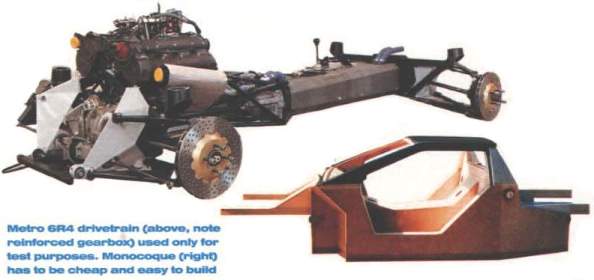
skwdenyer said:
For a tubular (whether spaceframe or backbone), you can add a great deal of stiffness by cladding the chassis.
The figures I quoted above for 'Seven' type chassis include paneling. It doesn't add much for a tubular backbone, if it's fully triangulated, because the structure is almost perfect already, and the additional material you'll add by way of paneling is similarly close to the neutral axis. Lotus-type backbones, of folded sheet steel, are all 'paneling' already, of course.
And, of course, by panelling, you're effectively creating a hybrid spaceframe/monocoque, so it's kind of cheating, if you're trying to analyse the pros and cons of the pure structural 'types'.
Edited by Equus on Wednesday 19th June 19:15

OverSteery said:
The danger is what do people actually mean when they say "chassis". Much of the Esprit's praise is the general handling. Suspension geometry, weight distribution, engine location, spring/damper rates all play a part.
Yes sure. But my thought was if a backbone was an all out bad idea for rigidity etc, even with the rest of the system doing their jobs, the Esprit would not have the praise it has. Actually one of the reasons I chose the Esprit as the example of a bkacbone for the discussion is that it's quite a low tech car, being old now. But it still works somehow. Thanks for the tips. I will google the term.
Gassing Station | General Gassing | Top of Page | What's New | My Stuff