
tyres an tread depth across the width
Discussion


rev-erend said:
Tyres with tread depth lower than 1.6mm is illegal and will result in an MOT fail.
Pretty sure this differs from the police advise of 1.6mm across 3/4 of the tread.
As we are set to enter winter, I would invest in a new set.
Legal is minimum of 1.6mm across the central 3/4 of width for cars.Pretty sure this differs from the police advise of 1.6mm across 3/4 of the tread.
As we are set to enter winter, I would invest in a new set.
vonhosen said:
rev-erend said:
Tyres with tread depth lower than 1.6mm is illegal and will result in an MOT fail.
Pretty sure this differs from the police advise of 1.6mm across 3/4 of the tread.
As we are set to enter winter, I would invest in a new set.
Legal is minimum of 1.6mm across the central 3/4 of width for cars.Pretty sure this differs from the police advise of 1.6mm across 3/4 of the tread.
As we are set to enter winter, I would invest in a new set.
You will likely get an advisory on the depth. That is to make you aware that the tyres would not last through to the next MOT. That sort of advisory is very common.
Edited by Pica-Pica on Monday 5th October 17:06
Here's the government/DVSA's MOT website info for tread width & the measured section.
Tread depth
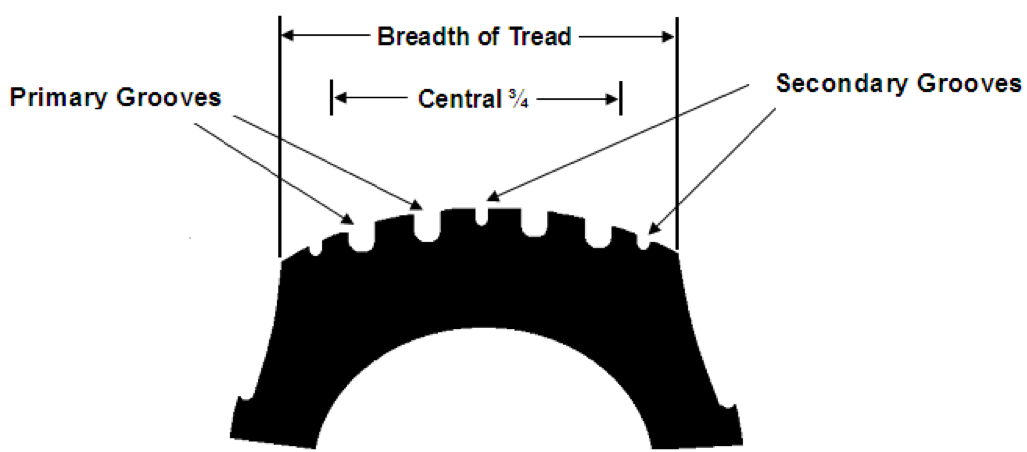
A tread pattern is the combination of plain surfaces and grooves extending across the breadth of the tread and round the entire circumference. It excludes any tie-bars, tread wear indicators, or features designed to wear out substantially before the remainder of the pattern, and other minor features.
In simple terms, grooves containing tread wear indicators (TWI) or grooves cut as deep as those containing the wear indicators when new, are considered to be primary grooves. Other grooves or sipes that are not cut as deep as the primary grooves are secondary grooves and are not to be considered when assessing tread depth.
The ‘breadth of tread’ is the part of the tyre which can contact the road under normal conditions of use measured at 90 degrees to the peripheral line of the tread.
Different vehicles require different tread depths.
The following vehicles first used on or after 3 January 1933 need 1.6mm tread depth:
Either side of the central three-quarters of the tyre can be devoid of tread (‘bald’).
Diagram 1. Primary and secondary grooves in tyre tread pattern
Tread depth
A tread pattern is the combination of plain surfaces and grooves extending across the breadth of the tread and round the entire circumference. It excludes any tie-bars, tread wear indicators, or features designed to wear out substantially before the remainder of the pattern, and other minor features.
In simple terms, grooves containing tread wear indicators (TWI) or grooves cut as deep as those containing the wear indicators when new, are considered to be primary grooves. Other grooves or sipes that are not cut as deep as the primary grooves are secondary grooves and are not to be considered when assessing tread depth.
The ‘breadth of tread’ is the part of the tyre which can contact the road under normal conditions of use measured at 90 degrees to the peripheral line of the tread.
Different vehicles require different tread depths.
The following vehicles first used on or after 3 January 1933 need 1.6mm tread depth:
- passenger vehicles with a maximum of 8 passenger seats, excluding the driver’s seat
- goods vehicles or dual-purpose vehicles not exceeding 3,500kg DGW
- tricycles with an ULW more than 410kg and all quadricycles
Either side of the central three-quarters of the tyre can be devoid of tread (‘bald’).
Diagram 1. Primary and secondary grooves in tyre tread pattern
mmm-five said:
Here's the government/DVSA's MOT website info for tread width & the measured section.
Tread depth
A tread pattern is the combination of plain surfaces and grooves extending across the breadth of the tread and round the entire circumference. It excludes any tie-bars, tread wear indicators, or features designed to wear out substantially before the remainder of the pattern, and other minor features.
In simple terms, grooves containing tread wear indicators (TWI) or grooves cut as deep as those containing the wear indicators when new, are considered to be primary grooves. Other grooves or sipes that are not cut as deep as the primary grooves are secondary grooves and are not to be considered when assessing tread depth.
The ‘breadth of tread’ is the part of the tyre which can contact the road under normal conditions of use measured at 90 degrees to the peripheral line of the tread.
Different vehicles require different tread depths.
The following vehicles first used on or after 3 January 1933 need 1.6mm tread depth:
Either side of the central three-quarters of the tyre can be devoid of tread (‘bald’).
Diagram 1. Primary and secondary grooves in tyre tread pattern
In addition to all that, an asymmetric all-season tyres such as Vredestein Quatrac 5, will have have sipes on the inside - designed for ice/snow grip, normal grooves across the centre - to balance dry and wet handling, especially aquaplaning, and reduced sipes and grooves on the outside for dry handling.Tread depth
A tread pattern is the combination of plain surfaces and grooves extending across the breadth of the tread and round the entire circumference. It excludes any tie-bars, tread wear indicators, or features designed to wear out substantially before the remainder of the pattern, and other minor features.
In simple terms, grooves containing tread wear indicators (TWI) or grooves cut as deep as those containing the wear indicators when new, are considered to be primary grooves. Other grooves or sipes that are not cut as deep as the primary grooves are secondary grooves and are not to be considered when assessing tread depth.
The ‘breadth of tread’ is the part of the tyre which can contact the road under normal conditions of use measured at 90 degrees to the peripheral line of the tread.
Different vehicles require different tread depths.
The following vehicles first used on or after 3 January 1933 need 1.6mm tread depth:
- passenger vehicles with a maximum of 8 passenger seats, excluding the driver’s seat
- goods vehicles or dual-purpose vehicles not exceeding 3,500kg DGW
- tricycles with an ULW more than 410kg and all quadricycles
Either side of the central three-quarters of the tyre can be devoid of tread (‘bald’).
Diagram 1. Primary and secondary grooves in tyre tread pattern
semisane said:
Thanks for the feedback
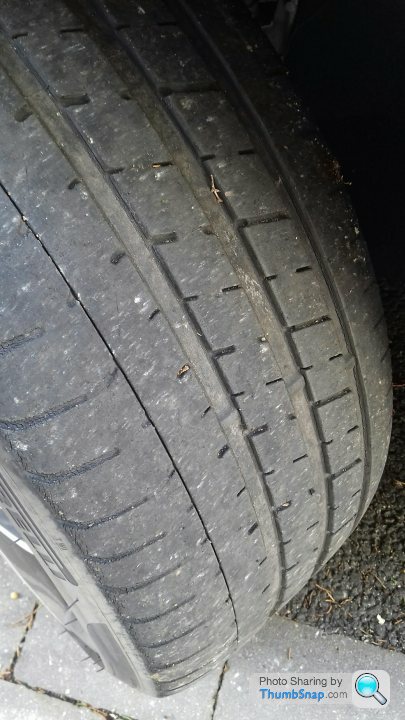
ok so the attached diagram shows centre 3/4 - as such I don't see how they could be legal......
unless of course I have misunderstood the guidance ?

That black line does not look like the centre-line, the red circled part is not considered part of the ‘centre 3/4’ to me.ok so the attached diagram shows centre 3/4 - as such I don't see how they could be legal......
unless of course I have misunderstood the guidance ?
They arent illegal but are getting past their best, evidence of cracking as well which wont cause it to fail but another clue that they are not that far off replacing.
< 1.6mm is the point at which you get three points per tyre, the legal minimum and to me its too low really as the tread pattern has long since stopped effectively clearing water and is now more of a vestige of where the tread used to be, 4mm or more is recommended for winter driving.
For a lot of people tyres are a distress purchase and not expected, it comes at MOT time and the main stipulation is often the cheapest available, which are often utter s t, best to go for mid range recognised brands if not the top tier. I have had budgets and by and large they have been very variable, some were acceptable and others amazed me how anyone made and sold something so completely useless and dangerous (Triangle they were called)
< 1.6mm is the point at which you get three points per tyre, the legal minimum and to me its too low really as the tread pattern has long since stopped effectively clearing water and is now more of a vestige of where the tread used to be, 4mm or more is recommended for winter driving.
For a lot of people tyres are a distress purchase and not expected, it comes at MOT time and the main stipulation is often the cheapest available, which are often utter s
t, best to go for mid range recognised brands if not the top tier. I have had budgets and by and large they have been very variable, some were acceptable and others amazed me how anyone made and sold something so completely useless and dangerous (Triangle they were called)Pica-Pica said:
semisane said:
That black line does not look like the centre-line, the red circled part is not considered part of the ‘centre 3/4’ to me.
also note cracking around the circumference towards the inside.....
DailyHack said:
More concerned about the cracking on the edges than tread 3 or 4mm or not!
My understanding is cracking isnt evidence of the tyre being about to fail in a spectacular manner, some tyres (Michellin Pilot Sports for example) are very prone to it but it doesn't significantly weaken the tyre, the cracks are very shallow and not really anything to worry about in most cases they are superficial. Bulges and slits are the ones to worry about as that is where the structure has been compromised and is likely lead to a failure.Orangecurry said:
Might just be the Ackermann effect if on full-lock. Depends on the car.
And from this angle, the outer edges are wearing more, so you should get a proper GEO, not the crap one at Kwik-fit
Some cars tend to wear tyres in a certain way, my BMW hammers the front tyres on the outside edges, evenly, its just the way they are set up, I asked our local place to check the fronts when I replaced the rears and it was perfect apparently.And from this angle, the outer edges are wearing more, so you should get a proper GEO, not the crap one at Kwik-fit
Edited by Orangecurry on Monday 5th October 19:36
semisane said:
Thanks all - yes time to change.
As an aside I get really bad 'crabbing' in the cooler weather at parking speed.
Will a new set of tyres get rid of this or do I also need to get the geometry checked ?
Crabbing might just be what your car does. I've found that wore the insides rather than outsides though.As an aside I get really bad 'crabbing' in the cooler weather at parking speed.
Will a new set of tyres get rid of this or do I also need to get the geometry checked ?
Gassing Station | General Gassing | Top of Page | What's New | My Stuff