
Why aren't fuel gauges more accurate?
Discussion


Basically, every car I’ve ever had, from old sheds to 9-month-old metal, have had fuel gauges that are at best an estimation.
After first filling up, it takes ages and ages for the needle to move at all.
Once it does begin to move, it slowly drops to the half-tank mark.
And then once I get to half a tank, it seems to plummet to empty at double the pace.
This seems to be the case with every car I’ve owned.
I’ll take my Mustang GT as an example, from a full tank the car shows an estimated 425-450 miles range, I’ll get 250 miles from a full tank to about half a tank.
At the half-tank mark, the estimated range will still show around 200 miles remaining, but I end up needing to fill it up after just another 100 or so miles (usually I run it low, a gallon left in the tank at most).
Digital range estimation aside, and just using the gauge itself, the first half on the gauge seems to take 2.5x longer to go down than the second half and it seems to be like this on every car (not necessarily as big of a difference).
Why? Is it that hard to have an accurate fuel gauge that accurately shows your fuel level?
It's not hard to have an accurate fuel gauge, bit it is harder than having an inaccurate one and manufacturers will, as with anything else, have to decide whether it's worth the extra cost.
To turn the question on its head, all other things being equal would you pay more for a car to get an accurate fuel gauge? If so, how much more.
To turn the question on its head, all other things being equal would you pay more for a car to get an accurate fuel gauge? If so, how much more.
I would assume:
Most fuel level sensors are very simple and purely measure the height of the fluid. That would work perfectly if every fuel tank was a nice cube.
In reality they will be quite complex different shapes, so a 10% change in fluid height near the top could be a very different volume of fuel compared to a 10% change of height near the bottom.
Quite basically fuel senders are a hinged stick have a float on them, coupled with a resistor to send that position of the stick (=arm) which will interpret that as an approximate fuel volume on the gauge in the instrument cluster. There will be electronic damping software to compensate for temporary uphills, downhills, and laterally g forces. The fuel will be retained in a swirl pot so as not to run out on swift turns. (One test for this is 3 complete circles at maximum lateral g, at three different, very tight, circle diameters. The fuel should pick up on these tests, even though the driver may throw up). To avoid damage to the float, the float will never reach the top or bottom of the tank, whereas the fuel will, hence the reason why the F mark will never be exceeded on the gauge, although the fuel level may be above the point from where the float is physical controlled to avoid hitting the top of the tank. The float will stay there (and hence read Full) until the level drops to a point where the float can the drop as well. Once the lower float point is reached, fuel injection pulses will be read to adjust the distance to empty, as the float can no longer do that. That is how it used to be, I doubt it has changed since then.
Edited by Pica-Pica on Thursday 2nd December 15:32
Pica-Pica said:
Quite basically fuel senders are a hinged stick have a float on them, coupled with a resistor send that position of the stick (=arm) which will interpret that as an approximate fuel volume on the gauge in the instrument cluster. There will be electronic damping software to compensate for temporary uphills, downhills, and laterally g forces. The fuel will be retained in a swirl pot so as not to run out on swift turns. (One test for this is 3 complete circles at maximum lateral g, at three different, very tight, circle diameters. The fuel should pick up on these tests, even though the driver may throw up). To avoid damage to the float, the float will never reach the top or bottom of the tank, whereas the fuel will, hence the reason why the F mark will never be exceeded on the gauge, although the fuel level may be above the point from where the float is physical controlled to avoid hitting the top of the tank. The float will stay there (and hence read Full) until the level drops to a point where the float can the drop as well. Once the lower float point is reached, fuel injection pulses will be read to adjust the distance to empty, as the float can no longer do that. That is how it used to be, I doubt it has changed since then.

The kind of thing I'd never thought about but makes perfect sense when pointed out.
Buffy d said:
Older BMs, like my E28 and the E24, had an asymmetric fuel gauge to compensate for the shape of the fuel tank I believe 
Pic stolen from the internet:
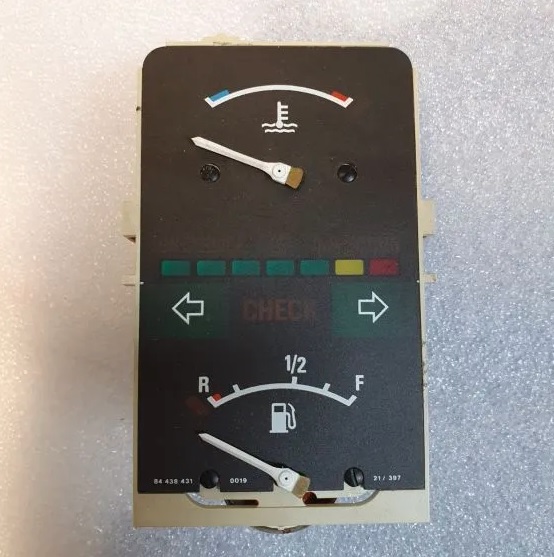
Ha! Ha! Before compensatory software was in place. Pic stolen from the internet:
I do recall, way, way back, as a small boy, being in a car where the fuel needle would swing about as the vehicle moved and jolted about. Jerrycans were popular then too!
Because there's no real need for them to be accurate. They're only there to save you running out of fuel. I prefer the way my Moto Guzzi does it: a light comes on when it decides the fuel level is low enough for me to think about topping up. It also shows me how many miles I've done since the light came on, but that's just laughs, really.
 )
dontlookdown said:
Have wondered the same thing. Can only presume it's some kind of nudge psychology. Once the gauge starts to drop, it drops quickly and you are supposed to think 'ooh, I better fill up'. All a bit nannyish really.
My Merc stops telling you the range once you get below 30 miles remaining, I assume in an attempt to stop you playing roulette!Pica-Pica said:
Ha! Ha! Before compensatory software was in place.
I do recall, way, way back, as a small boy, being in a car where the fuel needle would swing about as the vehicle moved and jolted about. Jerrycans were popular then too!
I remember the Rover 220 would swing from a quarter to empty to well above half full on left turns (and obviously the other way round). I do recall, way, way back, as a small boy, being in a car where the fuel needle would swing about as the vehicle moved and jolted about. Jerrycans were popular then too!
Gassing Station | General Gassing | Top of Page | What's New | My Stuff