
MX-5 sets four lap records... on fossil-free fuel
A thousand miles, four famous circuits, and a whole lotta hope

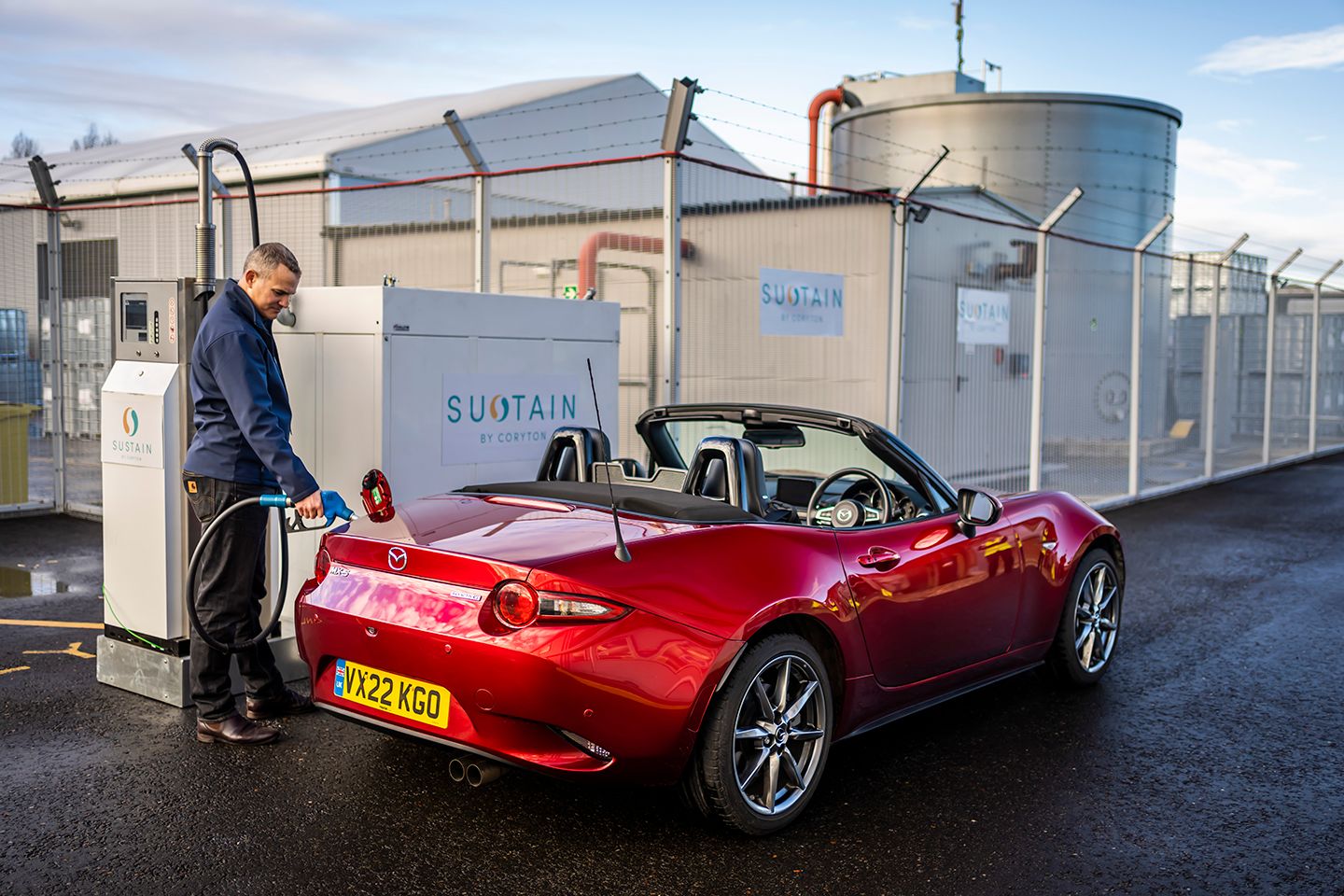
Driving an MX-5 a thousand miles and around four race tracks - Knockhill, Anglesey, Oulton Park and Kirkistown - sounds like wonderful way to spend a week for any PHer. Mazda UK (clearly endowed with unspent marketing budget) has just undertaken the trip itself, with one crucial difference: the MX-5 was running on fossil-free sustainable petrol.
This completely standard 2.0-litre MX-5 Roadster was powered by Coryton’s Sustain fuel, which is created from 100 per cent agricultural waste, hence Mazda can claim benchmark lap times for a car using sustainable fuel (canny old dogs). No modifications were required, and the little Mazda is said to have averaged 45mpg when not hooning around racetracks. The firm reckons the trip was about ‘highlighting the role sustainable fuels can play in de-carbonising both road cars and motorsport, the drive also highlights how sustainable fuels could complement Mazda’s Multi-Solution approach to achieving climate neutrality.’ Which, of course, is the song we're hearing on repeat from wily Japanese manufacturers.
That motorsport mention is important, too. Mazda is already competing in Japanese Super Taikyu with a biodiesel powered 2, and a more powerful 3 is coming, too. For this circuit drive, Mazda involved Motorsport UK ‘to recognise and support the completion of laps on a circuit in each of the UK nations.’ While there are series out there like Porsche Supercup already using synthetic fuel, it would be great to see grassroots motorsport find a more sustainable alternative as well. Just think how many MX-5s are out there racing...

Motorsport UK’s CEO Hugh Chambers said of the drive: “Sustainable fuels, such as biofuels, efuels and synthetic fuels provide a low-carbon alternative to conventional hydrocarbon fuels, ensuring the lifespan of these vehicles is maximised with minimum impact. It’s fantastic to see Coryton Fuels join forces with Mazda to demonstrate that it’s possible for everyday road cars to not only be driven on a motorsport circuit powered by 100% sustainable fuels, but do so with no loss of performance or reliability.”
Which all sounds - dare it be said - quite encouraging, even taking into account the oft-mentioned shortcomings of e-fuels. Mazda’s Multi-Solution approach to carbon neutrality now includes Spark Controlled Compression Ignition, mild hybrids, PHEVs, Skyactiv electric vehicles, the big straight-six petrol and diesels coming to the CX-60 next year, and now steps towards fossil fuel-free fuel as well. Mazda is also keen to point out it was the first OEM to join the eFuel Alliance. Needless to say, to us this sort of approach sounds far more interesting than simply a glut of electric SUVs.
Obviously the availability of fuel without fossils in it is still over the horizon - and heaven knows how much it’ll cost - but we're happy to cling to Mazda's optimism. UK MD Jeremy Thomson noted: “This is a brilliant demonstration of how sustainable fuels can play a part in reducing automotive CO2 emissions if they became widely available. In line with Mazda’s position on renewable efuels, I’m delighted that with this activity here in the UK we have helped to increase discussion and awareness on the part sustainable fuels can play alongside electrification in reducing emissions from vehicles.” Amen to that.


TX.
This is potentially the way to keep fun cars alive in a way that's better for the environment. Why the f
 k are you here if you aren't in favour of that?
I can already predict who's going to start posting with the usual straw man arguments.
TX.
This is potentially the way to keep fun cars alive in a way that's better for the environment. Why the f
k are you here if you aren't in favour of that?I can already predict who's going to start posting with the usual straw man arguments.

Sustainable fuels are those that are not extracting new carbon that's safely tucked away in the ground, where it should be, so how do you make it?
As fanciful as it may seem, it's a recycling of the Co2 that's already in the atmosphere, either through natural means (plants are good at this), or mechanical means (lots of energy), either way your looking for a way to get the Hydrogen and Carbon atoms into a process that you can then reform into a liquid you can use.
1. Loads of energy.. yes and no.
There is one method that uses ethanol as a base that is put back through the processes, stripping away the oxygen molecule and then reforming to produce a broad range hydrocarbon. The beauty of this method is that the ethanol is made using residual heat from industry (in this case a bakery), the second process then creates an exothermic reaction, where the heat is recovered and effectively self powers.
Second method, you need to make methanol and hydrogen first. Yes that's very energy intensive, and is the true definition of an e-fuel (notice I didn't call the last one an e-fuel). Idea behind these is to utilise excess renewable energy to create the methanol and hydrogen before it going through a very similar process as above. These facilities are designed to be built "off-grid" where it is hard to transport energy down a cable, i..e Sahara or Chile windfarms. In this case think of the liquid as nothing more than an energy carrier, of which liquid is rarely beaten as we've had 140 years of building infrastructure around it.
2. Still got tail pipe emissions. Yes there is, but they are not new emissions, they were already in the environment, and in the case of methane that also goes into these fuels, you're effectively reducing Co2 emissions 10 fold to the warmer effects of methane Vs Co2.
3. Cost, not sure if this one's been asked yet. But yes more expensive, but then so are EVs and they will get more expensive once all the incentives are removed. There is however a simple supply Vs demand issue with sustainable fuels..
4. Why does it make a difference now Vs an ev. Simply because you don't have to scrap an older car, by a new one with 30% more imbedded emissions, drive 60K miles to recover those emissions before the ev pays you back (based on a renewable grid, it's about 3 X as bad in Germany).
5. Full (big) Evs are a waste, hybridisation is technically the best solution, along with sustainable fuels. For every Tesla esq car, you could have 11 hybrids doing the same journeys an average driver does, so from a resource perspective they are better for the environment.

Maybe if enough people undertake these sorts of endeavours, the government will wake up and realise that the enemy is the use of fossil fuels, not internal combustion engines! It's not too late for them to undo the 2030 and 2035 bans and look instead at subsidising and encouraging the development of non-fossil fuels in order to help bring down production costs, thereby increasing demand and making them financially viable for the millions of motorists who don't want to ditch their perfectly fine ICE vehicles.
It just seems crazy to me for society to be binning technology that has evolved enormously and so effectively over the last 100+ years!

there said it !

From s**t, comes methane, from methane you can make Methanol! That Methanol can either be made in to a surogate, or in to MTBE (methyl tertiary butyl ether), this is used in a wide range of industries as well as fuels.
In that respect it is deemed carbon neutral.
Bio-gasoline has been in production for over a decade, the process of turning plant sugars into combustible fuel is a bit like fermenting grapes into wine I suppose.
The amount of biogasoline/petrol you can produce from a certain amount of plant matter, and the cost of the plant, equipment and process input energy required is what we really need to know.
But as usual, these details are not disclosed, I will leave you to draw your own conclusions as to why that might be the case.
Suffice to say that decarbonisation isn't really decarbonisation if it requires a huge amount of upfront investment which entails the production of millions of tons of plant & equipment that produces lots of upfront carbon emissions.
There is a laws of physics element at play here which takes a bit of explaining.
Basically, the more mass (weight) you put into the medium that is storing the energy you carry in the vehicle, the less waste heat is produced in the equivalent well-to-wheel chain.
And waste heat is a bedfellow of carbon emissions.
Lightweight storage media such as liquid fuels and hydrogen unfortunately produce large amounts of waste heat.
Large amounts of waste heat, i.e. low efficiency, is annoyingly good at be very counterproductive to decarbonisation efforts.
Trying to explain this is almost certainly going to get me labelled as an EV-fanboi, despite the fact that I don't own or drive an EV.
What TX describes as 'miraculous battery improvements' has got nothing to do with energy efficiency, but everything to do with energy density.
These are mutually exclusive characteristics, but it seems that details such as these go in one ear and out the other.
Energy efficiency is, to all intents and purposes, a baked-in characteristic that cannot be altered no matter how much money or time you have.
It would be lovely to be able to say otherwise, but the simple fact of the matter is that the combination of a very high energy load (tens of millions of passenger cars) and a low efficiency decarbonisation option WILL NOT decarbonise anything.
And that's assuming you can find the enormous amount of money it would require to try doing it on a mass scale anyway.
Hence we get all manner of smokescreens and diversions to try to steer us away from these uncomfortable truths.
Q. How much can you produce
A. Unfortunately thats a "it depends" answer. a UCL study concluded there was enough organic waste to create enough fuels to de-fosilise the European light duty sector and beyond (aviation forget it). However, lets take the e-fuels scenario - in theory an infinite amount until Co2 runs out, that woudl be great wouldn't it - well no we still need co2 to live, but you probably get the point.
Q. Reward vs effort (resource)
A. Most of these plants will be needed in the long term to replace the petrochemicals industry, unless we want to stop making everything..??? The idea behind all of these plants, is short term sustainable fuels goals whilst we work on other technologies that can achieve the desired results, so that in the long term they are repurposed to make the chemicals we all need in our every day lives.
Q. efficency -
A. you can be as inefficient as you like as long as you have unlimited resources. Clearly this works with e-fuels in "off-grid" renewables scenario. The cost is what will ultimately be led by market forces as the energy will not be competing with on-grid requirements.
there said it !
From s**t, comes methane, from methane you can make Methanol! That Methanol can either be made in to a surogate, or in to MTBE (methyl tertiary butyl ether), this is used in a wide range of industries as well as fuels.
In any case, it doesn't change the fact that gross inefficiency pushes the system-level decarbonisation timeline way too far to the right.
Ugly as it seems, the fastest decarbonisation option for cars, in absence of a massive reduction in use, is to put mass into batteries and avoid the inefficiency in the first place.
Then it becomes a question of the importance of decarbonisation vs damage from mineral extraction.
Whilst batteries are heavily scrutinised and their carbon footprints are advertised in lights for everyone to see, things like distillers, electrolysers, compressors, storage tanks and huge increases in electricity generating resources (above and beyond the EV burden) are all essentially given a free pass.
Despite the fact that they also have their own carbon footprints...
At a system level, the best decarbonisation option is the one with the lowest incremental mass burden as seen by the planet.
Unfortunately, this means the heaviest mass burden as seen by the car owner, which is fundamentally why we have so much ill-informed resistance to EVs, because, in general, people will only look at what is before their eyes, and not what's hidden in the background.
Sustainable fuels are those that are not extracting new carbon that's safely tucked away in the ground, where it should be, so how do you make it?
As fanciful as it may seem, it's a recycling of the Co2 that's already in the atmosphere, either through natural means (plants are good at this), or mechanical means (lots of energy), either way your looking for a way to get the Hydrogen and Carbon atoms into a process that you can then reform into a liquid you can use.
1. Loads of energy.. yes and no.
There is one method that uses ethanol as a base that is put back through the processes, stripping away the oxygen molecule and then reforming to produce a broad range hydrocarbon. The beauty of this method is that the ethanol is made using residual heat from industry (in this case a bakery), the second process then creates an exothermic reaction, where the heat is recovered and effectively self powers.
Second method, you need to make methanol and hydrogen first. Yes that's very energy intensive, and is the true definition of an e-fuel (notice I didn't call the last one an e-fuel). Idea behind these is to utilise excess renewable energy to create the methanol and hydrogen before it going through a very similar process as above. These facilities are designed to be built "off-grid" where it is hard to transport energy down a cable, i..e Sahara or Chile windfarms. In this case think of the liquid as nothing more than an energy carrier, of which liquid is rarely beaten as we've had 140 years of building infrastructure around it.
2. Still got tail pipe emissions. Yes there is, but they are not new emissions, they were already in the environment, and in the case of methane that also goes into these fuels, you're effectively reducing Co2 emissions 10 fold to the warmer effects of methane Vs Co2.
3. Cost, not sure if this one's been asked yet. But yes more expensive, but then so are EVs and they will get more expensive once all the incentives are removed. There is however a simple supply Vs demand issue with sustainable fuels..
4. Why does it make a difference now Vs an ev. Simply because you don't have to scrap an older car, by a new one with 30% more imbedded emissions, drive 60K miles to recover those emissions before the ev pays you back (based on a renewable grid, it's about 3 X as bad in Germany).
5. Full (big) Evs are a waste, hybridisation is technically the best solution, along with sustainable fuels. For every Tesla esq car, you could have 11 hybrids doing the same journeys an average driver does, so from a resource perspective they are better for the environment.
Gassing Station | General Gassing | Top of Page | What's New | My Stuff