
Lotus Eletre | PH Used Buying Guide
The most controversial Lotus in history is also a secondhand bargain - here's what you need to know
Key considerations
- Available for £62,500
- Dual electric motor, all-wheel drive
- 905hp version is a member of the Two Second Club
- Handles amazingly well for a 2.6 tonne SUV
- No shortage of (mainly software-related) issues
- Great cars in many ways but depreciation a concern
Launched in 2022 for deliveries to UK deposit holders in the last quarter of 2023, the Eletre (derived from an Eastern European word for ‘coming to life’, and pronounced elle-etra) was Lotus’s first all-electric SUV.
Not so long ago, you would have struggled to find anyone who was familiar with the glorious heritage of the Lotus name who also thought that Lotus would sell an all-electric anything, let alone an electric SUV. But times change, and here we are. Many of those in the market for a luxury car are now wanting large SUVs, and a refusal to acknowledge that demand would be a mad approach for any manufacturer to take. Fair play to Lotus, they went all-in on what some would-be comedians might call a volte-face by offering not just the Eletre that’s the subject of this buying guide, but also an accompanying electric Emeya saloon.
Lotus said that the Eletre combined the soul (whatever that was) of the Emira with the aero performance of the Evija to create a hyper-SUV, and they used a ‘Born British, Raised Globally’ tagline plus phrases like ‘UK-led design’ to try and establish a connection with the Colin Chapman-founded, Norfolk-based manufacturer of lightweight sports cars. Parent group Geely even went to the bother of allowing Lotus to purchase a majority stake in itself (long story there), but behind the badging the Eletre was a Chinese vehicle engineered in Raunheim, Germany and built in Wuhan, with some ‘product definition’ and design input from Hethel and Coventry.
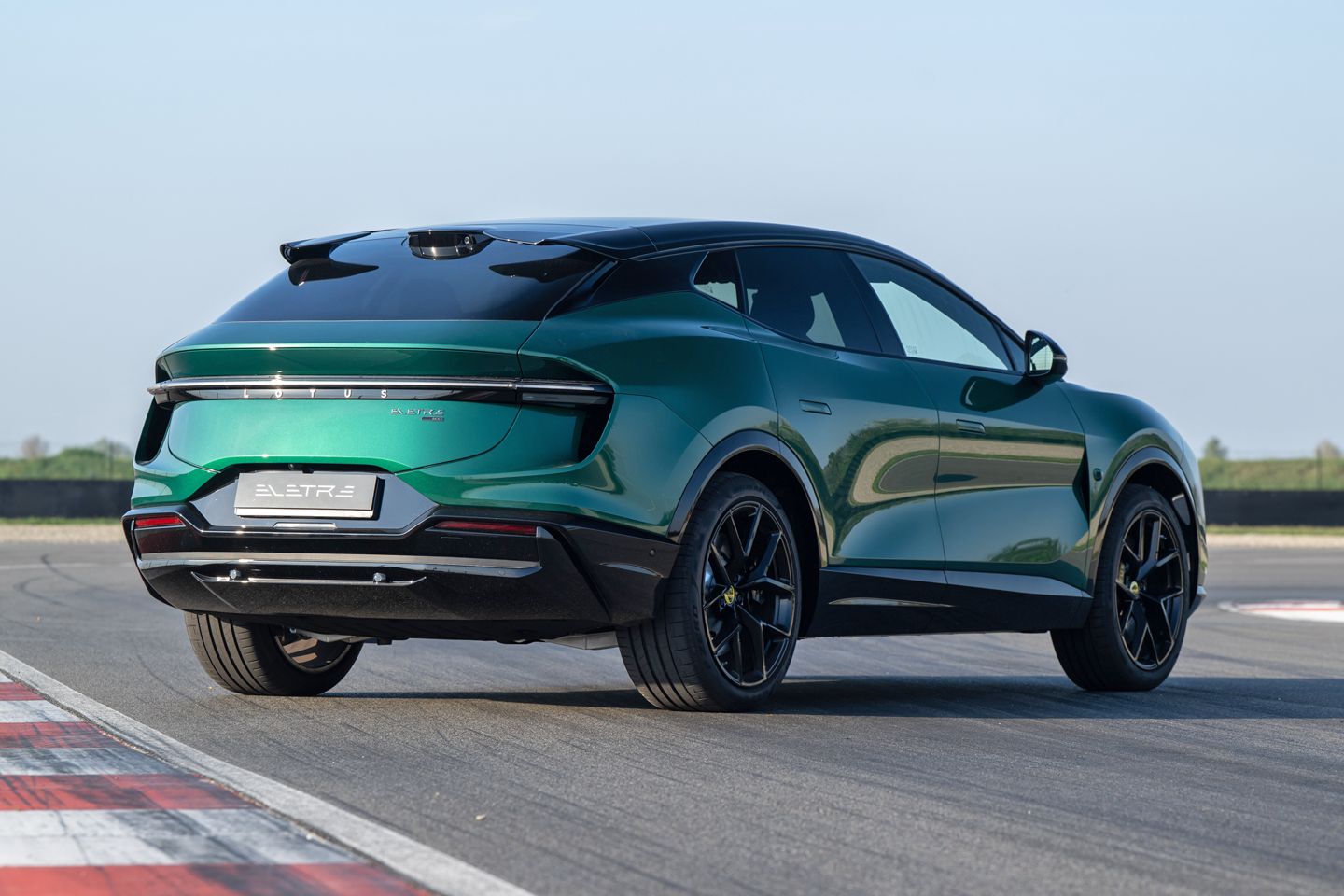
Obviously Lotus has always been a focused sporting marque so the Eletre’s performance had to be convincing. Happily, despite very un-Lotus-like weights of between 2,490 and 2,640kg, it was. These dual-motor all-wheel drive cars with 112kW ternary lithium ion batteries were quick in either 603hp/524lb ft or 905hp/727lb ft guise, with 0-62mph times of 4.5 and 2.95 seconds respectively and a top speed of 155mph or 159mph in the 900 (revised downwards from initial claims of 165mph). To cover off the stress-free requirements of the average family the advertised ranges were also good, combined WLTP estimates stretching from 255 miles for the 900 to 373 miles for the base 600 model.
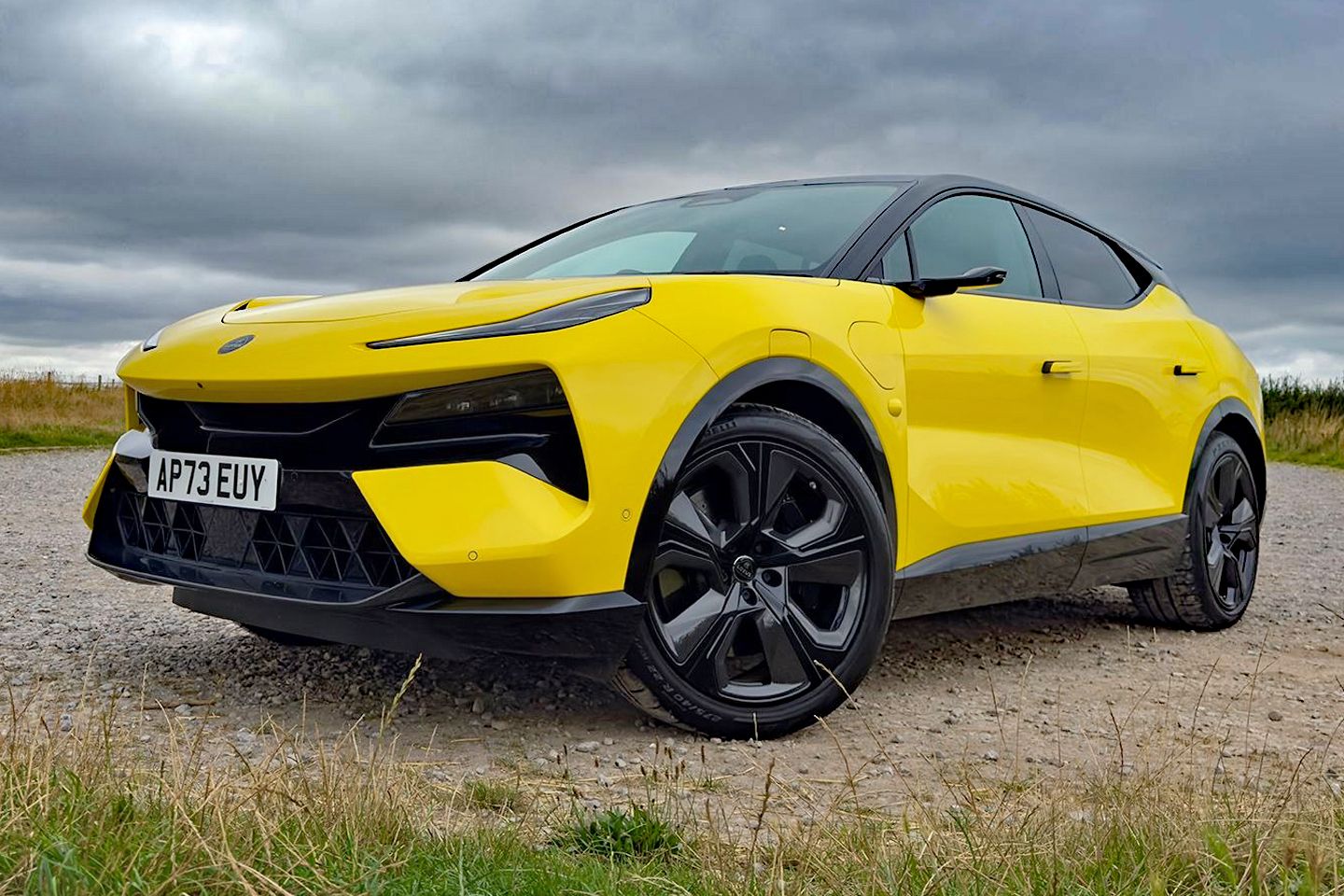
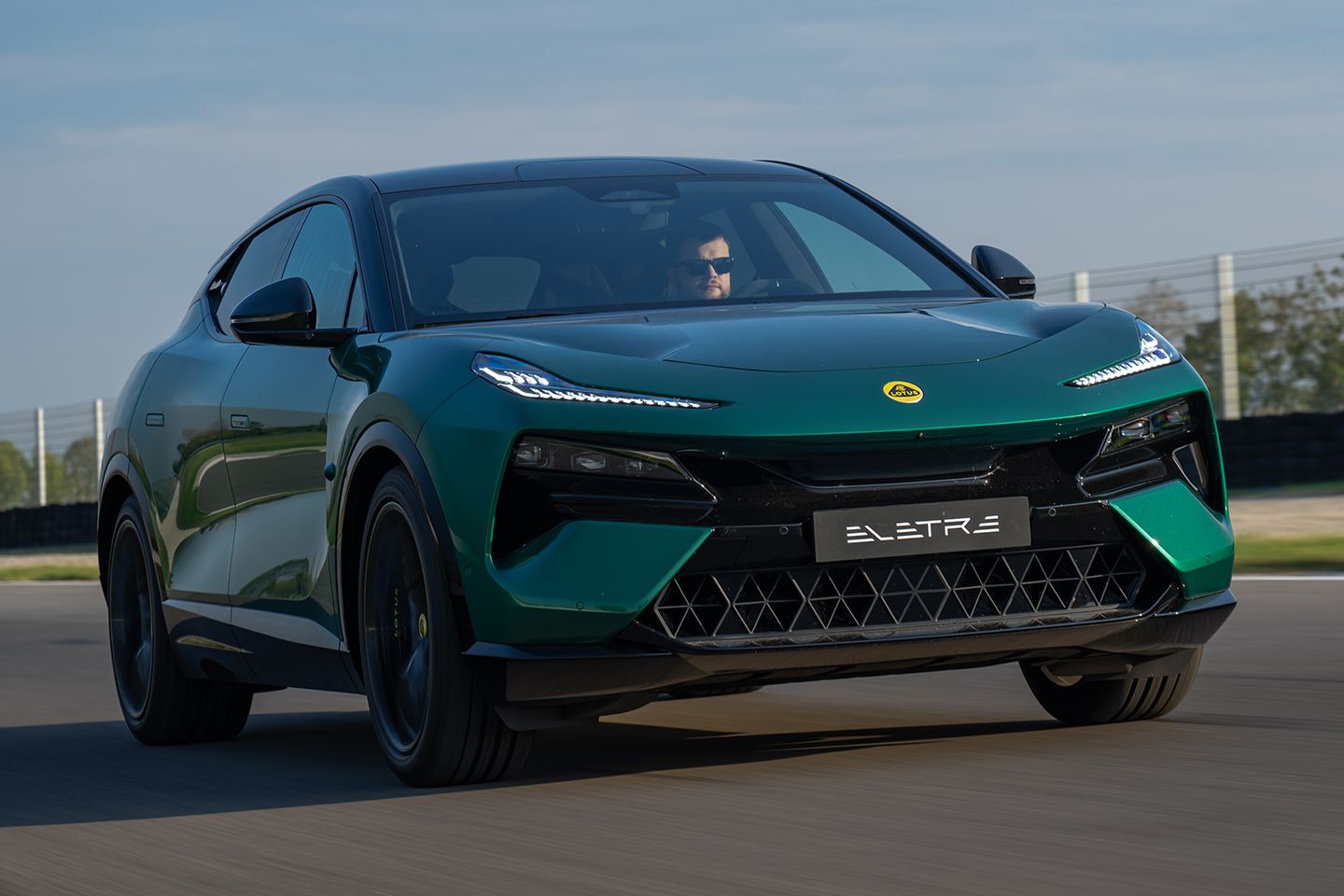
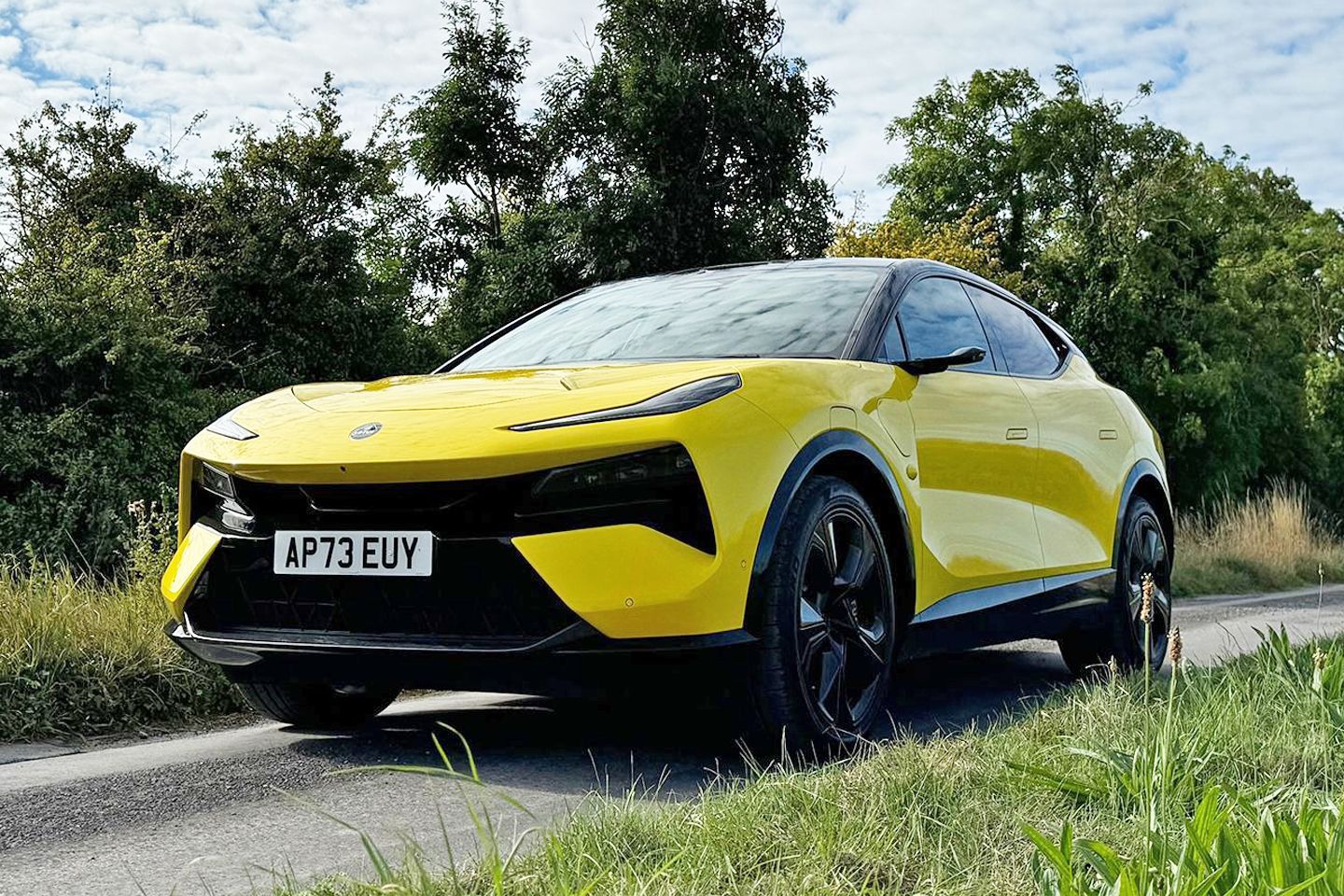
Styling-wise the Eletre was divisive. Fans said it was much better looking in the flesh than in photographs, which was a fair comment. Less charitable critics likened its front-end look to a catfish, possibly as a result of the design ‘porosity’ which allowed air to flow through the vehicle for improved aero, speed and range.
Most agreed that the quality of both the outside finishes and the inside materials was high, as was the standard spec across the range which included five drive modes, active air suspension, torque vectoring, matrix LED headlights, an active front grille, 22-inch 10-spoke forged wheels, 12-way electric front seats, four-zone climate control and a 1,380-watt 15-speaker KEF Premium audio system.
Prices were announced by Lotus in October 2022. The base Eletre came in at £89,500. The S added things like privacy glass, an active rear spoiler, configurable ambient lighting, illuminated side sills, soft close doors, auto-dim side mirrors, an air quality system and a 2,160-watt 23-speaker KEF Reference audio – but the premium for that S badge was £15k. The R – which was claimed to be the world’s fastest dual-motor pure electric SUV – was another £15k jump on at £120,000.
In spring 2025, Lotus introduced a new range of trim levels for both the Eletre and the Emeya EVs, cutting the starting prices of the basic 603hp Eletre from the £90,000+ to which they’d risen to a new figure of under £85,000. The hot 905hp model had gone up to nearly £130k, and a tenner under £140k for the Sport Carbon version.
Nearly nine out of every ten Eletres on the UK used market have covered fewer than 10,000 miles, but low mileages haven’t saved this car from chin-stroking levels of depreciation. When we were putting this guide together at the end of 2025 we found an ex-demo 2023 car with fewer than 10,000 miles on it that had been on sale since April 2024. Back then, its price was £102,000. After a series of drops over the next 20 months, some of them substantial, it was still unsold in December 2025 at under £66k. The highest mileage car we found was a 600 with just under 20,000 miles covered. Its price tag of under £62k made it the cheapest Eletre in sale in the UK.
SPECIFICATION | LOTUS ELETRE (2023-)
Engine: dual motor, 112kWh battery
Transmission: single or dual-speed (R) auto, all-wheel drive
Power (hp): 603 or 905
Torque (lb ft): 524 or 727
0-62mph (secs): 4.5 or 2.95
Top speed (mph): 155 (limited), 159 (R)
Weight (kg): 2,490-2,640
Range (WLTP combined): up to 373 (600)
Charging time (mins): 22 (10-80% via rapid charger)
Wheels (in): 22 (23 or 20 as options)
Tyres: 275/40 (f), 315/35 (r)
On sale: 2023-on
Price new (2023): £89,500 (S £104,500, R £120,000)
Price now: from £62,000
Note for reference: car weight and power data are hard to pin down with absolute certainty. For consistency, we use the same source for all our guides. We hope the data we use is right more often than it’s wrong. Our advice is to treat it as relative rather than definitive.
ENGINE & GEARBOX
Eletres didn’t come with one-pedal drive. Lotus maintained that its customers didn’t want it. There was no launch control either, but Track mode was all you needed for pulverisingly fast acceleration runs in the two-speed R, which had a lower gear on the rear motor to help it reliably deliver on its sub-3-second promise. Even the lower-powered one-speed Eletres would scrabble for traction in damp conditions on a heavy throttle, despite the staggered 315/35 tyres at the back.
A public charge of up to 80 per cent at an ultra-rapid 350kW point could take as little as 22 minutes, or just 2 minutes at the same point for a 30-mile top-up. A home charge of up to 100 per cent using a 7.4kW point would take between 16 and 17 hours, or 1.5hrs for a 30-mile top-up. Those numbers came down to a little under 6 hours or 31 minutes respectively on a 22kW charge point.
In exchange you’d probably be expecting good range capabilities, but if you were burning through a kilowatt hour every couple of miles – which reviews said was normal – those expectations would be dashed. Realistically, the range of an Eletre 600 on a cold day was nearer to 220-240 miles than the 373 miles quoted in the brochure. The Porsche Taycan’s battery capacity was nearly 19kWh smaller than the Eletre’s 112kWh, but its ability to average 3 miles per kWh in cold weather gave it a range that was closer to 280 miles. Quite a difference.
Some of those who took the Eletre plunge have had to put up with their cars being off the road for weeks or even months while dealers attempted to resolve niggly faults. Most seemed to be software related but some 12v batteries have died, attributed in some cases to a faulty supercapacitor. As we were going to press, would-be buyers were being told by Lotus that there would be a delay on new Eletre deliveries to give them time to address a potential motor issue in a batch of cars. Expecting inexperienced tech staff to deal with EV issues has been problematic for just about every dealership network, not just Lotus’s, which by our count currently numbers 15 service centres on the British mainland. The UK warranty for the Eletre was five years or 100,000 miles, with five years of European roadside assistance, so there’s still plenty of reassurance for used buyers as of the end of 2025.
CHASSIS
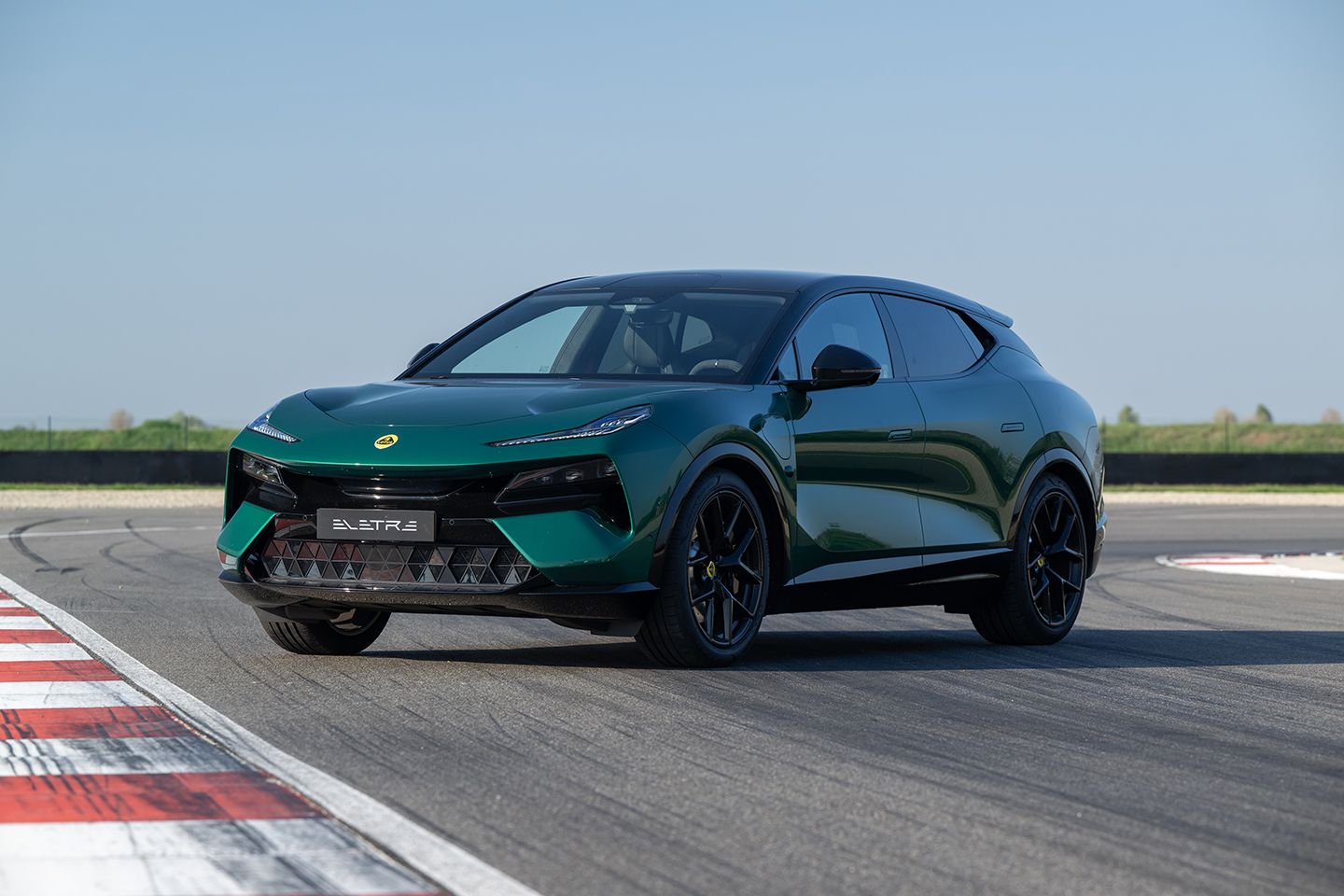
Air suspension, adaptive damping, active ride height control and torque vectoring were all standard on every Eletre, but rear steering was only an option unless you specified the Dynamic Handling Pack that was standard equipment on the R. With that box ticked you got Intelligent Active Roll Control and stiffer dampers along with the RWS, resulting in very little detectable roll and only a small penalty in the amount of jarring on UK roads.
Grip was large, but it was wise to mind your throttle openings out of corners in the R when in Track mode. Even Sport mode was maybe a bit too urgent for public roads, but the slacker, lighter-steering default Tour mode made Eletre life very nice indeed, with lovely fluid damping and good ‘shrinkability’ when hooning. The steering actually did manage to convey a Lotus feel, as per the engineers’ aim. It all felt very connected.
Wheels were 22-inch as standard, but you could specify 23-inch or unfashionably small (but probably comfier-riding) 20-inch aero ones. Carbon ceramic brakes and ten-piston calipers were on the R options list, but the standard braking with monster 412mm discs up front was mighty enough for most.
BODYWORK
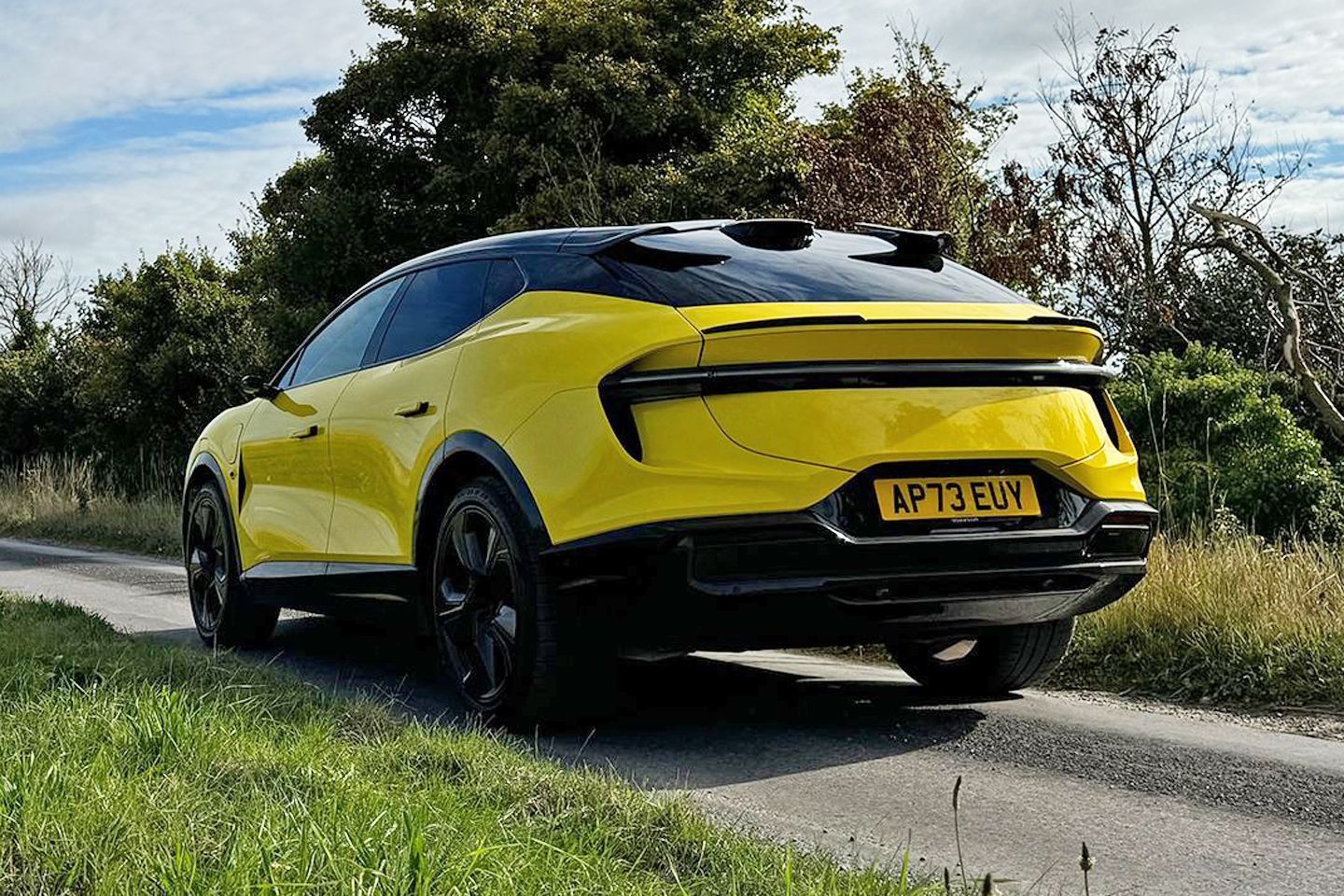
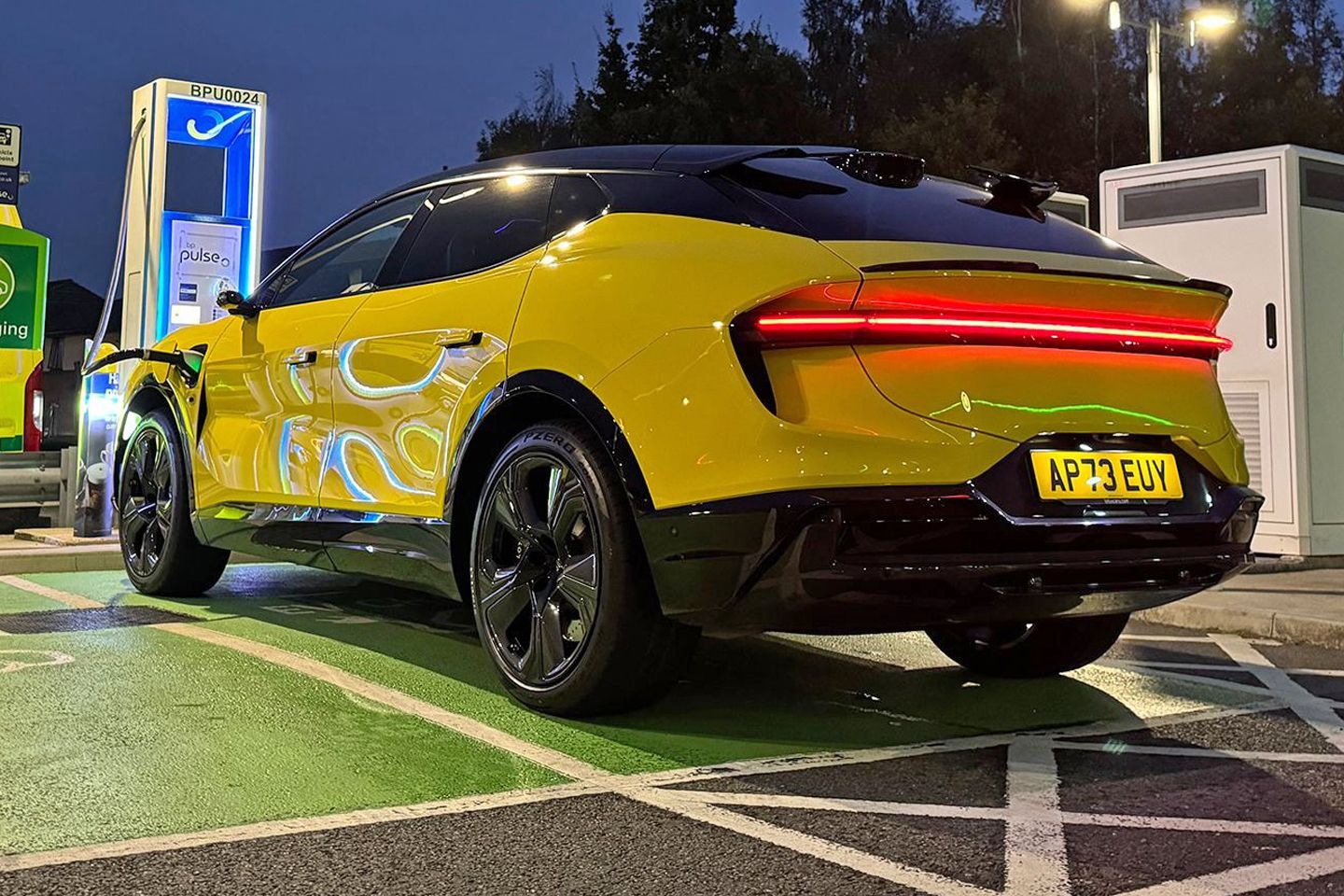
The Eletre’s body, which did have a Urus-y look to it, was said to be ‘carved by air’. Carbon fibre and aluminium were used ‘extensively’. Every model’s body panels were made of aluminium and all the black bits on the R were CF, but despite that, at 5.1m long (longer than a full-fat Range Rover) and over 2.1m wide the Eletre was not an insignificant car, weighing at least 2.5 tonnes in any iteration. By EV standards the weight was actually not bad, but of course you always have to qualify statements like that. Launch colours were Natron Red, Galloway Green, Stellar Black, Kaimu Grey, Blossom Grey or Solar Yellow.
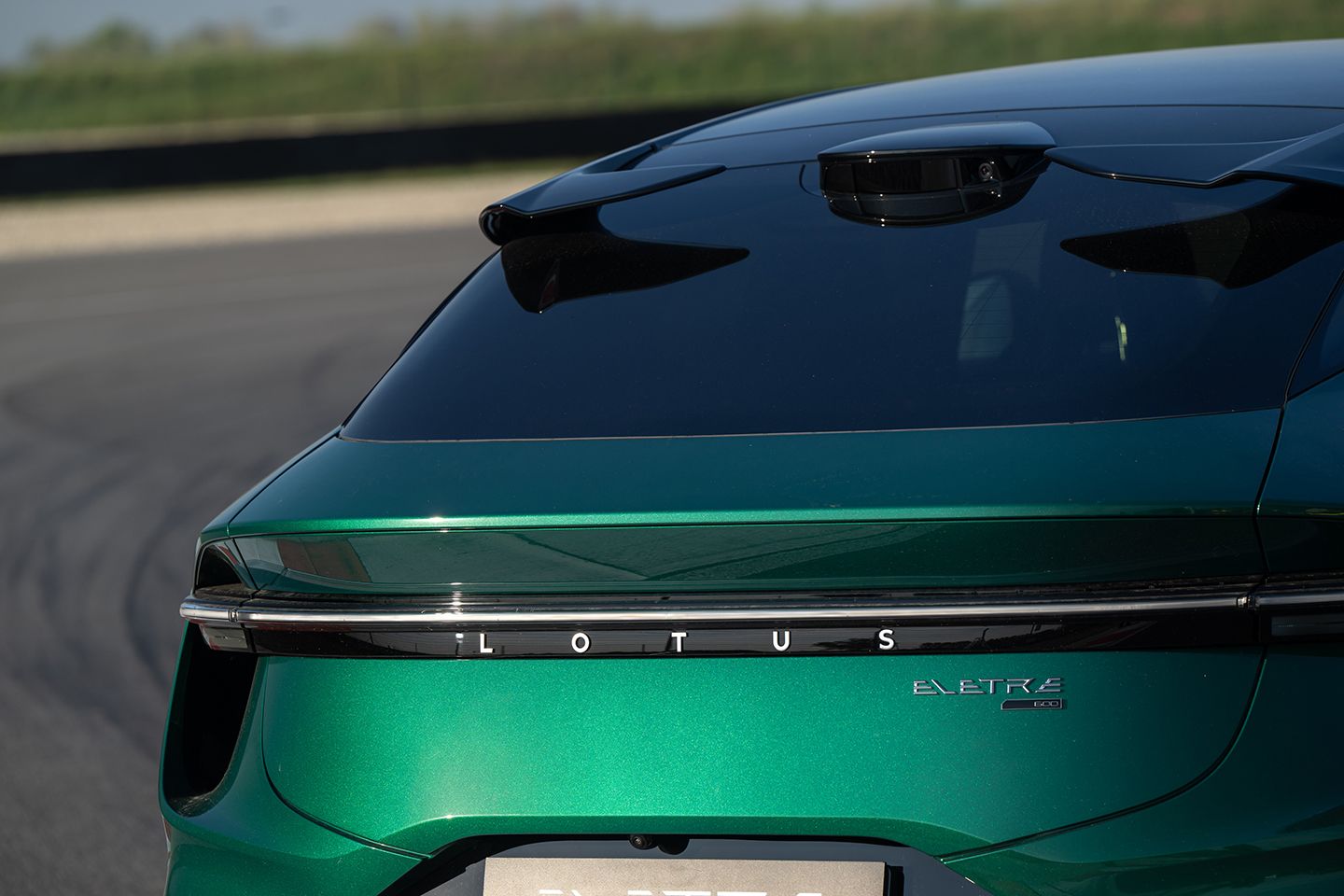
In line with the ‘porosity’ design, air found its way into and out of the car in many places, including the D-pillar. There were no fake vents anywhere, and the ones on the rear wings were properly impressive. A network of ‘lotus flower’ petals in the active front grille opened or closed in tune with the car’s cooling requirements. It sounded like a potential recipe for aggravation a few years down the line for UK owners used to flying stones, but in the shiny light of newness it was novel and interesting. From the rear the Eletre looked great.
The Eletre experience began outside the car with a showoff walk-up sequence involving the exterior lights, a ‘breathing’ active front grille and illuminating flush-fit doorhandles. Some Eletre doors have refused to unlock by any method, including the key fob. The full-width ribbon light at the back changed colour according to the battery’s charge level. An electronically deployable towbar with a 12v connector allowed you to haul loads of up to 2,250kg.
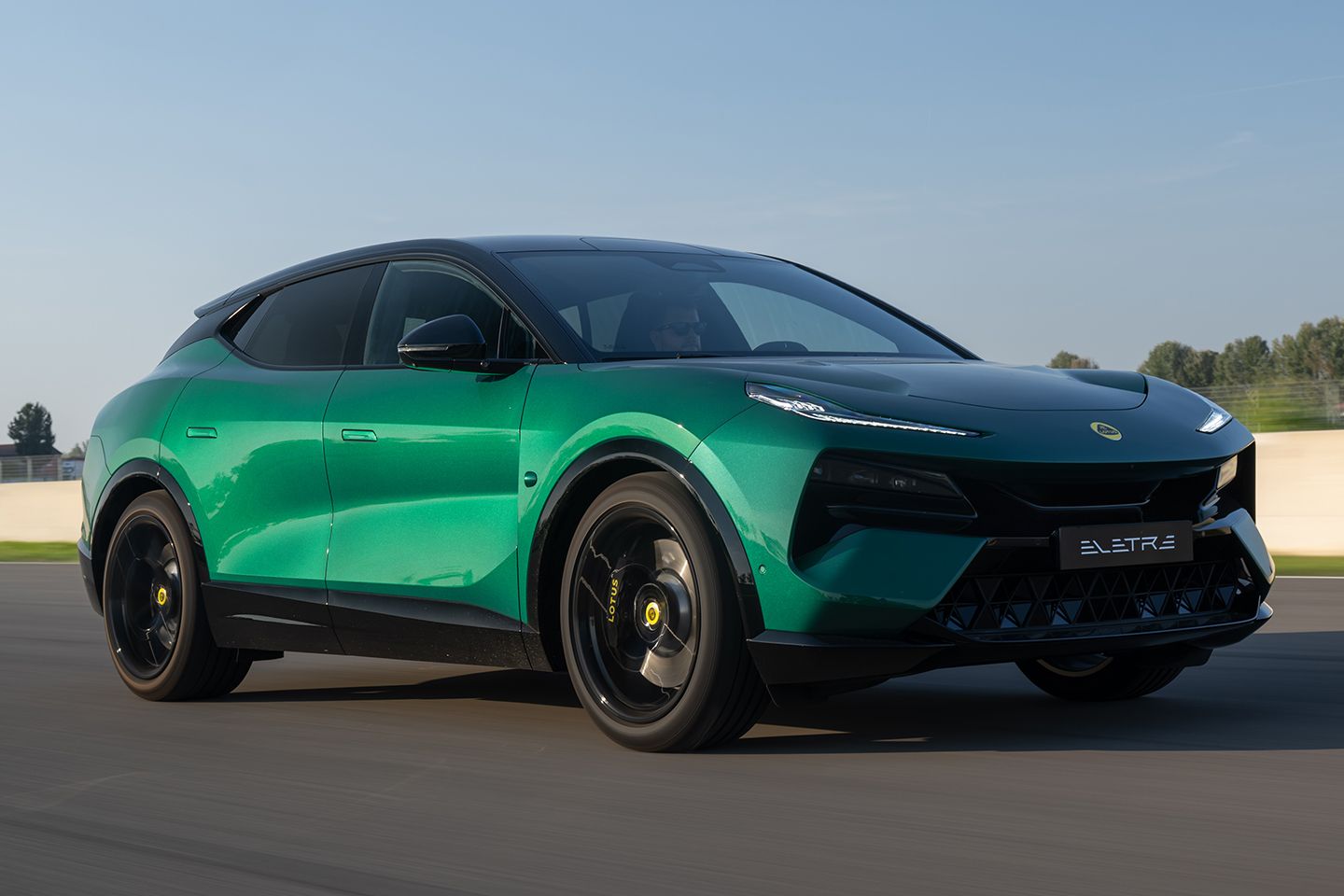
Instead of conventional door mirrors the Eletre could have ‘Electric Reverse Mirror Displays’ (part of a £4k package that included a rear spoiler) which you might have thought sounded like a complicated and expensive way to give you a view behind, but of course the three cameras involved in this system also gave you a 360-degree view from above and played a part in the intelligent driving technologies. On that score, Lotus was claiming a production car world-first for the Eletre for its deployable LIDAR (Light Detection and Ranging) tech which supported those technologies, including level 4 autonomous driving.
Not everyone immediately got on with the mirror displays’ in-cabin screens because they weren’t in the normal place your eyes instinctively went to for a rear view. You’d presumably get used to that, but it might be harder to forgive the red glare on the screens when negotiating hedged lanes at night with the regen on full and the brake lights being on most of the time. Auto-dipping headlights have been hit or miss despite software updates.
Normal boot capacity for four-seat configured cars with non-foldable rear seats was a hefty 611 litres, or 688 litres for the five-seaters, whose rear seats were foldable. Doing that enlarged your boot space to over 1,530 litres – quite a bit up on the old Elan. Buttons in the boot compartment lowered (and then raised) the suspension for easier loading. At the other end of the car was a 46-litre frunk for your charging cables and small sandwiches.
INTERIOR
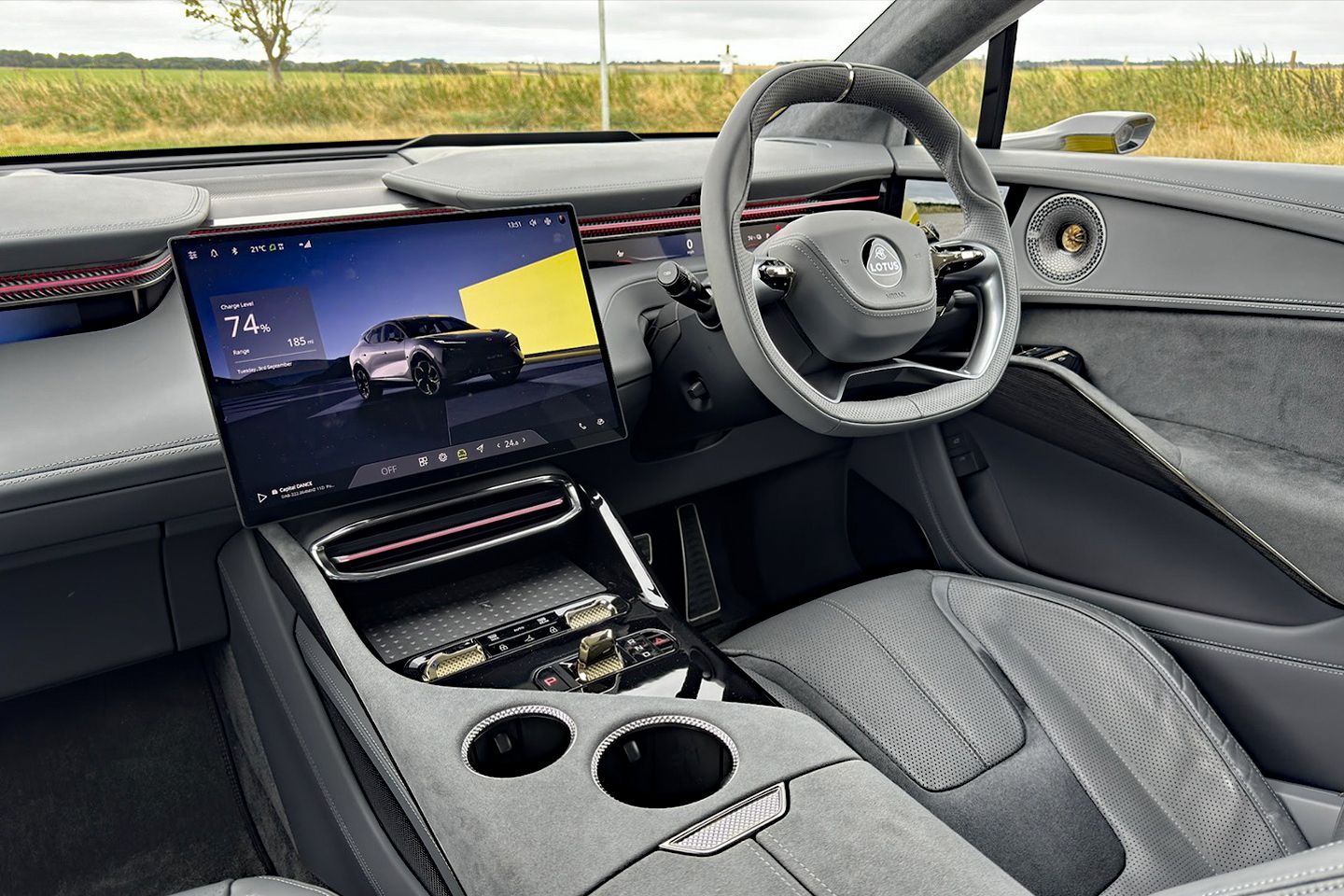
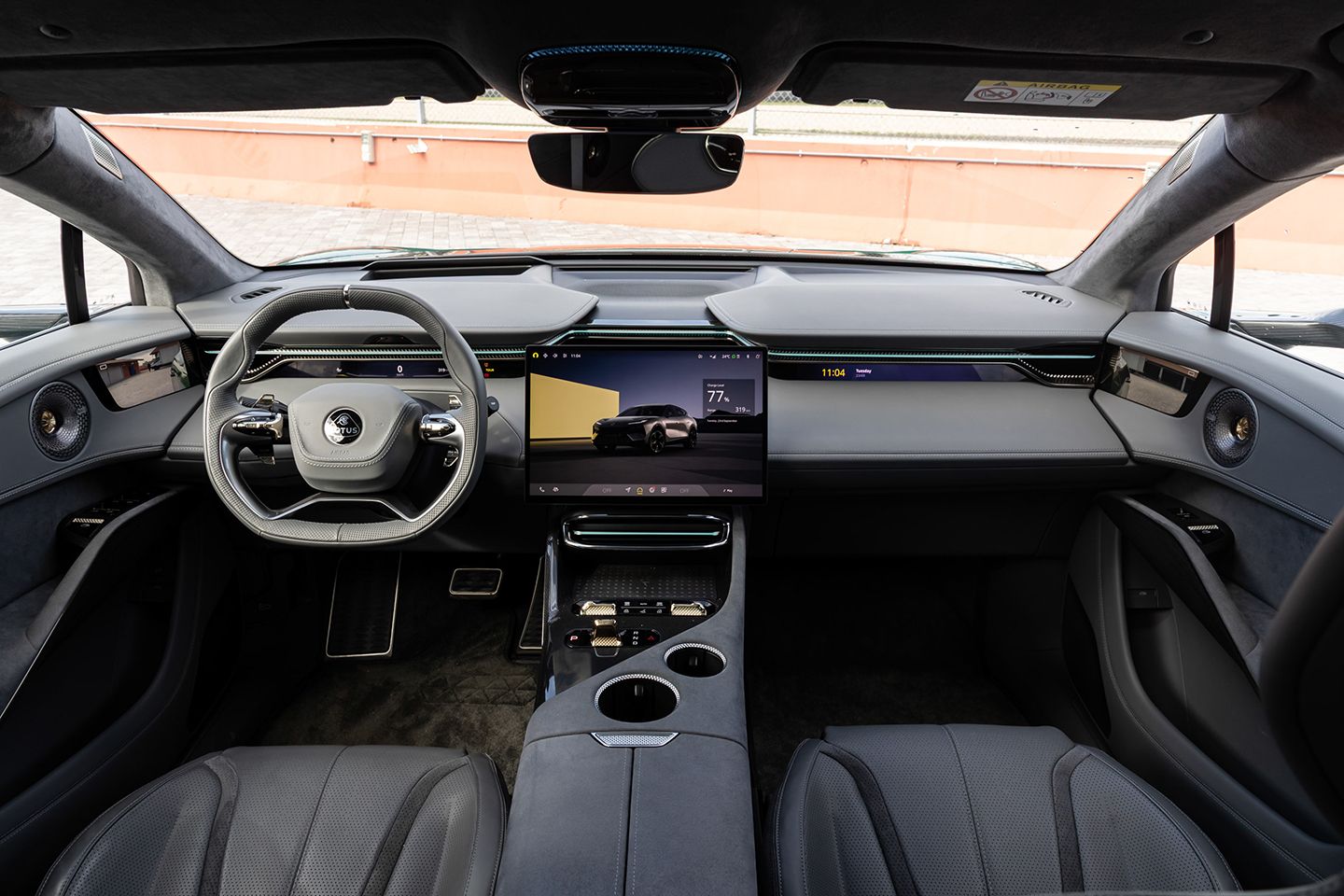
The Eletre cabin was a clean and beautifully modern design, less glitzy than the Urus but at least as functional. Older drivers would definitely recognise a minimalist Lotus vibe that was promoted by the small steering wheel through which you peered to access important info on the slender readout panel. Everything else was on the big (15.1-inch) central OLED screen that folded down when it wasn’t needed.
Those more mature drivers certainly wouldn’t feel a connection with Lotus past in terms of interior fit and finish, as the Eletre’s was leagues ahead of the old standard and a match for the very best rivals. There was a good complement of ‘real’ (as opposed to touch-sensitive) switchgear that all felt solid and well-made, but there was no physical knob to control audio volume. That had to be done via the right-hand toggle switch on the wheel. Its slow response meant that impatient people often ended up with unwanted extremes of volume. On the plus side, you did have lovely switches to adjust the HVAC. On the downside, there was a software-related problem with the delivery of warm air.
Drivers could drop their seat way down for confident sportiness, or way up for nervier urban driving. Rear-seat passengers were well looked after too with either two or three very comfortable seats, a good-sized central screen, and stacks of legroom. Cabin storage was great too courtesy of a big shelf under the centre console, huge door bins, a commodious cubby between the seats and two cupholders with neatly operating covers.
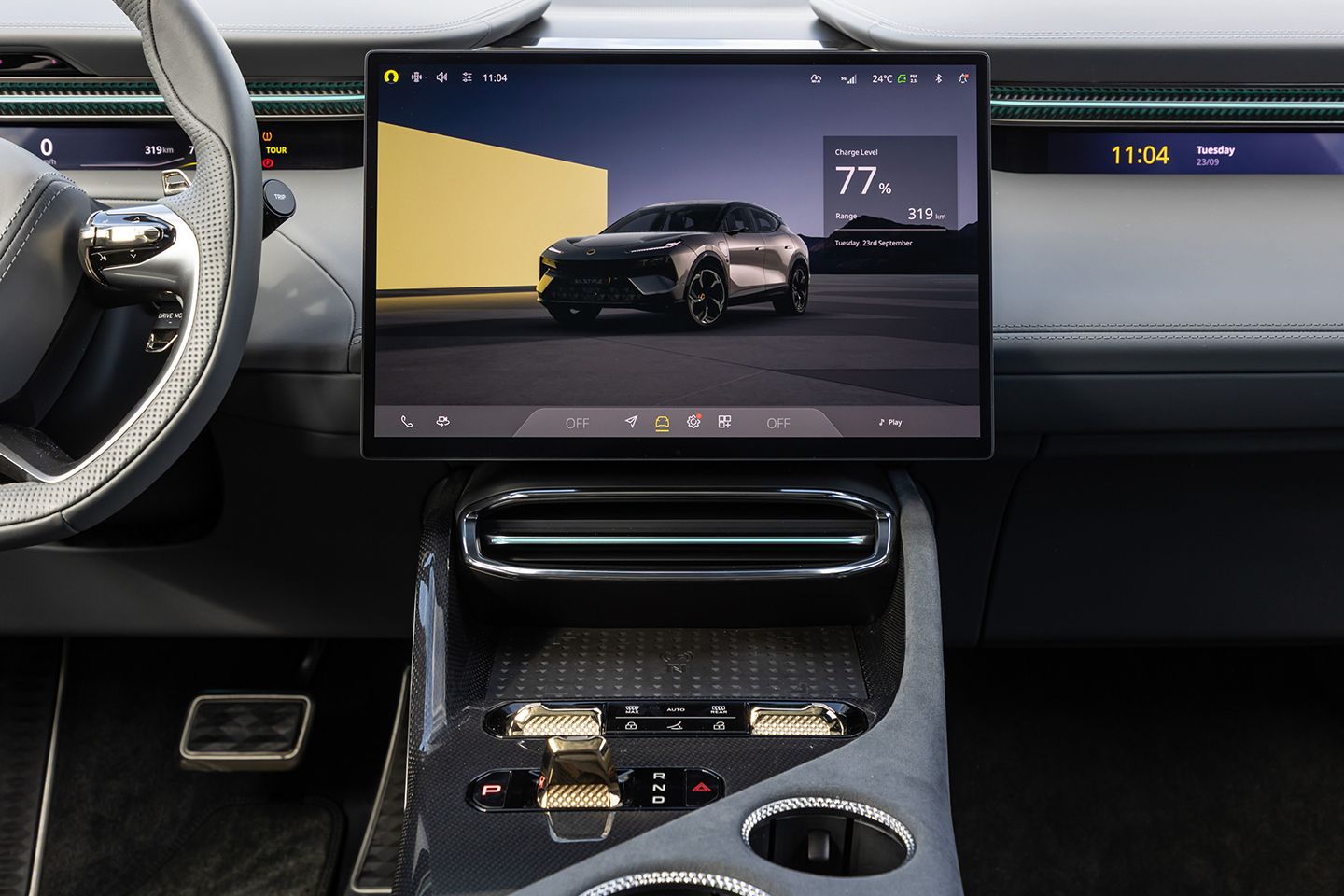
Android Auto was standard from the off, Apple CarPlay not arriving until somewhat later in the piece in early 2024. We presume that’s since been retro-fitted to earlier cars. For sat nav purposes, they defaulted to the car’s GPS that some have found to be less than brilliant. There have also been problems with sat nav screens suggesting that the car might be driving in a lake or through trees in a park rather than on the road.
Dates and times have been incorrect on some cars and there was no way for the owner to reset them. Nor was there a way to permanently turn off the annoyingly shouty lane assist or speeding warnings that became a legal requirement on new EU and UK-registered cars from July 2024. The fatigue alarm could be unduly pessimistic about your state of awareness, sometimes going off if you looked a bit too pointedly at the main screen or attempted to admire your profile in a shop window. If you wanted a bong-free environment, you had to switch stuff like this off before each drive. You would certainly be wanting to do that if any of your motoring was on rural roads as the lane-keeping assist in particular had the potential to drive you mad by being either overly-aggressive or overly-sensitive.
A head-up display was standard on the S and R models, and all cars had a wireless charging pad for your phone. Oddly, incoming phone calls had to be distractingly answered on the centre screen, with no steering wheel button for that. The main infotainment screen was not especially quick to respond and the screen was easily scratched. The ‘Digital Key’ didn’t always work with iPhones and the Eletre app hasn’t always behaved itself. The Lotus-recommended solution for that sort of thing was usually a soft reset or a hard factory one at service level.
PH VERDICT
You had to hand it to Lotus’s chassis engineers. Somehow they instilled a Lotusy driving feel into a big, heavy SUV that by the laws of physics had no right to handle at all, let alone well. Having succeeded in that challenge, their next hurdle was to achieve an acceptable balance between handling and comfort. In Tour mode, they managed that too. We don’t know how many Eletre test drives were converted into sales, but whatever the number was it probably would have been a lot smaller if the sales bod was stuck on the idea of Tour mode being only for sissies. It was the best mode for everyday driving, especially in the UK.
There’s no getting away from the fact that the Eletre was a big, heavy car, nearly 300kg heavier than the similarly powered Lamborghini Urus. You’ll be aware of the Lotus’s bulk all the time you’re in it (who thought they’d ever see that written down?) but you’ll also be marvelling at how well Lotus managed to make it behave in spite of its weight. If you’re a fully paid-up EV-hater, and maybe an SUV-hater as well, this seductive car will do more than any other to test your preconceptions. Especially when you notice that the Urus is more than twice the price of the basic Eletre.
Another close rival would be Porsche’s 590hp Taycan 4S Cross Turismo, a car for which there is a lot of love but which at a 2025 starting price of £99k has also been saddled by the depreciation that hits every premium EV. Is the Eletre Lotus’s Taycan? Well, of the 26 Eletres on PH at the time of writing, the most affordable one was this black base-spec 603hp car from 2023 with 5,500 miles recorded at a fiver under £65k. The cheapest 4S Cross Turismo we found was a ’21 reg with 41,000 miles on it at just under £46,000, while a more directly comparable ’23 Taycan 4S CT with 7,500 miles was £64k, so it looks like the (admittedly much bigger selling) Porsche is still losing the depreciation race versus the Eletre, though not by much. The cheapest 905hp Eletre on PH Classifieds was this ’24 example in yellow with 18,000 miles at £71,980.


Expensive, not particularly interesting and not without issues.
Which sums up EV ownership I guess (I have an EV as a daily)

in isolation, it is a reasonable looking enormous SUV with a reasonable specification
The problems are
a) doesn't fit the heritage of the brand (no one in USA, China, Middle East, 'stans and elsewhere where they hope to sell it cares in the way we do)
b) if's a bit big for uk roads but not the above markets
c) the ADAS is rubbish (no used or can be permanently turned off outside of the EU)
d) efficiency is poor (electricity is cheap in the target markets)
it is a typical big, fast chinese SUV with a Lotus badge on it and for some/many places in the world that is just fine
Seen in the flesh doesn’t change much, in fact it looks even more awkward from certain angles. I’m sure it goes and handles very well but there s simply not enough ‘Lotus’ in it to make me go out of my way and consider it if I was in the market for this type of car.
Seen in the flesh doesn t change much, in fact it looks even more awkward from certain angles. I m sure it goes and handles very well but there s simply not enough Lotus in it to make me go out of my way and consider it if I was in the market for this type of car.
in isolation, it is a reasonable looking enormous SUV with a reasonable specification
The problems are
a) doesn't fit the heritage of the brand (no one in USA, China, Middle East, 'stans and elsewhere where they hope to sell it cares in the way we do)
b) if's a bit big for uk roads but not the above markets
c) the ADAS is rubbish (no used or can be permanently turned off outside of the EU)
d) efficiency is poor (electricity is cheap in the target markets)
it is a typical big, fast chinese SUV with a Lotus badge on it and for some/many places in the world that is just fine
Some of which do look absolutely beautiful (if one still thinks of the Citroën CX Prestige as an admirable role model) but are simply too big and not German-whippy enough to sell over here. At least not yet...
BTW, anyone ever seen a Lotus Emetic? Too big as well, but less deplorable than an SUV.
Once they're down to buttons, they might make a useful old smoker/flamer.
 t. As evidenced by the prices. Shouldn t be any room for coverage of it here.
 Also, why would you buy a Rolls Royce when you can get a Dacia for 35x cheaper price, etc …
These have a use case, but it s not for the majority of a fuel loving, drivers car audience.
I shudder to think what would happen if you got shunted by that near 3 ton monstrosity mind you…
Green they say?? Bol-acks we say…
Am sure someone will be along shortly to tell us that the depreciation is ‘normal’ - the same as everything else - and nothing to see here… also…
Gassing Station | General Gassing | Top of Page | What's New | My Stuff