
Turbo lag? Worse than N/A?
Discussion


Is the band of power before the turbo comes on boost actually any less powerful than the car would be if it didn't have a turbo? I.e is it only called 'lag' because it feels slower than it does when the turbo kicks in?
I would imagine the turbo does cause a tiny drop in power compared to an N/A car from maybe not being able to clear exhaust gasses as efficiently and maybe not sucking air in as efficiently (obviously before it's on boost) but generally I would have thought the only real lag is because you are waiting for the turbo.
Drove a 225 twin turbo TT today and I could really feel the lag, turbo didn't kick in till about 4k and and needed to change up around 7k. Felt a strange engine, no power low down, a fairly decent mid range torquey kick, then out of steam very quick. Apart from the high power band the delivery reminded me of a diesel. Not sure what to make of it, was a bit disappointed. Maybe the top model would be better?
I would imagine the turbo does cause a tiny drop in power compared to an N/A car from maybe not being able to clear exhaust gasses as efficiently and maybe not sucking air in as efficiently (obviously before it's on boost) but generally I would have thought the only real lag is because you are waiting for the turbo.
Drove a 225 twin turbo TT today and I could really feel the lag, turbo didn't kick in till about 4k and and needed to change up around 7k. Felt a strange engine, no power low down, a fairly decent mid range torquey kick, then out of steam very quick. Apart from the high power band the delivery reminded me of a diesel. Not sure what to make of it, was a bit disappointed. Maybe the top model would be better?
This isn't really turbo "lag", but "boost threshold", if we're being picky. Lag is delay from stamping on the loud pedal to getting full boost, the boost threshold is the engine speed at which the turbo starts to give boost. So, say, 1300rpm giving hardly any power in a single-turbo diesel will be a boost threshold problem, not lag. Now, 80s F1.. That's lag problems 
Anyways.. As you say, the difference will only be very slight and due to more back-pressure from the slowly-spinning turbo in the way of the exhaust system. The reason people cite it as a problem with turbo engines isn't that the turbo itself makes the engine sluggish at lower revs, but because if you had a 225bhp turbocharged engine and a 225bhp naturally aspirated one, odds are that the unblown engine is going to pull a lot harder from, say, 1500rpm because of a higher compression ratio and other factors.
You could say that a turbo engine of similar power to a naturally aspirated one is "lazier", relying on its turbo to provide its power, hence it feeling a lot slower in the lower range. Obviously if you threw the turbo away, it ain't gonna be any faster at the same point in the rev range, but a comparable engine that never had a turbo probably will be.
If that makes as much sense as it did in my head
Anyways.. As you say, the difference will only be very slight and due to more back-pressure from the slowly-spinning turbo in the way of the exhaust system. The reason people cite it as a problem with turbo engines isn't that the turbo itself makes the engine sluggish at lower revs, but because if you had a 225bhp turbocharged engine and a 225bhp naturally aspirated one, odds are that the unblown engine is going to pull a lot harder from, say, 1500rpm because of a higher compression ratio and other factors.
You could say that a turbo engine of similar power to a naturally aspirated one is "lazier", relying on its turbo to provide its power, hence it feeling a lot slower in the lower range. Obviously if you threw the turbo away, it ain't gonna be any faster at the same point in the rev range, but a comparable engine that never had a turbo probably will be.
If that makes as much sense as it did in my head
McSam said:
This isn't really turbo "lag", but "boost threshold", if we're being picky. Lag is delay from stamping on the loud pedal to getting full boost, the boost threshold is the engine speed at which the turbo starts to give boost. So, say, 1300rpm giving hardly any power in a single-turbo diesel will be a boost threshold problem, not lag. Now, 80s F1.. That's lag problems
The F1 engines were a bit iffy with boost threshold to IIRC - something like a 900hp gain in 500rpm made it a bit difficult to drive...Defcon5 said:
Gaz. said:
My Golf GTI & my 318iS both have 140-145bhp, and about the same torque (140ish lbs.ft) and despite the BMW having shorter gearing the Golf simply murders it in any gear and at any revs, even way below the boost threshold.
Are you sure the 
davepoth said:
The F1 engines were a bit iffy with boost threshold to IIRC - something like a 900hp gain in 500rpm made it a bit difficult to drive...
 I suppose that too! But they would rarely be out of the boost range in racing, so I went for the lag issues that led to planting one's foot half a second before the apex!
torqueofthedevil said:
Cheers for the tech answers that's explained it. Forgot about the lower CR on the turbo engines.
They told me it was twin turbo, hadn't done any research first. What is the spec of the top engine then?
180 - 1.8 low pressure turboThey told me it was twin turbo, hadn't done any research first. What is the spec of the top engine then?
225 - 1.8 higher pressure turbo
3.2V6 - Ronseal.
I drove a lightly fettled Pulsar GTIR recently and it was absolutely gutless below 3,000 rpm. Even cruising at 30mph in 4th at just under 2,000rpm was a struggle. The 16v engine in my 106 is supposed to be 'peaky' and high revving but it has twice as much grunt as the pulsar did up to 3,000rpm.
This isn't for the same GTIR that I drove, but it's fairly typical of a high specific output turbocharged engine. You can see at 3,000rpm it's barely making 70hp...
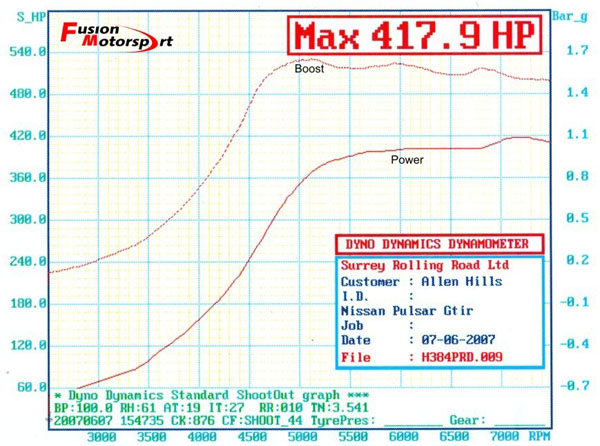
This shoddy scan is the best I can find for anything similar to my 106 (it has a Saxo VTS engine) and you can see that even though peak power is less than 1/3rd of that of the pulsar, at 3,000rpm it's around the same 65-70hp band as the Pulsar.

This isn't for the same GTIR that I drove, but it's fairly typical of a high specific output turbocharged engine. You can see at 3,000rpm it's barely making 70hp...
This shoddy scan is the best I can find for anything similar to my 106 (it has a Saxo VTS engine) and you can see that even though peak power is less than 1/3rd of that of the pulsar, at 3,000rpm it's around the same 65-70hp band as the Pulsar.
torqueofthedevil said:
Drove a 225 twin turbo TT today and I could really feel the lag, turbo didn't kick in till about 4k and and needed to change up around 7k. Felt a strange engine, no power low down, a fairly decent mid range torquey kick, then out of steam very quick. Apart from the high power band the delivery reminded me of a diesel. Not sure what to make of it, was a bit disappointed. Maybe the top model would be better?
Same engine as in my car (Leon Cupra R 225), with a different map. In my car, the turbo comes on with a huge surge at 3500rpm, with very little lag if you keep it on the boil and use the gearbox properly. If you are driving in a relaxed fashion, then floor it and expect something to happen you will get a couple of seconds of waiting for the boost to build. For a quick overtake, I blip the throttle and change into 3rd give it half throttle for a second or two to build boost and speed then when the tyres have keyed into the road it gets WOT until I'm past. If you are not familiar with turbo engines then I suppose that may seem hard work to get it shifting, but you will find the same problem in any turbo car. May I point you to the video of Clarkson in an Evo, 5th gear at 30mph and WOT, and the car proving unable to build any boost at all?As for the "diesel" comparison, a turbo that comes on song at 3500rpm before needing to shift up at 7000rpm gives you a lot more room to hold onto a gear that any turbo diesel I can think of!
Gassing Station | General Gassing | Top of Page | What's New | My Stuff