
Discussion


What do you guys prefer, front engine rear drive, mid engine rear drive, weight biased to the front or rear?
The MX5 is in the linked clip showing perfect balance. I prefer this set up now and use this drive train for Replicar, Mevtser and Exocet but not too long ago you could not drag me out of middies.
https://www.youtube.com/watch?feature=endscreen&am...
The MX5 is in the linked clip showing perfect balance. I prefer this set up now and use this drive train for Replicar, Mevtser and Exocet but not too long ago you could not drag me out of middies.
https://www.youtube.com/watch?feature=endscreen&am...
I used to have a GTM Libra. After much development including getting Z Cars to sort the rear suspension I loved it. The driving experience was great with fantastic traction and balance with delicate steering. This was true up to the limit. Beyond the limit it was VERY difficult to handle.
My new car, Thruxton GT is traditional front engine, rear drive. I haven't driven mine yet above 10mph but the demo car is much easier to drive quickly and when it does slide about much easier to control and hold the angle.
Most so called mid engine kit cars really aren't as they use a FWD transverse set up so the weight is too high and too far back leading to pendulum roll over steer. If it was true mid engine 50/50 I'm sure it would have been much better. The Libra was nearer 60/40 biased to the rear.
The MX5 I broke to build my kit was pretty good, especially in the wet where the lack of power wasn't an issue. When I added the supercharger and gave it 215bhp it was getting pretty good. I expect my Thruxton with 240bhp, 550kg to be even better. Being sat right on the rear axle with a fast rack will make the feel even better and I am looking forward to huge slip angles and plenty of oppo!
In conclusion. A true mid engine car well driven will be faster around a lap than a well driven front engine RWD. A crap driver like me will be having the most fun with it on the lockstops out of every corner going the slowest!
My new car, Thruxton GT is traditional front engine, rear drive. I haven't driven mine yet above 10mph but the demo car is much easier to drive quickly and when it does slide about much easier to control and hold the angle.
Most so called mid engine kit cars really aren't as they use a FWD transverse set up so the weight is too high and too far back leading to pendulum roll over steer. If it was true mid engine 50/50 I'm sure it would have been much better. The Libra was nearer 60/40 biased to the rear.
The MX5 I broke to build my kit was pretty good, especially in the wet where the lack of power wasn't an issue. When I added the supercharger and gave it 215bhp it was getting pretty good. I expect my Thruxton with 240bhp, 550kg to be even better. Being sat right on the rear axle with a fast rack will make the feel even better and I am looking forward to huge slip angles and plenty of oppo!
In conclusion. A true mid engine car well driven will be faster around a lap than a well driven front engine RWD. A crap driver like me will be having the most fun with it on the lockstops out of every corner going the slowest!
At the moment I am trying out mid-engine dynamics, I am quite enjoying the way the front end feels light and delicate on the road yet very reactive to changes of steering input. I was reading a web page the other night which suggested a car that has a weight bias to either the front or rear is more predictable than one with a 50/50 balance.
I would say, why choose, have both and enjoy the differences.
I would say, why choose, have both and enjoy the differences.

Cobra replicas are front engined rear wheel drive cars , yet all three I've built ( AK's) have had slightly more of their weight over the rear wheels rather than the front wheels typically split 44/56 %, so are actually "mid engined" and handle extremely well.
Also helps to get the power down when accelerating which is the true grin inducing factor.
However I do build using all aluminium V8's rather than the typical cast iron boat anchors favoured by the traditionalists but I would suggest that even cast iron lumps are positioned far enough back in most Cobra chassis to give reasonable balance.
Cheers,
Tony
Also helps to get the power down when accelerating which is the true grin inducing factor.
However I do build using all aluminium V8's rather than the typical cast iron boat anchors favoured by the traditionalists but I would suggest that even cast iron lumps are positioned far enough back in most Cobra chassis to give reasonable balance.
Cheers,
Tony
More important than balance is linearity of driver input to predictable chassis response. This depends more on suspension setup (wishbone angles, spring and damper rates, roll centres, even tyre sidewall constuction etc.) than having 50 /50 balance.
This explains why the Nissan Deltawing doesn't behave like a old Porsche 911 despite having more weight over the rear wheels.
This explains why the Nissan Deltawing doesn't behave like a old Porsche 911 despite having more weight over the rear wheels.
rdodger said:
I used to have a GTM Libra. After much development including getting Z Cars to sort the rear suspension I loved it. The driving experience was great with fantastic traction and balance with delicate steering. This was true up to the limit. Beyond the limit it was VERY difficult to handle.
In conclusion. A true mid engine car well driven will be faster around a lap than a well driven front engine RWD. A crap driver like me will be having the most fun with it on the lockstops out of every corner going the slowest!
Agreed.In conclusion. A true mid engine car well driven will be faster around a lap than a well driven front engine RWD. A crap driver like me will be having the most fun with it on the lockstops out of every corner going the slowest!
If you consider the point about which the car will try to spin/rotate (the "horizontal centre of gravity") and the polar moment of inertia ("dumbell effect") you can see why this is likely, even before you get to suspension etc.

I really don't know whats the Perfect weight balance, Example I saw a Porsche GT3 on some scales once and it was 71% rear 29% front !!!!! That just defies logic and just proves even a Car thats raved on about by many people (Not Me though), when set up properly can though the 50/50 debate out the window.... Also if your getting that 50/50 by putting the heavy items at the opposite ends of the car, then your increasing the Polar Moment of Inertia, which is Bad for Cornering and car confidence / predictability.
It really is a mine field, but like most car design there's always a compromise somewhere......
It really is a mine field, but like most car design there's always a compromise somewhere......
I do not think there is a perfect balance or engine configuration. At least not a fixed mechanical one, just look at all of the latest super cars with torque vectoring and active suspension etc.
The various engine layouts and drive trains usually have something they excel at. The trick is to design a good example of whatever configuration you choose. As a driver the fun is in learning how to get the best out of a given car.
How about a front-mid rwd using an Impreza engine, plenty of older cheap ones about? It would certainly help keep the CoG low. There are also quite a few early Boxsters for sub £5K, I wonder how much you could get for the parts while keeping the engine etc? Just imagine how good a Boxster that weighed 8-900kgs would be.
The various engine layouts and drive trains usually have something they excel at. The trick is to design a good example of whatever configuration you choose. As a driver the fun is in learning how to get the best out of a given car.
How about a front-mid rwd using an Impreza engine, plenty of older cheap ones about? It would certainly help keep the CoG low. There are also quite a few early Boxsters for sub £5K, I wonder how much you could get for the parts while keeping the engine etc? Just imagine how good a Boxster that weighed 8-900kgs would be.
having had a front engined 230bhp 600kg rwd car and a 170bhp 850 kg mid engine car, I can safely say the mid engined car has a light but grippy front end (that is very addictive as it reacts so nicely) AND gives a shed-load more feedback. I've learn't a lot more in the lesser powered mid engine car than I ever did in the more rapid front engined car. Its a no brainer for me, mid engined all day long (although oversteer is harder to control).
i agree with Martin A. 50/50 is a great concept but the overall set up and sprung, unsprung weight blah blah blah seems to be where the balance comes from but you could have a pig of a chassis aswell that no matter what you do it will always be crap!
my car below is not a kit car but a full racer and was built with a porsche engine with a flipped diff to make the boxster layout but in 1985! the big advantage the porsche design is a very low centre of gravity for the whole car.
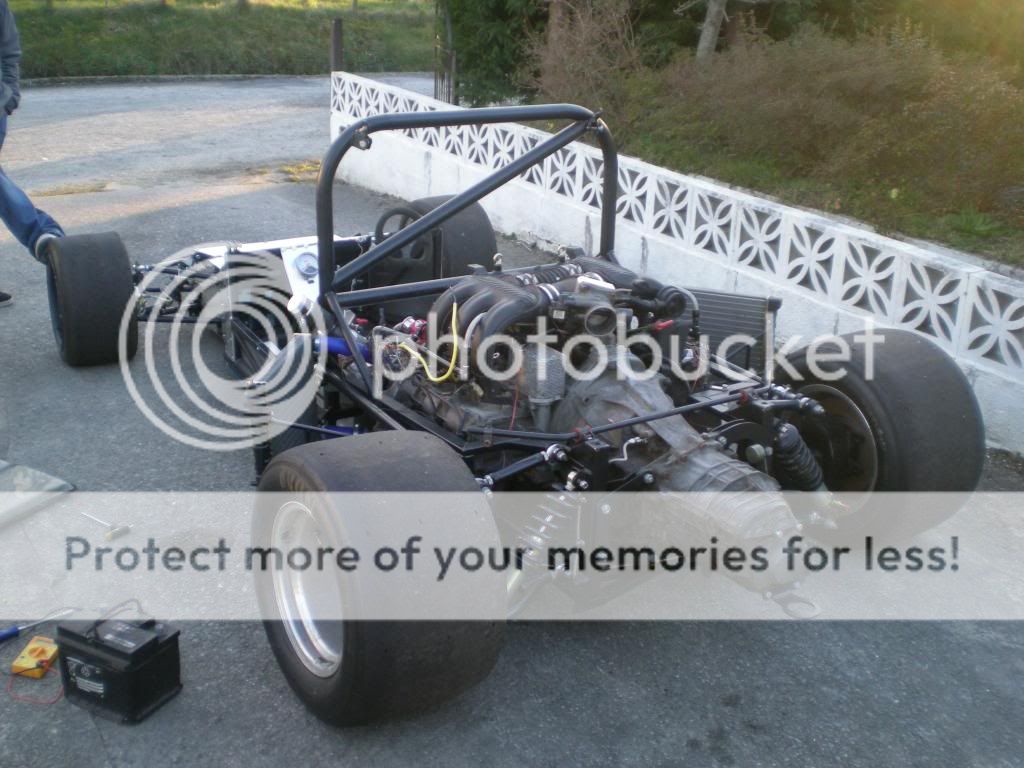
my car below is not a kit car but a full racer and was built with a porsche engine with a flipped diff to make the boxster layout but in 1985! the big advantage the porsche design is a very low centre of gravity for the whole car.

I had a Fisher Fury which was front-mid engine, rear wheel drive i.e. all the mass was between the axles. Did not have it corner weighted but suspect it was about 60/40 front/rear. Interestingly the engine was off set to the passenger side to counteract the driver weight (assumes only a driver most of the time and legacy from the racing origins).
Like the picture above, a porsche boxter engine/gearbox or scooby sti engine/gearbox (4wd locked off a la SDR Storm) in something like a Spire GT-R would be pretty high up my kit list.
Like the picture above, a porsche boxter engine/gearbox or scooby sti engine/gearbox (4wd locked off a la SDR Storm) in something like a Spire GT-R would be pretty high up my kit list.
I think you're all adding too much complexity.
You need to keep the weight close to the two wheel axle and low down.
Draw a triangle between the three tyre contact patches and extend a line vertically down to the ground from the Centre of Gravity. This represents the force exerted on the car by the CofG. As you corner right, the force line will swing out to the left, as you brake it swings forwards and as you accelerate it swings backwards.
If at any time the C of G force line intersects the ground at a point outside of the contact patch triangle, the the vehicle will tip. For a 2F1R the worst case is clearly accelerating hard in a tight corner.
So the answer to the question is, depends on the configuration : 2F1R, keep the weight forwards. 1F2R keep the weight at the rear.
HTH.
You need to keep the weight close to the two wheel axle and low down.
Draw a triangle between the three tyre contact patches and extend a line vertically down to the ground from the Centre of Gravity. This represents the force exerted on the car by the CofG. As you corner right, the force line will swing out to the left, as you brake it swings forwards and as you accelerate it swings backwards.
If at any time the C of G force line intersects the ground at a point outside of the contact patch triangle, the the vehicle will tip. For a 2F1R the worst case is clearly accelerating hard in a tight corner.
So the answer to the question is, depends on the configuration : 2F1R, keep the weight forwards. 1F2R keep the weight at the rear.
HTH.
mikeveal said:
I think you're all adding too much complexity.
You need to keep the weight close to the two wheel axle and low down.
Draw a triangle between the three tyre contact patches and extend a line vertically down to the ground from the Centre of Gravity. This represents the force exerted on the car by the CofG. As you corner right, the force line will swing out to the left, as you brake it swings forwards and as you accelerate it swings backwards.
If at any time the C of G force line intersects the ground at a point outside of the contact patch triangle, the the vehicle will tip. For a 2F1R the worst case is clearly accelerating hard in a tight corner.
So the answer to the question is, depends on the configuration : 2F1R, keep the weight forwards. 1F2R keep the weight at the rear.
HTH.
The original post was about four wheel vehicles not trikes. Not that what your saying is wrong about trikes but the dynamics of trikes are different from those of four wheel vehicles due to the lack of roll resistance at the single wheel end. You need to keep the weight close to the two wheel axle and low down.
Draw a triangle between the three tyre contact patches and extend a line vertically down to the ground from the Centre of Gravity. This represents the force exerted on the car by the CofG. As you corner right, the force line will swing out to the left, as you brake it swings forwards and as you accelerate it swings backwards.
If at any time the C of G force line intersects the ground at a point outside of the contact patch triangle, the the vehicle will tip. For a 2F1R the worst case is clearly accelerating hard in a tight corner.
So the answer to the question is, depends on the configuration : 2F1R, keep the weight forwards. 1F2R keep the weight at the rear.
HTH.
Stuart Mills said:
Flipping the transaxle is a way around the engine being on the opposite side of the rear axle.
Which Porsche layout do drivers prefer though.
This one;

or this;

The BoxsterWhich Porsche layout do drivers prefer though.
This one;
or this;
Simply because it has taken 50 years for Porsche to engineer out the odd handling from the rear engine layout. I haven't got that long!
Martin A said:
The original post was about four wheel vehicles not trikes. Not that what your saying is wrong about trikes but the dynamics of trikes are different from those of four wheel vehicles due to the lack of roll resistance at the single wheel end.
See, I told you you were over complicating things. Whaddya want to go and put a redundant wheel on it for?Gassing Station | Kit Cars | Top of Page | What's New | My Stuff