
Discussion


Just been to see the race of champions at wembley. Good fun and nice to see the big name drivers overcook it in the excitement, when they aren't taking it too seriously.
Got a fairly close look at some of the F1 cars, which I haven't done before and it got me wondering:
Why are spoilers attached to the body of the car and not direct say to the axle (or an unsprung part - forgive the technical ignorance). I would have thought there is energy wasted in downforce transfered from the body through the suspension. If they were attached to an unsprung part of the car wouldn't this put all the downforce directly to the wheels, saving energy and therefore requiring smaller spoilers - saving on weight and drag etc etc, also wouldn't this allow for weight saving in suspension components etc as they could be less beefy?
I realise this might not be applicable to F1 as there are so many ridiculous regulations (which is why I'm not too keen), but is it applicable to other motorsport or have I asked an obviously stupid question?
Chatted with my mates and no-one could think of a good reason against, so I thought I'd ask the encyclopedia that are PHers
Got a fairly close look at some of the F1 cars, which I haven't done before and it got me wondering:
Why are spoilers attached to the body of the car and not direct say to the axle (or an unsprung part - forgive the technical ignorance). I would have thought there is energy wasted in downforce transfered from the body through the suspension. If they were attached to an unsprung part of the car wouldn't this put all the downforce directly to the wheels, saving energy and therefore requiring smaller spoilers - saving on weight and drag etc etc, also wouldn't this allow for weight saving in suspension components etc as they could be less beefy?
I realise this might not be applicable to F1 as there are so many ridiculous regulations (which is why I'm not too keen), but is it applicable to other motorsport or have I asked an obviously stupid question?
Chatted with my mates and no-one could think of a good reason against, so I thought I'd ask the encyclopedia that are PHers
horsmai said:
I realise this might not be applicable to F1 as there are so many ridiculous regulations (which is why I'm not too keen), but is it applicable to other motorsport or have I asked an obviously stupid question?
because they like the downforce pushing the car down on the springs as it lowers the profile and reduces drag and creates better diffuser down force.
Not only that but in cornering it can be advantageous to have some inside wheel lift to help the car turn.
also as mentioned above with independent suspension there would be movement about the two poles leading to fatigue.
Not only that but in cornering it can be advantageous to have some inside wheel lift to help the car turn.
also as mentioned above with independent suspension there would be movement about the two poles leading to fatigue.
Edited by mark69sheer on Tuesday 18th December 14:41
When aerofoils first appeared on formula cars the rear wing was attached directly to the rear uprights. Following a number of rather spectacular failures, when the wings fell off due to the direct shock loads from suspension movement, the rules were changed and all aerodynamic devices had to be fixed to the sprung mass. It is a rule that as far as I know has never been changed, in the same way that F1 cars still run 13 inch wheels whilst just about every car in the world is now on low profile rubber.
Cheers
NigelJ
Cheers
NigelJ
rubystone said:
horsmai said:
Yes they were. People such as Colin Chapman bolted very tall, spindly wings to the suspension components of cars such as the Lotus 49, but a spate of failures banned them. They took their inspiration from the Chapparal sportscars of Jim Hall (Didn't Jim nick the idea from someone else too?)NIgelJ said:
It is a rule that as far as I know has never been changed, in the same way that F1 cars still run 13 inch wheels whilst just about every car in the world is now on low profile rubber.
With something as inherently light and stiff as a modern F1 car, the compression of the tyre is used as part of the suspension. I very much doubt you'd want to run a 600kg car with almost as much downforce over curbs with low profile tyres!sfaulds said:
Mark, why wouldn't they just run the car lower in the first place? Or fit a diff?
Good effort though!
If the car was run lower then it would be too low for the kerbs in slow corners and would just spin off the track or scrape its plank illegally.Good effort though!
Running lower at high speed has the advantages mentioned.
The cars do have a diff but but that only solves the different radii turns taken by the inside and outside wheels diffs don't apportion grip front to back ie extra grip on the front outside tyre for quelling understeer..etc
The rear inside wheel even with a diff will lift up as weight passes to the opposite corner. It may notleave the track but it will still be gripping less.
10 Pence Short said:
With something as inherently light and stiff as a modern F1 car, the compression of the tyre is used as part of the suspension. I very much doubt you'd want to run a 600kg car with almost as much downforce over curbs with low profile tyres!
They do it in LM sportscars.[quote]If the car was run lower then it would be too low for the kerbs in slow corners and would just spin off the track or scrape its plank illegally.
[/quote]
So you're saying they scrape the plank at high speeds then? How much change in ride height does it cause over what speed range? I'll wager the cars are stiff enough that it's insignificant - and ask yourself *why* the cars are so stiff.
[quote]Running lower at high speed has the advantages mentioned.
[/quote]
I don't beleive the reduction in height would be enough to make a significant difference - do you have data or experiance to show otherwise?
[quote]The cars do have a diff but but that only solves the different radii turns taken by the inside and outside wheels diffs don't apportion grip front to back ie extra grip on the front outside tyre for quelling understeer..etc
The rear inside wheel even with a diff will lift up as weight passes to the opposite corner. It may notleave the track but it will still be gripping less.
[/quote]
Ahh, you're a karter.
Now surely if mounting wings on the suspension would make so much difference to grip levels in corners, then the benfits would massively outweigh your theoretical disadvantages?
[/quote]
So you're saying they scrape the plank at high speeds then? How much change in ride height does it cause over what speed range? I'll wager the cars are stiff enough that it's insignificant - and ask yourself *why* the cars are so stiff.
[quote]Running lower at high speed has the advantages mentioned.
[/quote]
I don't beleive the reduction in height would be enough to make a significant difference - do you have data or experiance to show otherwise?
[quote]The cars do have a diff but but that only solves the different radii turns taken by the inside and outside wheels diffs don't apportion grip front to back ie extra grip on the front outside tyre for quelling understeer..etc
The rear inside wheel even with a diff will lift up as weight passes to the opposite corner. It may notleave the track but it will still be gripping less.
[/quote]
Ahh, you're a karter.
Now surely if mounting wings on the suspension would make so much difference to grip levels in corners, then the benfits would massively outweigh your theoretical disadvantages?
moffspeed said:
rubystone said:
horsmai said:
Yes they were. People such as Colin Chapman bolted very tall, spindly wings to the suspension components of cars such as the Lotus 49, but a spate of failures banned them. They took their inspiration from the Chapparal sportscars of Jim Hall (Didn't Jim nick the idea from someone else too?)Interesting points, thanks all! - should have known it would be down to antiquated regulations.
I can't see the arguement for using the downforce to actually lower the body of the car and therefore decrease drag, surely the force required to lower the profile of the car is creating drag. A car without big spoilers has a higher top speed than the same car with big spoilers - down to drag. If the car was lowered on by some means other than downforce, then yes, but you can't lower the body using downforce and get a reduction in drag, you'd be creating energy from nothing wouldn't you?
Plus wouldn't the wear on the independent suspension be negated if each wheel had it's own independent spoiler attached? (includes front splitter/whatever).....dunno, just guessing, as you wouldn't mount a pair of big wings at each end of the car if you were attaching direct to 4 independently sprung wheels.
Realise this is a mute point for F1 as it was tried and failed due to old technology and safety issues. I remember my dad telling a few other examples of this when I was a kid, but was wondering why we don't see it in other motorsport.
As far as low profile tyres: I thought F1s had high prfiles because a large and flexible tyre wall a) acts as suspension b) prevents wheelspin - like in drag cars.
I can't see the arguement for using the downforce to actually lower the body of the car and therefore decrease drag, surely the force required to lower the profile of the car is creating drag. A car without big spoilers has a higher top speed than the same car with big spoilers - down to drag. If the car was lowered on by some means other than downforce, then yes, but you can't lower the body using downforce and get a reduction in drag, you'd be creating energy from nothing wouldn't you?
Plus wouldn't the wear on the independent suspension be negated if each wheel had it's own independent spoiler attached? (includes front splitter/whatever).....dunno, just guessing, as you wouldn't mount a pair of big wings at each end of the car if you were attaching direct to 4 independently sprung wheels.
Realise this is a mute point for F1 as it was tried and failed due to old technology and safety issues. I remember my dad telling a few other examples of this when I was a kid, but was wondering why we don't see it in other motorsport.
As far as low profile tyres: I thought F1s had high prfiles because a large and flexible tyre wall a) acts as suspension b) prevents wheelspin - like in drag cars.
10 Pence Short said:
With something as inherently light and stiff as a modern F1 car, the compression of the tyre is used as part of the suspension. I very much doubt you'd want to run a 600kg car with almost as much downforce over curbs with low profile tyres!
I've always felt that the compression of the tyre is used as part of the suspension because the designers are forced to use the 13" wheels; they'd much rather have low-profile tyres and control everything with more adjustable and predictable springs & dampers. Regarding the last point, the cars will generate downforce far in excess of their own weight - although to be fair, probably not at the speeds at which they're bouncing over kerbs!
Spanish GP in Barcelona 1969 saw the Upright mounted wings reach their most ridiculous proportions.
.jpg)
Later images show the wings starting to crease in the middle and finally both Lotus 49s crashed out within yards of each other when the wings finally collapsed.
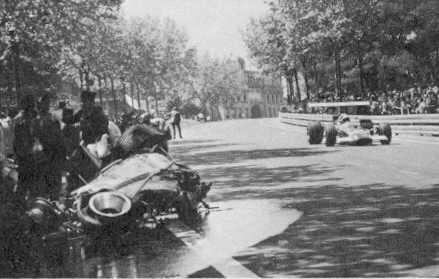
For next round - Monaco - all the teams arrived with Wing spec'd cars but after an emergency meeting of the CSI the moveable wings were banned.
Tony
Later images show the wings starting to crease in the middle and finally both Lotus 49s crashed out within yards of each other when the wings finally collapsed.
For next round - Monaco - all the teams arrived with Wing spec'd cars but after an emergency meeting of the CSI the moveable wings were banned.
Tony
The F1 high profile tyres are down to the regulations specifying the size. In 2009 they are moving to 15" wheels with lower profile tyres similar to CART (unless they change their mind again).
Mounting the wings on the uprights has a lot of advantages, but it also has a lot of disadvantages, the wing mounts are far more complex as they have to articulate, so the angle of attack of the wing is changing whilst the suspension goes through it's travel. With Aero being so advanced now and Aero balance being critical this alone would render it dificult to work with, ignoring the vibration fatigue issues.
Mounting the wings on the uprights has a lot of advantages, but it also has a lot of disadvantages, the wing mounts are far more complex as they have to articulate, so the angle of attack of the wing is changing whilst the suspension goes through it's travel. With Aero being so advanced now and Aero balance being critical this alone would render it dificult to work with, ignoring the vibration fatigue issues.
The idea of using downforce to glue a car to the road goes back quite a long way -
Opel Rocket Car - 1928

Merceded 300 SLR 1955 - the device sticking up is an air brake which also supplied a small amount of downforce
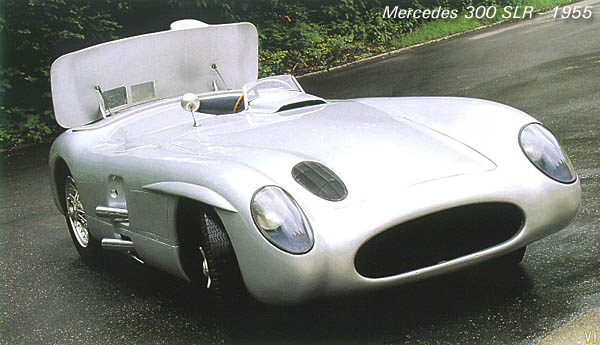
The May brothers from Switzerland entered a Potsche fitted with a huge wing attached by tall struts in the 1955 or 1956 Le Mans race. However, the scrutineers propmptly baned the device and it ran wingless during the race.
If that car had been allowed to run it is likely we might have seem wings on Grand Prix cars by 1961/62.
Opel Rocket Car - 1928
Merceded 300 SLR 1955 - the device sticking up is an air brake which also supplied a small amount of downforce
The May brothers from Switzerland entered a Potsche fitted with a huge wing attached by tall struts in the 1955 or 1956 Le Mans race. However, the scrutineers propmptly baned the device and it ran wingless during the race.
If that car had been allowed to run it is likely we might have seem wings on Grand Prix cars by 1961/62.
Gassing Station | General Motorsport | Top of Page | What's New | My Stuff