
Modern ground effect F1 car
Discussion


There are rules about the floor of an F1 car, meaning you can't make a true ground effect car. Is there anything in the rules to stop an F1 team effectively having a false floor which complies with the regulations, and has a second floor parallel to and above it, forming abox open at the front and back. The shape of the upper floor could be sculpted to create a ground effect device. Would anything like this actually work?
You're confused about what your confusion is :-)
There's no difference between an aerofoil and ground effect, both produce a pressure difference that causes a force to act in a direction.
What you're missing is that the force has to act against something, the rear wing force acts on the car through it's mounting structure and through to the wheels and then the ground. By contrast, the ground effect surface force would act on the bottom of the car, pulling it down through the suspension, wheels, to the ground. But there would also be an equal and opposite force acting on the lower floor that would cancel out the effect at the wheels.
What you've described is a system that is effectively isolated from the environment, so the net effect on the environment is zero. I'm sure the setup would slow the car down as both floors would be stressed in opposite directions, the force required for this must come from somewhere, so drag must be increased overall.
There's no difference between an aerofoil and ground effect, both produce a pressure difference that causes a force to act in a direction.
What you're missing is that the force has to act against something, the rear wing force acts on the car through it's mounting structure and through to the wheels and then the ground. By contrast, the ground effect surface force would act on the bottom of the car, pulling it down through the suspension, wheels, to the ground. But there would also be an equal and opposite force acting on the lower floor that would cancel out the effect at the wheels.
What you've described is a system that is effectively isolated from the environment, so the net effect on the environment is zero. I'm sure the setup would slow the car down as both floors would be stressed in opposite directions, the force required for this must come from somewhere, so drag must be increased overall.
what led me to think about it was a comment from Renault that th current double decker diffusers would lead to ground effect cars.
I imagined the upper deck (defined by the top of the diffuser and the bottom of what was the floor, if I have understood what I've read properly) being moved further and further forward until it ran the entire length of the car. As you guys have now explained, that would be pointless. It would no longer be acting as a diffuser at that point I suppose.
I imagined the upper deck (defined by the top of the diffuser and the bottom of what was the floor, if I have understood what I've read properly) being moved further and further forward until it ran the entire length of the car. As you guys have now explained, that would be pointless. It would no longer be acting as a diffuser at that point I suppose.
Edited by DangerousMike on Thursday 26th March 10:29
DangerousMike said:
There are rules about the floor of an F1 car, meaning you can't make a true ground effect car. Is there anything in the rules to stop an F1 team effectively having a false floor which complies with the regulations, and has a second floor parallel to and above it, forming abox open at the front and back. The shape of the upper floor could be sculpted to create a ground effect device. Would anything like this actually work?
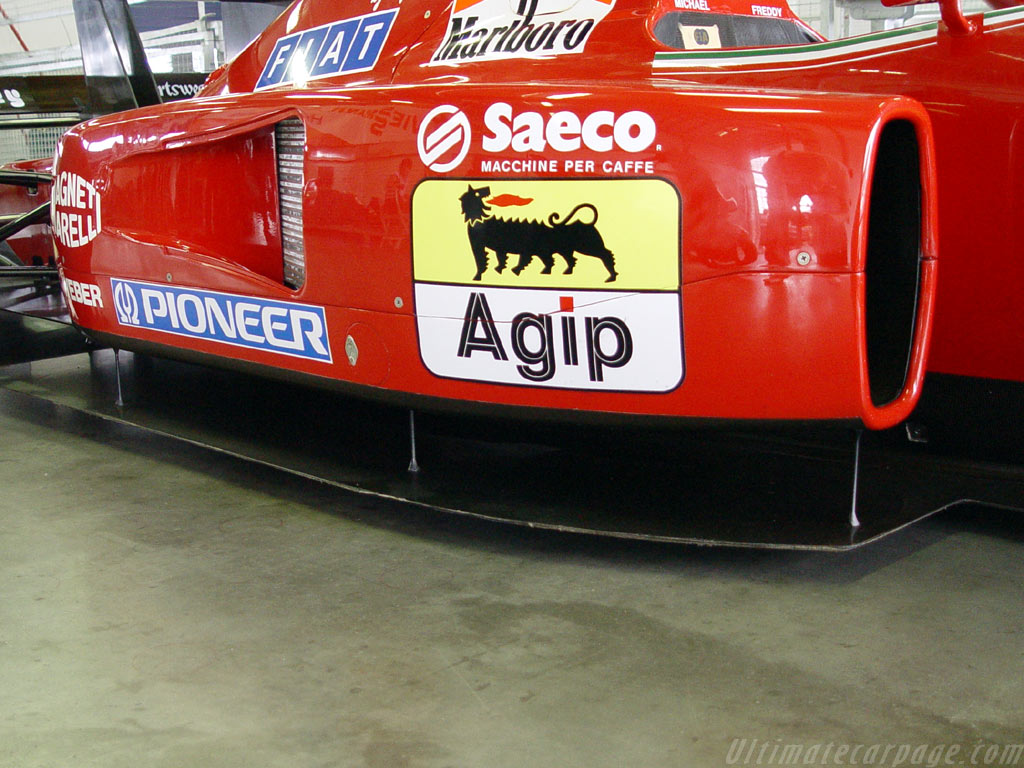
Ferrari tried it in 1992 with F92, they used 2 floors one above the other but I don't know if the top one was sculptured. It was rubbish though, didn't help they had Ivan Capelli driving alongside Alesi that year. They put a conventional floor on it later in the season. You can see on the image below the sides are open, so perhaps there are regulations in place to prevent a closed sided box under the car anyway, stopping the ground effect idea.All it ended up doing was raising the centre of gravity for an already heavy V12 engine.
FourWheelDrift said:
DangerousMike said:
There are rules about the floor of an F1 car, meaning you can't make a true ground effect car. Is there anything in the rules to stop an F1 team effectively having a false floor which complies with the regulations, and has a second floor parallel to and above it, forming abox open at the front and back. The shape of the upper floor could be sculpted to create a ground effect device. Would anything like this actually work?
Ferrari tried it in 1992 with F92, they used 2 floors one above the other but I don't know if the top one was sculptured. It was rubbish though, didn't help they had Ivan Capelli driving alongside Alesi that year. They put a conventional floor on it later in the season. You can see on the image below the sides are open, so perhaps there are regulations in place to prevent a closed sided box under the car anyway, stopping the ground effect idea.All it ended up doing was raising the centre of gravity for an already heavy V12 engine.
DangerousMike said:
There are rules about the floor of an F1 car, meaning you can't make a true ground effect car. Is there anything in the rules to stop an F1 team effectively having a false floor which complies with the regulations, and has a second floor parallel to and above it, forming abox open at the front and back. The shape of the upper floor could be sculpted to create a ground effect device. Would anything like this actually work?
The cars already go way faster than the old ground effects cars of the past, if they were to corner any faster then would become dangerous to drive.I'd guess the downforce generated by todays upper bodywork makes up for this ban.
I think the laptimes might be faster on slicks this year.
Re putting an aerofoil inside a "tunnel". That will work, to the extent that (assuming the aerofoil is fixed to the side of the tunnel) it will still exert a force on the whole tunnel relative to the atmosphere. If it didn't then a wind tunnel would never work  The problem is whether you can make a tunnel large enough to allow a free enough flow of air to get any significant benefit. Very unlikely!
The cons massively outweigh the pros of such an approach.
What has really changed in the last 25 years is the availability of very accurate CFD (Computational Fluid Dynamics, not Computational Fluid Design as the commentary this morning called it) tools. Aerodynamics is very, very sophisticated now.
The problem is whether you can make a tunnel large enough to allow a free enough flow of air to get any significant benefit. Very unlikely!The cons massively outweigh the pros of such an approach.
What has really changed in the last 25 years is the availability of very accurate CFD (Computational Fluid Dynamics, not Computational Fluid Design as the commentary this morning called it) tools. Aerodynamics is very, very sophisticated now.
skwdenyer said:
Re putting an aerofoil inside a "tunnel". That will work, to the extent that (assuming the aerofoil is fixed to the side of the tunnel) it will still exert a force on the whole tunnel relative to the atmosphere. If it didn't then a wind tunnel would never work The problem is whether you can make a tunnel large enough to allow a free enough flow of air to get any significant benefit. Very unlikely!
The cons massively outweigh the pros of such an approach.
What has really changed in the last 25 years is the availability of very accurate CFD (Computational Fluid Dynamics, not Computational Fluid Design as the commentary this morning called it) tools. Aerodynamics is very, very sophisticated now.
Calling CFD very accurate is a bit of a fallacy, it's not - predicting separation is still very very difficult and cannot be done using methods used in industry, ie. RANS methods, and especially in F1 separation is critical. Higher order methods such as DNS are getting close, but these are just not practical in an environment such as F1. The problem is whether you can make a tunnel large enough to allow a free enough flow of air to get any significant benefit. Very unlikely!The cons massively outweigh the pros of such an approach.
What has really changed in the last 25 years is the availability of very accurate CFD (Computational Fluid Dynamics, not Computational Fluid Design as the commentary this morning called it) tools. Aerodynamics is very, very sophisticated now.
CFD at the moment is just used as a method to eliminate a large number of (e.g. front wing) designs, as it gives quite good approximations of what is and is not clearly going to work. All final designs will still have to be wind tunnel tested to give a much more accurate picture of whether the design works, and its interaction with the rest of the car, and to give and idea of what alterations need to be made.
Obviously the true test of whether it works is on the track.
CFD is an excellent, cheap tool, but there's no way you can design a competitive car using it alone (yet).
Edited by navier_stokes on Friday 27th March 12:26
navier_stokes said:
Calling CFD very accurate is a bit of a fallacy, it's not - predicting separation is still very very difficult and cannot be done using methods used in industry, ie. RANS methods, and especially in F1 separation is critical. Higher order methods such as DNS are getting close, but these are just not practical in an environment such as F1.
CFD at the moment is just used as a method to eliminate a large number of (e.g. front wing) designs, as it gives quite good approximations of what is and is not clearly going to work. All final designs will still have to be wind tunnel tested to give a much more accurate picture of whether the design works, and its interaction with the rest of the car, and to give and idea of what alterations need to be made.
Obviously the true test of whether it works is on the track.
CFD is an excellent, cheap tool, but there's no way you can design a competitive car using it alone (yet).
Well, given your "handle", I'd assume you know what you're talking about CFD at the moment is just used as a method to eliminate a large number of (e.g. front wing) designs, as it gives quite good approximations of what is and is not clearly going to work. All final designs will still have to be wind tunnel tested to give a much more accurate picture of whether the design works, and its interaction with the rest of the car, and to give and idea of what alterations need to be made.
Obviously the true test of whether it works is on the track.
CFD is an excellent, cheap tool, but there's no way you can design a competitive car using it alone (yet).
 My principal numerical modelling expertise is in structures, not aero.
I would, however, described CFD as "very accurate" when compared to anything else available on-screen or on-paper. We are at the stage where we can get to a pretty good approximation using CFD, allowing tunnel work to focus on the detail. That is IMHO a major change over the last 20 years or so.
I would argue against the idea that CFD is "cheap", however. Moore's law is helping, of course, but the hardware required to crunch the data, store the data, post-process the results, and so on is still in the many, many £millions area for a company like McLaren. Companies like this help to keep businesses like SGI in business these days (when the US Government isn't doing it, of course...).
Added to that, the cost of experienced "hands" to drive the CFD is high. And, unless they have the most extraordinary all-parametric modelling capability (and access to a few orders of magnitude more of computing power than I know about) then they will need a lot of those hands to keep the CFD seats warm and focussed.
Actually, that said, that (automatic optimisation) seems to be happening: check out this rather interesting "CV" from a current Renault F1 guy here which says:
Fabrizio_Tessicini said:
I am Project leader for the development of an innovative automatic optimisation system for the aerodynamic design of 2009 formula one car. Based on the new 38 TeraFlops Cluster machine, the virtual wind tunnel is able to find the optimal shape of the car using a modified version of Navier Stokes equations.
I'm intrigued as to why you think higher-order methods aren't practical in F1? But overall I think you'd agree that CFD work has revolutionised the process of getting a better approximation, sooner. The ban on testing, and the reduction in wind tunnel scale, will - I hope - help to push this further.skwdenyer said:
navier_stokes said:
Calling CFD very accurate is a bit of a fallacy, it's not - predicting separation is still very very difficult and cannot be done using methods used in industry, ie. RANS methods, and especially in F1 separation is critical. Higher order methods such as DNS are getting close, but these are just not practical in an environment such as F1.
CFD at the moment is just used as a method to eliminate a large number of (e.g. front wing) designs, as it gives quite good approximations of what is and is not clearly going to work. All final designs will still have to be wind tunnel tested to give a much more accurate picture of whether the design works, and its interaction with the rest of the car, and to give and idea of what alterations need to be made.
Obviously the true test of whether it works is on the track.
CFD is an excellent, cheap tool, but there's no way you can design a competitive car using it alone (yet).
Well, given your "handle", I'd assume you know what you're talking about CFD at the moment is just used as a method to eliminate a large number of (e.g. front wing) designs, as it gives quite good approximations of what is and is not clearly going to work. All final designs will still have to be wind tunnel tested to give a much more accurate picture of whether the design works, and its interaction with the rest of the car, and to give and idea of what alterations need to be made.
Obviously the true test of whether it works is on the track.
CFD is an excellent, cheap tool, but there's no way you can design a competitive car using it alone (yet).
My principal numerical modelling expertise is in structures, not aero.I would, however, described CFD as "very accurate" when compared to anything else available on-screen or on-paper. We are at the stage where we can get to a pretty good approximation using CFD, allowing tunnel work to focus on the detail. That is IMHO a major change over the last 20 years or so.
I would argue against the idea that CFD is "cheap", however. Moore's law is helping, of course, but the hardware required to crunch the data, store the data, post-process the results, and so on is still in the many, many £millions area for a company like McLaren. Companies like this help to keep businesses like SGI in business these days (when the US Government isn't doing it, of course...).
Added to that, the cost of experienced "hands" to drive the CFD is high. And, unless they have the most extraordinary all-parametric modelling capability (and access to a few orders of magnitude more of computing power than I know about) then they will need a lot of those hands to keep the CFD seats warm and focussed.
Actually, that said, that (automatic optimisation) seems to be happening: check out this rather interesting "CV" from a current Renault F1 guy here which says:
Fabrizio_Tessicini said:
I am Project leader for the development of an innovative automatic optimisation system for the aerodynamic design of 2009 formula one car. Based on the new 38 TeraFlops Cluster machine, the virtual wind tunnel is able to find the optimal shape of the car using a modified version of Navier Stokes equations.
I'm intrigued as to why you think higher-order methods aren't practical in F1? But overall I think you'd agree that CFD work has revolutionised the process of getting a better approximation, sooner. The ban on testing, and the reduction in wind tunnel scale, will - I hope - help to push this further.Having said that, wind tunnels are only approximations also, even neglecting the fact that scale models are used. The turbulence levels in a good wind tunnel are approximately 0.1% (deviation from the mean stream). However turbulence levels in the real world, the atmosphere, are much less than this, by orders of magnitude. This is a problem for aerospace design also, as it greatly effects things like separation points. This is why you need to track test it as well.
Higher order methods just aren't practical in any engineering field at the moment, we simply do not have the computing power - they are still at university/research levels. Even defence/aerospace companies that have a lot of time on their hands (in comparison to F1 development) still very rarely use it because it is so costly.
Without going into too much detail, practical RANS methods that are used in F1 and the majority of engineering fields use "average" values for turbulence using statistical methods (which is the key to almost all real world aerodynamics) and solve equations which are derived using intuition rather than sound physical mathematics. Often this involves "fudging" constants to make the model fit with very specific, simple experimental results. As soon as they are applied to real world geometry, such as F1 cars, this can all get a bit hairy
Turbulence is a highly complex phenomenon which no-one really understands and is one of the few unsolved physical problems out there, but the basic computational problem is that in order to fully describe it, you need to resolve turbulent structures ranging from the size of your car, right down to scales much less than a mm. In practice, using DNS methods which do this, you need huge computing power and storage. So for example 1 simulation for RANS might take a few hours on say a front wing. If you were to use the same model for a DNS simulations, we're talking weeks/months. Right now the teams will be doing 1000's of simulations a season so as you can see, this is not practical. Maybe DNS will be the norm in a decade or two.
Either way, I'm sure F1 will be at the forefront of practical CFD, that's for certain.
DangerousMike said:
I wonder do they use some kind of evolutionary algorithms in designing their bodywork?
Coupled optimisation tools have been available for a while, and there are commercially available tools such as:http://www.optimalsolutions.us/index.php
But I suspect most of the top teams will have their in house codes. It's debatable whether geometry modifying tools are better/quicker than an aerodynamicist analysing the results and making changes themselves - I guess it depends how good your program/aerodynamicist is
Edited by navier_stokes on Friday 27th March 14:20
navier_stokes said:
DangerousMike said:
I wonder do they use some kind of evolutionary algorithms in designing their bodywork?
Coupled optimisation tools have been available for a while, and there are commercially available tools such as:http://www.optimalsolutions.us/index.php
But I suspect most of the top teams will have their in house codes. It's debatable whether geometry modifying tools are better/quicker than an aerodynamicist analysing the results and making changes themselves - I guess it depends how good your program/aerodynamicist is
Edited by navier_stokes on Friday 27th March 14:20
With budget caps for next year, I wonder how many teams are going to spend as much as they can this year on codes, processing power, and so on
Thanks for the additional information on the earlier point. As I say, my numerical (FE) analysis work was on structures; some of the impact analyses my group used to run would take 30 days or so to complete. But, again, Moore's law is your friend on those type of problems: it is simply a game of deciding when computing power is cheap enough to buy some more. The Renault cluster model can be a good one for this type of thing - just keep adding and/or upgrading nodes.
Gassing Station | General Motorsport | Top of Page | What's New | My Stuff