
Remembering Rindt
Discussion


Remembering Rindt

Jochen Rindt
It is forty years to the day, since Jochen Rindt died in practice for the 1970 Italian Grand Prix at Monza.
Jochen Rindt was a fantastic talent, the like of which only seem to come around once a decade or so. He was a super-fast driver who shot into the motor-racing fraternity's consciousness one sunny day in 1964. That Formula Two meeting at Crystal Palace really got people talking about him, he beat Graham Hill and looked like he was mucking about whilst he did it. People soon realised that this was his style, sideways everywhere. Rindt is still one of the drivers referred to by Sir Jackie Stewart when he talks about outright car control.
Early years.
Rindt started out as a wealthy amateur participating in club racing in Austria.
After entering his home Grand Prix in 1964, putting in a solid showing but ultimately retiring, the Cooper team made him a works driver for 1965. Unfortunately, Cooper were in their twilight years at this point and never really gave Jochen a car that his talents deserved. Nevertheless, he stayed with them through 1966 and 1967 when they were powered by a strong, but heavy, Maserati V12 engine. Rindt was regularly in the points and occasionally on the podium, but victory eluded him. For 1968 he was hot property, for although his F1 results were unspectacular, he continued racing in F2 and sports cars.
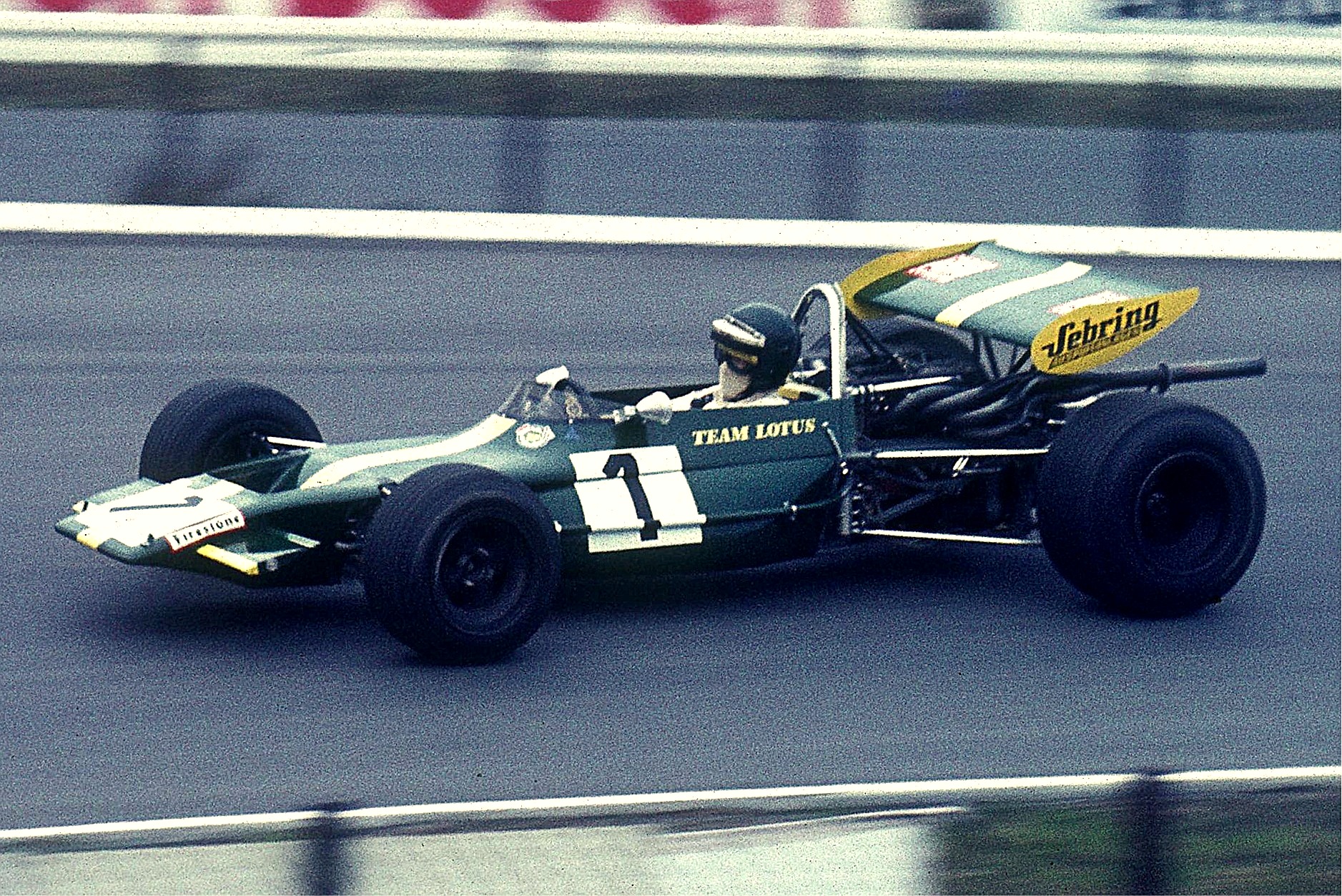
Rindt in his F2 Lotus
He became known as the 'King of F2' and he won the Le Mans 24 hours in 1965 sharing a Ferrari 250LM with the American Masten Gregory. With these results on his CV, Rindt managed to get the number two seat at Brabham, recently vacated by Denny Hulme the reigning F1 champion. Jack Brabham and the Brabham designer Ron Tauranac had decided to go with some 4valve heads on their previously reliable Repco V8 engines rather than go with Cosworth's DFV, which had been rather fragile in 1967. It was the wrong decision. Rindt had two pole positions, but only two finishes that year (both podiums) out of twelve races. It was around this time that Denis (Jenks) Jenkinson, the famous motoring reporter, had a bet with Jochen that if he won a Grand Prix, Jenks would shave off his trademark bushy beard.

Rindt (on roof) of 1965 LeMans winning Ferrari 250LM
To Lotus and Success.
Lotus's Colin Chapman came a-calling for Jochen's services in 1969, putting Graham Hill's nose out of joint in the process. Hill was upset that Rindt had been signed as a joint number one driver despite never having won a race, compared to Hill's multiple wins and two world championships, the most recent being the season before! Before the 1969 F1 season started, the Tasman series had to be attended to. Lotus sent two type 49s down under for Rindt and Hill. Jochen finished second in the standings, running the winner Chris Amon close for the title, but he scored a win in the wet at Warwick Farm circuit that people who witnessed it still talk about today.
The third race of the 1969 season left a big impact on Jochen Rindt's life, literally. The high wings that Lotus in were running proved too effective for their internal structure. Rindt's rear wing collapsed just a few laps after Hill's had, at the same flat out point on the Spanish circuit. Rindt ended up sitting upside down in a twisted aluminium car that was leaking fuel. He survived and was, quite remarkably, not badly hurt. However he did have quite a knock on the head which forced him to sit out the Monaco Grand Prix. The Lotus mechanics were amazed that Jochen wasn't more seriously injured as, when they tried back at the factory, they couldn't get in the battered and contorted remains of his car.
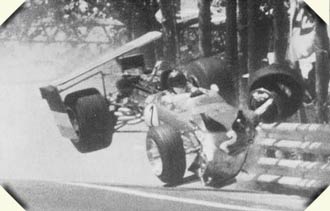
Rindt’s accident in Spain 1969
Jochen was back for the next race, but was out of sorts, still suffering the after effects of the knock to his head. For the French Grand Prix at Clermont Ferrand, Jochen got motion sickness and blurred vision, again due to the accident.
At the British Grand Prix, Jochen was back on form. For two thirds of the race he had a battle for the lead with Jackie Stewart. But the strange thing was, Jackie (usually super smooth) was driving very raggedly and Jochen was calmly and serenely keeping the upper hand over Jackie. Jochen would have won the race if it hadn't been for Colin Chapman insisting on putting in too little fuel. The pit stop dropped Rindt down to fourth at the end of the race.
Rindt made up for this in the penultimate race of the season, the United States Grand Prix. He drove away from the other competitors to win. Denis Jenkinson kept true to his word and shaved his beard off, but it was back for the next season.
Championship Year.
1970 had a slow start for Rindt. The new Lotus 72 was not yet ready so the old 49s (now in 'C' specification) were pressed into action for the first couple of races. The Monaco Grand Prix saw an amazing last lap as Rindt (who had finally realised, halfway through the race, that the Lotus 49 was a great car around the principality) got to within 2 seconds of Jack Brabham, who was in the lead. Rindt watched as Brabham outbraked himself whilst getting past a backmarker and had hit the barriers at the last corner. Rindt drove past as Brabham was reversing out and took the chequered flag. He was as surprised as anyone.

Brabham locks up under braking at Monaco, as Rindt gets ready to pounce
After a retirement in the last Grand Prix to be held on the old Spa-Francorchamps circuit, the next four races fell to Rindt and the Lotus 72 which was now a fast and reliable proposition in “C” specification.
Rindt now had a clear lead in the driver's World Championship, only Jacky Ickx could beat him by winning all of the 4 remaining races and Jochen scoring less than 2 points. It looked good for Jochen.
In practice for the Italian Grand Prix, Lotus boss Colin Chapman wanted the 72s to run without wings to lower the drag and raise the top speed. Neither of the Lotus drivers were happy about this, Rindt wanted to be able to race the older Lotus 49, whereas number two driver John Miles simply stated "it doesn't run straight"(without the wings). The problem was the Cosworth powered cars had to do everything they could to keep up with the more powerful Ferraris of Ickx and Regazzoni. Removing the wings reportedly gave the Lotus' an extra 600rpm. With their gearing that meant a top speed of 205mph.

Rindt’s Lotus 72C without wings at Monza 1970
On Jochen's fifth lap of a run in practice, Denny Hulme, who was following him, reported that Jochen weaved a little towards the braking area for the Parabolica corner then snapped sharp left into the Armco barrier.
The front of the car was destroyed, shattering Jochen's ankles. The official accident report blamed a faulty brake shaft on the Lotus for instigating the accident, but the cause of death was found to be the Armco barriers which had been incorrectly installed, causing the wedge-shaped Lotus to push the layers of Armco apart. The report also mentioned that Jochen was not wearing the crotch straps on his 6 point harness. This allowed his body to “submarine” down into the cockpit and the harness’ buckle cut his throat.
Jacky Ickx didn't manage to overtake Jochen Rindt's points total in the remainder of the 1970 season.
Jochen Rindt remains Formula One's only posthumous World Champion. He left behind a wife, Nina, and a daughter Natascha.

Nina, Natascha and Jochen
Jochen Rindt’s career results
F1
Championships – 1 (1970)
Victories – 6
Pole Positions – 10
Fastest laps – 3
Career points – 109
Other notable results
Le Mans 1965 winner (shared drive with Masten Gregory)


Jochen Rindt
It is forty years to the day, since Jochen Rindt died in practice for the 1970 Italian Grand Prix at Monza.
Jochen Rindt was a fantastic talent, the like of which only seem to come around once a decade or so. He was a super-fast driver who shot into the motor-racing fraternity's consciousness one sunny day in 1964. That Formula Two meeting at Crystal Palace really got people talking about him, he beat Graham Hill and looked like he was mucking about whilst he did it. People soon realised that this was his style, sideways everywhere. Rindt is still one of the drivers referred to by Sir Jackie Stewart when he talks about outright car control.
Early years.
Rindt started out as a wealthy amateur participating in club racing in Austria.
After entering his home Grand Prix in 1964, putting in a solid showing but ultimately retiring, the Cooper team made him a works driver for 1965. Unfortunately, Cooper were in their twilight years at this point and never really gave Jochen a car that his talents deserved. Nevertheless, he stayed with them through 1966 and 1967 when they were powered by a strong, but heavy, Maserati V12 engine. Rindt was regularly in the points and occasionally on the podium, but victory eluded him. For 1968 he was hot property, for although his F1 results were unspectacular, he continued racing in F2 and sports cars.
Rindt in his F2 Lotus
He became known as the 'King of F2' and he won the Le Mans 24 hours in 1965 sharing a Ferrari 250LM with the American Masten Gregory. With these results on his CV, Rindt managed to get the number two seat at Brabham, recently vacated by Denny Hulme the reigning F1 champion. Jack Brabham and the Brabham designer Ron Tauranac had decided to go with some 4valve heads on their previously reliable Repco V8 engines rather than go with Cosworth's DFV, which had been rather fragile in 1967. It was the wrong decision. Rindt had two pole positions, but only two finishes that year (both podiums) out of twelve races. It was around this time that Denis (Jenks) Jenkinson, the famous motoring reporter, had a bet with Jochen that if he won a Grand Prix, Jenks would shave off his trademark bushy beard.
Rindt (on roof) of 1965 LeMans winning Ferrari 250LM
To Lotus and Success.
Lotus's Colin Chapman came a-calling for Jochen's services in 1969, putting Graham Hill's nose out of joint in the process. Hill was upset that Rindt had been signed as a joint number one driver despite never having won a race, compared to Hill's multiple wins and two world championships, the most recent being the season before! Before the 1969 F1 season started, the Tasman series had to be attended to. Lotus sent two type 49s down under for Rindt and Hill. Jochen finished second in the standings, running the winner Chris Amon close for the title, but he scored a win in the wet at Warwick Farm circuit that people who witnessed it still talk about today.
The third race of the 1969 season left a big impact on Jochen Rindt's life, literally. The high wings that Lotus in were running proved too effective for their internal structure. Rindt's rear wing collapsed just a few laps after Hill's had, at the same flat out point on the Spanish circuit. Rindt ended up sitting upside down in a twisted aluminium car that was leaking fuel. He survived and was, quite remarkably, not badly hurt. However he did have quite a knock on the head which forced him to sit out the Monaco Grand Prix. The Lotus mechanics were amazed that Jochen wasn't more seriously injured as, when they tried back at the factory, they couldn't get in the battered and contorted remains of his car.
Rindt’s accident in Spain 1969
Jochen was back for the next race, but was out of sorts, still suffering the after effects of the knock to his head. For the French Grand Prix at Clermont Ferrand, Jochen got motion sickness and blurred vision, again due to the accident.
At the British Grand Prix, Jochen was back on form. For two thirds of the race he had a battle for the lead with Jackie Stewart. But the strange thing was, Jackie (usually super smooth) was driving very raggedly and Jochen was calmly and serenely keeping the upper hand over Jackie. Jochen would have won the race if it hadn't been for Colin Chapman insisting on putting in too little fuel. The pit stop dropped Rindt down to fourth at the end of the race.
Rindt made up for this in the penultimate race of the season, the United States Grand Prix. He drove away from the other competitors to win. Denis Jenkinson kept true to his word and shaved his beard off, but it was back for the next season.
Championship Year.
1970 had a slow start for Rindt. The new Lotus 72 was not yet ready so the old 49s (now in 'C' specification) were pressed into action for the first couple of races. The Monaco Grand Prix saw an amazing last lap as Rindt (who had finally realised, halfway through the race, that the Lotus 49 was a great car around the principality) got to within 2 seconds of Jack Brabham, who was in the lead. Rindt watched as Brabham outbraked himself whilst getting past a backmarker and had hit the barriers at the last corner. Rindt drove past as Brabham was reversing out and took the chequered flag. He was as surprised as anyone.
Brabham locks up under braking at Monaco, as Rindt gets ready to pounce
After a retirement in the last Grand Prix to be held on the old Spa-Francorchamps circuit, the next four races fell to Rindt and the Lotus 72 which was now a fast and reliable proposition in “C” specification.
Rindt now had a clear lead in the driver's World Championship, only Jacky Ickx could beat him by winning all of the 4 remaining races and Jochen scoring less than 2 points. It looked good for Jochen.
In practice for the Italian Grand Prix, Lotus boss Colin Chapman wanted the 72s to run without wings to lower the drag and raise the top speed. Neither of the Lotus drivers were happy about this, Rindt wanted to be able to race the older Lotus 49, whereas number two driver John Miles simply stated "it doesn't run straight"(without the wings). The problem was the Cosworth powered cars had to do everything they could to keep up with the more powerful Ferraris of Ickx and Regazzoni. Removing the wings reportedly gave the Lotus' an extra 600rpm. With their gearing that meant a top speed of 205mph.
Rindt’s Lotus 72C without wings at Monza 1970
On Jochen's fifth lap of a run in practice, Denny Hulme, who was following him, reported that Jochen weaved a little towards the braking area for the Parabolica corner then snapped sharp left into the Armco barrier.
The front of the car was destroyed, shattering Jochen's ankles. The official accident report blamed a faulty brake shaft on the Lotus for instigating the accident, but the cause of death was found to be the Armco barriers which had been incorrectly installed, causing the wedge-shaped Lotus to push the layers of Armco apart. The report also mentioned that Jochen was not wearing the crotch straps on his 6 point harness. This allowed his body to “submarine” down into the cockpit and the harness’ buckle cut his throat.
Jacky Ickx didn't manage to overtake Jochen Rindt's points total in the remainder of the 1970 season.
Jochen Rindt remains Formula One's only posthumous World Champion. He left behind a wife, Nina, and a daughter Natascha.
Nina, Natascha and Jochen
Jochen Rindt’s career results
F1
Championships – 1 (1970)
Victories – 6
Pole Positions – 10
Fastest laps – 3
Career points – 109
Other notable results
Le Mans 1965 winner (shared drive with Masten Gregory)
Thanks. I can only see one mistake in it too (not bad for a first attempt). I'll see if the beards can spot it before I edit it. I was going to email Garlick and see if he would run it as a feature/article, but I forgot all this week and I suspect he doesn't answer his work emails on a saturday or a sunday. 
Lovely write-up. Cant remember which drive it was (Elford) who said at one of the races:
"They said that during the race Stewart was smooth and Rindt was ragged. But from where I was when they lapped me, it was the other way round- Stewart was ragged and Rindt was smooth!"
And dont forget Ed Hugus at Le Mans in 1965
"They said that during the race Stewart was smooth and Rindt was ragged. But from where I was when they lapped me, it was the other way round- Stewart was ragged and Rindt was smooth!"
And dont forget Ed Hugus at Le Mans in 1965
williamp said:
Lovely write-up. Cant remember which drive it was (Elford) who said at one of the races:
"They said that during the race Stewart was smooth and Rindt was ragged. But from where I was when they lapped me, it was the other way round- Stewart was ragged and Rindt was smooth!"
And dont forget Ed Hugus at Le Mans in 1965
Interesting. Ed Hugus isn't mentioned in any of my resources. I take it he was 3rd driver?"They said that during the race Stewart was smooth and Rindt was ragged. But from where I was when they lapped me, it was the other way round- Stewart was ragged and Rindt was smooth!"
And dont forget Ed Hugus at Le Mans in 1965
That Elford(?) quote is familiar. Could be from Silverstone '69 that I mentioned, but apparently it was visible as a spectator that the driving styles had "swapped".
Ed Hugus was the reserve driver for the Chinetti-entered (NART?) Ferrari 250LM that Rindt and Gregory drove to victory. Gregory was supposed to have told Hugus to drive a stint during the night when Masten was tired but this has not been substantiated.
Will be interested to hear what the inaccuracy is, MB.
Will be interested to hear what the inaccuracy is, MB.
Hmmm. Interesting Porky. Thanks for that.
I'm afraid that I really don't have a lot of info on Le Mans at all. It just doesn't fall within my field of interest that much. I am very much at the mercy of reliable sources such as Wikipedia.
But, if I could put my own (very) uneducated and uninformed spin on things...would a team, who are going for overall victory, put a reserve driver in the car for a night stint? The rules were a lot looser back then about driving hours, surely the done thing would be to put Rindt in for an extra stint?
Anyway, I have no basis for that, just my inane ramblings.
I'm afraid that I really don't have a lot of info on Le Mans at all. It just doesn't fall within my field of interest that much. I am very much at the mercy of reliable sources such as Wikipedia.
But, if I could put my own (very) uneducated and uninformed spin on things...would a team, who are going for overall victory, put a reserve driver in the car for a night stint? The rules were a lot looser back then about driving hours, surely the done thing would be to put Rindt in for an extra stint?
Anyway, I have no basis for that, just my inane ramblings.
Although I am currently beardless - the only mistake I can find in the article is the comment stating that the 1970 Spanish GP was the 3rd GP of the season. It was the 2nd.
The 1st was the South African GP - which was held in early 1970. The Spanish race waqs the first of the European season and was held in mid April. Imagine a 6 week gap in proceedings today.
The 1st was the South African GP - which was held in early 1970. The Spanish race waqs the first of the European season and was held in mid April. Imagine a 6 week gap in proceedings today.
I would like to do an article on Ronnie, but I wouldn't be able to make it anywhere near as good as the one that Adam Cooper did for Motorsport magazine about 8-9 years ago.
I'll see. I might do something on a significant car as the next one.
It's the one area that I think PH is lacking. Historic motorsport.
I'll see. I might do something on a significant car as the next one.
It's the one area that I think PH is lacking. Historic motorsport.

Eric Mc said:
Although I am currently beardless - the only mistake I can find in the article is the comment stating that the 1970 Spanish GP was the 3rd GP of the season. It was the 2nd.
The 1st was the South African GP - which was held in early 1970. The Spanish race waqs the first of the European season and was held in mid April. Imagine a 6 week gap in proceedings today.
3rd GP of the 1969 season. Although thinking about it, I could be wrong on that. I think Monaco was after Spain that year. You could be correct, but in the wrong year.The 1st was the South African GP - which was held in early 1970. The Spanish race waqs the first of the European season and was held in mid April. Imagine a 6 week gap in proceedings today.
That takes it to 2 mistakes and one possible one.

Rouleur said:
If you fancy writing an article about a particular marque then I'd suggest that Chaparral might be an interesting one, they're fascinating cars that not a lot of people know much about.

Hmmm. More technical innovation than Chapman and Jim Hall wasn't afraid to withdraw his cars if he thought they were dangerous.
It's a thinker.

Mazda Baiter said:
Eric Mc said:
Although I am currently beardless - the only mistake I can find in the article is the comment stating that the 1970 Spanish GP was the 3rd GP of the season. It was the 2nd.
The 1st was the South African GP - which was held in early 1970. The Spanish race waqs the first of the European season and was held in mid April. Imagine a 6 week gap in proceedings today.
3rd GP of the 1969 season. Although thinking about it, I could be wrong on that. I think Monaco was after Spain that year. You could be correct, but in the wrong year.The 1st was the South African GP - which was held in early 1970. The Spanish race waqs the first of the European season and was held in mid April. Imagine a 6 week gap in proceedings today.
That takes it to 2 mistakes and one possible one.
By the 4th race of the season, new rules regarding wings had been introduced.
Eric, you are, of course, correct.
Most teams turned up to Monaco with high, upright mounted wings on the front and rear of the cars. When the call came in to remove the wings, the Lotus mechanics ripped up the ally sheet from the benches in the race truck to make a sloping engine cover. Graham Hill went on to win the race.
On a side note, the Lotus 49 is the most successful car at Monaco ever. 3 wins from 1968-1970
Most teams turned up to Monaco with high, upright mounted wings on the front and rear of the cars. When the call came in to remove the wings, the Lotus mechanics ripped up the ally sheet from the benches in the race truck to make a sloping engine cover. Graham Hill went on to win the race.
On a side note, the Lotus 49 is the most successful car at Monaco ever. 3 wins from 1968-1970
Gassing Station | General Motorsport | Top of Page | What's New | My Stuff