
2013 Toyota Prius (7 seat version)
Discussion


This is my entry for "least PH car ever". It's the 7-seat version of the Gen3 Prius. It's front-wheel drive, a hybrid, an MPV, and it was bought brand new, so I like to think that it fails all of the basic PH acceptability tests. I don't think I'll need to get out the custard for this one.

The original Gen1 Prius - with a tiny boot, a frumpy exterior, 49mpg, and a petrol-electric drivetrain which was largely dismissed as a gimmick - was introduced in 1997. Things have moved on since then. This version - introduced in 2012 - is far less compromised than the Gen1, but the core Prius philosophy remains: a cutting edge drivetrain wrapped in a body and interior that is primarily functional and makes little concession to aesthetics or fashion. The result is a car with a curious mix of high-tech and low-tech and some bizarre design features, but which provides possibly the easiest ownership experience of any car on sale today.
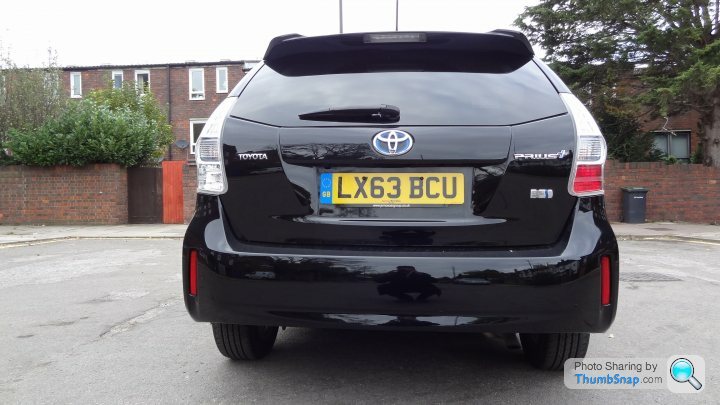
The exterior profile is almost entirely dictated by packaging and aerodynamics. The windscreen is heavily raked and forms a near-continuous line with the bonnet. There is a small rear spoiler. The dimensions are similar to the Ford S-Max, which is probably its nearest competitor, but the Prius is slightly lower and the windscreen is more steeply raked.

The panels are plain, with little adornment. There are no sharp creases or complex surfaces. This helps airflow and reduces repair costs since many types of dents can be pulled or hammered out. It's as if the Bangle era never happened.

The front is designed to minimise wind resistance above all else. That means a large lower spoiler and lots of smooth edges. The grille is small compared to modern cars. This again improves aerodynamics and removes the need for active shutters in the grille. It can be done because the drivetrain has reduced cooling needs compared to conventional drivetrains.
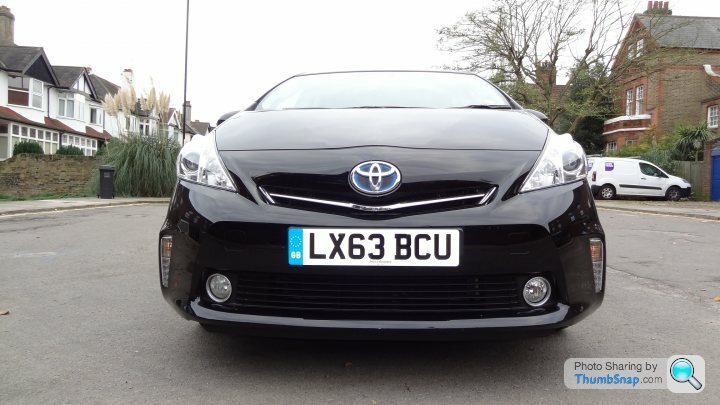
The headlights have small fins on them. This is ostensibly to deflect airflow over the wing mirrors, thus improving aerodynamics and mpg. It's a nice idea but I wonder how effective it really is. On a Boeing 747 it makes a difference. On a road car...I doubt it.
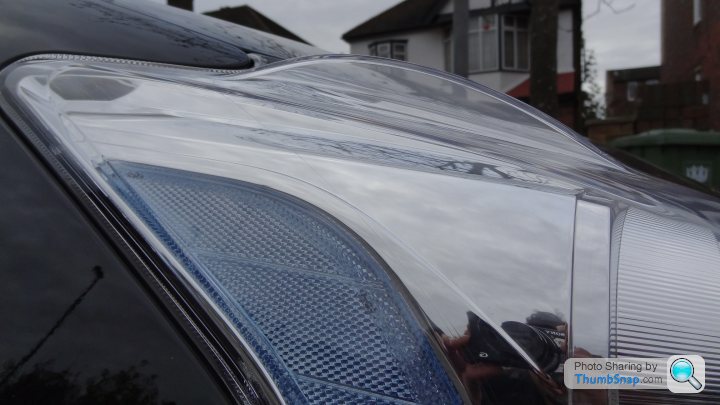
This car is in solid black paint. The coverage is excellent; I looked all over the car and could not find any area which had not been properly painted. This includes the bottom of the doors which is an area that is notorious for being left unpainted. However, the finish is rather poor, with a heavy orange peel effect. Smooth finishes have become harder to obtain since the EU mandated water-based paints, and solid paint is admittedly the bargain basement option, but other manufacturers manage to get smooth finishes, so it must be possible. And remember, this car costs around 26k new. The paint finish is not that of a 26k car. Sort it out please, Toyota.

This car is the baseline T4 spec. In this spec, the wheels are 16 inch alloys but - bizarrely - they are covered with the sort of plastic trims that you normally get on steel wheels. It's a highly practical solution since the trims protect the wheels from getting scuffed, and it's much cheaper to replace the trim than to refurb an alloy wheel, but it looks a bit "minicab". Again, this is not great on a car that costs 26k new. Higher models have exposed 17 inch alloy wheels.

Open the bonnet and you are greeted by a nice surprise: an engine, rather than a sea of black plastic. Almost everything is on display; there are very few covers.
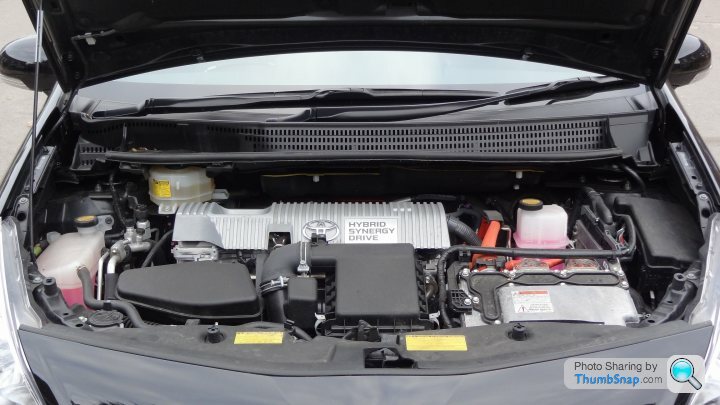
The Prius drivetrain (known as Hybrid Synergy Drive or HSD) has been covered before on PH, and there are loads of articles on the web, but it still seems to create confusion. This is unsurprising, since it is very different to a normal drivetrain, so I'll try and summarise a few key things.
The HSD consists of an internal combustion engine (ICE) and two motor/generators (MG1 and MG2).
The ICE is a 1.8 litre unit, 4 cylinders in-line, normally aspirated, chain driven, running the Atkinson cycle. This is more fuel-efficient than the conventional (Otto) cycle, but the downside is reduced power and torque. The idea is to use the electric motors to fill in the power and torque curve.
MG1/MG2 are connected to a high voltage, high capacity lithium-ion battery (the "traction battery"). The battery supplies power to, or absorbs power from, the drivetrain. It also powers all the ancillaries including the steering, coolant pump and HVAC. There is no accessory belt. In fact there are no belts at all.
The ICE and and MG1/MG2 are connected through an epicyclic gearset known as the power split device (PSD). The ICE drives the planet carrier, and MG1 and MG2 drive the sun and ring gear respectively. Final drive is taken off MG2. There are no clutches; all of the ICE, MG1 and MG2 are permanently connected through the PSD. There is no conventional transmission, whether manual, automatic or CVT.
This arrangement gives the following operating modes:
There is no conventional gearbox; the ICE and MG1/MG2 are permanently connected through the PSD. There is no conventional starter motor or 12 volt battery, since MG1 and the traction battery do the job. (Applying power to MG1 causes it to spin the ICE, thus acting as a starter motor.) There is also no turbo, clutch pack, DPF, DMF or alternator. There are no belts. This makes the drivetrain extremely simple and robust.
The loss of so many components not only increases reliability - the list of missing components above is pretty similar to Warranty Direct's list of most frequent component failures - but also results in a surprising amount of free space in what by modern standards is a small engine bay. You can see everything and there is a lot of space to work. I like this. It's unusual for a modern car, let alone an MPV, where the small bonnet area normally results in a tightly packed bay.
The engine in this car is 4 cylinders in-line, 1.8 litre capacity, running the Atkinson cycle as mentioned before.

The thick orange cabling near the back of the engine bay connects the 400v traction battery to the drivetrain. It transfers power between the battery and MG1/MG2.

This box is not a battery. It's a DC to DC converter which converts the 400v output from the traction battery to the 12v needed to power the car's electrical systems. As mentioned before, there is no conventional battery.

Take a look around the car and you are unlikely to spot the location of the traction battery. It's actually hidden in the bottom of the front armrest. This version of the Prius uses lithium ion battery technology rather than the older nickel metal hydride (NiMH) technology. The lithium ion battery has roughly the same capacity as the NiMH battery in the standard Prius, but is much smaller and lighter, making it possible to hide it in the armrest rather than having to place it under the boot floor.
As a result, there is no boot space taken up with the battery, which means a decent sized boot and 7 seats. However, as is common these days, there is no spare wheel; it's not even available as an option.

Boot space is excellent. The 5 rear seats fold individually as you would expect, giving a maximum load length of about 200cm with the front passenger seat as far forward as it can go. The front passenger seat also folds to increase the maximum load length to just under 300cm, which is great for tip, DIY and Ikea runs. As with most cars of this nature, using the rearmost seats eliminates most of the rear boot space, so you can't carry any significant amount of luggage with all 7 seats in use.
Keyless entry and start is standard, so you just need the key in your pocket in order to get going. Opening and closing the door, you are struck by the lack of solidity compared to other cars at this price point. It feels a bit flimsy. The Germans have become expert at designing car doors that give a reassuringly expensive thud when they close, because they give a perception of quality. (The phrase "perceived quality" seems to come up quite a lot in reviews of German cars.) The door of the Prius has no such pretensions; what you see is what you get.

Visibility is excellent all round. The vertical bootlid makes parking a doddle (and you get a rear-view camera as standard). It's very easy to position the car on the road.

The materials used in the interior are classic Japanese, and that isn't meant to be a compliment. It's a cacaphony of hard, grey plastics. There is no attempt to introduce soft-touch surfaces, save for some frankly odd padding on the front of the dashboard. On the other hand, it's easy to clean and will probably last forever. Having done many large tip and DIY runs I can confirm that it's basically indestructible. I get the feeling that this car was built by engineers who cared not one bit about showroom appeal. After a while you start to appreciate the honesty of it all.
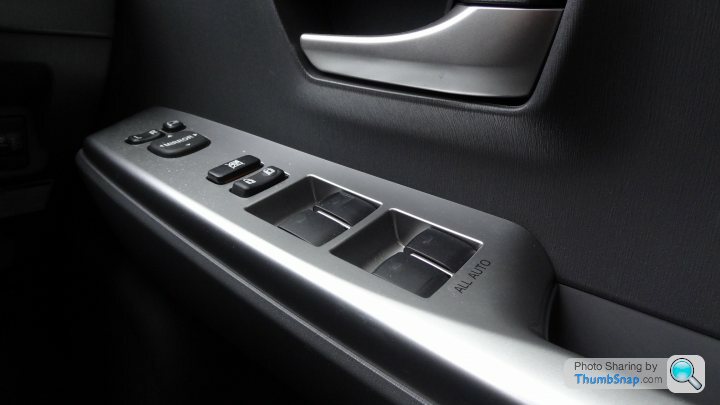
The cloth trim is hardwearing, but lacks any kind of emotional appeal. It isn't very nice, to be honest. Leather trim is an option.

The instrumentation is a delightful homage to 80s Japanese hi-fi, with its symphony of flickering LED gauges and numbers. The central placement, futuristic look, complete absence of dial gauges and turquoise blue colour remind me of the last Renault Espace.
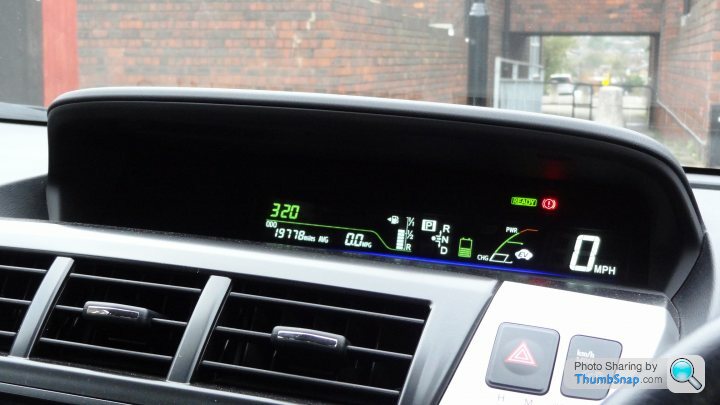
The left hand side contains a knowingly retro digital clock, odometer and trip computer.

The right hand side contains a number of displays giving the status of the powertrain including fuel remaining and battery charge. There is no rev counter; as mentioned previously, the Prius runs the engine at the most efficient rpm regardless of road speed, so a rev counter would be pointless. Instead you have a power meter, which shows the instantaneous power output of the hybrid system.
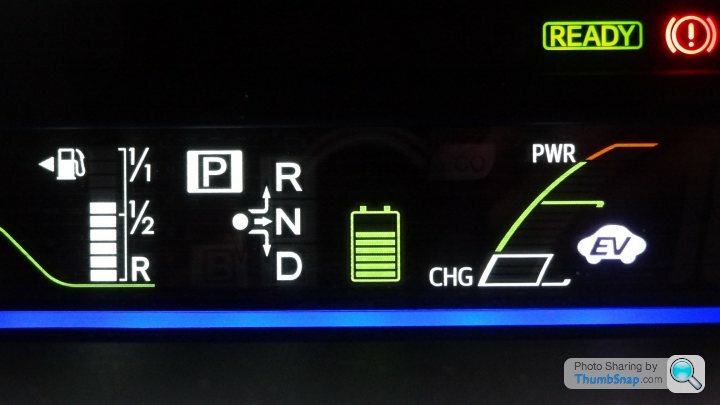
The speedo can be trivially switched between mph and km/h, which is great for driving on the continent. However, the odometer and trip computer functions - distance and fuel economy - stay in imperial units. This is annoying. If I am in France, all the distances are measured in km, so my odometer should also be in km.

Included as standard is a head-up display which projects speed and sat-nav directions (where fitted) onto the windscreen, directly in the line of vision. It works brilliantly, and avoids the need to keep refocusing between the windscreen and instrumentation. Having got used to it, I can't imagine buying a car without it.

This blue lever is the gear lever. Oddly, it doesn't stay in position when you move it; it always springs back to the centre. You get used to it, but it would be nice if it behaved like every other gear lever out there and stayed in position. There is no facility to change gears manually, since as mentioned previously there is no gearbox.

Below the main instrument panel you get a second central touchscreen. This is used for a number of functions including the audio, car settings and the energy monitor which tells you the current state of energy flow in the car. Here the engine is acting as a generator and topping up the battery.

The screen can be switched to show an enhanced trip computer. This shows mpg over time including the amount of energy recovered through the regenerative braking.

As is usual for Japanese cars this one comes fully loaded; there are very few options. Standard equipment includes keyless entry and start, CD/radio/Bluetooth, panoramic sunroof, reversing camera, HUD and auto wipers. There are however some strange omissions; there are no auto headlights, no service indicator and no parking sensors. (Some of these omissions are apparently rectified on the upcoming facelift.)
Hit the blue button to start - there is no ignition barrel - and one of two things will happen. The first is that the car comes to life completely silently, and you can trundle off in full EV stealth mode, to the mild astonishment of nearby pedestrians - because the sight of a fully grown car running in pure electric mode is still pretty cool despite the Prius having been out for years. However, you can only do this if the engine is already warm. If it isn't, it will spring into life, as the hybrid computer runs it at high rpm in order to get it up to temperature as quickly as possible. Once the engine has reached operating temperature the car goes into steady state and will allow EV mode and stop/start.
Driving in town you soon realise another way in which the car turns convention on its head. The Prius is at its best in town and at its worst on the open road. It makes the process of being stuck in traffic almost enjoyable. You sit smug in the knowledge that you are using zero fuel, interrupted only by the engine occasionally kicking in to top up the battery. All the accessories are electric so you can happily spend ages with the engine off and the heater or air con running. Also, you don't have to worry about doing lots of short journeys, because there is no DPF.
The stop/start is light years ahead of other cars, since MG1 is orders of magnitude more powerful than a normal starter motor, and so the engine appears to switch digitally on and off as you drive; there is no clatter of a starter motor and no delay while you wait for the engine to fire. It's pretty cool. Also, the engine is expressly designed to stop/start over millions of cycles, so unlike other cars, you never find yourself worrying about the long term damage it might be doing. (Apparently one of the reasons Toyota have been slow to adopt direct injection technology is that they had to get it working reliably in this scenario.)
Speed up a bit and you notice a few more things. The first is the often criticised constant engine note when accelerating; like a CVT, or a manual box with a slipping clutch. It grates at first, but you quickly get used to it. It doesn't bother me any more. The second is the noise level, which is OK but not class leading. Wind noise is acceptably muted but there is quite a lot of road noise. You can hold a normal conversation up to about 90mph, but it never feels really quiet except when running in EV mode. (The car will run up to 45mph in EV mode.) The third is the acceleration profile, which feels more linear than other cars. Whereas diesels start you off with a strong shove but then tail off as the speed rises, this car keeps pushing all the way to 110mph before giving up.
It's difficult to criticise the handling, since this is meant to be a workhorse rather than a track car, so you can hardly expect it to handle well. Of course, you can have fun in pretty much any vehicle if you take the time to understand it. But there isn't much fun to be had here. This is one of the few areas where the Honda Gen2 Insight wins over the Prius. The Insight, with its light weight, low centre of gravity and responsive steering, is surprisingly fun to chuck about. This car is not. The centre of gravity is high, the steering is rather heavy and it needs a little time to change direction. It isn't just the fact that it's an MPV; it's the fact that in order to achieve the fuel economy and reliability, it has to disconnect you from the driving experience somewhat. The Ford S-Max shows that the problem of getting an MPV to handle well can be solved. Toyota have promised improved handling on the facelift, but I doubt that it is their highest priority.
I'd better talk about fuel economy...this car has done about 20k miles so I consider it run-in. My workload is about 50% town and 50% A-road/motorway by time. I have a heavy right foot and tend to "make swift progress" where possible. Under these conditions I get an average 55mpg. If I'm doing mainly motorway driving it goes down to 52mpg. With town driving alone, 60mpg is easily done. Very cold weather knocks about 2mpg off those numbers. Pretty good for a 7-seat MPV if you ask me.
Reliability has been typical Toyota. Nothing has gone wrong, or shown any sign of going wrong. Admittedly the car only has 20k on it, but I have a feeling that it will go on forever. My local dealer has been selling the Prius ever since it was available in the UK and reckons that out of the thousands they have seen, they have only ever done one battery replacement, and that was on a minicab with 350,000 miles. Servicing is cheap and predictable, the dealers are nice, road tax is zero, insurance is ridiculously low, it isn't fussy about fuel quality, and it will likely outlast me. As I said, it's such an easy car to own.

Toyota made a huge gamble in developing hybrid technology when the rest of the industry was rushing towards diesel, and it seems that they may have been right. Diesel technology is not only reaching a plateau - with manufacturers reliant on ever-higher fuel pressures and ever-tighter tolerances to try and squeeze out extra efficiency at the expense of long-term reliability - but is now, rightly or wrongly, considered a health hazard and is surely set to be taxed out of existence. Meanwhile, hybrid technology has broken out of its eco-warrior demographic and is now found in everything from superminis to supercars (think McLaren P1 and LaFerrari). However, the industry is not standing still, and many of the major players are now offering hybrid drivetrains in normal-looking cars, many of which are - frankly - nicer to look at and nicer to drive than the Prius, even if they are not as economical or reliable in the real world. Toyota are promising great things for the Gen4 Prius, some of which sound as wacky as the Gen1 Prius must have seemed back in 1997. There is talk of graphene motors, silicon carbide electronics, 4WD and huge weight savings amongst other things. But the Gen4 has been delayed until late 2015 due to problems getting the new drivetrain to work, the patents on the HSD have meanwhile run out meaning that it is open season for other companies to use the design, and Toyota's new focus on hydrogen powered cars - they view battery EVs as a dead end - may prove to be an expensive distraction.
It would be a real shame if the company that pioneered hybrid technology, in the face of widespread derision at the time, ended up being a footnote in automotive history
The original Gen1 Prius - with a tiny boot, a frumpy exterior, 49mpg, and a petrol-electric drivetrain which was largely dismissed as a gimmick - was introduced in 1997. Things have moved on since then. This version - introduced in 2012 - is far less compromised than the Gen1, but the core Prius philosophy remains: a cutting edge drivetrain wrapped in a body and interior that is primarily functional and makes little concession to aesthetics or fashion. The result is a car with a curious mix of high-tech and low-tech and some bizarre design features, but which provides possibly the easiest ownership experience of any car on sale today.
The exterior profile is almost entirely dictated by packaging and aerodynamics. The windscreen is heavily raked and forms a near-continuous line with the bonnet. There is a small rear spoiler. The dimensions are similar to the Ford S-Max, which is probably its nearest competitor, but the Prius is slightly lower and the windscreen is more steeply raked.
The panels are plain, with little adornment. There are no sharp creases or complex surfaces. This helps airflow and reduces repair costs since many types of dents can be pulled or hammered out. It's as if the Bangle era never happened.
The front is designed to minimise wind resistance above all else. That means a large lower spoiler and lots of smooth edges. The grille is small compared to modern cars. This again improves aerodynamics and removes the need for active shutters in the grille. It can be done because the drivetrain has reduced cooling needs compared to conventional drivetrains.
The headlights have small fins on them. This is ostensibly to deflect airflow over the wing mirrors, thus improving aerodynamics and mpg. It's a nice idea but I wonder how effective it really is. On a Boeing 747 it makes a difference. On a road car...I doubt it.
This car is in solid black paint. The coverage is excellent; I looked all over the car and could not find any area which had not been properly painted. This includes the bottom of the doors which is an area that is notorious for being left unpainted. However, the finish is rather poor, with a heavy orange peel effect. Smooth finishes have become harder to obtain since the EU mandated water-based paints, and solid paint is admittedly the bargain basement option, but other manufacturers manage to get smooth finishes, so it must be possible. And remember, this car costs around 26k new. The paint finish is not that of a 26k car. Sort it out please, Toyota.
This car is the baseline T4 spec. In this spec, the wheels are 16 inch alloys but - bizarrely - they are covered with the sort of plastic trims that you normally get on steel wheels. It's a highly practical solution since the trims protect the wheels from getting scuffed, and it's much cheaper to replace the trim than to refurb an alloy wheel, but it looks a bit "minicab". Again, this is not great on a car that costs 26k new. Higher models have exposed 17 inch alloy wheels.
Open the bonnet and you are greeted by a nice surprise: an engine, rather than a sea of black plastic. Almost everything is on display; there are very few covers.
The Prius drivetrain (known as Hybrid Synergy Drive or HSD) has been covered before on PH, and there are loads of articles on the web, but it still seems to create confusion. This is unsurprising, since it is very different to a normal drivetrain, so I'll try and summarise a few key things.
The HSD consists of an internal combustion engine (ICE) and two motor/generators (MG1 and MG2).
The ICE is a 1.8 litre unit, 4 cylinders in-line, normally aspirated, chain driven, running the Atkinson cycle. This is more fuel-efficient than the conventional (Otto) cycle, but the downside is reduced power and torque. The idea is to use the electric motors to fill in the power and torque curve.
MG1/MG2 are connected to a high voltage, high capacity lithium-ion battery (the "traction battery"). The battery supplies power to, or absorbs power from, the drivetrain. It also powers all the ancillaries including the steering, coolant pump and HVAC. There is no accessory belt. In fact there are no belts at all.
The ICE and and MG1/MG2 are connected through an epicyclic gearset known as the power split device (PSD). The ICE drives the planet carrier, and MG1 and MG2 drive the sun and ring gear respectively. Final drive is taken off MG2. There are no clutches; all of the ICE, MG1 and MG2 are permanently connected through the PSD. There is no conventional transmission, whether manual, automatic or CVT.
This arrangement gives the following operating modes:
- ICE can be run as a generator via MG1/MG2 to recharge the battery
- MG1/MG2 can drive the car independently with the ICE off (pure EV mode)
- Under hard acceleration, ICE and MG work together to provide maximum overall torque
- When moving, ICE and MG power can be blended in any combination. In particular, the ICE can run at the most efficient rpm independently of road speed, with MG1/MG2 being used to either supply extra power and torque (as motors) or absorb surplus ICE energy and store it in the battery for use later (as generators)
- When coasting or braking, MG1/MG2 act as generators to recharge the battery and this action slows the car down (simulating engine braking); the mechanical brakes are only used if additional stopping force is required
- Stop-start comes for free, since the system switches to EV mode at low speeds
There is no conventional gearbox; the ICE and MG1/MG2 are permanently connected through the PSD. There is no conventional starter motor or 12 volt battery, since MG1 and the traction battery do the job. (Applying power to MG1 causes it to spin the ICE, thus acting as a starter motor.) There is also no turbo, clutch pack, DPF, DMF or alternator. There are no belts. This makes the drivetrain extremely simple and robust.
The loss of so many components not only increases reliability - the list of missing components above is pretty similar to Warranty Direct's list of most frequent component failures - but also results in a surprising amount of free space in what by modern standards is a small engine bay. You can see everything and there is a lot of space to work. I like this. It's unusual for a modern car, let alone an MPV, where the small bonnet area normally results in a tightly packed bay.
The engine in this car is 4 cylinders in-line, 1.8 litre capacity, running the Atkinson cycle as mentioned before.
The thick orange cabling near the back of the engine bay connects the 400v traction battery to the drivetrain. It transfers power between the battery and MG1/MG2.
This box is not a battery. It's a DC to DC converter which converts the 400v output from the traction battery to the 12v needed to power the car's electrical systems. As mentioned before, there is no conventional battery.
Take a look around the car and you are unlikely to spot the location of the traction battery. It's actually hidden in the bottom of the front armrest. This version of the Prius uses lithium ion battery technology rather than the older nickel metal hydride (NiMH) technology. The lithium ion battery has roughly the same capacity as the NiMH battery in the standard Prius, but is much smaller and lighter, making it possible to hide it in the armrest rather than having to place it under the boot floor.
As a result, there is no boot space taken up with the battery, which means a decent sized boot and 7 seats. However, as is common these days, there is no spare wheel; it's not even available as an option.
Boot space is excellent. The 5 rear seats fold individually as you would expect, giving a maximum load length of about 200cm with the front passenger seat as far forward as it can go. The front passenger seat also folds to increase the maximum load length to just under 300cm, which is great for tip, DIY and Ikea runs. As with most cars of this nature, using the rearmost seats eliminates most of the rear boot space, so you can't carry any significant amount of luggage with all 7 seats in use.
Keyless entry and start is standard, so you just need the key in your pocket in order to get going. Opening and closing the door, you are struck by the lack of solidity compared to other cars at this price point. It feels a bit flimsy. The Germans have become expert at designing car doors that give a reassuringly expensive thud when they close, because they give a perception of quality. (The phrase "perceived quality" seems to come up quite a lot in reviews of German cars.) The door of the Prius has no such pretensions; what you see is what you get.
Visibility is excellent all round. The vertical bootlid makes parking a doddle (and you get a rear-view camera as standard). It's very easy to position the car on the road.
The materials used in the interior are classic Japanese, and that isn't meant to be a compliment. It's a cacaphony of hard, grey plastics. There is no attempt to introduce soft-touch surfaces, save for some frankly odd padding on the front of the dashboard. On the other hand, it's easy to clean and will probably last forever. Having done many large tip and DIY runs I can confirm that it's basically indestructible. I get the feeling that this car was built by engineers who cared not one bit about showroom appeal. After a while you start to appreciate the honesty of it all.
The cloth trim is hardwearing, but lacks any kind of emotional appeal. It isn't very nice, to be honest. Leather trim is an option.
The instrumentation is a delightful homage to 80s Japanese hi-fi, with its symphony of flickering LED gauges and numbers. The central placement, futuristic look, complete absence of dial gauges and turquoise blue colour remind me of the last Renault Espace.
The left hand side contains a knowingly retro digital clock, odometer and trip computer.
The right hand side contains a number of displays giving the status of the powertrain including fuel remaining and battery charge. There is no rev counter; as mentioned previously, the Prius runs the engine at the most efficient rpm regardless of road speed, so a rev counter would be pointless. Instead you have a power meter, which shows the instantaneous power output of the hybrid system.
The speedo can be trivially switched between mph and km/h, which is great for driving on the continent. However, the odometer and trip computer functions - distance and fuel economy - stay in imperial units. This is annoying. If I am in France, all the distances are measured in km, so my odometer should also be in km.
Included as standard is a head-up display which projects speed and sat-nav directions (where fitted) onto the windscreen, directly in the line of vision. It works brilliantly, and avoids the need to keep refocusing between the windscreen and instrumentation. Having got used to it, I can't imagine buying a car without it.
This blue lever is the gear lever. Oddly, it doesn't stay in position when you move it; it always springs back to the centre. You get used to it, but it would be nice if it behaved like every other gear lever out there and stayed in position. There is no facility to change gears manually, since as mentioned previously there is no gearbox.
Below the main instrument panel you get a second central touchscreen. This is used for a number of functions including the audio, car settings and the energy monitor which tells you the current state of energy flow in the car. Here the engine is acting as a generator and topping up the battery.
The screen can be switched to show an enhanced trip computer. This shows mpg over time including the amount of energy recovered through the regenerative braking.
As is usual for Japanese cars this one comes fully loaded; there are very few options. Standard equipment includes keyless entry and start, CD/radio/Bluetooth, panoramic sunroof, reversing camera, HUD and auto wipers. There are however some strange omissions; there are no auto headlights, no service indicator and no parking sensors. (Some of these omissions are apparently rectified on the upcoming facelift.)
Hit the blue button to start - there is no ignition barrel - and one of two things will happen. The first is that the car comes to life completely silently, and you can trundle off in full EV stealth mode, to the mild astonishment of nearby pedestrians - because the sight of a fully grown car running in pure electric mode is still pretty cool despite the Prius having been out for years. However, you can only do this if the engine is already warm. If it isn't, it will spring into life, as the hybrid computer runs it at high rpm in order to get it up to temperature as quickly as possible. Once the engine has reached operating temperature the car goes into steady state and will allow EV mode and stop/start.
Driving in town you soon realise another way in which the car turns convention on its head. The Prius is at its best in town and at its worst on the open road. It makes the process of being stuck in traffic almost enjoyable. You sit smug in the knowledge that you are using zero fuel, interrupted only by the engine occasionally kicking in to top up the battery. All the accessories are electric so you can happily spend ages with the engine off and the heater or air con running. Also, you don't have to worry about doing lots of short journeys, because there is no DPF.
The stop/start is light years ahead of other cars, since MG1 is orders of magnitude more powerful than a normal starter motor, and so the engine appears to switch digitally on and off as you drive; there is no clatter of a starter motor and no delay while you wait for the engine to fire. It's pretty cool. Also, the engine is expressly designed to stop/start over millions of cycles, so unlike other cars, you never find yourself worrying about the long term damage it might be doing. (Apparently one of the reasons Toyota have been slow to adopt direct injection technology is that they had to get it working reliably in this scenario.)
Speed up a bit and you notice a few more things. The first is the often criticised constant engine note when accelerating; like a CVT, or a manual box with a slipping clutch. It grates at first, but you quickly get used to it. It doesn't bother me any more. The second is the noise level, which is OK but not class leading. Wind noise is acceptably muted but there is quite a lot of road noise. You can hold a normal conversation up to about 90mph, but it never feels really quiet except when running in EV mode. (The car will run up to 45mph in EV mode.) The third is the acceleration profile, which feels more linear than other cars. Whereas diesels start you off with a strong shove but then tail off as the speed rises, this car keeps pushing all the way to 110mph before giving up.
It's difficult to criticise the handling, since this is meant to be a workhorse rather than a track car, so you can hardly expect it to handle well. Of course, you can have fun in pretty much any vehicle if you take the time to understand it. But there isn't much fun to be had here. This is one of the few areas where the Honda Gen2 Insight wins over the Prius. The Insight, with its light weight, low centre of gravity and responsive steering, is surprisingly fun to chuck about. This car is not. The centre of gravity is high, the steering is rather heavy and it needs a little time to change direction. It isn't just the fact that it's an MPV; it's the fact that in order to achieve the fuel economy and reliability, it has to disconnect you from the driving experience somewhat. The Ford S-Max shows that the problem of getting an MPV to handle well can be solved. Toyota have promised improved handling on the facelift, but I doubt that it is their highest priority.
I'd better talk about fuel economy...this car has done about 20k miles so I consider it run-in. My workload is about 50% town and 50% A-road/motorway by time. I have a heavy right foot and tend to "make swift progress" where possible. Under these conditions I get an average 55mpg. If I'm doing mainly motorway driving it goes down to 52mpg. With town driving alone, 60mpg is easily done. Very cold weather knocks about 2mpg off those numbers. Pretty good for a 7-seat MPV if you ask me.
Reliability has been typical Toyota. Nothing has gone wrong, or shown any sign of going wrong. Admittedly the car only has 20k on it, but I have a feeling that it will go on forever. My local dealer has been selling the Prius ever since it was available in the UK and reckons that out of the thousands they have seen, they have only ever done one battery replacement, and that was on a minicab with 350,000 miles. Servicing is cheap and predictable, the dealers are nice, road tax is zero, insurance is ridiculously low, it isn't fussy about fuel quality, and it will likely outlast me. As I said, it's such an easy car to own.
Toyota made a huge gamble in developing hybrid technology when the rest of the industry was rushing towards diesel, and it seems that they may have been right. Diesel technology is not only reaching a plateau - with manufacturers reliant on ever-higher fuel pressures and ever-tighter tolerances to try and squeeze out extra efficiency at the expense of long-term reliability - but is now, rightly or wrongly, considered a health hazard and is surely set to be taxed out of existence. Meanwhile, hybrid technology has broken out of its eco-warrior demographic and is now found in everything from superminis to supercars (think McLaren P1 and LaFerrari). However, the industry is not standing still, and many of the major players are now offering hybrid drivetrains in normal-looking cars, many of which are - frankly - nicer to look at and nicer to drive than the Prius, even if they are not as economical or reliable in the real world. Toyota are promising great things for the Gen4 Prius, some of which sound as wacky as the Gen1 Prius must have seemed back in 1997. There is talk of graphene motors, silicon carbide electronics, 4WD and huge weight savings amongst other things. But the Gen4 has been delayed until late 2015 due to problems getting the new drivetrain to work, the patents on the HSD have meanwhile run out meaning that it is open season for other companies to use the design, and Toyota's new focus on hydrogen powered cars - they view battery EVs as a dead end - may prove to be an expensive distraction.
It would be a real shame if the company that pioneered hybrid technology, in the face of widespread derision at the time, ended up being a footnote in automotive history
Outstanding write up, thank you for taking the time and effort.
These are on the radar for the next mum-mobile, so very interesting to see a useful boot compared to earlier versions, in 5 seat mode anyway. You say the S Max was the closest comptitor, did you choose between the two, and if so what swayed you to this?
These are on the radar for the next mum-mobile, so very interesting to see a useful boot compared to earlier versions, in 5 seat mode anyway. You say the S Max was the closest comptitor, did you choose between the two, and if so what swayed you to this?
That's an excellent write up, thanks for sharing.
I was always more a fan of the Honda Insight than the original Prius. The same idea, but Honda made it a much more focused car. This of course came at the cost of practicality but it was so much more efficient then the first gen Prius. Hell, as far as I know a mk1 Insight with a new Ni-MH battery is still more efficient than the current gen Prius.
I would love to see something really different from Toyota like a turbine or small rotary powered hybrid but of course even if they could make it they would probably never sell it.
I was always more a fan of the Honda Insight than the original Prius. The same idea, but Honda made it a much more focused car. This of course came at the cost of practicality but it was so much more efficient then the first gen Prius. Hell, as far as I know a mk1 Insight with a new Ni-MH battery is still more efficient than the current gen Prius.
I would love to see something really different from Toyota like a turbine or small rotary powered hybrid but of course even if they could make it they would probably never sell it.
I remember 6 of us getting a taxi last year from Brick Lane to Piccadilly and one of these turned up. It was a brand new 13 plate but it already had a space-saver on and plenty of scratches and dents inside and out. The taxi driver certainly didn't drive it like a hybrid; I have no idea how he was able to drive that thing that fast whilst 7-up. Saying that, the wallow going around bends at speed did mean I was getting more than familiar with the nice, friend of a friend American girl who was a who I had only just met.
Very good write-up indeed!
I'm not sure the interior space is as large as a S-Max (having owned 2 of those). The Pruis+ does however, carry 5 + lots of luggage, well.
We use a local company (webtaxi.lu) to ferry us to/from the airport on family holidays as they're 1/2 the price of the usual taxis here. I found the sudden EV > engine at high revs a little unnerving when first experienced, but I now understand that's because there's no gearbox. I didn't know that before reading this.
I'm not sure the interior space is as large as a S-Max (having owned 2 of those). The Pruis+ does however, carry 5 + lots of luggage, well.
We use a local company (webtaxi.lu) to ferry us to/from the airport on family holidays as they're 1/2 the price of the usual taxis here. I found the sudden EV > engine at high revs a little unnerving when first experienced, but I now understand that's because there's no gearbox. I didn't know that before reading this.

Croutons said:
These are on the radar for the next mum-mobile, so very interesting to see a useful boot compared to earlier versions, in 5 seat mode anyway. You say the S Max was the closest comptitor, did you choose between the two, and if so what swayed you to this?
I did take a long look at the S-Max as well as a test drive. It's a very, very good car. Superb handling. Two things swayed me.Firstly, I do a lot of short journeys, which rules out diesel, but I had heard a few negative stories about the reliability of the petrol versions, and a work colleague had to have a complete new Ecoboost engine under warranty after the old one experienced oil starvation (according to Ford). I know that for every person with a problem there are a hundred without, but it put me off a bit.
The second was that, quite simply, I could see myself getting bored of it quickly. It's a very well executed version of a standard idea. The Prius is a very different creature. It looks and drives like nothing else. It's novel and I wanted to experience it.
There is apparently a facelift coming soon, with better (i.e. less grey
) trim etc.Croutons said:
I guess the boot floor has to be so high to accomodate the pull up seats, which is the only downside I can see size-wise.
Exactly. In the US it is called the Prius V, and it is the same size but with just 5 seats and the boot is corresponding bigger (you might also a spare wheel, not sure)mikeulster500 said:
These are shocking to drive. I had one from new in 2011 and found it so disconnected from the road. Glad to be in an Audi now
I had a new A6 for a week in 2013. They are shocking to drive, the steering, although heavy, was massively disconnected from the road. So glad to be in a lotus now.Gassing Station | Readers' Cars | Top of Page | What's New | My Stuff