
Intel Advances 'Spy In The Car' Tech
Latest 'black box' features GPS, data recording and in-car video
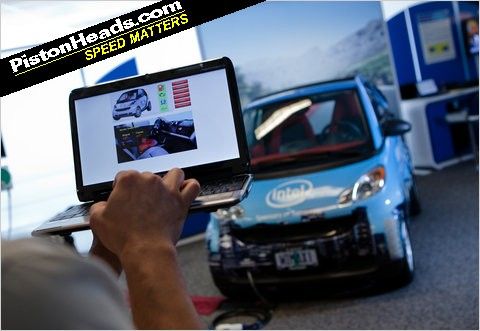
Intel wants to see your car 'connected'
The US Congress is pushing for the mandatory installation of aircraft style black boxes in cars over there, partly motivated by the troubles surrounding Toyota's 'unintended acceleration' issue.
The NYT report describes how Intel has been showing off its kit on a Smart car, and how as well as recording data like speed and whether you braked before an accident, it now records footage from cameras located inside and outside the car.
According to Intel this is not ground-breaking technology, as the system uses kit that will become standardised on cars in future as manufacturers increasingly opt to fit driver aids like all-round parking cameras, gps and internet connectivity.
At present and in the US at least, any on-board data recorded by your vehicle belongs not to you as the car's owner, but to the manufacturer.
New black box technology, if it happens, is sure to open a whole new can of worms over privacy issues and who may be required to pass what info to the police or insurance companies when things go pear-shaped. What a thrilling prospect...


As for parking camera's - well if you can't park a car confidently without cameras or sensors, then quite frankly you shouldn't have passed your driving test in the first place.
Technology for technology's sake - that's all

As for parking camera's - well if you can't park a car confidently without cameras or sensors, then quite frankly you shouldn't have passed your driving test in the first place.
Technology for technology's sake - that's all
 The way I see it, if the technology replaces something you should have to do to be able to pass a driving test, it's unnecessary.
 k you Intel.
Good example of a strawman argument though.

As for parking camera's - well if you can't park a car confidently without cameras or sensors, then quite frankly you shouldn't have passed your driving test in the first place.
Technology for technology's sake - that's all
http://uncyclopedia.wikia.com/wiki/Internet_toaste...
Not impressed...not one bit!
However, playing devils advocat... why is necessarily it bad?
Plus points:
+ Can understand causes of crashes and make cars/roads safer and save lives.
+ Can properly identify the party in the wrong and hold them to account, therefore more likley to find driving standard improve.
+ Innocent drivers will avoid the increase in premium if they avoid having any blame attached. (Should end up with bad drivers having much higher premiums and good drivers having much lower permiums.)
Negative points:
- Cost, which will be passed onto the customer.
- Privacy, I don't want to be tracked but this is overcome if the system only records 10 secs before and after a crash, with the other data on a rolling delete.
- If I'm driving like a twit then there's more chance I'll be 'found out' if I crash.
- Some people may all drive overly cautiously if they know they will be monitored in the event of a crash, this overly cautious attitude could cause hold ups.

Good example of a strawman argument though.
(not to mention the fact that before all the front wheel drive crap you could still start with a flat battery...)
Gassing Station | Motoring News | Top of Page | What's New | My Stuff