
HGF Diagnostics
Discussion


I have recently replaced head gaskets due to massive failure - losing up to 1L coolant every five minutes, distorted fire ring, damaged head etc.
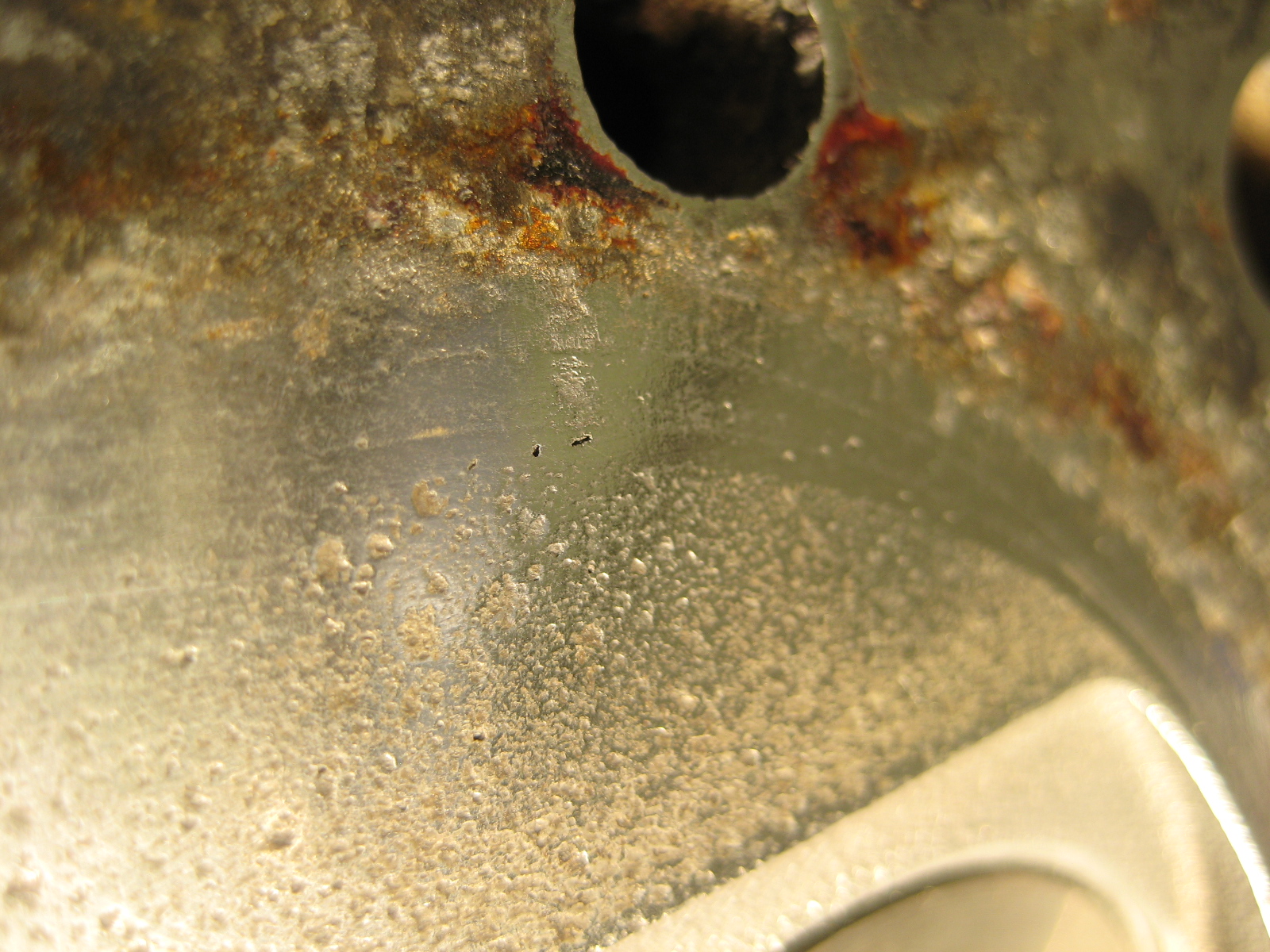
Interestingly on another forum it was suggested that the pitting in the combustion chamber was probably due to detonation. Fortunately it is limited to that cylinder and there is no obvious piston damage.
What has just occurred to me that the PO replaced the fuel injector on that cylinder alone, and I'm now wondering whether that could be the ultimate culprit - sub-spec/damaged/partially blocked etc.
If that were the case it would be a remarkably easy fix, and since I can hear the occasional low rev pinking it should be easy to determine whether a new injector has done the trick.
Any thoughts?
Interestingly on another forum it was suggested that the pitting in the combustion chamber was probably due to detonation. Fortunately it is limited to that cylinder and there is no obvious piston damage.
What has just occurred to me that the PO replaced the fuel injector on that cylinder alone, and I'm now wondering whether that could be the ultimate culprit - sub-spec/damaged/partially blocked etc.
If that were the case it would be a remarkably easy fix, and since I can hear the occasional low rev pinking it should be easy to determine whether a new injector has done the trick.
Any thoughts?
Jhonno said:
Injector Tune.. Send them off for a service and clean. You'll get a spray pattern and flow report before and after. Excellent service.
You're not the first person to recommend them, and they replied to a query I sent at 11pm last night within 30 minutes! That is dedication....fatjon said:
Are they holes through to the water jacket in the top right quadrant?
I'm not aware of any other issues or damage, other than the remaining pitting that was far too deep to be removed by the skim.There are no cross contamination issues now the engine is running again, although it's only done 100 miles or so.
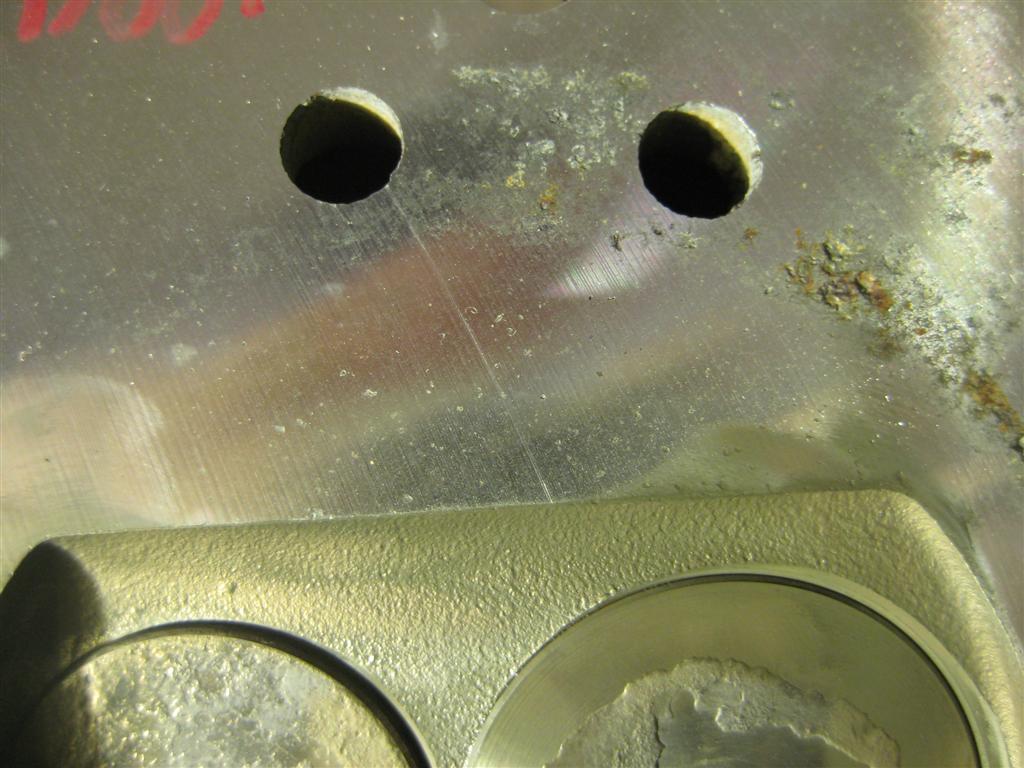
It was the red arrowed bits I was referring too but they look much less worrying in the new picture angle. The green arrowed bits though, I would not be too happy about. They look to be right under the sealing ring. I would have been inclined to get busy with the TIG and fill them in before the skim.
Time will tell, maybe I'm just a bit of a fuss pot, it has been said before.

Time will tell, maybe I'm just a bit of a fuss pot, it has been said before.
fatjon said:
The green arrowed bits though, I would not be too happy about. They look to be right under the sealing ring. I would have been inclined to get busy with the TIG and fill them in before the skim.
They are about 5mm from the edge of the fire ring, and I agree in an ideal world they wouldn't be there. The machine shop did mention the possibility of using metal epoxy, a la dental filling to stop the rot, but I let it ride. I didn't want to risk welding and distortion - those poor heads have suffered enough already from overheating.By the way, I will be ignoring the Owner's Manual recommendation to use 25/75 antifreeze/water from now on.
Maybe the offendIng injector is the wrong spec, ie lower cfm than the others.
Edit: ukkid are your 2 photos of the same chamber? The hole for the studs is in different places. Just wondering.
Edit2: ignore that, the first must be a more oblique angle
Edit: ukkid are your 2 photos of the same chamber? The hole for the studs is in different places. Just wondering.
Edit2: ignore that, the first must be a more oblique angle
Edited by FarmyardPants on Thursday 10th December 14:21
Edited by FarmyardPants on Thursday 10th December 14:35
ukkid35 said:
Jhonno said:
Injector Tune.. Send them off for a service and clean. You'll get a spray pattern and flow report before and after. Excellent service.
You're not the first person to recommend them, and they replied to a query I sent at 11pm last night within 30 minutes! That is dedication....ridds said:
That's corrosion, not det.
If you look at the rest of the chamber there is no damage at all. It's more likely you had coolant leaking into teh cylinder and tracking across the head causing the corrosion damage to that machined surface.
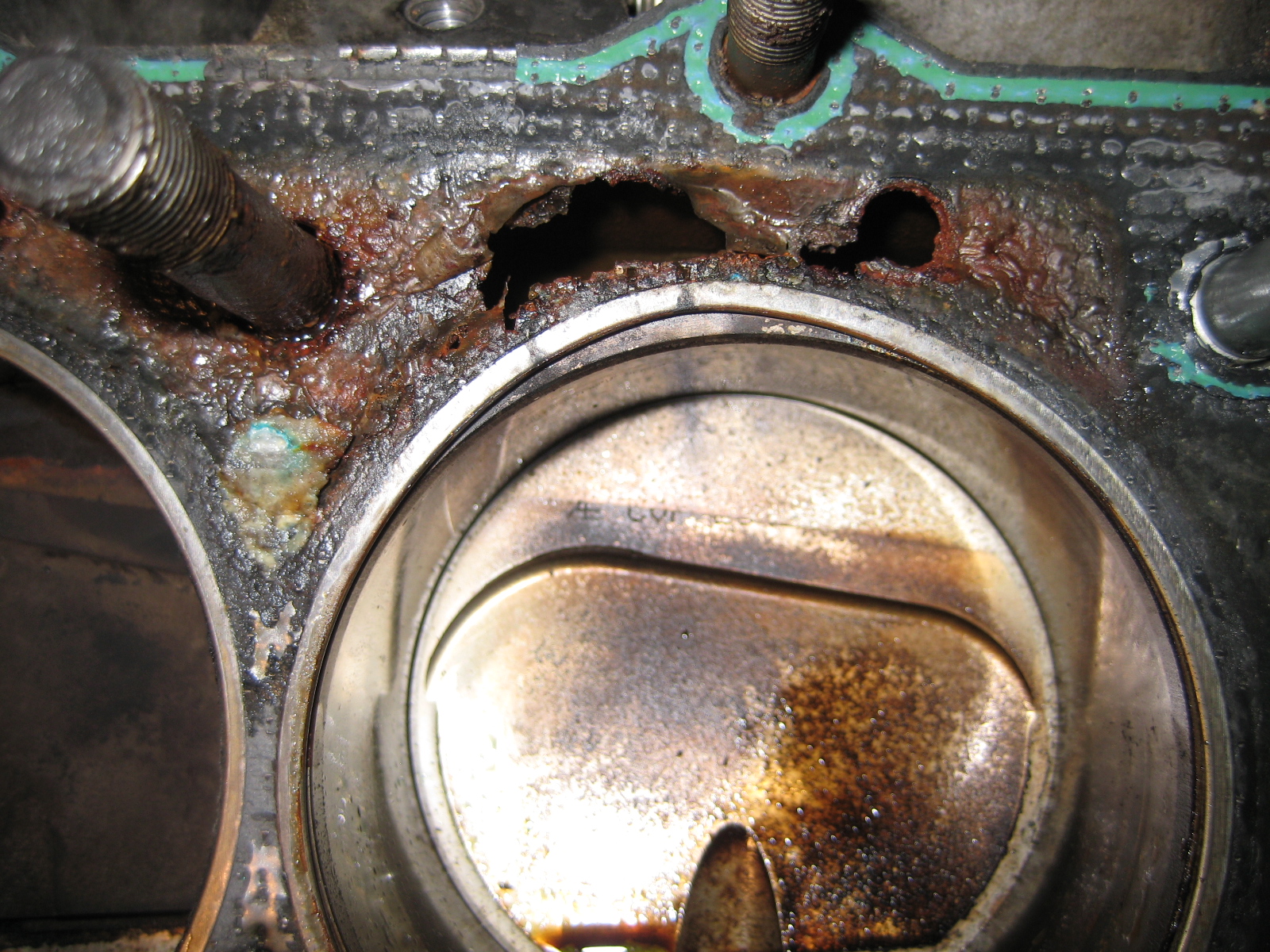
That's what I originally assumed, but if you check the corresponding face of the piston, it seems to be slightly 'sanded', and the etched number has part worn away (which I hadn't originally noticed).If you look at the rest of the chamber there is no damage at all. It's more likely you had coolant leaking into teh cylinder and tracking across the head causing the corrosion damage to that machined surface.


ukkid35 said:
That's what I originally assumed, but if you check the corresponding face of the piston, it seems to be slightly 'sanded', and the etched number has part worn away (which I hadn't originally noticed).
Again looks "squished" clean to me, you'll be amazed what damage water can do. That, plus the mechanical deformation of the gasket.Det starts at hot spots (namely edges of pistons, spark plugs, valves etc) not flat areas of pistons and heads.
Also your piston is clean which is usually caused by water ingress into the cylinder. Seen it many a time on HGF.
I'm not really sure when the water could have got in - it was forcibly expelled by the combustion gases most of the time. The only time it could have got in would be when the engine shut off and cooled, but I don't think that would have been a big part of the puzzle otherwise it would have hydrolocked.
The D1720BA 3144 has a flow rate of 314cc/min
The required flow rate for a 420BHP engine at 0.5 BSFC is 347cc/min
If you re-run the calculation at 388 BHP (what mine made on Emeralds Dyno) you need a flow rate of 320cc/min.
If you tweak the BSFC to .47 and thus assume the engine is unusually efficient for an 2v race engine you get 301cc/min required but lets face it, fuel efficient and AJP8 are not usually found in the same sentence.
You can play around with the numbers for the actual BHP of the engine and its brake specific fuel consumption but my guess based on the evidence is that it's a wrong 'un.
I can't find any data on the D1720CE 3427 but the lambdas are not going to pick up one cylinder which is only 1 AFR weak so there will be no correction applied, you will just slowly but surely detonate the hell out of the crowns, head and gasket if it is too small. The ECU also goes open loop when off the cruise so the lambdas have no corrective action anyway when you are giving it some.
I would bin it and put in a replacement the same as the other seven for the sake of 50 quid. It's meaningless to compare it to other AJP engines, of either size. If TVR change injectors part way through the production run they will just make any required adjustment to the opening time in the map so the map has to be right for your injectors and ECU not someone elses.
The numbers 3144 for a 314cc and 3427 for an "X"cc also make me wonder if the clue is in the number?
The required flow rate for a 420BHP engine at 0.5 BSFC is 347cc/min
If you re-run the calculation at 388 BHP (what mine made on Emeralds Dyno) you need a flow rate of 320cc/min.
If you tweak the BSFC to .47 and thus assume the engine is unusually efficient for an 2v race engine you get 301cc/min required but lets face it, fuel efficient and AJP8 are not usually found in the same sentence.
You can play around with the numbers for the actual BHP of the engine and its brake specific fuel consumption but my guess based on the evidence is that it's a wrong 'un.
I can't find any data on the D1720CE 3427 but the lambdas are not going to pick up one cylinder which is only 1 AFR weak so there will be no correction applied, you will just slowly but surely detonate the hell out of the crowns, head and gasket if it is too small. The ECU also goes open loop when off the cruise so the lambdas have no corrective action anyway when you are giving it some.
I would bin it and put in a replacement the same as the other seven for the sake of 50 quid. It's meaningless to compare it to other AJP engines, of either size. If TVR change injectors part way through the production run they will just make any required adjustment to the opening time in the map so the map has to be right for your injectors and ECU not someone elses.
The numbers 3144 for a 314cc and 3427 for an "X"cc also make me wonder if the clue is in the number?
It won't pick 1 cylinder being weak as the Lambda control system on the MBE is too dumb for it anyway. Fueling at WOT is speed and throttle position control, there's no clever lambda control going on. Even when switching at Lambda 1 you would see a slight trim in that bank only "if" the lower delivery / PW was significantly off.
It's certainly not ideal that you have an odd injector there and agree you should certainly replace it to remove doubt.
How often do you run at Peak Power and WOT?? I suspect a great deal less than you think.
I've seen many engines that have had HGF and clean pistons are a classic sign of it. Imagine the pressure that area is under when you squish the water out. Even if it was half a CC each time you started the engine that's a fair amount of damage.
Again, Det very rarely (if ever) forms on a flat cooled surface like that, the edges of the intake valve, seat, piston pocket, edge of the piston will go first. Your chamber / piston shows zero signs of this.
It's certainly not ideal that you have an odd injector there and agree you should certainly replace it to remove doubt.
How often do you run at Peak Power and WOT?? I suspect a great deal less than you think.
I've seen many engines that have had HGF and clean pistons are a classic sign of it. Imagine the pressure that area is under when you squish the water out. Even if it was half a CC each time you started the engine that's a fair amount of damage.
Again, Det very rarely (if ever) forms on a flat cooled surface like that, the edges of the intake valve, seat, piston pocket, edge of the piston will go first. Your chamber / piston shows zero signs of this.
ridds said:
Again, Det very rarely (if ever) forms on a flat cooled surface like that, the edges of the intake valve, seat, piston pocket, edge of the piston will go first. Your chamber / piston shows zero signs of this.
No sign of damage to the plug on cylinder 1 (top right) either. Not sure what's going on in cylinder 2 though.
I would differ on that last point.
That pitting is classic detonation damage. You seem to be confusing pre-ignition and detonation.
https://www.hastingsmfg.com/ServiceTips/detonation...
Agreed that pre-ignition is unlikely to be initiated from a large cool flat surface but late cycle detonation of remaining pockets of weak mixture is the issue with a dodgy injector and the surface before the skim is yelling this pretty loudly. Another point to bear in mind is that even at cruise and low to medium throttle openings when lambda is working this cylinder could be running at 15.7:1 or worse while the others are happy at stoich and the lambda has no idea there is a problem.
That pitting is classic detonation damage. You seem to be confusing pre-ignition and detonation.
https://www.hastingsmfg.com/ServiceTips/detonation...
Agreed that pre-ignition is unlikely to be initiated from a large cool flat surface but late cycle detonation of remaining pockets of weak mixture is the issue with a dodgy injector and the surface before the skim is yelling this pretty loudly. Another point to bear in mind is that even at cruise and low to medium throttle openings when lambda is working this cylinder could be running at 15.7:1 or worse while the others are happy at stoich and the lambda has no idea there is a problem.
Gassing Station | Cerbera | Top of Page | What's New | My Stuff