
Discussion


Dear AJP Experts,
1) During my recent delve into the bowls of my motah, I found a very frayed pipe which was hoseclipped onto a toothed Dowel (?) on the inside odd bank of the block. (Indicated ‘A’ in the first pic). Does anyone know what this feeds/fed by ?
I thought it may be part of the Heating System as the pipe disappears into the Bulkhead.
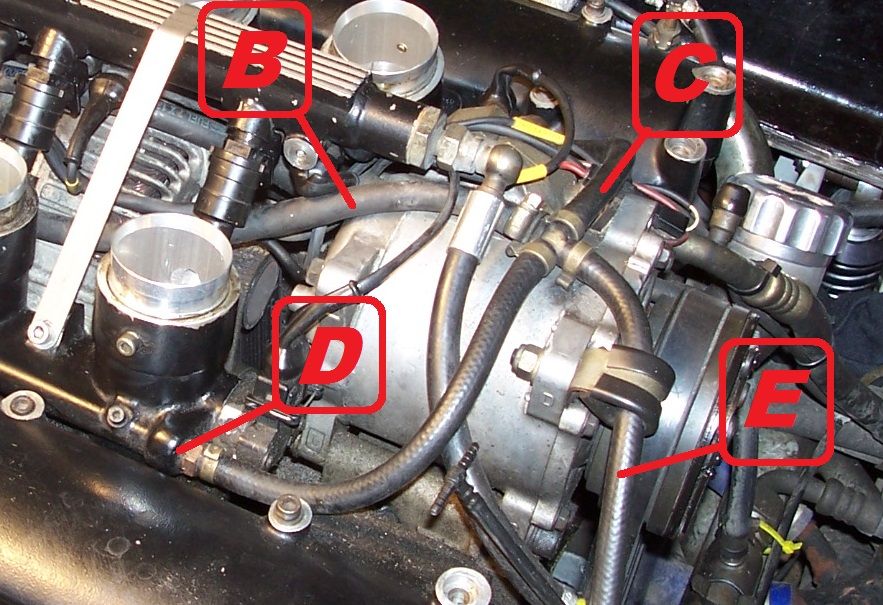
2) I don’t inderstand what the pipes B,C,D and E carry in what direction to where (second Pic). Can anyone enlighten me ?
Ta !
Mr Confused
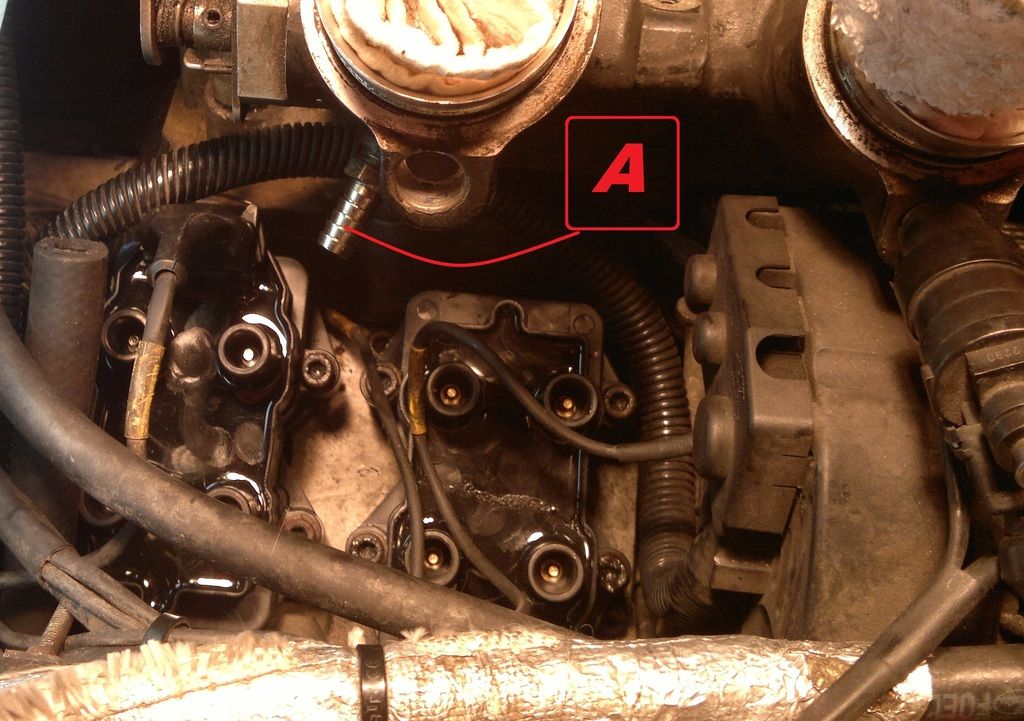
1) During my recent delve into the bowls of my motah, I found a very frayed pipe which was hoseclipped onto a toothed Dowel (?) on the inside odd bank of the block. (Indicated ‘A’ in the first pic). Does anyone know what this feeds/fed by ?
I thought it may be part of the Heating System as the pipe disappears into the Bulkhead.
2) I don’t inderstand what the pipes B,C,D and E carry in what direction to where (second Pic). Can anyone enlighten me ?
Ta !
Mr Confused
and just in case you wondered what the carbon canister does like I did... 
When the vehicle is shut off, there is a pressure imbalance within the fuel tank caused by fuel being siphoned out, but no air being let back in to take up the empty space. The lower pressure in the gas tank promotes a greater rate of evaporation, letting some of the fuel become a gas. Eventually the tank's internal pressure equalizes, at which point the gas leaves the tank through the vent port and goes into the carbon canister. It's trapped there by the properties of the carbon within the canister, keeping it from escaping into the air. When the vehicle's engine starts, the sudden suction created along the intake manifold opens up the purge valve and pulls all the gaseous fuel out of the canister and burns it in the engine. The canister goes unused until the car is turned off again.
From this thread
https://www.pistonheads.com/gassing/topic.asp?t=96...
and more reading from MikeSR over here
https://www.pistonheads.com/gassing/topic.asp?h=0&...
When the vehicle is shut off, there is a pressure imbalance within the fuel tank caused by fuel being siphoned out, but no air being let back in to take up the empty space. The lower pressure in the gas tank promotes a greater rate of evaporation, letting some of the fuel become a gas. Eventually the tank's internal pressure equalizes, at which point the gas leaves the tank through the vent port and goes into the carbon canister. It's trapped there by the properties of the carbon within the canister, keeping it from escaping into the air. When the vehicle's engine starts, the sudden suction created along the intake manifold opens up the purge valve and pulls all the gaseous fuel out of the canister and burns it in the engine. The canister goes unused until the car is turned off again.
From this thread
https://www.pistonheads.com/gassing/topic.asp?t=96...
and more reading from MikeSR over here
https://www.pistonheads.com/gassing/topic.asp?h=0&...

CerbWill said:
A is the brake booster vacuum hose. .....
Hi William 
Have put everything back together. Went out for a test drive and had No Brakes

Do I have to wait until some sort of negative pressure is built up after altering this pipe ?
If so, how on earth does that negative pressure stay constant when the car has been stopped for a while (i.e. between 2 mins and 2 months) ?
Ta !
PJ
Edited by Mr Cerbera on Wednesday 10th May 17:41
Gassing Station | Cerbera | Top of Page | What's New | My Stuff