
Carbs vrs fuel injection
Discussion


Is there already a topic on this?
I'm a child of the 70's and in my mind, my ultimate engine has carbs, downdraft webers. As I'm in a position to start a project car here in the US where carbs seem to be the weapon of choice for performance tuners, apart from fuel economy, what are the arguements for fuel injection?
I'm a child of the 70's and in my mind, my ultimate engine has carbs, downdraft webers. As I'm in a position to start a project car here in the US where carbs seem to be the weapon of choice for performance tuners, apart from fuel economy, what are the arguements for fuel injection?
fatbutt said:
Is there already a topic on this?
I'm a child of the 70's and in my mind, my ultimate engine has carbs, downdraft webers. As I'm in a position to start a project car here in the US where carbs seem to be the weapon of choice for performance tuners, apart from fuel economy, what are the arguements for fuel injection?
Carbs would only be the weapon of choice if forced to use them by rules or regulations. Or by someone who simply doesnt understand fuel injection.I'm a child of the 70's and in my mind, my ultimate engine has carbs, downdraft webers. As I'm in a position to start a project car here in the US where carbs seem to be the weapon of choice for performance tuners, apart from fuel economy, what are the arguements for fuel injection?
That's not to say carbs cant work very very well though. But for all round performance they simply cannot compete.
I would be more asking what are the arguments for using a carb setup ? Other than a big single carb will of course be cheaper, and have the proper look for an old V8, if that's what you want.
You also need to factor in, that the term fuel injection usually goes hand in hand with mapped ignition. Although they can of course be separate.
The two combined will never be matched by a carb/dizzy in almost any respect.
If your carbs are specced for best power, then fuel injection will not give much improvement really. A slight reduction in intake blockage (assuming no old fashioned air flow/MAP sensors that were a big restriction) means very small gains. But you will notice the fuel injection will be better at low/medium revs and part throttle.
A carb can only really be set up well (jetted, sized etc) for a small range of RPMs. Outside of that it's a compromise, and it's rare that optimum performance is acheived elsewhere in the rev range.
With fuel injection, because you can specify the amount of fuel (and the spark timing, although 3D ignition maps are fairly common with carbs too) precisely with RPM and load, you can maximise everything everywhere.
This can either give best output, best emissions, smoothest cruise...
Obviously you still need to choose the right size of throttle diameter, and you can get away with quite a lot smaller than with a carb (because you are removing venturis and chokes mainly), so a 48mm carb might be replaced with a 38mm throttle body to give similar performance.
I reserve the right to be wrong or inaccurate. I would welcome corrections where applicable.
A carb can only really be set up well (jetted, sized etc) for a small range of RPMs. Outside of that it's a compromise, and it's rare that optimum performance is acheived elsewhere in the rev range.
With fuel injection, because you can specify the amount of fuel (and the spark timing, although 3D ignition maps are fairly common with carbs too) precisely with RPM and load, you can maximise everything everywhere.
This can either give best output, best emissions, smoothest cruise...
Obviously you still need to choose the right size of throttle diameter, and you can get away with quite a lot smaller than with a carb (because you are removing venturis and chokes mainly), so a 48mm carb might be replaced with a 38mm throttle body to give similar performance.
I reserve the right to be wrong or inaccurate. I would welcome corrections where applicable.
tristancliffe said:
A carb can only really be set up well (jetted, sized etc) for a small range of RPMs. Outside of that it's a compromise, and it's rare that optimum performance is acheived elsewhere in the rev range.
I think that's a rather pessimistic stance for modern sophisticated single choke per cylinder carbs and might be contested somewhat by the chaps at Weber. They have adjustments for the idle, progression and main jet circuits that allow all parts of the rev range to be accurately fueled within fairly close limits. What they can't do on a single given choke size is provide both best power and good economy. That's why production cars usually employed twin choke carbs to get good economy on the small barrel and extra power when the second kicked in.The problem is gas speed through the choke and venturi to both provide a good signal (depression) to the fuel jets and to properly atomise the fuel. Small chokes = high gas speed which generates a strong depression to draw fuel cleanly through the jets and atomise it fully in the turbulent airstream. Large chokes reduce the flow restriction which helps peak power but hurts the other two factors at small throttle openings and low rpm.
The trade off is quite severe when you try to get that last 5% to 10% of the engine's potential power output. Chokes sized for good economy can get you over 30 mpg but increase those by a few mm to squeeze the last few bhp out of the engine and economy can drop to 20 mpg in normal driving.
TB's give you the best of both worlds as fuel supply and atomisation is guaranteed regardless of the throttle size.
tristancliffe said:
Obviously you still need to choose the right size of throttle diameter, and you can get away with quite a lot smaller than with a carb (because you are removing venturis and chokes mainly), so a 48mm carb might be replaced with a 38mm throttle body to give similar performance
A closer equivalance is that a carb will flow about the same as a TB the same size as the chokes in the carb. Maximum choke size in a carb tends to be about 7mm smaller than the throttle bore before you have to move to a bigger carb so that gives you an approximation of the size for an equivalent TB.Much of this is covered here.
http://www.pumaracing.co.uk/Chokes.htm
The American tuning industry is still much more carb oriented than other parts of the world due to the proliferation of carb specific racing regulations for V8 engined cars. However no doubt they'll eventually get dragged kicking and screaming into the 20th century and maybe even one day into the 21st.
Pumaracing said:
The American tuning industry is still much more carb oriented than other parts of the world due to the proliferation of carb specific racing regulations for V8 engined cars. However no doubt they'll eventually get dragged kicking and screaming into the 20th century and maybe even one day into the 21st.
Yep. Aren't NASCAR V8s on carbs?I read a lot of the rodding magazines and 9 times out of 10 the 1000BHP monster someones cooked up is on carbs.
As fuel is still (relatively) cheap and this is a fun car, economy is not my priority. I want the look of a 70's supercar when I open the bonnet.

fatbutt said:
Yep. Aren't NASCAR V8s on carbs?
I read a lot of the rodding magazines and 9 times out of 10 the 1000BHP monster someones cooked up is on carbs.
As fuel is still (relatively) cheap and this is a fun car, economy is not my priority. I want the look of a 70's supercar when I open the bonnet.
NASCAR are forced to by regulations. But given they are oval cars and spend most of their live at high rpm and full throttle. It isnt exactly difficult to optimise that carb for that application.I read a lot of the rodding magazines and 9 times out of 10 the 1000BHP monster someones cooked up is on carbs.
As fuel is still (relatively) cheap and this is a fun car, economy is not my priority. I want the look of a 70's supercar when I open the bonnet.
So in those engines, chances are fuel injection may not offer a massive benefit other than perhaps better fuel economy meaning less pitstops.
Slinky said:
If you really want, I'm sure there's someone in the states that does injector setups that look like a Holley carb..
Back when I injected the Chevy (God dont i sound old) - 4 barrel throttle bodies were ultra expensive billet items from the states. So I purchased a brand new Holley and converted it into a throttle body, which only cost me about £120.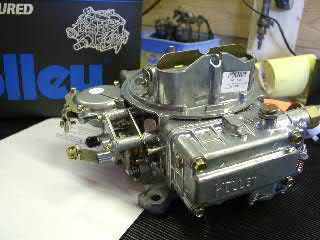
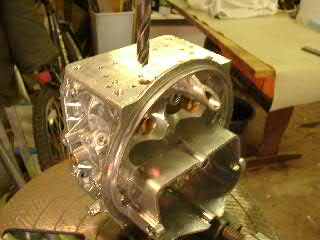
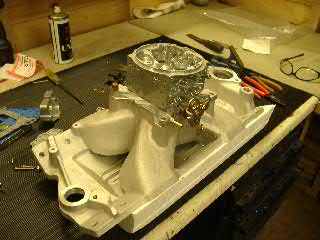
Ultimately, a fuel injected engine will make a higher output that a carb one (as you can optimse the intake for airflow only (esp with direct injection FI!)
The only reason i personally would use a carb is to look "period" and even then i'd probably try and use it just as the throttle and hide some injectors somewhere..........
The only reason i personally would use a carb is to look "period" and even then i'd probably try and use it just as the throttle and hide some injectors somewhere..........
Granted not the same application but I debated for ages whether to ditch twin SUs on my 4 litre Rover V8 in favour of EFi - main reasons against EFi were that:
if there was a problem with carbs then it will usually manifest itself with a visible cause
I can strip them at the side of the road and very few spares required take little room
they work
Fuel costs drove me to fit EFi and the biggest changes I have noticed are:
More torque and sooner in the rev range
Improved economy
Unless something drastic happens (EMP!) I don't think I will return to carburetters good though they were.
if there was a problem with carbs then it will usually manifest itself with a visible cause
I can strip them at the side of the road and very few spares required take little room
they work
Fuel costs drove me to fit EFi and the biggest changes I have noticed are:
More torque and sooner in the rev range
Improved economy
Unless something drastic happens (EMP!) I don't think I will return to carburetters good though they were.
Max_Torque said:
Ultimately, a fuel injected engine will make a higher output that a carb one (as you can optimse the intake for airflow only (esp with direct injection FI!)
Not really true. It's really quite easy to set up a carburettor to provide exactly the right mixture in a single set of circumstances (full throttle, high revs) so I would expect a carburettor set up in such a way to provide a similar amount of power to fuel injection.The difference is that the carbed car would not work as a car at all, being completely undriveable at anything other than full throttle with high revs. The fuel injected car could be quite easily driven to the shops.
davepoth said:
Max_Torque said:
Ultimately, a fuel injected engine will make a higher output that a carb one (as you can optimse the intake for airflow only (esp with direct injection FI!)
Not really true. It's really quite easy to set up a carburettor to provide exactly the right mixture in a single set of circumstances (full throttle, high revs) so I would expect a carburettor set up in such a way to provide a similar amount of power to fuel injection.The difference is that the carbed car would not work as a car at all, being completely undriveable at anything other than full throttle with high revs. The fuel injected car could be quite easily driven to the shops.
The overall "AFR" of the engine has nothing to do with it.
Ultimately you can get a higher peak manifold volumetric efficiency / power output with FI for 2 main reasons:
1) you can design your port just to deal with air, allowing a wider spread in intake velocities, and cruically, pressure changes in areas like the port to valve throat radius do not affect the mixture state
2) You can use a "pencil" injector to squirt a jet of fuel directly past the valve when it is open, minimising displaced air charge during the intake stroke
and most important
3) the mixture preperation with FI allows a much faster burn rate (and more efficient use of fuel mass (less caught in crevices or passed directly out of the exh port etc), moving ignition timing towards TDC, and hence improving the engines thermal efficiency.
of course, all things are relative, but data suggests proper fuel preperation to be worth approx 3 to 5% in terms of power, which is not to be sniffed at!
You are competely correct about the driveability on carbs however, especially when matched to clockwork ignition...... ;-)
Gassing Station | Engines & Drivetrain | Top of Page | What's New | My Stuff