
Mapping an Oil temperature sensor
Discussion


looking for a little more advice.
I changed my ECU to a motec... the sensors and loom were not spec'd by me mainly as I have little idea about what spec ect I needed.
Anyhow the car is up and running and done quite a few miles and Im just trying to iron out some creases... Ive managed to get the proper sensor maps for the oil and fuel pressure and now I just need to resolve the inacuarate maps for the fuel and oil temperature sensors.
They are both the same universal sensor and I have only managed to get a ohms to deg c table... this isnt any use as I need volts to Deg C... so I need to write my own table which is what I have done, but its not at all easy as I dont have a good way of putting a temp probe into the oil as its running and fuel is even harder.
I can take the fuel temp sensor out, disconnect the fuel pumps and then put the sensor in boiling water and get a map for both under 100 deg c... but any advice or hints on how I can get the map up to 130 deg C.
of cause the other solution is to buy new sensors, but this is a real hassle and the sensor i have are fine just unmapped..... i just cant beleive I cant find a map for them, how can anyone else use them? or am i just missing a trick?
I changed my ECU to a motec... the sensors and loom were not spec'd by me mainly as I have little idea about what spec ect I needed.
Anyhow the car is up and running and done quite a few miles and Im just trying to iron out some creases... Ive managed to get the proper sensor maps for the oil and fuel pressure and now I just need to resolve the inacuarate maps for the fuel and oil temperature sensors.
They are both the same universal sensor and I have only managed to get a ohms to deg c table... this isnt any use as I need volts to Deg C... so I need to write my own table which is what I have done, but its not at all easy as I dont have a good way of putting a temp probe into the oil as its running and fuel is even harder.
I can take the fuel temp sensor out, disconnect the fuel pumps and then put the sensor in boiling water and get a map for both under 100 deg c... but any advice or hints on how I can get the map up to 130 deg C.
of cause the other solution is to buy new sensors, but this is a real hassle and the sensor i have are fine just unmapped..... i just cant beleive I cant find a map for them, how can anyone else use them? or am i just missing a trick?
I would guess that the temperature senders are going to be reasonably linear, so measure voltage at ambient and at boiling, and extrapolate from there.
As a double check, you could probably measure the approximate temperature of the probe using one of the infrared 'guns', and compare dash readings to 'real' temps and see if they're close enough.
In the past, I've used adhesive temperature strips on water pipes and oil tanks near the sensors, drive a bit, and compared the sensor's max reading to the value recorded on the strip. That gets you to within 10 degrees, and you can refine from there.
With the resistance/temperature data you can determine if the sensor is linear or not, and use that to refine the data.
A combination of these will get you within a couple of degrees, which is probably plenty close enough.
As a double check, you could probably measure the approximate temperature of the probe using one of the infrared 'guns', and compare dash readings to 'real' temps and see if they're close enough.
In the past, I've used adhesive temperature strips on water pipes and oil tanks near the sensors, drive a bit, and compared the sensor's max reading to the value recorded on the strip. That gets you to within 10 degrees, and you can refine from there.
With the resistance/temperature data you can determine if the sensor is linear or not, and use that to refine the data.
A combination of these will get you within a couple of degrees, which is probably plenty close enough.
Question:
Are these 2 or 3 wire sensors?
If they are 2 wire sensors then the ecu will be using a "pull up" resistor internally, and the sensor will be yanking the voltage back down to ground.
You cannot be certain the sensor is a linear resistance sensor (in fact, generally they aren't)
However, if you have the resitance vs temperature curve, it's pretty easy to work backwards to a voltage curve, even if you don't know the pull up resistor value in the ecu (probably 10k).
(if you don't know the pull up value you will have to translate the curve to fit the one point in temp you do know (for example, leave engine to soak to ambient temp, measure ambient temp, use that as refference point)
Further to all this, absolute accuracy for oil and fuel temp isn't really critical. yes, you want to know if your oils over say ~130degC, but it doesn't really matter if you are reading 135degC when it's actually 131degC for example!
Please post up the wiring and sensor resistance characterisitc and i'll knock you up a spreadsheet to calc the map in the ECU !
Are these 2 or 3 wire sensors?
If they are 2 wire sensors then the ecu will be using a "pull up" resistor internally, and the sensor will be yanking the voltage back down to ground.
You cannot be certain the sensor is a linear resistance sensor (in fact, generally they aren't)
However, if you have the resitance vs temperature curve, it's pretty easy to work backwards to a voltage curve, even if you don't know the pull up resistor value in the ecu (probably 10k).
(if you don't know the pull up value you will have to translate the curve to fit the one point in temp you do know (for example, leave engine to soak to ambient temp, measure ambient temp, use that as refference point)
Further to all this, absolute accuracy for oil and fuel temp isn't really critical. yes, you want to know if your oils over say ~130degC, but it doesn't really matter if you are reading 135degC when it's actually 131degC for example!
Please post up the wiring and sensor resistance characterisitc and i'll knock you up a spreadsheet to calc the map in the ECU !
the sensor is definatelly not linear from the readings I have managed to take.... they are 2 wire sensors and the other temp sensors I have also have a strange non linear curve but with totally different volts for temp (I also have air temp and water temp but these are different sensors although also 2 wire).
below is a link to the temp sensor I have apparently used... Im not 100% following you, but what you are saying is I can take the measurements I have and the sensor table and make my own conversion... maybe.
So:
according to my attempts of measurements on the car (measured the surface temp of the alloy sump so not precise)
76.3 deg C = 0.482 Volts
41.6 deg C = 1.335 Volts
according to the table.
75 deg C = 110 ohms
45 deg C= 290 ohms
Im going to try to see if I can work out a table of volts to deg c from this... i may be some time lol
http://www.efi-parts.co.uk/index.php?productID=125
So:
according to my attempts of measurements on the car (measured the surface temp of the alloy sump so not precise)
76.3 deg C = 0.482 Volts
41.6 deg C = 1.335 Volts
according to the table.
75 deg C = 110 ohms
45 deg C= 290 ohms
Im going to try to see if I can work out a table of volts to deg c from this... i may be some time lol
http://www.efi-parts.co.uk/index.php?productID=125
Edited by andygtt on Thursday 21st March 14:57
trying to find information in my motec specifications... i found that the eng sensor 0-5v has a max current of .02Amps... this is the spec of the ecu which i thought may be useful but im stuggling lol
Input Characteristics
Analog Voltage Inputs
Suitable for: Potentiometers, Voltage output sensors & Variable resistance sensors.
Note that variable resistance sensors require a pullup resistor to the 5V sensor supply. (Normally a 1000 ohm resistor is used)
Measurement Voltage Range: 0 to 15 V
Note that voltages outside this range may affect the readings on other inputs.
Input Resistance: 100k ohms to 0V
Resolution: 3.74 mV
Filter: 150Hz 1st order
Measurement Method: Absolute
Analog Temp Inputs
Suitable for: 2 wire variable resistance sensors and some voltage output sensors.
Note that some voltage output sensors may not be able to drive input resistance.
Measurement Voltage Range: 0 to 15 V
Note that voltages outside this range may affect the readings on other inputs.
Input Resistance: 1000 ohms to the 5V sensor supply and 100k ohms to 0V.
Resolution: 3.74 mV
Filter: 150Hz 1st order
Measurement Method: Absolute
When used as Switch Inputs
The Analog Temp Inputs may also be used as Switch Inputs
Trigger Levels: Programmable 0 to 15V
Hysteresis: Individually programmable high and low levels.
Input Characteristics
Analog Voltage Inputs
Suitable for: Potentiometers, Voltage output sensors & Variable resistance sensors.
Note that variable resistance sensors require a pullup resistor to the 5V sensor supply. (Normally a 1000 ohm resistor is used)
Measurement Voltage Range: 0 to 15 V
Note that voltages outside this range may affect the readings on other inputs.
Input Resistance: 100k ohms to 0V
Resolution: 3.74 mV
Filter: 150Hz 1st order
Measurement Method: Absolute
Analog Temp Inputs
Suitable for: 2 wire variable resistance sensors and some voltage output sensors.
Note that some voltage output sensors may not be able to drive input resistance.
Measurement Voltage Range: 0 to 15 V
Note that voltages outside this range may affect the readings on other inputs.
Input Resistance: 1000 ohms to the 5V sensor supply and 100k ohms to 0V.
Resolution: 3.74 mV
Filter: 150Hz 1st order
Measurement Method: Absolute
When used as Switch Inputs
The Analog Temp Inputs may also be used as Switch Inputs
Trigger Levels: Programmable 0 to 15V
Hysteresis: Individually programmable high and low levels.

BTW, that 820 Ohm sensor isn't a great match for your ECU, as it is too low a resistance, hence you end up only using half the ADC's range (and halving your resolution in terms of DegC)
A 2k5 std sensor would be a better match like this one:
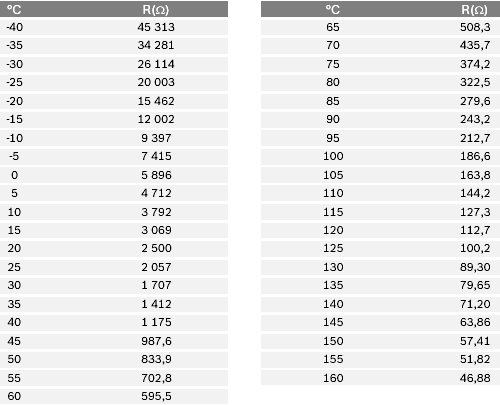
(your will work fine though for non critical accuracy things like oil or fuel temp etc)
A 2k5 std sensor would be a better match like this one:
(your will work fine though for non critical accuracy things like oil or fuel temp etc)
Max_Torque said:
Not entirely how they get to their quoted resolution of 3.76mV/bit (perhaps they have a 12bit adc, but noise prevents them resolving the last ~1.5bits?)
The spec says that the inputs measure up to 15v, 15/2^12 = 3.7mV. Seems a waste only using 1/3 of the range for 5v sensors though.This is the sender you need...
http://www.nzefi.com/product/oil-temperature-senso...
Just need to find it in the UK
http://www.nzefi.com/product/oil-temperature-senso...
Just need to find it in the UK
Mr2Mike said:
Max_Torque said:
Not entirely how they get to their quoted resolution of 3.76mV/bit (perhaps they have a 12bit adc, but noise prevents them resolving the last ~1.5bits?)
The spec says that the inputs measure up to 15v, 15/2^12 = 3.7mV. Seems a waste only using 1/3 of the range for 5v sensors though.(obviously the ADC will be a 5 or 3.3Vref, but with an opamp buffer with it's supply rails at Agnd and 15v)
I guess when you have a 12bit ADC you have plenty of resolution (4096) so can just make all you analogue inputs accept a higher input voltage to cover must eventualities?

I plotted in thie table above... Manipulated it a bit at bottom end as it was conveniently zero in my garage lol.
I have booked spa next weekend so will find out then if they are accurate :-)... Although I am in Brussels now and there is snow on ground, so noble may be a bit of a handful lol
I have booked spa next weekend so will find out then if they are accurate :-)... Although I am in Brussels now and there is snow on ground, so noble may be a bit of a handful lol
Gassing Station | Engines & Drivetrain | Top of Page | What's New | My Stuff